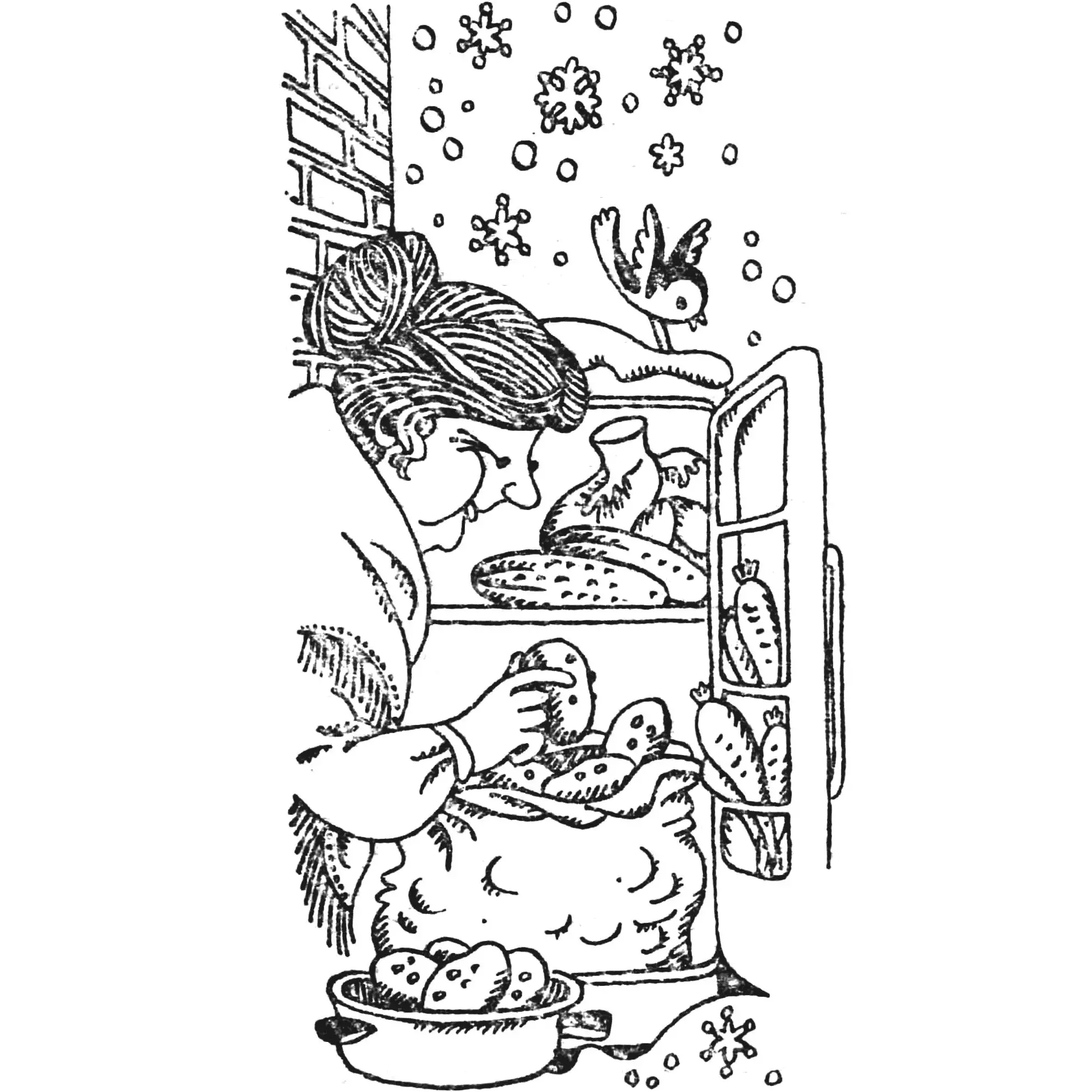
We read in your magazine about how to store vegetables on the balcony and decided to take advantage of the editorial invitation to share our experience. We’re sending a description of a storage unit that’s simpler to build and operate, which has been serving us reliably for seven winters without any special maintenance or repairs.
Our first thought, like the authors of previous articles, was to build a balcony thermostat box, using foam or fiberglass for thermal insulation and installing an automatic thermostat to turn the heating element on and off. However, why make something that’s literally lying around ready-made—refrigerators that have served their time?
We decided to use the body of a “Saratov-2” refrigerator. It’s low and barely protrudes beyond the balcony railing, so it won’t spoil the aesthetics of the building. Since it was to serve as a “refrigerator in reverse,” we started reading its name “inside out.”
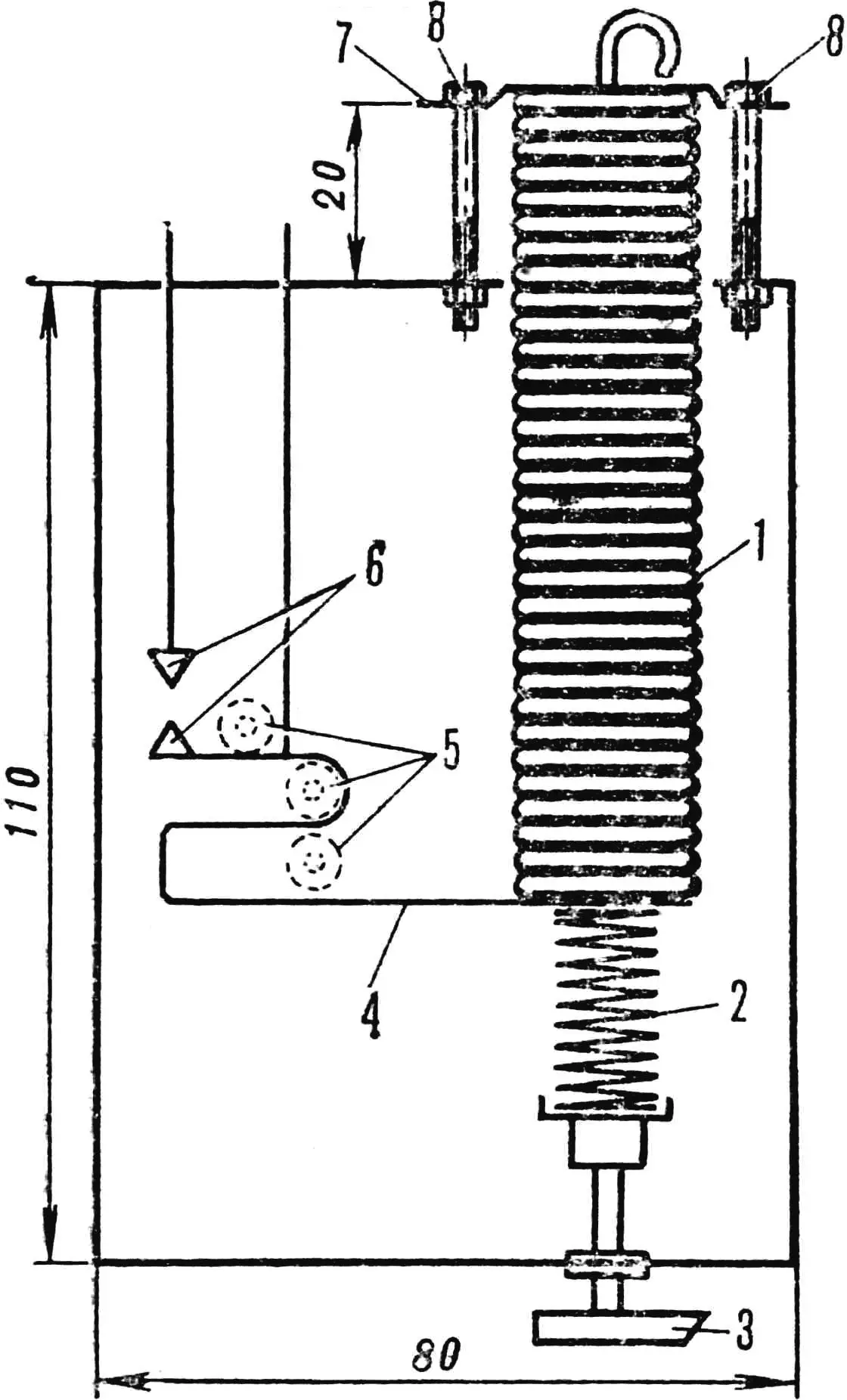
1 — drum, 2 — compression spring, 3 — handle, 4 — lever, 5 — contact springs, 6 — contacts, 7 — cover, 8 — adjustment bolts.
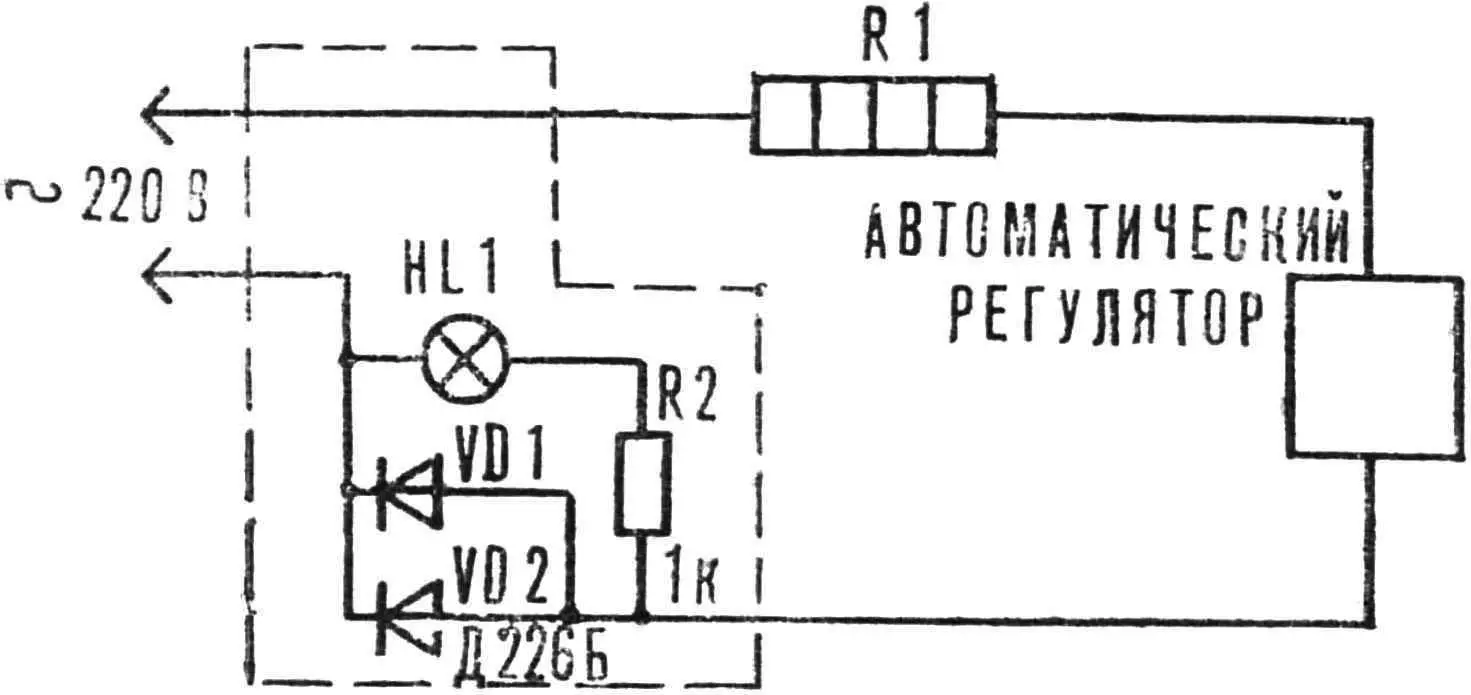
So, the anti-refrigerator “Votaras”; the refrigerator chamber volume is 85 liters plus 10 liters of additional volume from removing the freezer—95 liters total, or more than a bag of potatoes! To prevent it from freezing, a heater is needed. An approximate calculation of its power for such a volume and an average temperature difference between outside and inside of about 25—30° gave a value of 30—40 W with continuous operation. To save space, we settled on a flat heating element for a photo glazer with a power of 150 W. Series connection with a semiconductor diode reduced the power, bringing it closer to the calculated value and increasing the element’s durability. We wrapped it in sheet asbestos and placed it between two duralumin plates measuring 1 X 140 X 400 mm, tightened them with screws, and attached them at the bottom of the chamber with a 10 mm offset from the back wall. By the way, it might have been more rational to place the heater on the bottom and cover it with a wooden grate.
For automatic regulation, we modernized the refrigerator’s own thermostat for the on mode. To do this, we had to lengthen the corrugated bellows in the regulator by approximately 20 mm (it’s filled with a volatile liquid, whose pressure counteracts the compression spring force, changing the bellows length depending on the freezer temperature). To set the heater contacts to trigger at +2… +4°, it was sufficient to replace the bolts that secure the rear cover of the bellows mount to the regulator body with longer ones. Now, with the handle in the middle position, turning it toward positive temperatures gave changes up to +9°, toward negative—up to -12°, restoring, when needed, the anti-refrigerator’s freezer functions.
The second simple modification—changing the contact switching direction. For this, we removed the compression springs. As experience showed, the contacts work without burning even without them (they’ve never been cleaned or lubricated in all 7 years), and temperature regulation deviations didn’t exceed ± 1°.
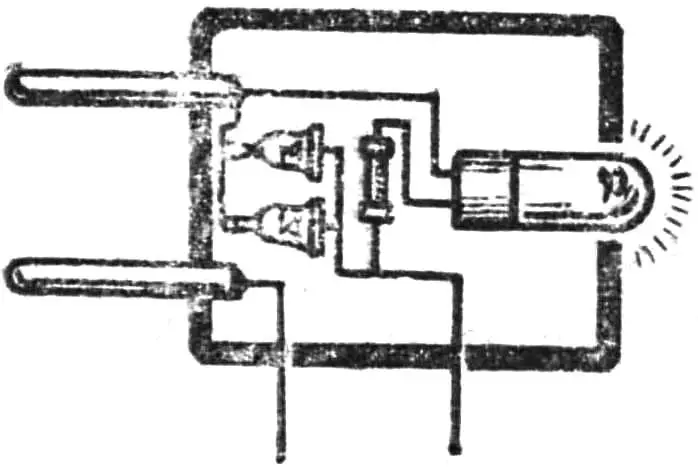
The anti-refrigerator’s electrical diagram shows diodes that reduce the heating element’s power and a neon lamp signaling its activation. Together with a current-limiting resistor, they’re housed in one case attached to the plug. To keep it small, we used two diodes rated for 0.25 A with reverse voltage of 250 V, connected in parallel.
When using a refrigerator of larger capacity, the circuit remains the same, only the heater power increases by connecting an additional element in parallel. In this case, the nominal total current of the semiconductor diodes is increased accordingly.
***
It seems that such storage units could be produced serially based on refrigerator production with minimal, as we can see, changes to the technology.
«M-K» 9’86, K. F. MOROZOV, K. K. MOROZOV
Recommend to read
 THE SOUND WILL BE LOUDER
In order to obtain a sound signal of high power (10 - 20W) from the simple Assembly of a sound generator, does not require complex amplifiers WOOFER. The generator on the popular chip... RECTANGULAR ASTERISK
Not so long ago was invented the elliptical leading Cycling asterisk, allowing to increase the efficiency of holotransmit, faster to scroll through "dead spots". One time they even went...
