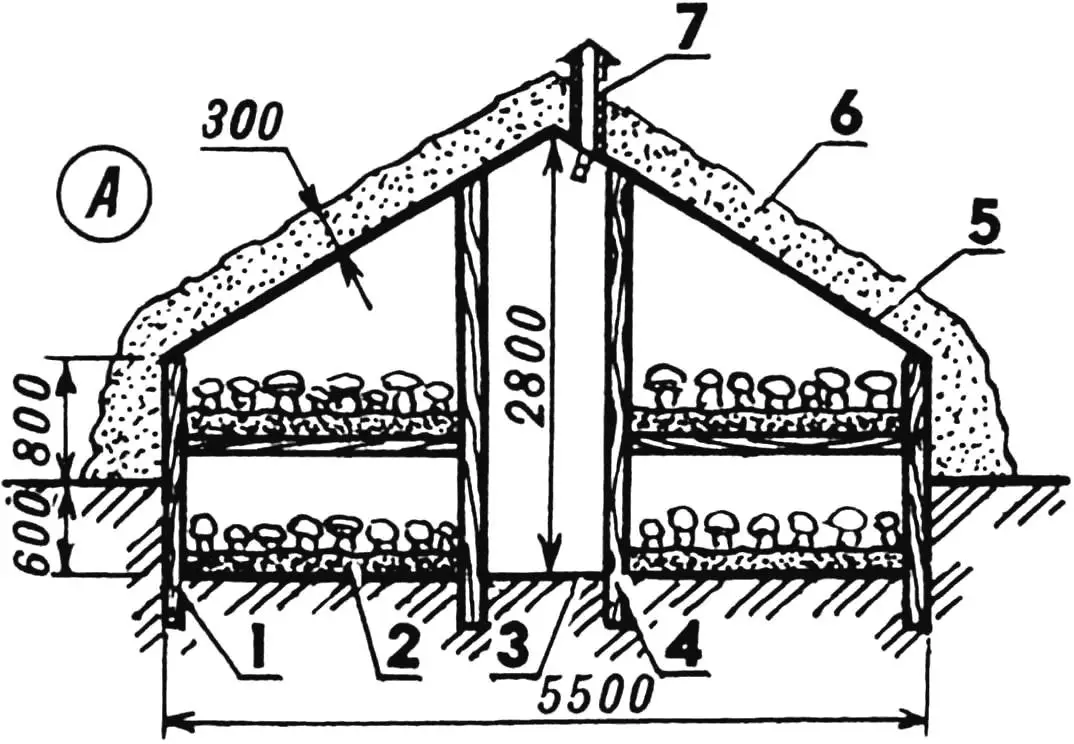
Champignon cultivation began at least two hundred years ago. In the early 19th century these mushrooms were successfully grown by Petersburg market gardeners, with the peasant Osinin from Yaroslavl Province considered a pioneer. Whole dynasties of mushroom growers from Moscow, Novgorod, Tver and other major cities are known, who used specialised greenhouses for their production (fig. A).
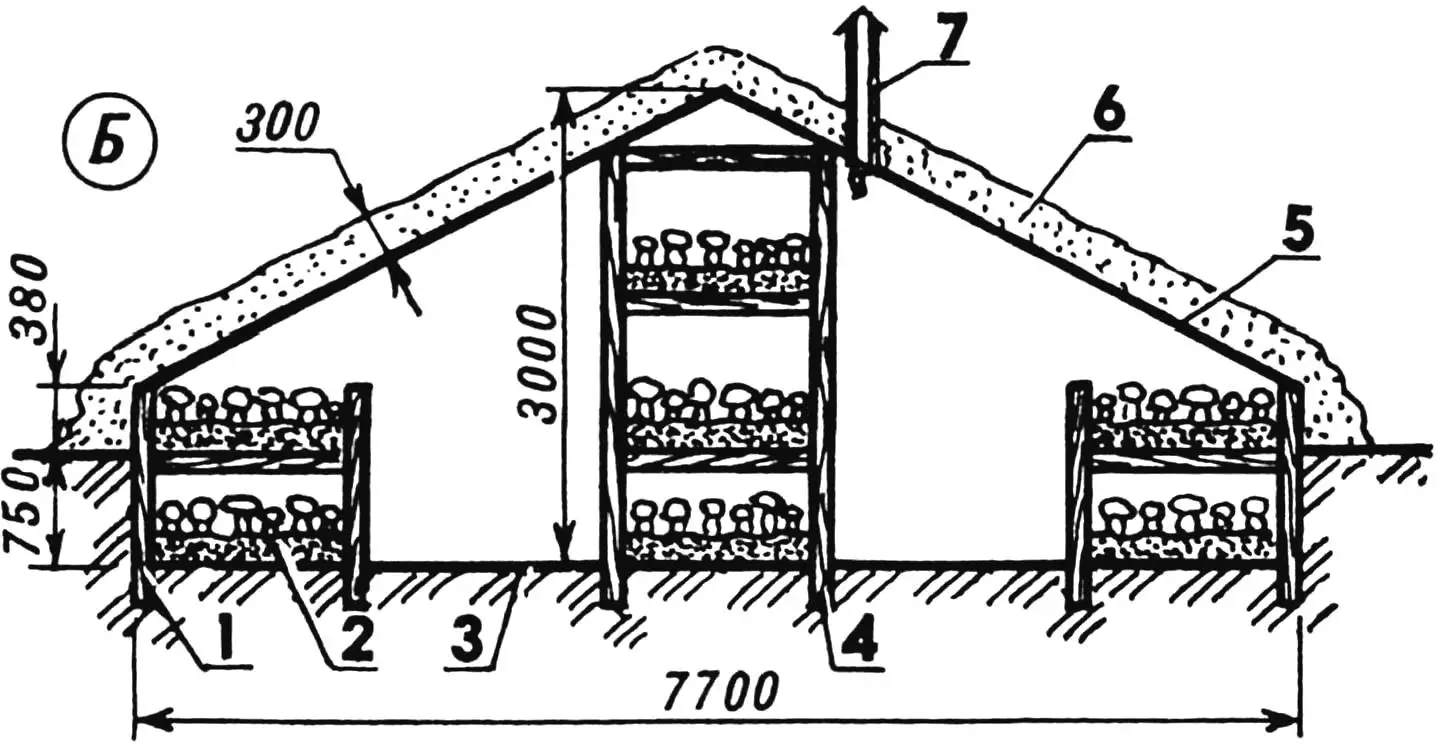
A major contribution to the development of domestic mushroom growing was made by Yefim Andreyevich Grachev — author of the first manual “On the cultivation of champignons”. He also developed a highly refined agronomic technique for growing mushrooms. Moreover, he designed an original seven-tier (seven-bed) champignon greenhouse (fig. B), which proved excellent over a century and a half and has lost none of its relevance for today’s farmers. Grachev managed to set up a model mushroom production on his farm that yielded 4 tonnes of mushrooms per year, accounting for up to a third of all champignon production in Petersburg. When sending to market, mushrooms were packed in wicker baskets, six per basket. Up to one million such baskets were produced annually at Grachev’s farm.
The art of growing champignons the Grachev way lies in preparing the growing media. They must have adequate warmth and moisture. Besides specialised greenhouses, other premises may be used where a steady temperature can be maintained (in winter not below plus 8 °C) and fresh air supplied. Preference is given to conservatories, storerooms and cellars. However, growing mushrooms in basements of residential buildings is not recommended, as high humidity, ammonia released by the substrate, and frequent soil disinfection accelerate wear of these structures.
Growing champignons in the open ground is still considered unreliable, as it depends entirely on weather. But if, as they say, there is no alternative, a shady site is chosen for the crop, sheltered from wind and rain, elevated and dry. To improve growing conditions, experienced growers dig a trench 0.5 m deep and 1 m wide, line it with brick or boards, then fill it with pre-prepared compost and inoculate with wild (or preferably purchased) spawn. The bed is covered on top with a layer of straw.
Ordinary hotbeds freed after early vegetables or seedlings are also adapted for mushroom growing. But the most thrifty and far-sighted growers prefer dedicated champignon greenhouses (among which Grachev-style designs remain unbeaten). The crop is usually harvested from late November through March–April. In summer many put their greenhouses in for repair.
Moscow market gardeners often follow a slightly different practice. Their combined 4-tier greenhouses with stove, electric or gas heating (fig. C) are used for champignons from September to February. After the growing cycle ends, the freed greenhouse space is used for forcing early vegetables, with the roof replaced by hotbed frames.
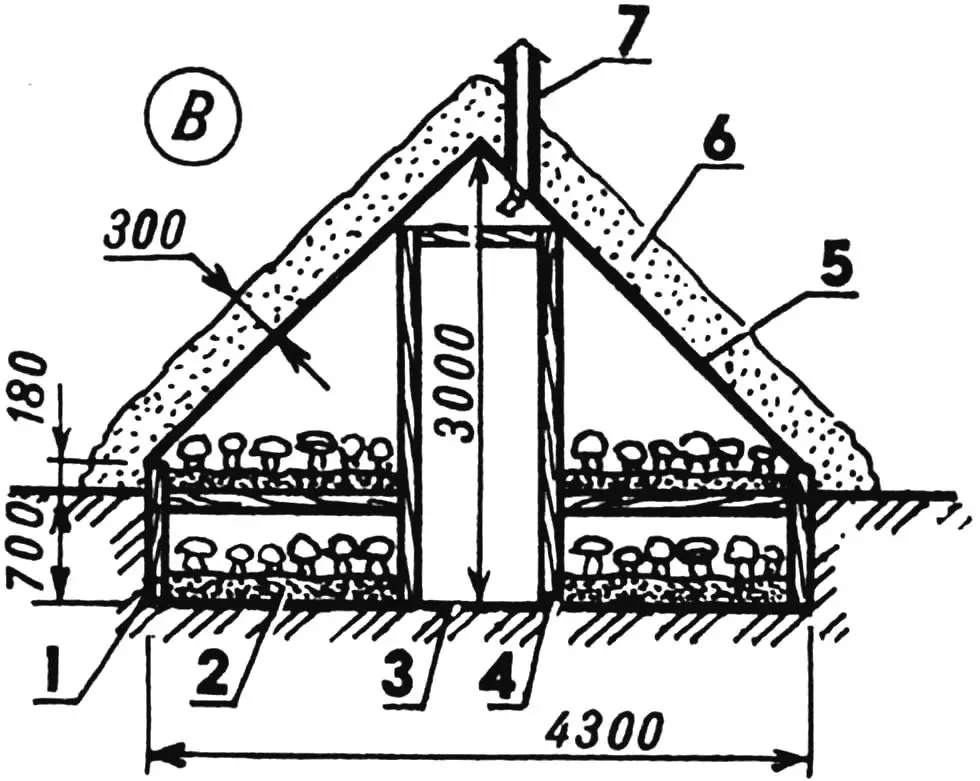
A — two-tier 4-tier Petersburg type; B — Grachev 7-tier of 1861; C — combined 4-tier of Moscow gardeners; 1 — wooden wall; 2 — tier or bed; 3 — tamped clay floor; 4 — wooden post with crossbars; 5 — gabled wooden roof (replaced by hotbed frames when forcing early vegetables); 6 — thermal insulation (layer of horse manure, covered with snow in winter); 7 — vent or flue (wooden box with felt-lined shutter)
Since all these greenhouses were originally designed for the Russian north, there are no fundamental differences between them. The cheapest timber is used for construction, as wooden structures usually need substantial repair or replacement almost every summer. Greenhouses are typically sunk 0.5–0.7 m into the ground, which makes it easier to maintain even temperature and humidity. A layer of fresh horse manure up to 0.3 m is placed on the gabled roof, and in winter the greenhouse is also covered with snow. This insulation is usually sufficient for so-called moderate cold; heating is provided for severe frosts. For ventilation, vents (flues) with felt-lined shutters are installed, one set per six linear metres of roof.
As a substrate for champignon growing, Russian growers have long preferred exclusively horse manure from healthy, well-built horses fed plenty of oats and kept on firm straw bedding. Experienced growers even considered how the animals were kept: they arranged things so that old bedding was left in place as long as possible, with fresh layers of straw regularly added on top. Constant trampling produced a uniform straw mass well soaked with liquid manure — an ideal medium for the microorganisms that “prepare” the substrate for the plantation.
As in former times, many growers (especially in rural areas and committed advocates of environmentally sound land use) use wild champignon spawn for planting, collected outside town on dumps from about mid-June to 1 September. The spawn is then dried and stored in a suitable place. Yet progress is inexorable, and more and more specialists now prefer artificially grown spawn to natural, and it often reaches the Russian market from abroad.
Modelist-Konstruktor No. 3’2001, K. ALEKSEEVA, Candidate of Biological Sciences
Recommend to read
 THE TABLE IN THE GARDEN
The combined table that you see in the picture, designed for garden or suburban area. It can be easily disassembled, so it is possible for winter to hide in the barn or under the canopy.... THE WHEELS UNDER CONTROL
Camber angles and toe of the car very accurately can be adjusted, without resorting to service stations. We just need to have some plumbing skills and to have the simplest tool to their...
