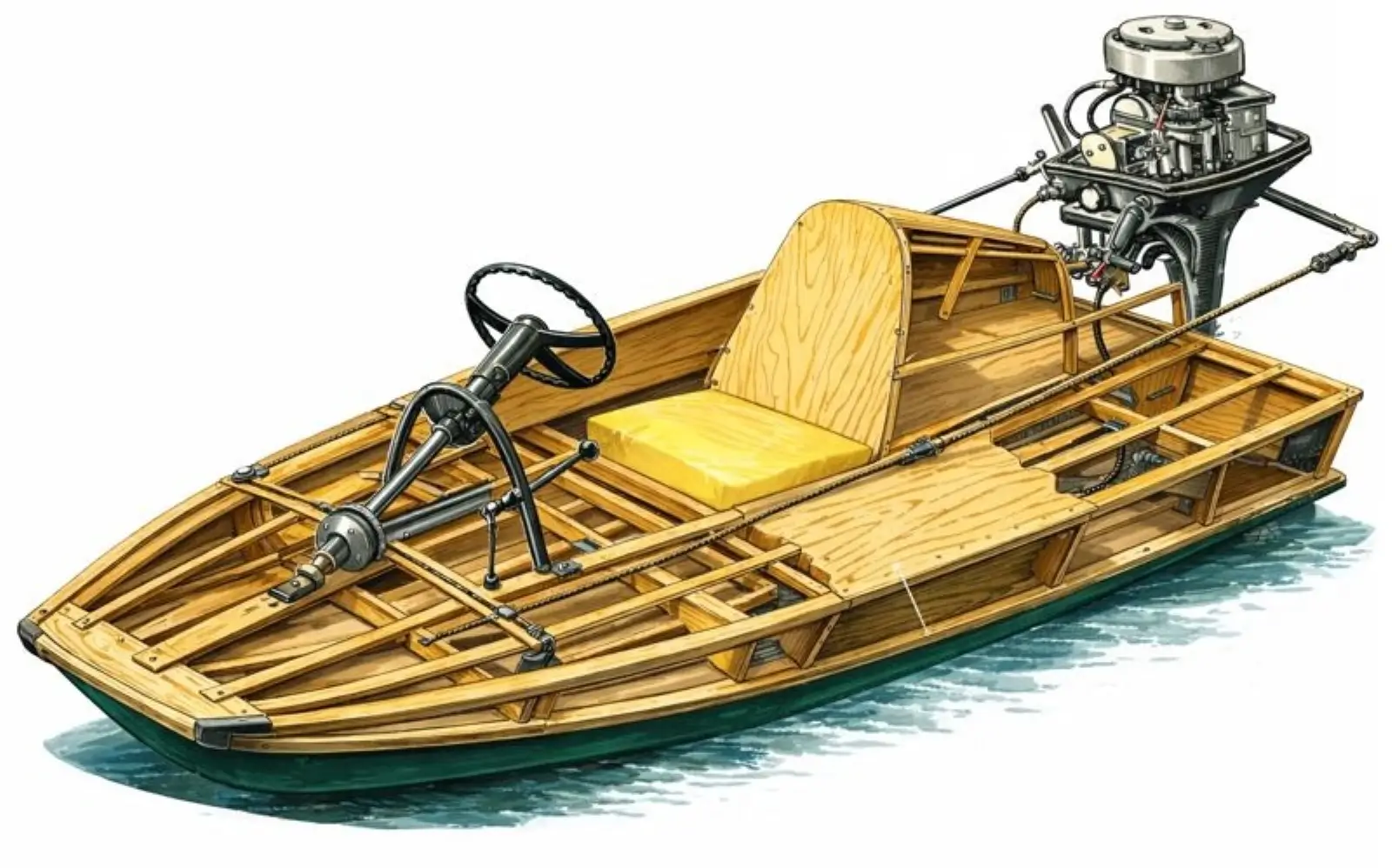
Four wheels, an engine, and a driver’s seat. Such are karts—tiny sports cars that surprisingly quickly gained widespread popularity in all countries of the world. Thanks to their simplicity and accessibility, karts opened the way to motorsports for broad segments of youth. Karting—racing in miniature cars—became a favorite sport of schoolchildren. Recently, the kart-car got a brother—the kart-glider, or, as it was called abroad, the hydrokart.
It proved to be as successful as its land-based relative. In a number of countries, national associations for hydrokarting have been organized, and drivers of miniature gliders have become as full-fledged masters of waterways as drivers of motorboats and boats.
Water karting technology improved very rapidly. Races on hydrokarts, usually held on closed tracks with many complex turns, attract huge crowds of spectators. A number of companies began serial production of hulls, engines, and accessories for water karting. Competition rules and classification of hydrokarts by type and power of engines used have been developed.
What is a hydrokart? It is a small single-seat glider equipped with a stationary or outboard engine of low power. The hydrokart hull, as a rule, has no cockpit and is an unsinkable float of perfect hydrodynamic shape and minimal weight (approximately 30—60 kg, depending on class, engine type, and equipment). The cost of a racing hydrokart compared to the cost of a boat or glider is very low. Nevertheless, the sporting results achieved on hydrokarts are quite convincing: speeds of over 100 km/h with extremely high maneuverability of these miniature vessels.
Operating a hydrokart requires good physical fitness, instant reaction, and excellent knowledge of the equipment from the driver, promotes the development of these qualities and strengthening of skills necessary for mastering more complex machines. This is an excellent school for training high-class driver-mechanics, a sport with a great future, and there is no doubt that our youth will master it as quickly as they mastered land karting. Being an excellent means of involving youth in sports, hydrokarting is also very valuable as a means of hardening the body: after all, the hydrokart driver, whose entire equipment consists of swimming trunks, a life jacket, and a protective helmet, is in constant contact with water, sun, and air.
In this issue, we offer a description and drawings of the simplest hydrokart “Pioneer,” based on a “sea sled” type hull1. The kart can be built in a pioneer camp in one shift. Outboard motors are already not uncommon in pioneer camps, and there will be more and more of them every year. So, there are opportunities for hydrokarting in pioneer camps.
BUILDING THE HULL
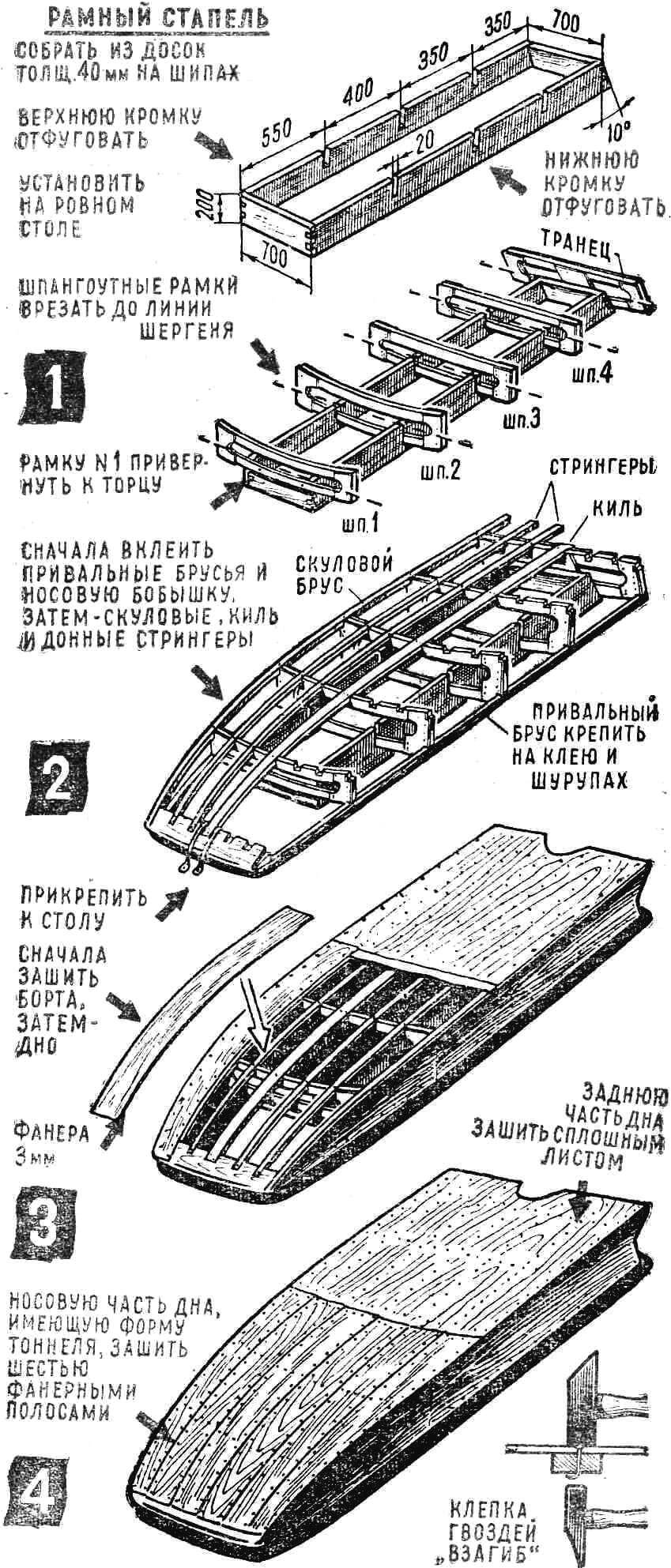
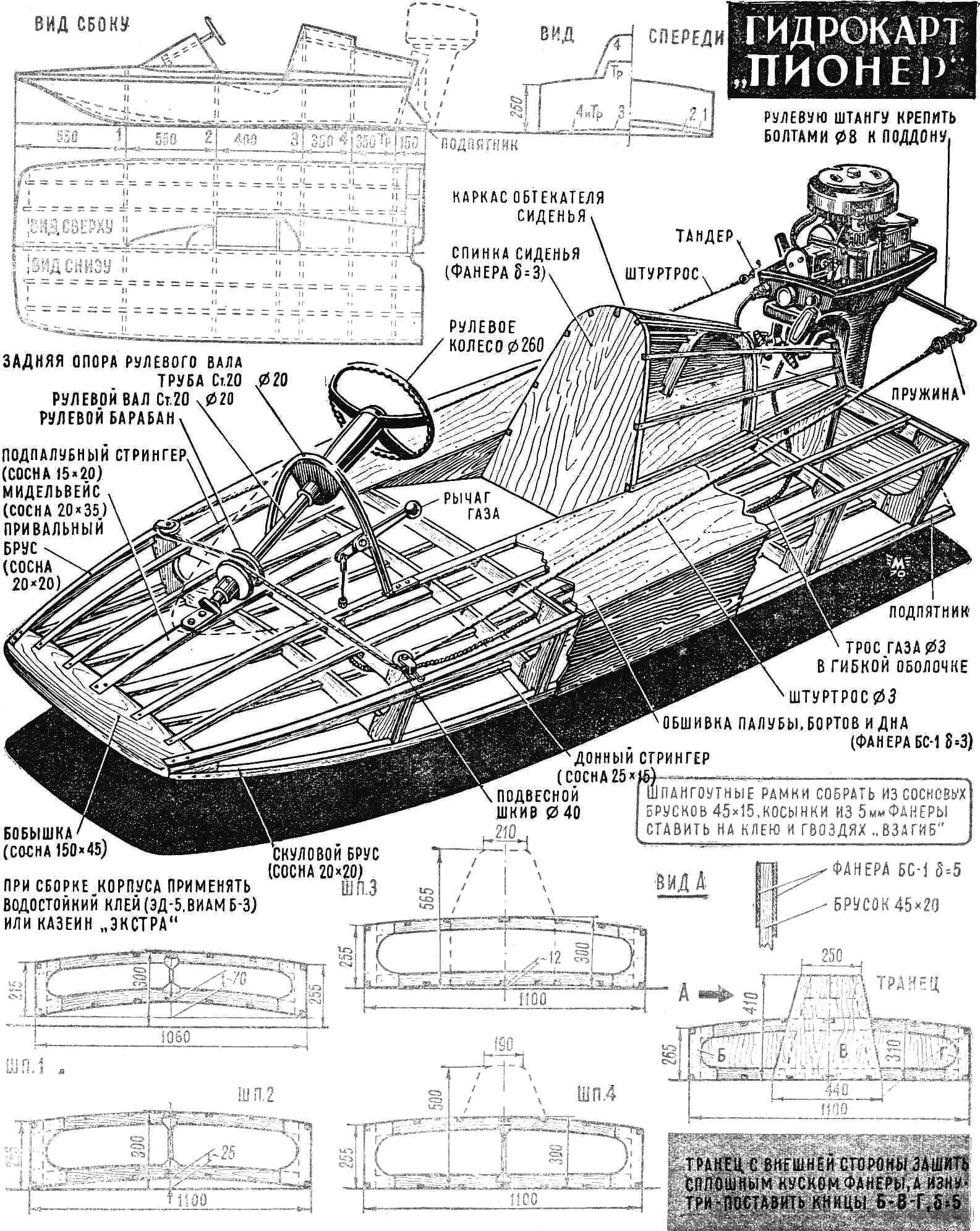
The design of the “Pioneer” hydrokart is shown in Figure 1. Having made the frame frames No. 1, 2, 3, 4 and the transom according to it, we set them up on the slipway (Fig. 2). It can be placed on a level wooden floor, a table tennis table, or a smooth wooden board of appropriate size. The hull is assembled in the sequence indicated in Figure 2. All connections of wooden parts are made with waterproof glue with pressing in screws and nails. Then the protruding corners and edges are trimmed so that the plywood sheathing lies flat.
First, the sides are sheathed, then the bottom. Some difficulties will be presented by sheathing the front part of the bottom, which has a tunnel shape. Here, several plywood strips should be used, cut according to pre-made cardboard templates. The connection is butt-jointed, along the stringers, with pressing in nails “bent over.” The rear part of the bottom can be sheathed with one piece of plywood. The “shirt” (outer layer of plywood) is positioned along the hydrokart hull.
The plywood sheathing is attached to the frame with glue, screws, and nails “bent over.”
When sheathing the bottom, do not forget to extend 150 mm of plywood beyond the transom edge to form the so-called “heel.”
The next operation is sheathing the deck and the driver’s seat fairing. For this, the frame is turned over, slots for subdeck stringers are cut in the beams, and after gluing them in place, the seat fairing frame is installed and the subdeck set is beveled.
For deck sheathing, one and a half sheets of 3-mm plywood will be needed. To make it lie flat, without bulging, it should be cut into two longitudinal parts and sewn in this sequence: first one half, up to the midship stringer (central subdeck stringer), then the second half, also up to the midship stringer line.
After sheathing the entire deck, except for the driver’s seat cell, you can proceed to assemble the fairing frame (see Fig. 1), and then to sheathing it from the sides and top with 3 mm thick plywood. The front frame of the frame, forming the seat back, is also sheathed with 3-mm plywood. Last, the side walls of the driver’s seat cell are made and glued in place. (A cushion made according to the driver’s height and build, determined on site, is placed inside the cell.)
After cleaning and patching defects, the entire hydrokart hull is covered with fiberglass or calico in one layer. Fiberglass is applied with epoxy resin; when covering with calico, colorless nitro lacquer or BF-2 glue can be used. It is recommended to paint the hydrokart with glyptal or nitroglyptal enamels in bright colors. The steering wheel (see Fig. 1)—round in shape, homemade or automotive—is installed on a bracket welded from a steel tube Ø 20 mm. The steering shaft (from the same steel tube) has a steering drum at its lower end, turned from a light alloy or hard wood. A steel steering cable Ø 3 mm is wound on the drum (5 turns) and goes through suspension pulleys to the rod installed on the engine. A spring serves to compensate for tensions arising in the system, and a turnbuckle (screw tie) is used to take up slack.
The most suitable engines for the “Pioneer” hydrokart are “Priboy” or “Veterok-8″—for beginner athletes—and “Veterok-12″—for more experienced ones. Engines of the same power are used on hydrokarts of this class abroad as well. However, it should be noted that instead of a remote 20-liter tank, it is much more convenient to have a small consumption tank with a capacity of 1.5—2 liters, mounted directly on the engine, with gravity feed of the fuel mixture. And if the engine cowl is removed, it becomes possible to start the engine with a cord not only by the athlete himself from the hydrokart, but also by the mechanic servicing it—from the pier.
Throttle control must work absolutely reliably, as the racer constantly has to change engine speed while covering the distance. Of the systems currently available, the simplest one can be used—with a return spring on the carburetor throttle lever. An ignition switch is mandatory; it is installed within the driver’s reach (best—on the steering wheel). In addition, in case the driver falls into the water, a device that automatically switches off the ignition must activate.
The described hydrokart is designed for a driver weighing no more than 55 kg (average weight of a teenager). If the driver is heavier, the kart’s balance will change, and the seat will have to be moved somewhat. How much—will be shown by the first test runs.
The most advantageous position of the hydrokart during planing and when making turns is adjusted by tilting the underwater part of the engine forward or backward.
MASTERING THE HYDROKART ON WATER
Mastering hydrokart control should be done carefully and sequentially, first at low speed, not far from base, in good weather (without waves). In the training area, it is necessary to have a duty auxiliary motorboat with rescue equipment and a set of dry clothes. Those who cannot swim are prohibited from operating hydrokarts, as is going out on the water at dusk and at night.
When making turns on a hydrokart, to avoid capsizing and reduce the turning radius (and this is very important in competitions!), it is necessary to heel the machine to the inside of the turn. For heeling, the driver, holding the steering wheel, shifts his body to the side, as much as his agility and the situation on the course allow. Virtuoso racers can drive their machines literally “on edge.”
TRACK FOR HYDROKART COMPETITIONS
If there are several similar hydrokarts, interesting competitions can be organized for speed on a closed circular track with several turns. The track location on the water body should be such that it is all well visible to spectators and judges on the shore. Therefore, the length of one lap should be set within no more than 1000 m (by the path traveled by participants). Number of turns: 7 at 90° and 6 chicanes at 45°. The recommended track layout eliminates the possibility of course intersections when passing it, which is especially important for beginner athletes. For track marking, 14 buoys are needed, which can be made from children’s rubber balls, inflated soccer inner tubes, brightly colored foam floats, etc., anchored.
Before the start, participants line up on the shore, while the hydrokarts prepared for the race are on the water under the supervision of mechanics. The start location is best placed on a sandy beach that slopes gently into the water. At the starter’s signal, participants run to their machines, start the engines, and go out on the track. A participant who fails to start before the race winner completes the entire track (as well as one who capsizes on the course) receives no points. The results of racers who complete the entire track are evaluated by time and the number of correctly passed buoys. For each incorrectly passed buoy, depending on local conditions and engine power—2 or 3 seconds of penalty time are added.
Mandatory equipment for participants in hydrokart competitions is a life jacket and a rigid-type protective helmet (The life jacket can be replaced with a “Calypso” type wetsuit made of porous rubber.).
G. MALINOVSKY, Master of Sports
Recommend to read
 ARMORED KAMAZ
Local military conflicts and counter-terrorism operations of recent years has revealed the problem of resistance army transportation from destroy military units of the enemy, and also... THE BEST HEATER FOR A SAUNA
While equipping my bathroom as a sauna (see "Modelist-Konstruktor" No. 10, 1997), I decided to make a powerful (3 — 3.5 kW) and reliable heater myself. The most acceptable option seemed to...
