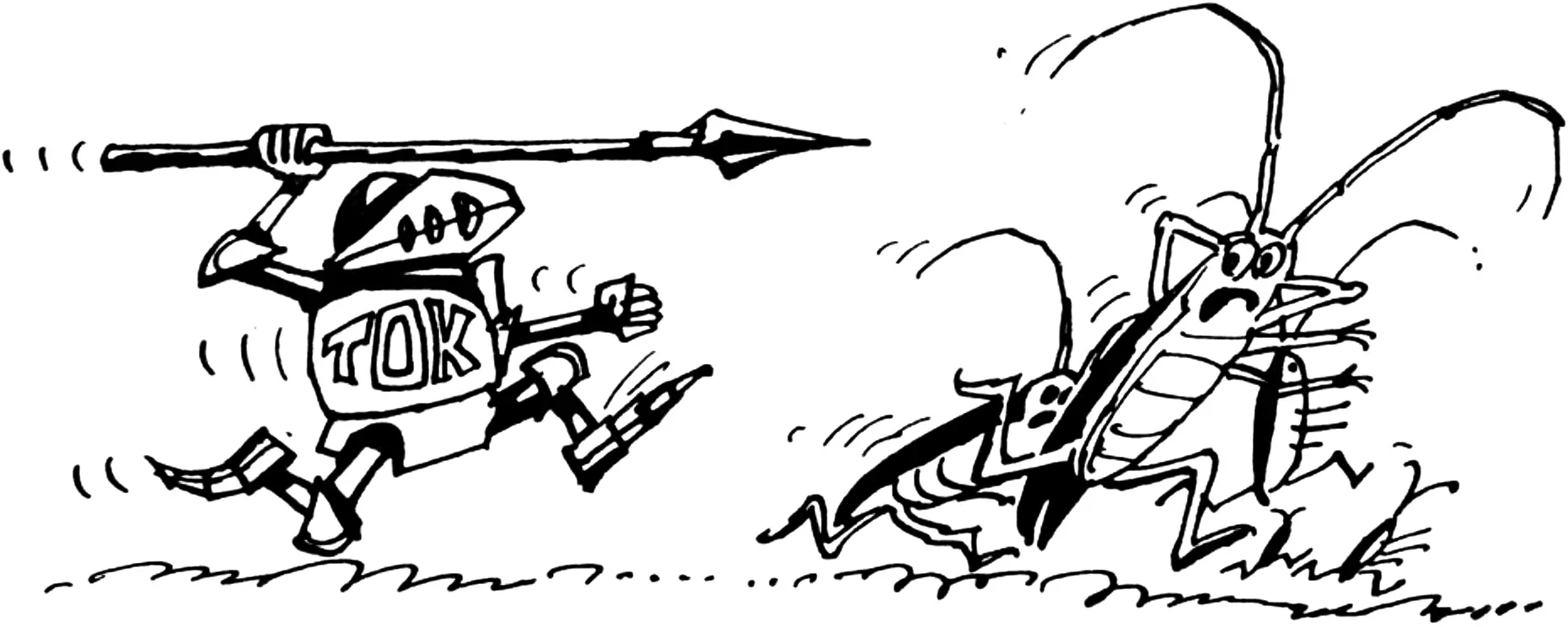
Cockroaches: people have tried everything to get rid of these black and reddish-brown sneak insects, but… Exterminating such hardy pests is still a problem. Especially for residents of densely occupied apartment blocks, dormitories, and rundown Khrushchev-era buildings.
Among quite promising ways to fight cockroaches, in my view, are even the simplest electroshock devices. I, for one, managed with such an “electric swatter” to wipe out a whole army of reddish-antennaed insects when moving into a flat neglected by the previous owner.
This well-proven anti-cockroach device is assembled on a board of dried wood. Dimensions depend on the intended use and ease of operation. A groove 4–5 mm wide and 2–3 mm deep is gouged around the perimeter of the board, 15 mm in from the edge. Along it, 0.2 mm apart, the inner and outer electrode loops are fastened (with 7 mm nails or with an adhesive that does not repel cockroaches), soldered from tin strips. It is desirable that the resulting spark gap run over the middle of the groove.
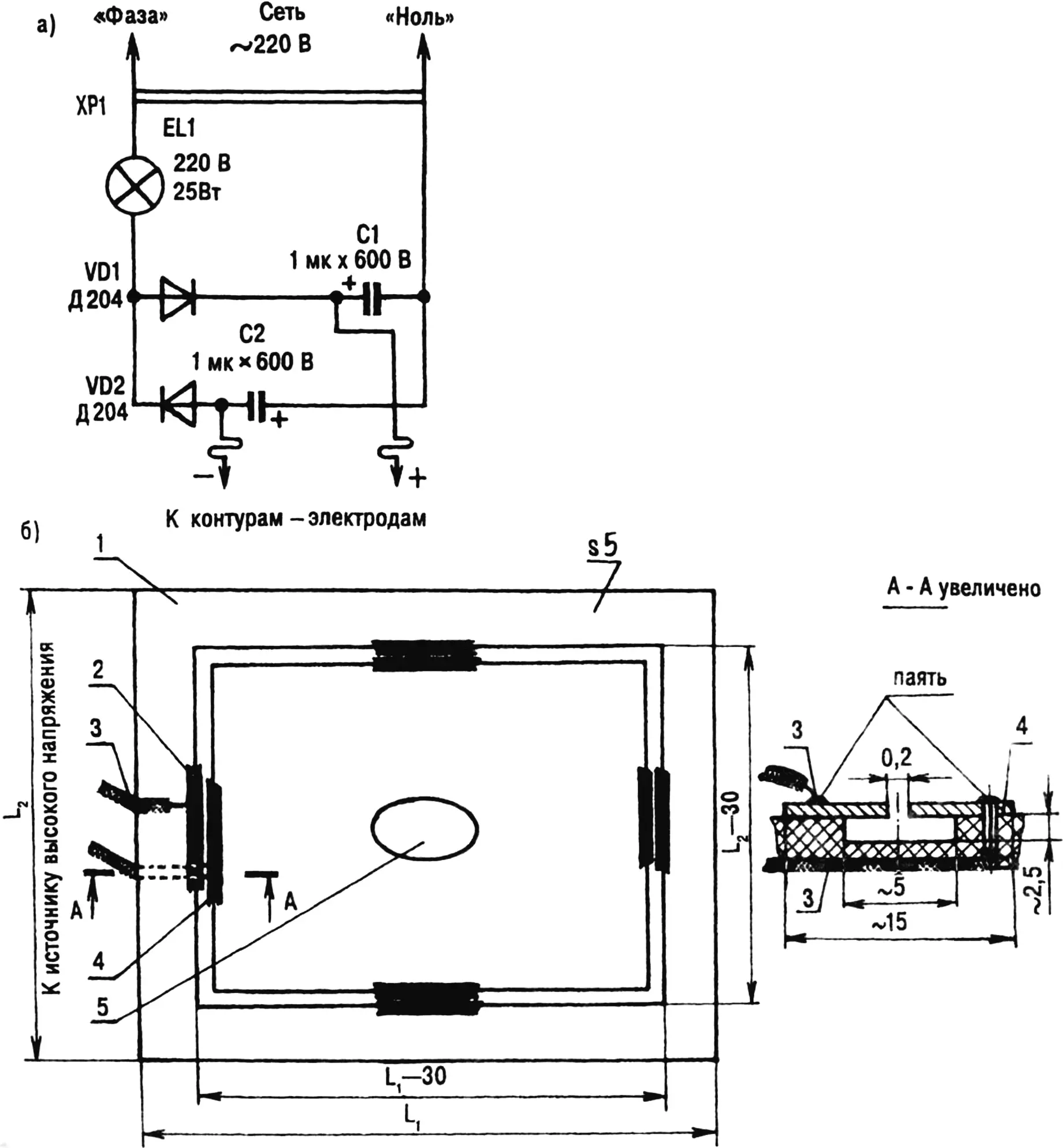
1 — wooden baseboard; 2,4 — electrode loops (tin s0.2); 3 — high-voltage wire (2 pcs.); 5 — bait; dimensions L1 and L2 — as fitted;
fastening of parts 2 and 4 is not shown.
A rectified high voltage is applied to the electrode loops. It is obtained from a so-called Latour circuit plugged into a household mains socket. Current pulses, passing through diode VD1 during half-cycles of one polarity of the supply voltage, charge capacitor C1 to nearly 300 V. During half-cycles of the opposite polarity, C2 is charged (through VD2). Because both capacitors appear in series with respect to the rectifier load, the device output is the sum of the two voltages (doubled if C1 and C2 are equal).
A scented bait with an odor attractive to the insects is placed in the middle of the baseboard (2–3 drops of vegetable oil or a bouillon cube ground to powder). In trying to reach it, cockroaches attempt to cross the gap between the electrode loops and are struck by electric current. The incandescent lamp here is used to quench quickly the voltaic arc that sometimes bridges even the most persistent insects, and also to protect the circuit parts from damage in accidental short circuits. The high-voltage lead to the inner electrode loop is brought through a hole in the board so that cockroaches cannot reach the bait without crossing the lethal-voltage gap. The groove, as practice shows, fully rules out any conditions that could start a fire.
Warning: when using the electroshock device, reliable protection of people and animals from even accidental contact with parts under high voltage must be provided!
«Modelist-Konstruktor» No. 12’99, G. POGUDIM
Recommend to read
 SHOWER ON ANY GROWTH
I propose to use as the shower head holder a prefabricated aluminum bracket for shelves sold in stores "DIY". The main advantage of this design is that a shower can use any family... CARGO TANDEM
Like many readers of "Modeller-designer", my Hobbies are designing and making homemade equipment is therefore with special interest I read in the journal of machines and mechanisms...
