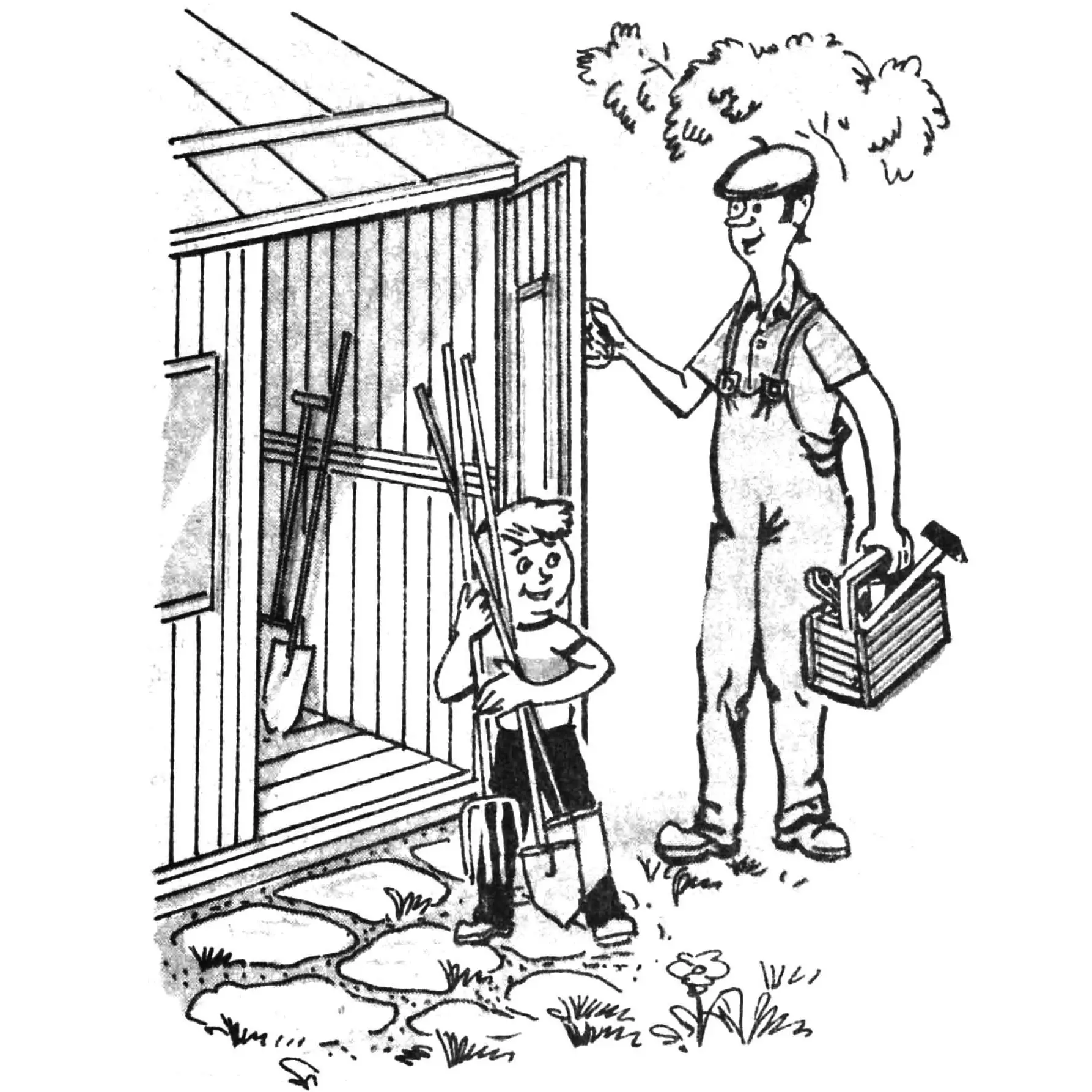
You can find all kinds of utility buildings on garden and dacha plots. Most often it is a tiny shed at the far end of the site or a large utility block combined with a summer kitchen. The disadvantage of such structures is the significant consumption of sawn timber. And most importantly, they take away valuable space from the garden and vegetable beds. However, these problems can be solved if the utility block is built as an extension to the house. A folding shed design is also convenient for arranging a small workshop inside.
It is exactly this type of utility structure that we introduce to readers in today’s issue of the “Home Craftsmen’s Club” section.
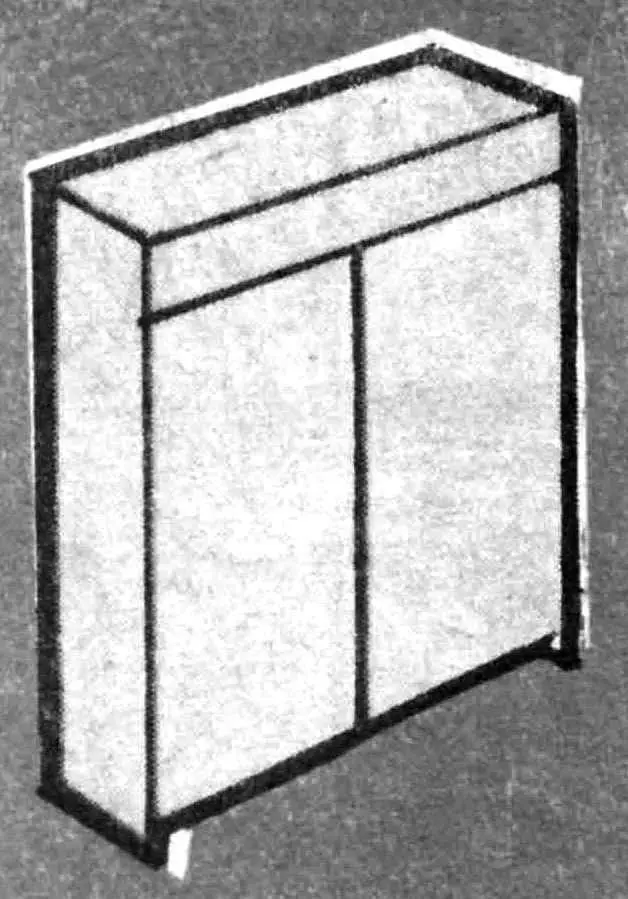
The folding timber-panel utility block has overall dimensions of 2200X1300X2300 mm when unfolded and 2200X300X2300 mm when folded. This transformation is especially convenient for a workshop. As a rule, all work on the garden plot is done in the warm season, and in winter the workshop is not used. Therefore, it can be folded away. The extension can also serve as a storage space for seedlings in spring or for harvested but not yet removed crops in autumn.
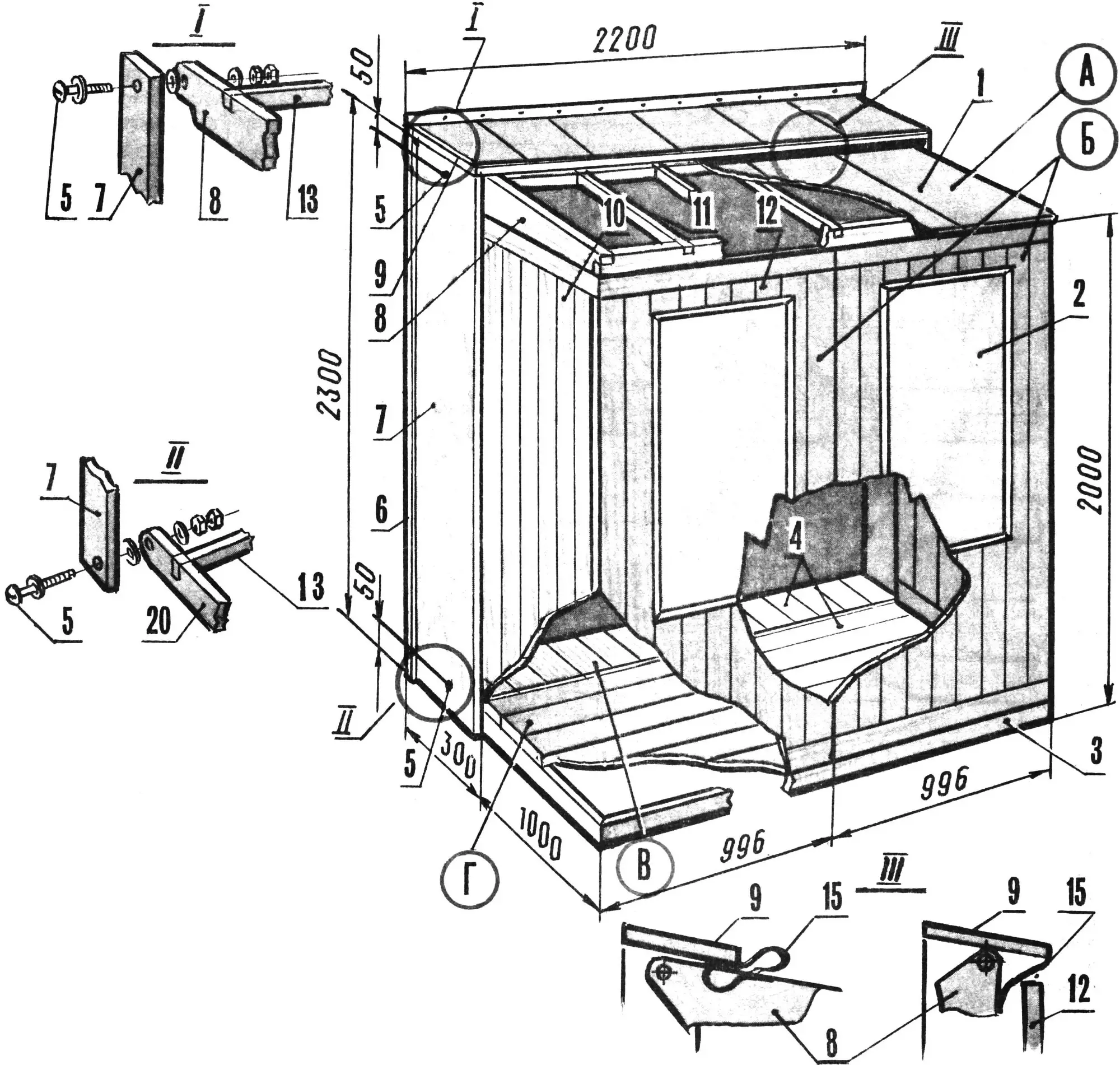
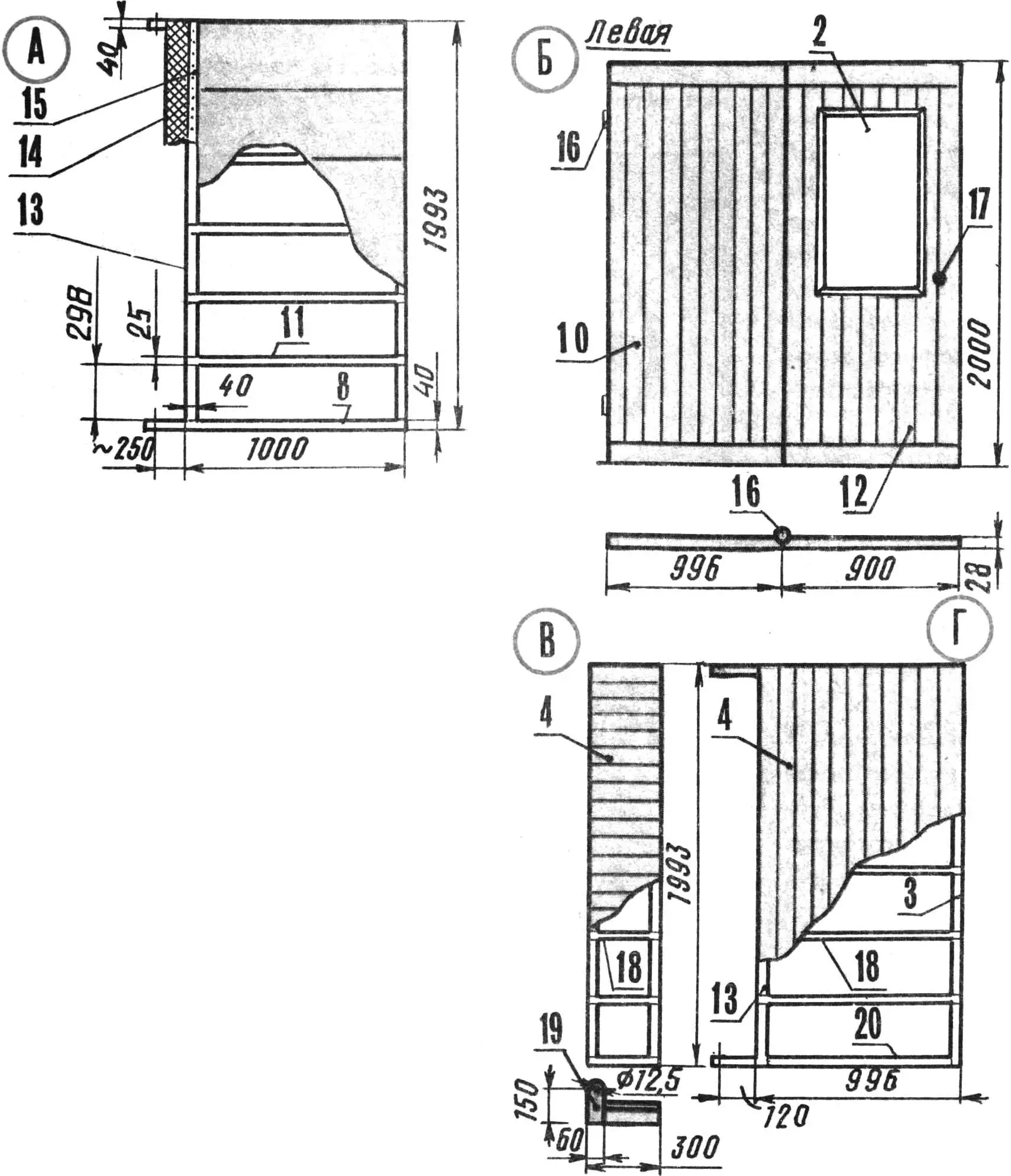
1 — metal roofing, 2 — door glazing, 3 — sill beam, 4 — floorboards, 5 — M12 bolt, 6 — beam for fastening the main frame walls, 7 — load-bearing frame wall, 8 — side panel of the drop-down roof section, 9 — canopy frame beam, 10 — wall-door, 11 — batten beam, 12 — glazed door, 13 — load-bearing beam, 14 — rubber seal, 15 — rubber strip, 16 — hinges, 17 — door handle, 18 — joists, 19 — metal angle with eyelet, 20 — side sill board with eyelet. I — hinge of the pivoting part of the roof, II — hinge of the floor panel, III — scheme for installing the rubber strip (item 15) in the open (left) and folded (right) positions of the utility block.
Before starting construction of the utility block, you need to choose which wall of the house it is better to attach it to. Preference should be given to a blank wall (without windows) located on the north, northwest, or northeast side of the house. At the chosen place, two vertical beams with a cross-section of 100X100 mm are fastened to the house wall, and the walls of the load-bearing frame are nailed to them. They serve as the base for all other movable elements, which are assembled separately. A canopy frame is nailed to the upper sloping ends of the walls and then covered with metal roofing. On the main façade side of the utility block, a strip of sheet rubber with an overhang of 300–400 mm is laid under the edge of the roofing metal. It protects against precipitation when the folding roof section is lowered.
Next, all the panel-type pivoting elements are assembled. The drop-down roof is made from two side panels with holes for hinges, two load-bearing beams, and the batten. The entire surface is covered with roofing metal on top. The drop-down part of the roof is attached to the walls of the load-bearing frame with M12 bolts, using washers and locknuts. The free edge of the rubber strip fixed on the canopy is attached to the roofing of the pivoting part and secured with screws and a metal plate.
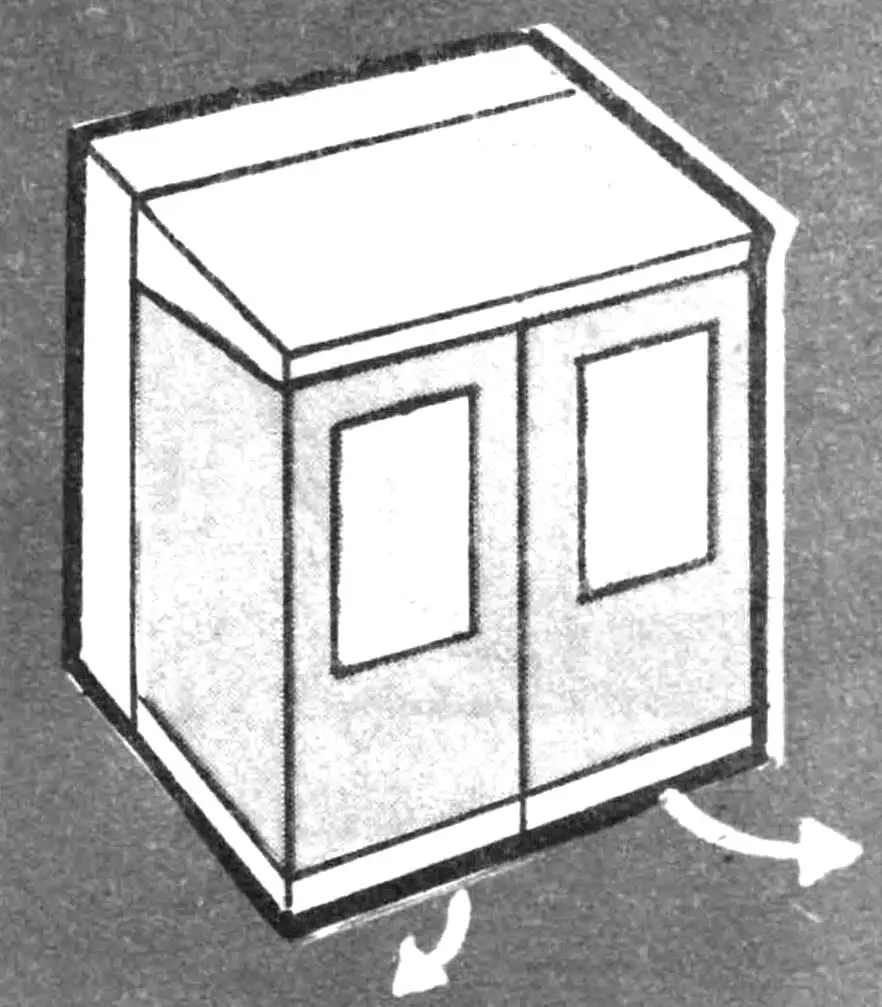
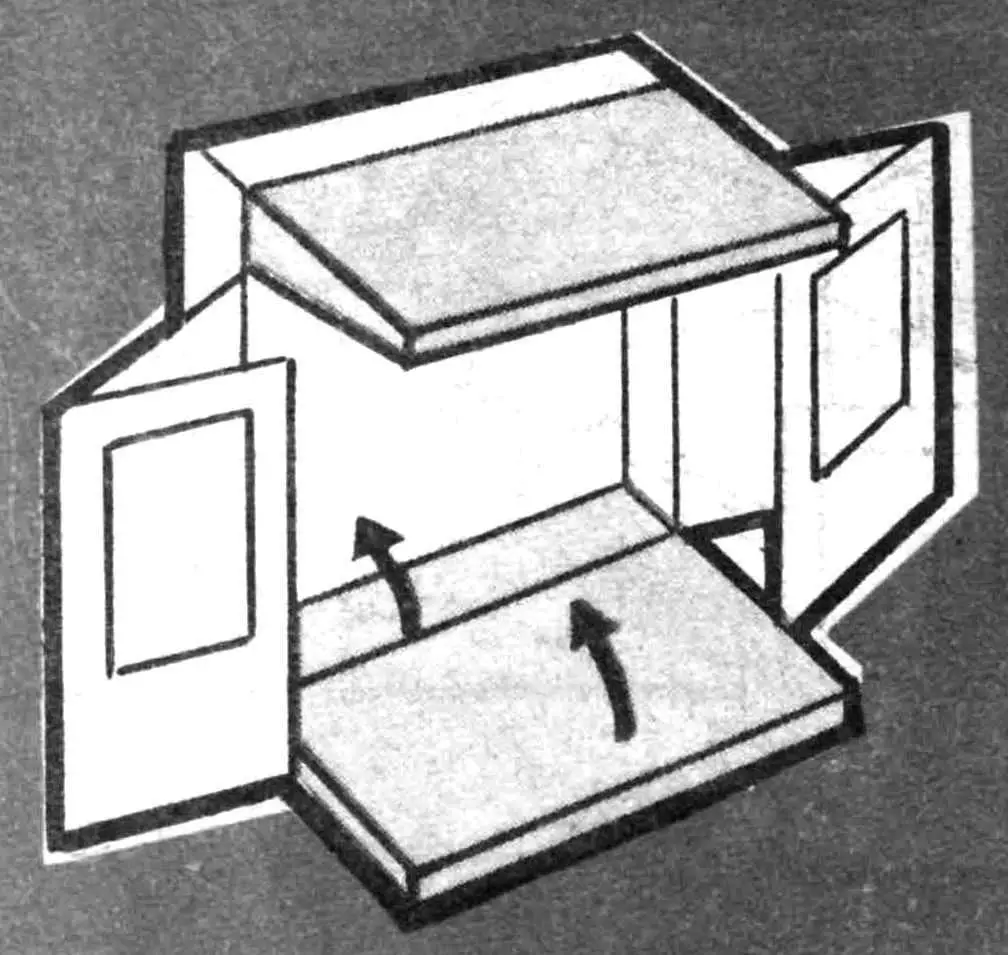
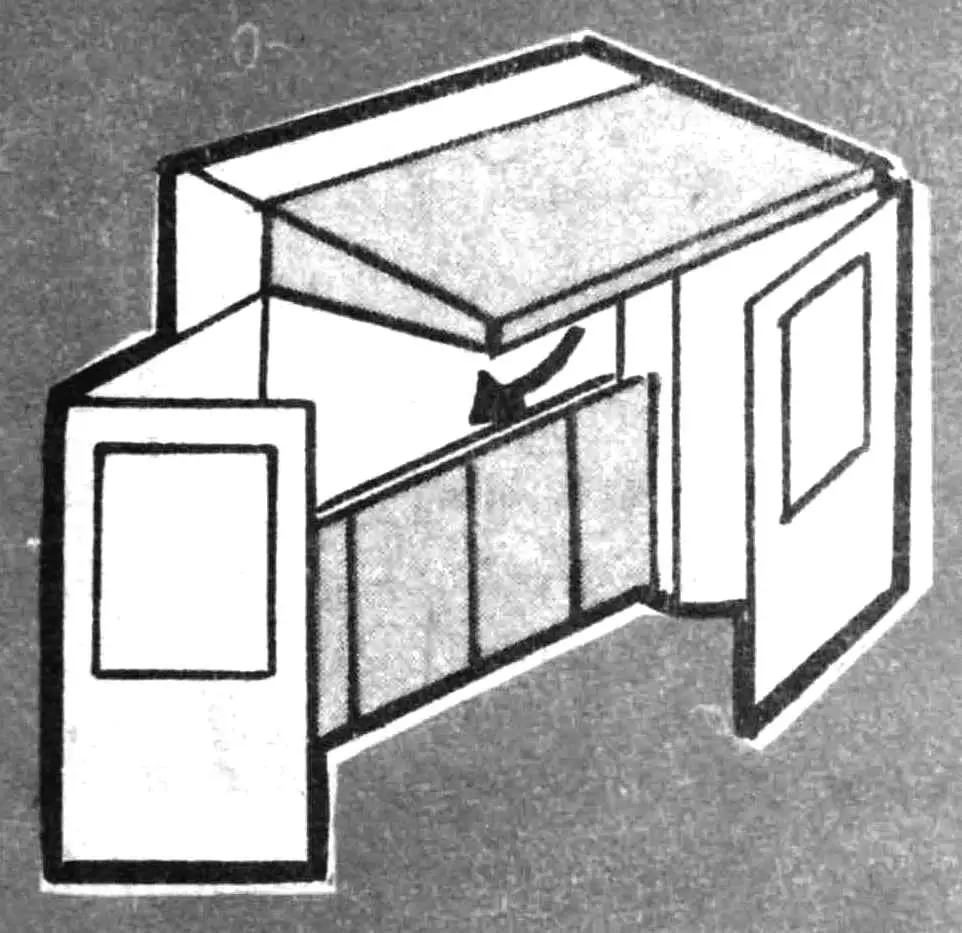
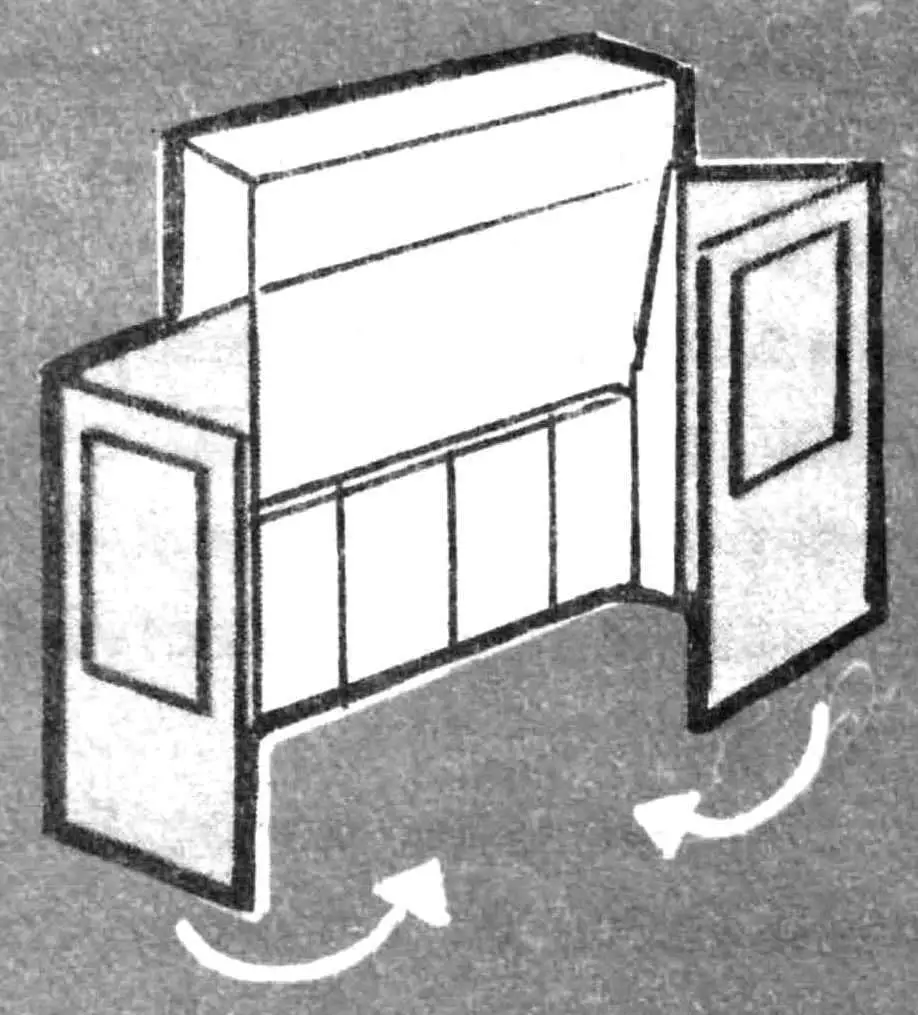
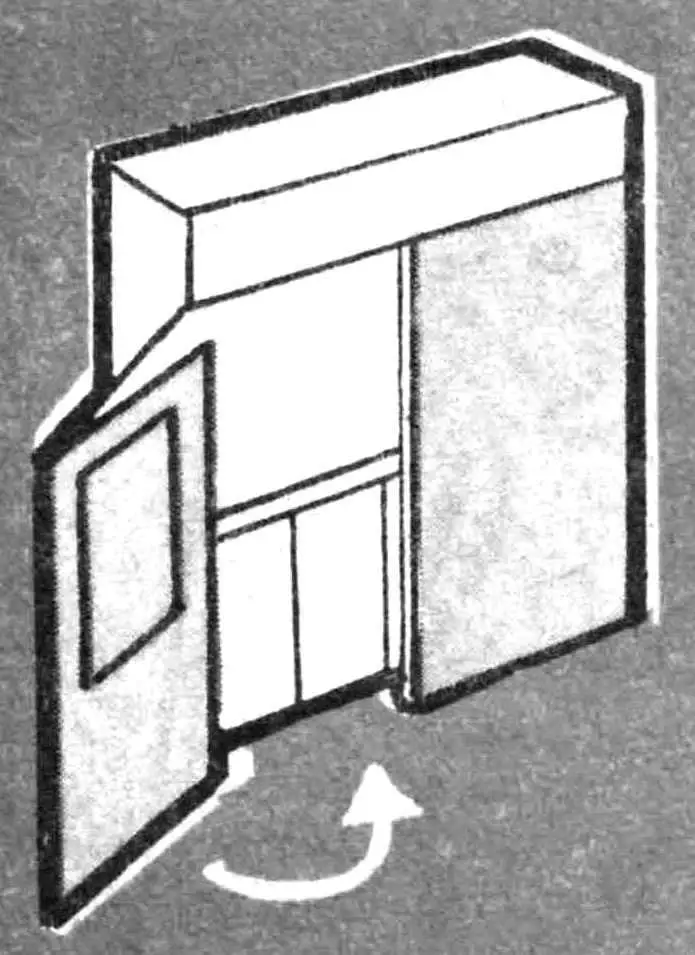
The paired doors consist of two leaves — a solid one and a glazed one — connected by hinges. Each leaf is assembled from tongue-and-groove boards (flooring planks) 28 mm thick. The glazed leaves are slightly narrower than the solid ones, which makes it easier to fold the utility block away for winter. The paired doors are attached to the walls of the load-bearing frame with hinges. In the working position of the structure, the solid doors act as side walls, while the glazed ones perform their direct function as doors.
The floor of the utility block consists of two folding panel sections assembled separately. Each panel is made from two load-bearing beams, side sill boards, joists, and a plank deck. Each panel element is attached to the walls of the load-bearing frame with bolted hinges, just like the drop-down part of the roof. To prevent the floor from dropping below the required level, a simple foundation of bricks or a tar-treated log must be placed under the corners up to the level of the lower edge of the load-bearing frame walls.
All movable parts of the utility block are fixed in the working position with simple latches — window bolts. To lock the structure for winter, standard padlock hasps are screwed onto the solid door leaves.
“M-K” 11’91, N. Pomytkin
A motorcycle and a car are different machines. First and foremost, in terms of comfort. But can the advantages of two-wheeled transport be combined with the convenience of a passenger car? It turns out they can. Such two-wheeled machines—autorollers or motocars—are sometimes seen on the streets. We suggest you build one of these designs yourself.
This vehicle is a scooter with an engine of about 50 cm³ displacement, which, unlike traditional two-wheelers, has a light plastic body with a folding top, a seat almost like in a car, and two additional small wheels that can be raised and lowered like landing gear on an aircraft.
Let’s get to work. We’ll start with the frame. Obviously, you can’t build it without a welding set. You’ll need steel tubes with an outside diameter of 34 mm and wall thickness of 2.5 mm, tubes 22 mm in diameter (same wall thickness), and a front telescopic fork from any moped or scooter. The frame is designed for wheels from a Riga-built mini-moped, but scooter wheels will work too. You’ll also need sheet steel about 2.5 mm thick.
First, draw the frame full size. This will let you cut the blanks correctly and accurately from the drawing and finally fix the main dimensions of the parts.
As the drawings show, the autoroller frame is backbone-type and consists of a welded two-tube L-shaped spine that also acts as the rear wheel fork. To each tube, 4 mm thick steel plates with longitudinal slots for the axle are welded. We recommend cutting the slots after the plates are fitted—this helps get the work more accurate.
Now join the rear wheel to the frame tubes, tighten the axle nuts firmly, and mark where the bends will be. For a small bend you don’t need to pack the tube with sand—a tube bender is enough. After fitting, the tubes are welded at two or three points.
Next, fit the wheel in the front fork and fix the fork to the floor with wooden battens in the position shown. In the same way, set the frame spine with the rear wheel. Temporarily secure the spine to the steering column with soft copper wire. Check the wheel alignment carefully—they must lie in one plane. If correct, tack the spine to the steering column in two or three places. After final fitting, weld all joints fully. At the front, the spine-to-column joint is reinforced with gussets cut from 2.5 mm steel sheet.
The rear engine mounting bracket is cut and bent from 3 mm sheet steel. Do this in place: first cut a cardboard template and only after fitting make the metal blank. Fit the front bracket the same way.
After machining, attach the bracket to the engine and fix it on the frame with wire. Alignment must be checked again—the cylinder axis must lie in the frame’s plane of symmetry, and the carburetor platform must be level. After tacking the brackets, do a final check and complete the welding with the engine removed.
The frame base is ready. Add the cross tube that serves as the pivot for the extra wheels and small pads for the driver’s seat. The frame is then fully assembled.
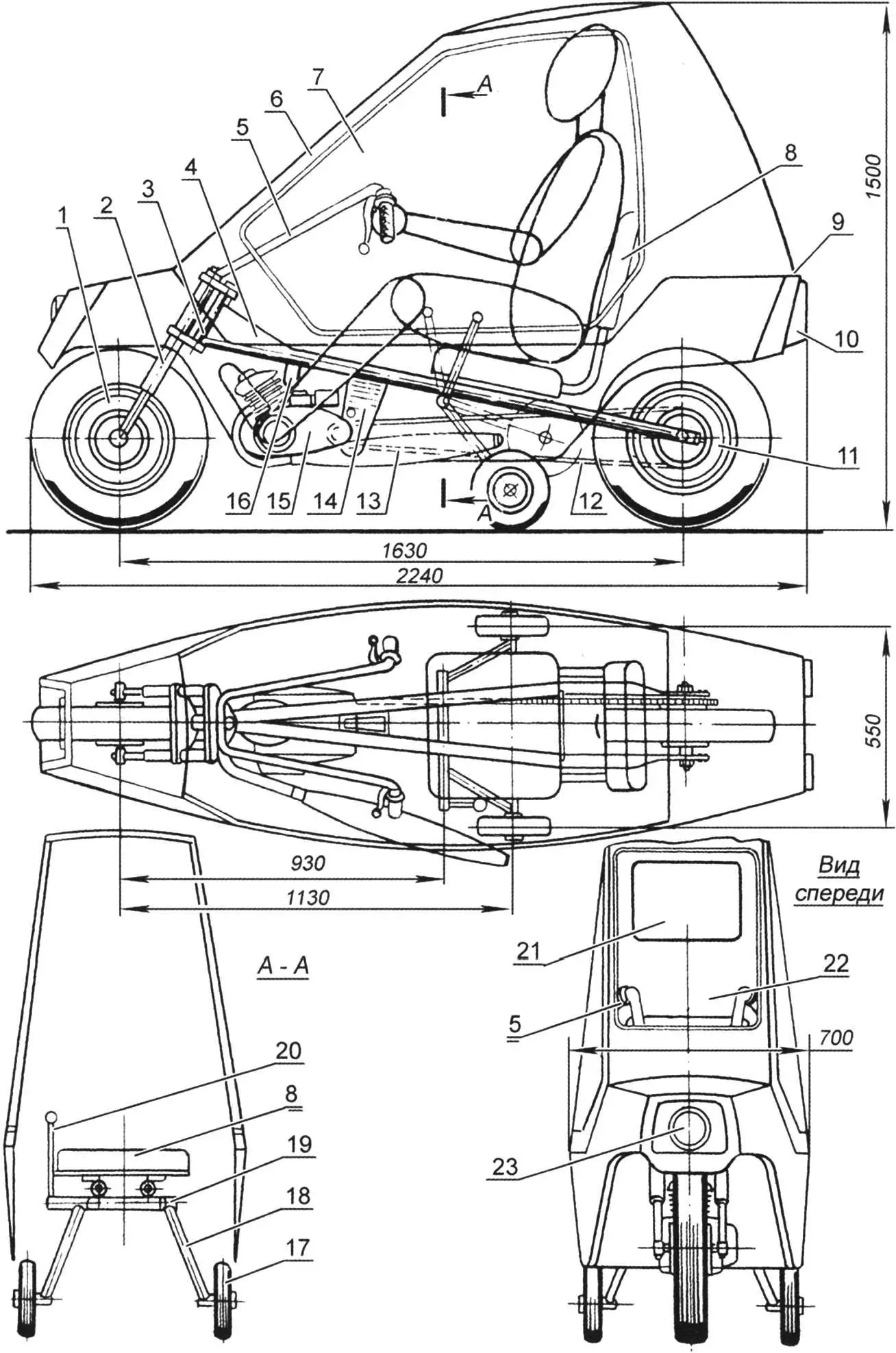
1 – front wheel (from mini-moped or scooter); 2 – front wheel fork (from any moped); 3 – frame steering column; 4 – reinforcing gusset from 2.5 mm steel sheet; 5 – handlebar (from mini-moped); 6 – folding glazed cab – “canopy”; 7 – block “glass” (Mylar film); 8 – driver’s seat (metal chair top, padded with foam and vinyl); 9 – hinge of folding cab (“canopy”); 10 – rear lights and stop lights (from motorcycle or scooter); 11 – rear wheel (from mini-moped or scooter); 12 – bushed roller chain (from two standard moped chains); 13 – muffler (from any moped); 14 – rear engine bracket (bent from 3 mm steel sheet); 15 – engine (Sh-58 or Sh-62 type); 16 – front engine bracket (bent from 3 mm steel strip); 17 – side support wheel; 18 – chassis strut (22 mm tube); 19 – support wheel pivot; 20 – chassis wheel raise/lower lever; 21 – rear window (Mylar film); 22 – front window (Mylar film); 23 – front headlight (from any moped)
For the extra wheels’ axle, choose a tube whose outside diameter allows it to rotate freely in the pivot. If you can’t find one, use a smaller tube or rod and compensate the gap with rings cut from plastic hose—they work well as plain bearings.
The chassis strut is made from 22 mm outside diameter steel tube. Weld a bushing to one end and a turned steel axle to the other. On the left strut, weld a short 10 mm steel rod with a thread for a plastic handle. This is the chassis control lever.
The extra wheels must lock reliably in both extended and retracted positions. The mechanism is straightforward; we suggest designing it yourself.
Chassis wheels can be from a children’s bicycle. Prefer rubber “balloon” or solid-rubber (not plastic) tires up to 200 mm in diameter.
The autoroller fuel tank is a 5 litre plastic or aluminium can. Fit a standard motorcycle fuel tap with sediment bowl and mount it at the rear of the body. Drill a vent hole in the can cap.
The body is plastic. The structure is built from 20×20 mm wooden battens.
The lower part of the body is like a small boat hull. Assemble the transverse frames from battens, then add the longitudinal battens per the drawing. Then skin the frame. Kitchen furniture plastic (sold in hardware stores) is a good option. Use epoxy for gluing the frame and skin. If you can’t find plastic, thin plywood or hardboard up to 3 mm is acceptable, or other options.
The upper part is built similarly. Glazing is transparent film of the kind used for model aircraft. Make window frames from 10×20 mm battens with spacers. Place the frame on the film, cut with a 20 mm margin, fold the film over and glue to the frame with BF-2 adhesive. Iron the joint with the iron set to “silk”. Then screw the frame into the window opening.
The window may not look perfect at first—Mylar is stiff and hard to tension. Use the iron set to “cotton” or “linen” and iron the film; it will tighten and flatten.
Final finishing is simple. With plastic skin, fill joints with epoxy filler (epoxy glue and talc) and paint with nitro primer then nitro enamel. With plywood or hardboard, level with filler, then cover with a layer of glass cloth and epoxy and paint.
Pay special attention to the controls. They are much like a moped’s. On the handlebar (from a Riga mini-moped) fit the throttle, front brake lever (right), and clutch lever (left). If the engine has a manual gear selector, mount it on the left of the handlebar.
The engine starter needs modification. At minimum, reposition the kickstarter lever on the splined shaft so it’s easy to kick from the seat. Better is a cord starter: fit a pulley on the splined shaft with two or three turns of nylon cord, run the free end to a convenient spot for a left-hand pull, and add a T-handle.
The last control is the chassis raise/lower lever—best under the driver’s left hand. The brake pedal for the rear wheel goes under the right foot.
For the first runs, leave the cab (“canopy”) off. Sit comfortably (chassis extended), put the gear in neutral, and start the engine. After warm-up, move off in first, then second. Retract the chassis only when the autoroller feels stable. Operating the extra wheels will feel odd at first but is easy to learn.
When using the autoroller, remember the engine runs cooler than on a moped. Ensure the cylinder cooling opening in the body is in the front wheel well, directly opposite the cylinder, and larger than the cylinder. If cooling is insufficient and the engine overheats, consider forced cooling. It’s not hard: remove the right crankcase cover and fix aluminium blades for a centrifugal fan on the flywheel/generator rotor. Make an air duct from bent aluminium sheet or from cloth and epoxy on a foam former, filled with plasticine or non-hardening putty.
«Modelist-Konstruktor» No. 6’2014, I. YEVSTRATOV, engineer
Recommend to read
 AND “FRIENDSHIP” WILL NOT FAIL
When working two-handed saw (in people, it jokingly referred to as "Friendship-2") is often from the hand of one or the other Sawyer slip grip. The tool is locked, the labor process is... DUO ROLLERS
Original brush two foam rollers used for painting walls and ceilings V. Vakulenko from St. Petersburg. They are located on the shaft so that rotates in contact with each other, the lower...
