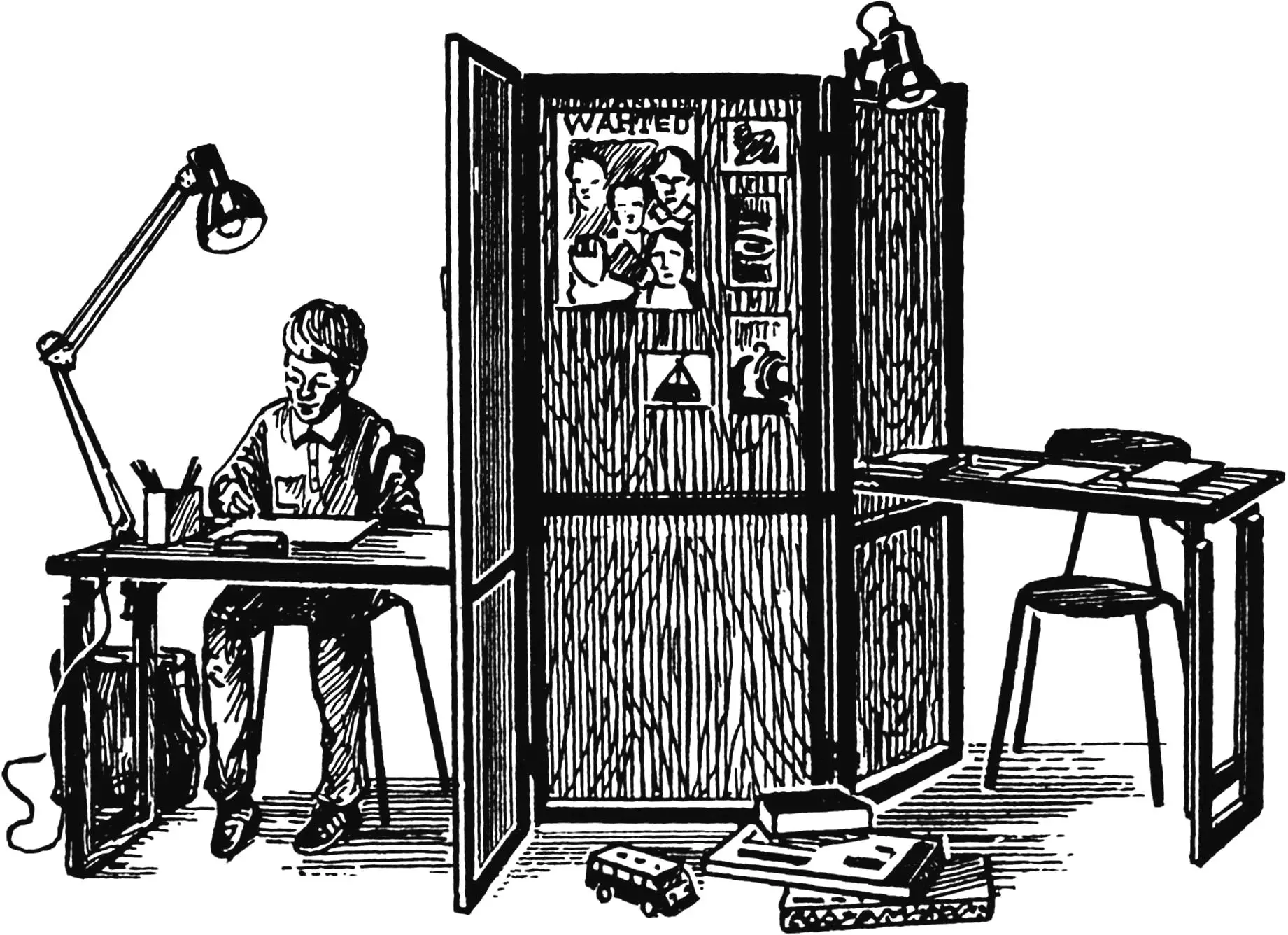
If there is no separate children’s room in the apartment, organizing a workspace for a schoolchild is not so simple, and even more so if there are two students in the family. However, even here the design ingenuity of home craftsmen suggests a solution. Here is what solution to the problem is offered, for example, by the Hungarian magazine “Eszermester Hobby”. This is a screen with folding tables.
At first glance at the drawings, the screen attracts attention. Schoolchildren studying on both sides of it will not interfere with each other. But upon careful examination of the design, it is easy to notice that this is not just a screen, but an unusual partition between two folding tables that are attached to it. Moreover, all elements of the design are so simple that children themselves can participate in its manufacture.
The materials needed for the work are accessible. First of all, these are wooden blocks with a cross-section of 40×20 mm and sheets of plywood or fiberboard.
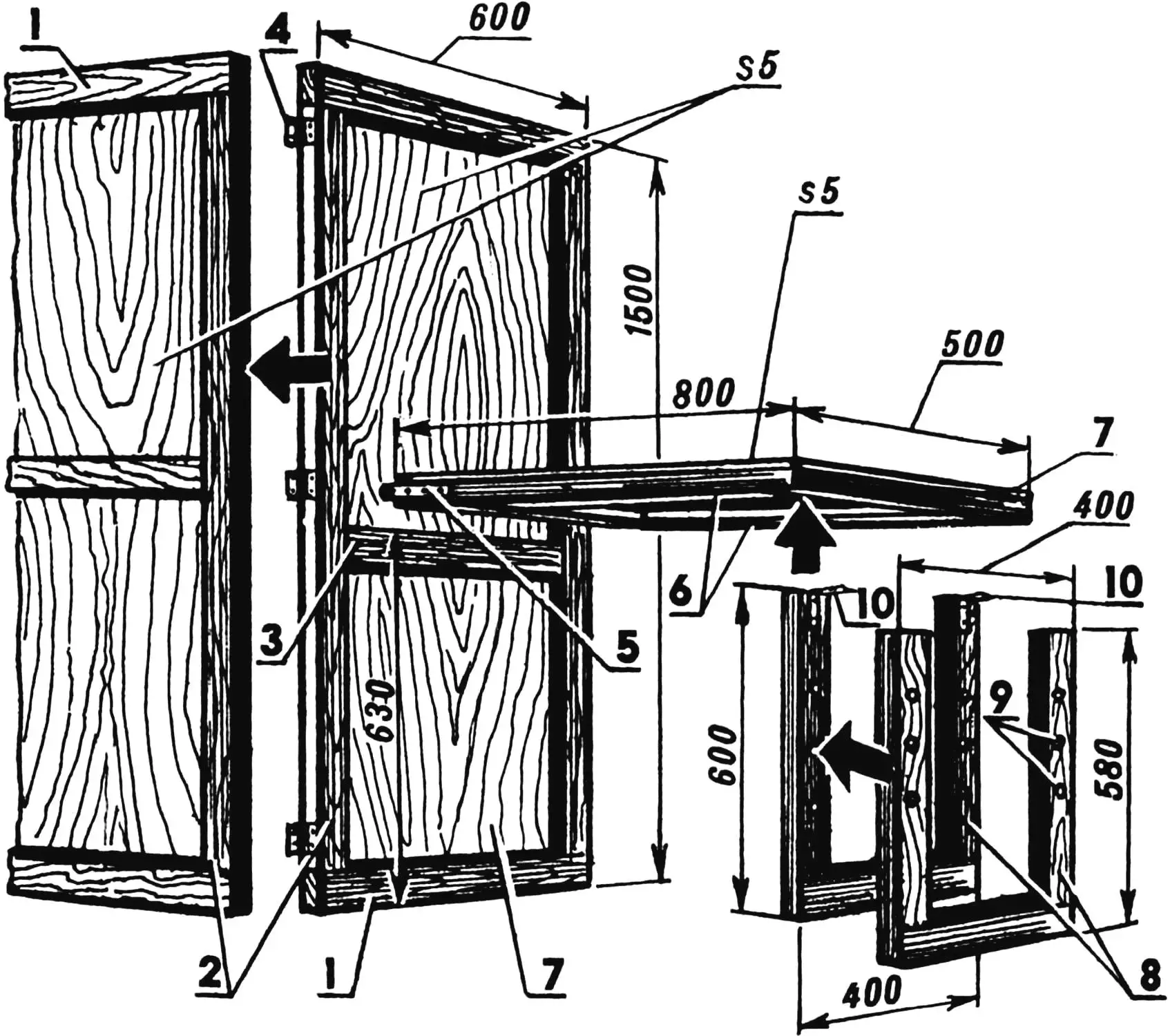
1,2 — screen frame blocks; 3 — screen post crosspiece; 4 — screen frame connection hinge; 5 — tabletop eye; 6 — tabletop frame; 7 — plywood sheathing; 8 — composite, adjustable leg; 9 — leg height adjustment holes; 10 — leg mounting hinges
First, the screen is assembled. It consists of three frames with crosspieces; the openings can be covered with dense fabric, sheathed with plywood or fiberboard. The frames are connected to each other traditionally — on hinges, two to three per joint. They must be fastened so that all three frames can be folded into one flat package. In this case, the frames that end up on the outside will become the bases for the folding tabletops.
The tables themselves can be assembled in the same way as the screen frames — from wooden blocks that form the tabletop frame and legs. The frames of the former are sheathed with plywood, and the frames of the latter are composite: each leg is assembled from two U-shaped parts, one of which is connected to the tabletop using metal hinges, and the second is attached to it with some downward offset and allows adjusting the table height to the child’s growth. Adjustment is carried out thanks to a series of holes on both parts of the leg, into which bolts with nuts are inserted. Similar holes can also be on the vertical blocks of the screen frames, to which the metal eyes of the tabletop frame are hingedly attached (ordinary screws can serve as hinges).


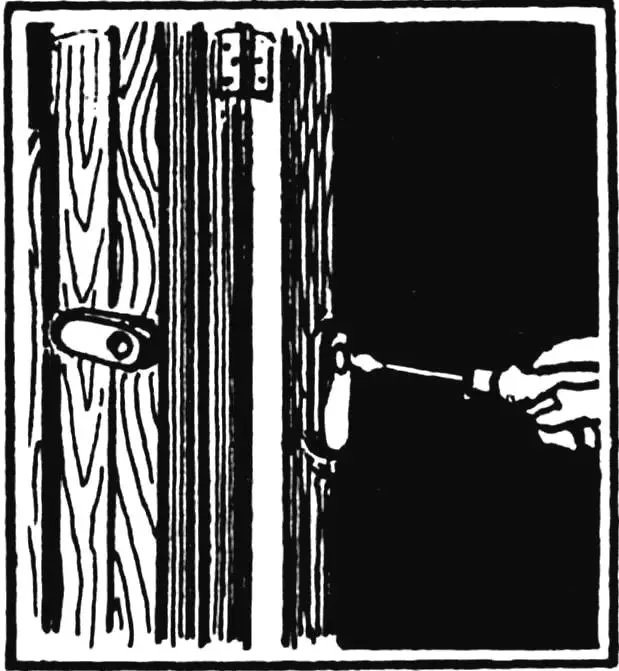
The width of the tabletop should be such that when folding the table, it fits flush inside the screen frame. In the raised position, the tabletop is fixed by wooden turnbuckles installed for this purpose on the vertical blocks of the screen. The stability of the table in the lowered, working position is provided by a hook on the tabletop frame, and on the leg — by a corresponding loop.
The tabletop, as well as its support-leg, does not necessarily have to be a frame construction: these parts can be cut from a furniture board, preserving the described method of connecting them to each other and to the screen.
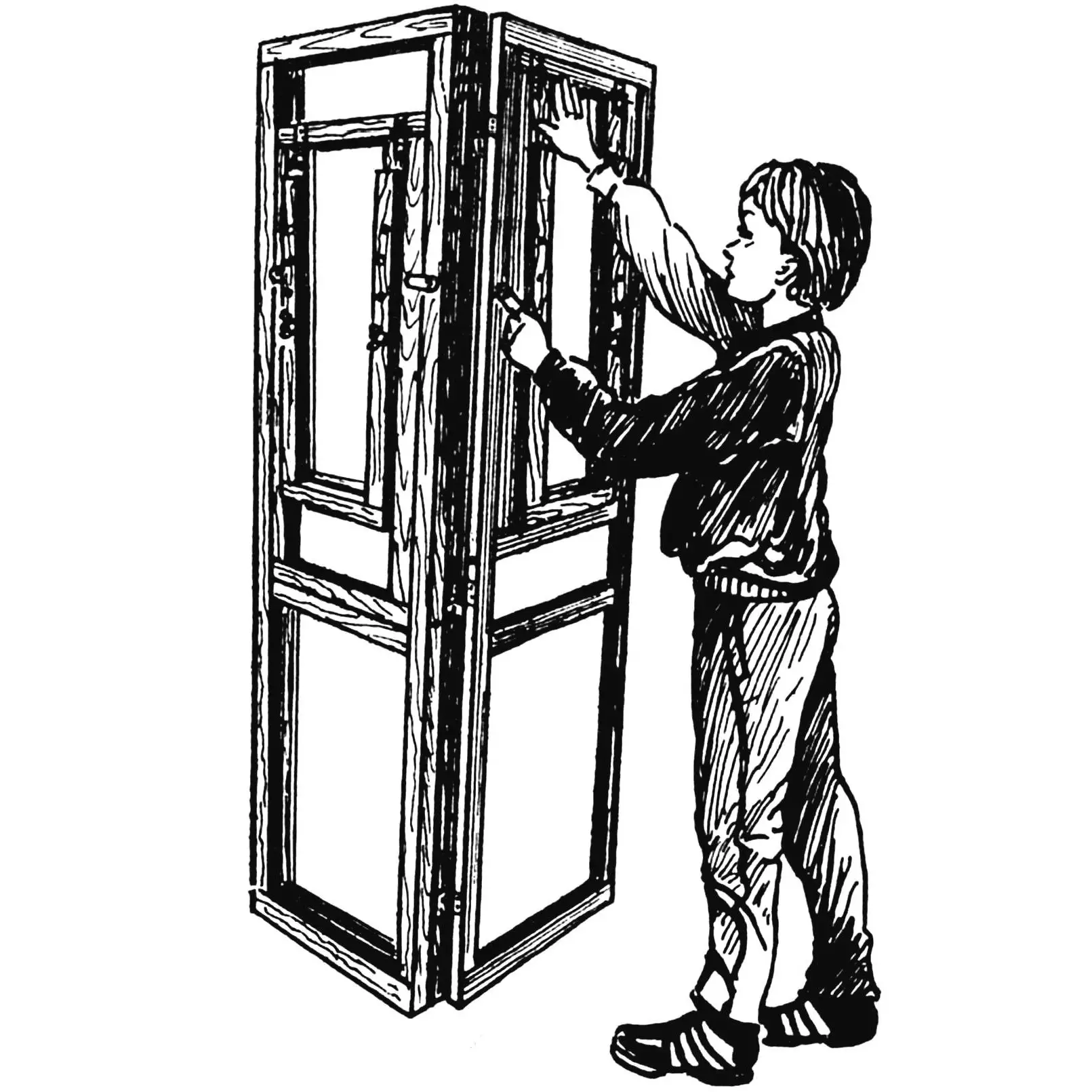
All wooden parts are carefully sanded with sandpaper, after which they are painted with bright-colored enamels or (if desired) impregnated with stain and coated in several layers (with intermediate drying) with furniture or parquet varnish.
Such a “cabinet” can be stationary as a permanent corner for schoolchildren’s studies or folded and put away each time after doing homework, so as not to interfere in a small room.
“Modelist-Konstruktor” No. 12’2000
Recommend to read
 AND A COT AND LOUNGER
How sometimes we easily leave cot: broken material and prepared for her place in the dustbin. But don't throw a roll cage! Release him from the numerous springs and wire. Measure the... P-06 EXPERIMENTAL
In 1935, in the Reactive section of the CA osoaviahima of the USSR designer A. I. Polar was designed and built experimental rocket. Originally it was called "Osoaviakhim" (R-1)....
