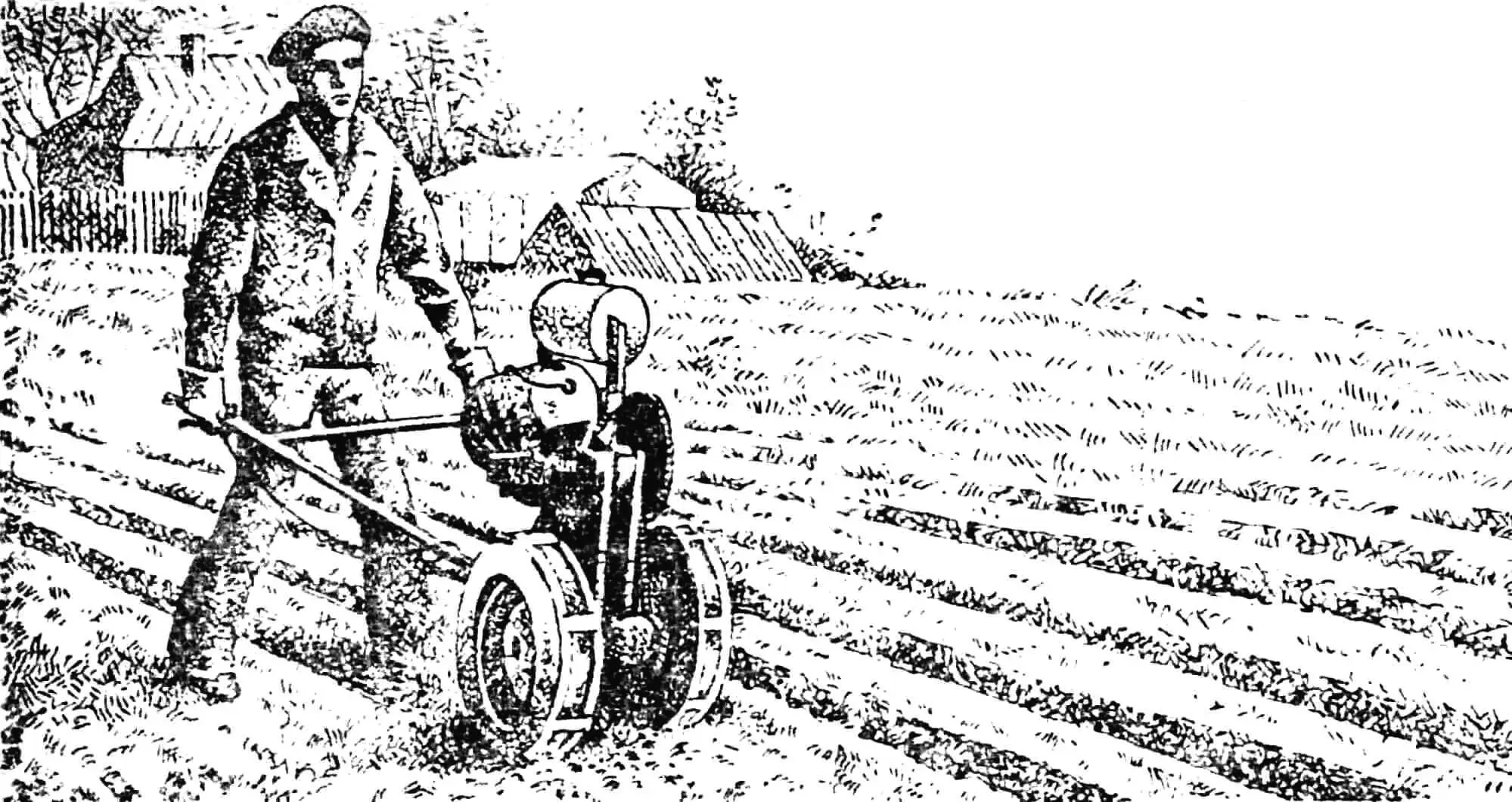
…The silence of a sunny spring morning was shattered by the sharp clatter of an engine. A peasant digging his garden with a shovel straightened up and looked over the fence at the neighbor’s plot: what was that noise at the old Ilyichevs’? He saw a small two-wheeled machine emerge from behind the outbuilding onto the garden, puffing bluish smoke, behind which, holding onto long control handles, walked the Ilyichevs’ son—Sergei Alekseevich.
The village mechanic immediately understood what kind of machine the neighbor had built: the plow suspended at the back and the control handles of characteristic shape spoke for themselves. The construction of the motor plow was clearly not very complex. The engine brand was familiar to the neighbor. Exactly the same motor, together with parts from his worn-out scooter, lay in his shed under a tarpaulin—he never got around to repairing it…
Meanwhile, Ilyichev turned around and, adding gas, drove the plow into the soil. Behind him, in the earth smoothed by snow and rain, the first furrow appeared. This was the “baptism of fire” of the “Vyatich,” a homemade walk-behind tractor created by engineer-designer Ilyichev.
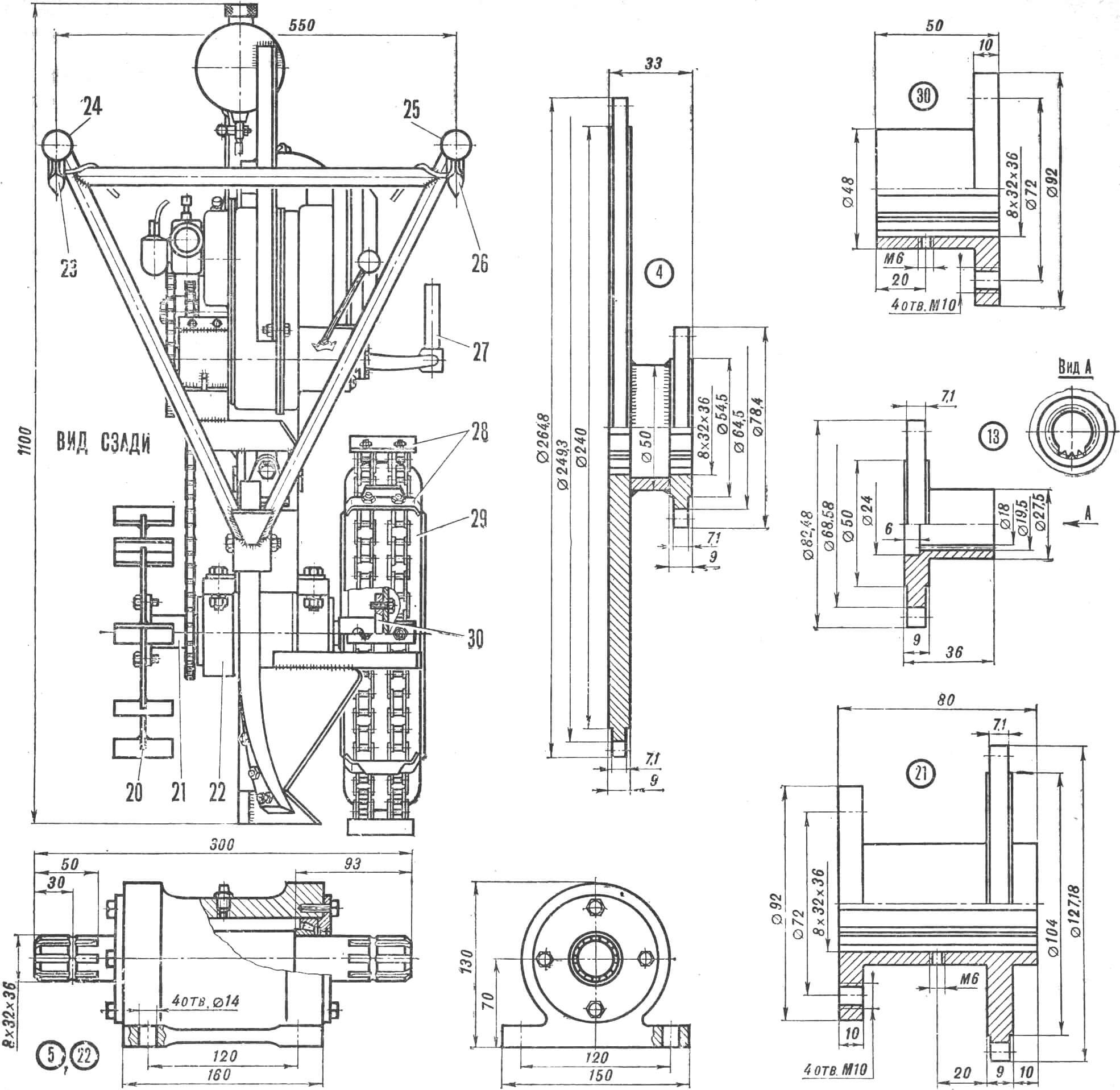
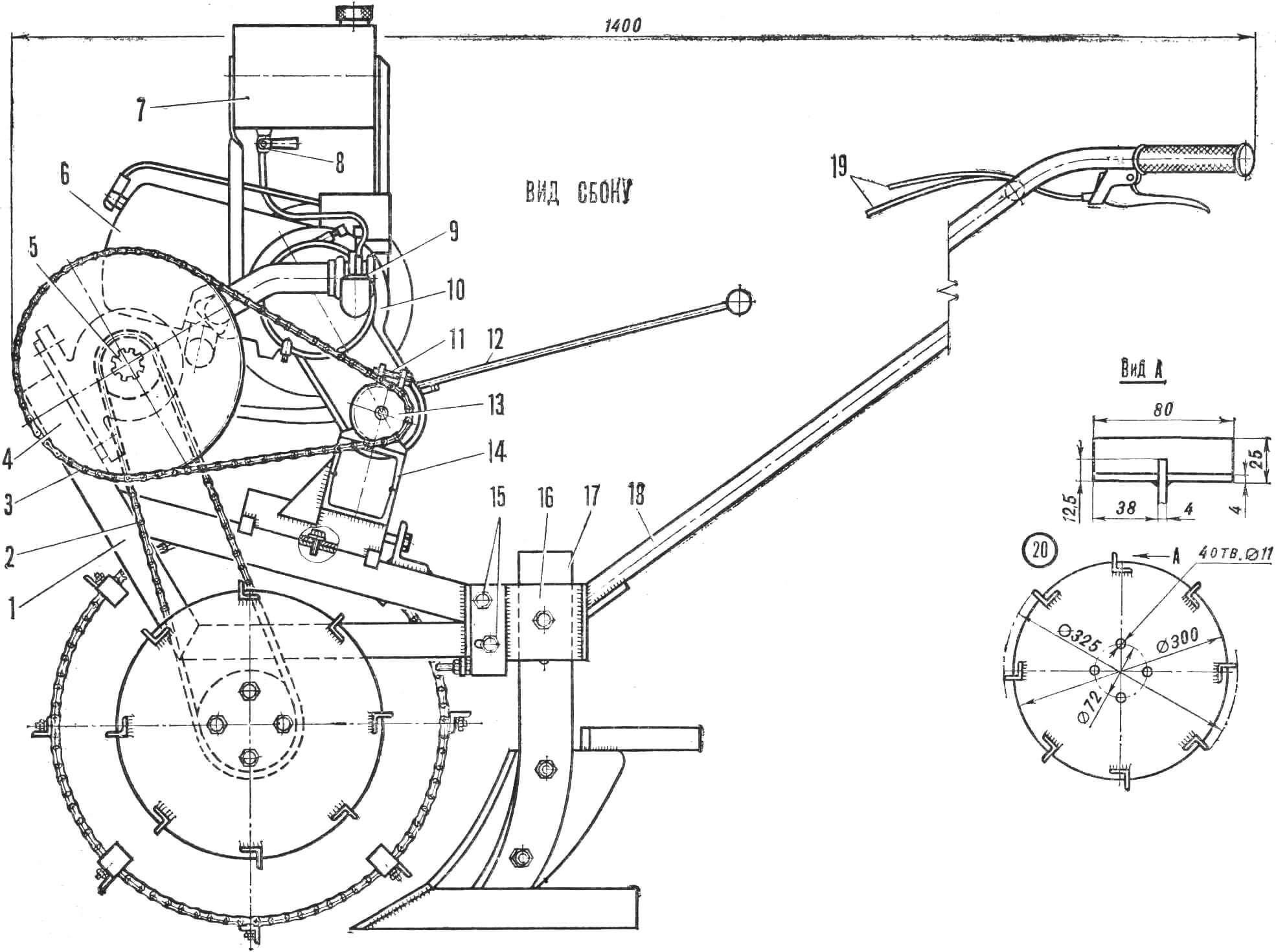
1 — frame, 2 — drive chain, 3 — driving chain, 4 — block of intermediate sprockets, 5 — intermediate bridge, 6 — engine housing, 7 — fuel tank, 8 — fuel tank valve, 9 — carburetor, 10 — engine, 11 — engine mounting bolts, 12 — gear shift lever, 13 — output sprocket, 14 — bracket, 15 — tool holder suspension bolts, 16 — tool holder housing, 17 — plow, 18 — control handle tube, 19 — control cables (conventionally cut), 20 — support wheel, 21 — drive sprocket, 22 — drive bridge housing, 23 — clutch lever, 24 — left control handle, 25 — right handle, 26 — throttle lever, 27 — kickstarter pedal, 28 — lugs, 29 — main wheel, 30 — main wheel flange.
Since then, residents of the Moscow region village of Morozki often see the mechanical gardener’s assistant working in the garden. When the potatoes have bushed up—Ilyichev, having changed the wheels and the tillage tool, takes it out to the garden to hill the plantings… When something needs to be transported—here, instead of a plow or hiller, a homemade cart is behind the “Vyatich.” Rumbling with its engine, the walk-behind tractor confidently pulls a fully loaded cart and a rider to boot—almost half a ton.
When it’s time to prepare firewood for winter—then Ilyichev’s micro-universal helps him. He removes the engine from the “Vyatich” frame together with the mounting bracket and installs it on a simple device with a pendulum disc saw.
The usefulness of the walk-behind tractor in agriculture is obvious. And the Ilyichevs’ neighbor began to stop more and more often near his disassembled scooter…
The magazine “Tekhnika—Molodezhi” in issue No. 7 of 1981 introduced readers to the general layout of the “Vyatich” and the operations that can be performed with it on household plots. The purpose of our publication is to give those interested in it a more in-depth explanation of the walk-behind tractor’s construction.
Conventionally, it can be divided into five parts: the frame, the engine group, the transmission, the wheels, and the tool holder with controls. So, we will examine the “Vyatich” device in order (Fig. 1).
The frame (Fig. 2) is welded from three beams—sections of channel No. 8. In the wall of the upper beam, M8 threads are cut in two holes for mounting the engine bracket. There, slightly below the holes, a central stop is welded—an angle with an M8×60 mm adjustment bolt, with which the bracket can be moved along the frame. Why—will become clear later.
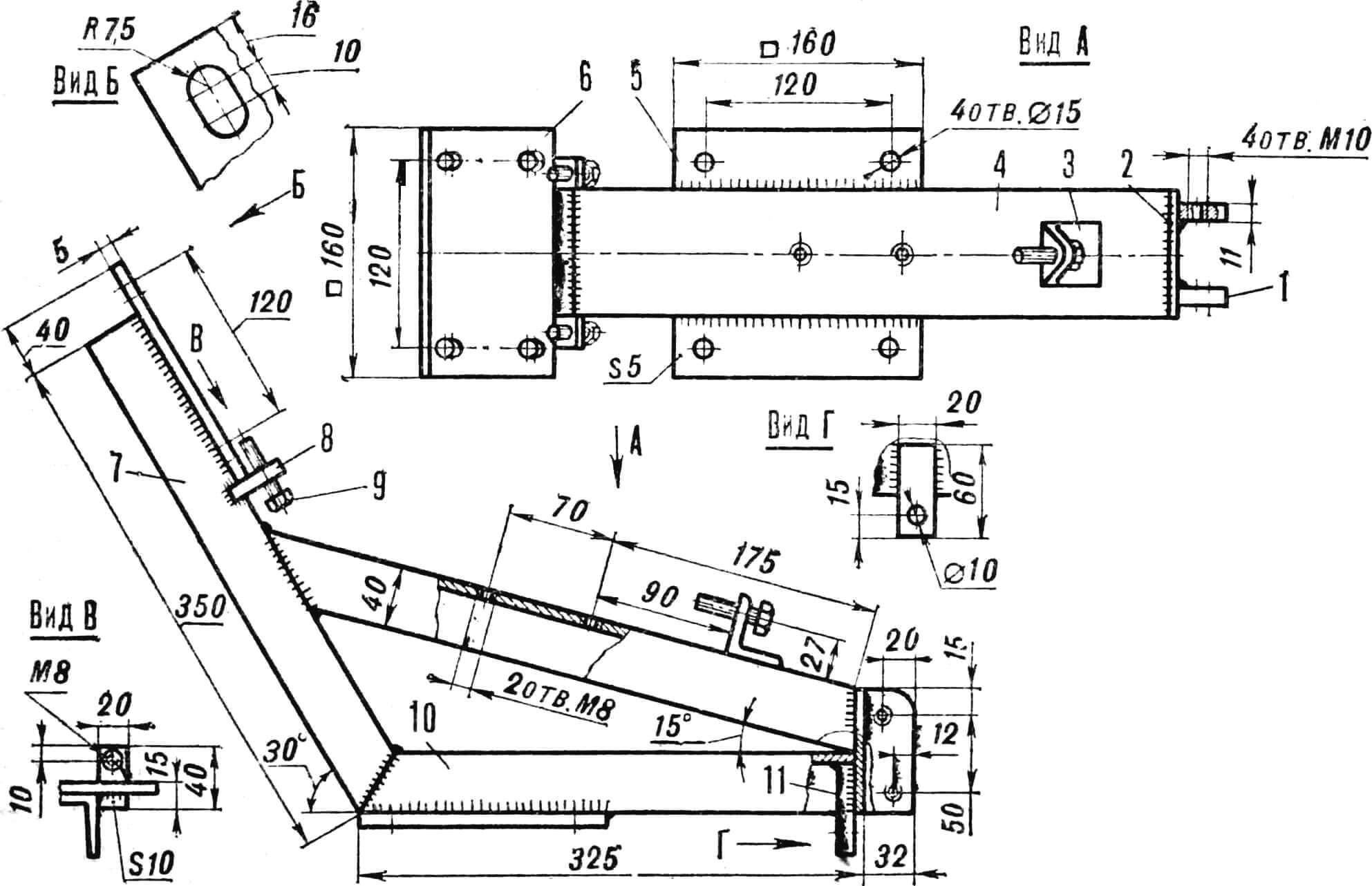
1 — tool holder suspension hinges, 2 — pad, 3 — central stop, 4 — upper beam, 5 — drive bridge platform, 6 — intermediate bridge platform, 7 — inclined beam, 8 — side stop (2 pcs.), 9 — adjustment bolt (3 pcs.), 10 — lower beam, 11 — shackle.
Square steel plates—platforms for the drive and intermediate bridges of the walk-behind tractor—are welded to the lower and inclined beams of the frame. The holes in the drive bridge platform for mounting its housing are cylindrical. In the intermediate platform, they are made in the form of slots, and below the platform, two side stops with M8×60 mm adjustment bolts are welded to the flanges of the inclined beam.
A rectangular plate—a pad—is welded to the rear part of the frame, and to it—on the outside—the tool holder suspension hinges. A shackle with a Ø 10 mm hole, into which the tool holder adjustment bolt enters, is welded to the inner side of the pad.
The engine group of the “Vyatich” consists of the engine, the bracket for mounting it to the frame, the output sprocket, and the fuel tank. The engine is taken from the well-known “Vyatka-150M” scooter (or from the “Elektron”), and has not undergone serious modifications, but some things have been changed. The carburetor pipe (Fig. 3) is separated from the flange, rotated 180° in the horizontal plane, and welded back to the flange (otherwise, when installing the engine on the frame, the carburetor would hit the structure; for the same reason, the muffler was removed). The kickstarter lever is notched in two places, bent along the notches, and welded in this position. After this, the lever, when lowering during engine start, stopped hitting the wheel.
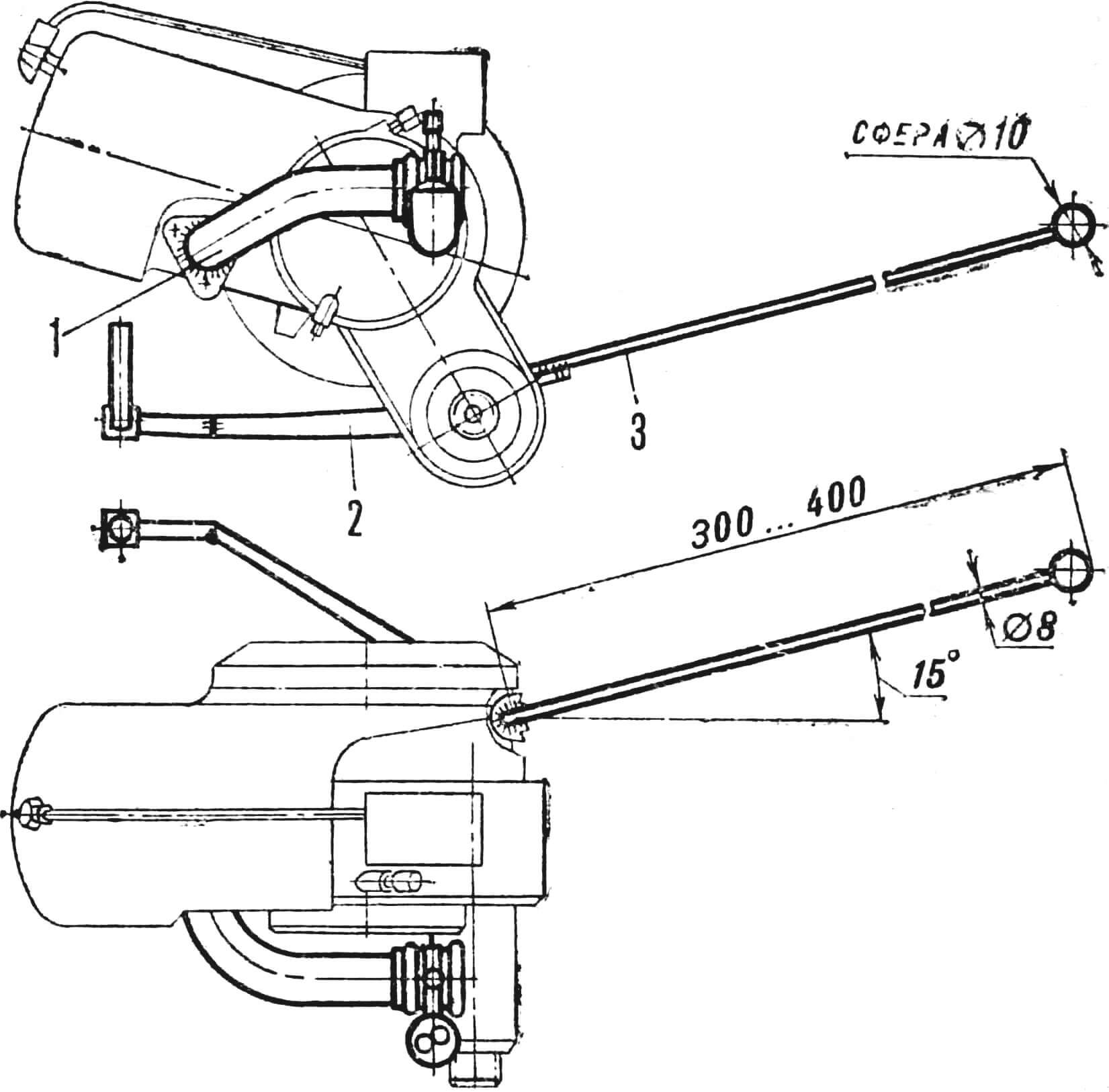
1 — carburetor pipe, 2 — kickstarter lever, 3 — gear shift lever.
The gear shift sector has also been modified. A steel rod with a ball at the end is welded to it, which can be easily reached while behind the walk-behind tractor control handles.
The output sprocket (see Fig. 1) is mounted on the engine power take-off shaft. It has 19 teeth with a pitch of 12.7 mm. The sprocket splines match the shaft splines.
The engine is mounted on the frame using a bracket welded from several parts, mainly sections of channel No. 8 (Fig. 4). The bracket clamp, tightened with bolts, grips the output shaft neck and securely holds the engine. The bracket itself is attached to the frame with two M8×10 mm bolts. For this, slots are cut in its base, allowing the bracket to be moved along the frame and thus change the driving chain tension (the adjustment bolt rotates in a thrust nut welded to the bottom of the console). And so that the bracket does not skew during adjustment, limiters are welded to the edges of its base, which orient the bracket along the upper beam.
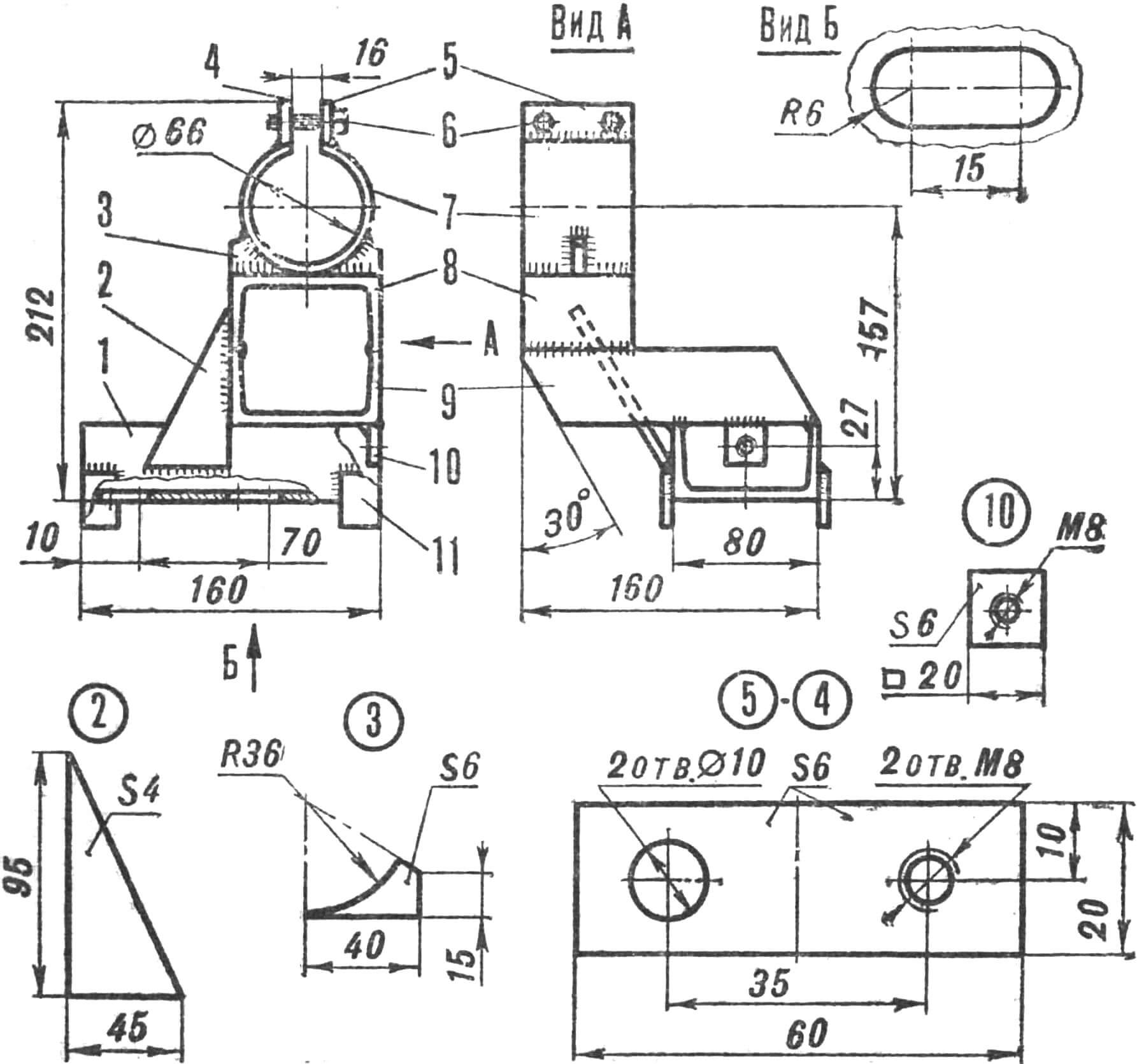
1 — base, 2 — stiffening rib, 3 — support, 4 — front clamp jaw, 5 — rear jaw, 6 — clamping bolt (2 pcs.), 7 — clamp, 6 — support, 9 — console, 10 — thrust nut, 11 — limiter.
The cylindrical fuel tank is mounted on two posts above the engine. Fuel flows from it to the carburetor by gravity.
The transmission consists of the intermediate and drive bridges (see Fig. 1), taken from decommissioned potato harvesters, sprockets, wheel flanges, and chains. The intermediate bridge is located on the inclined beam platform of the frame and can move slightly in its slots, tensioning the drive chain. The tension is adjusted with M8×60 mm bolts in the side stops of the frame.
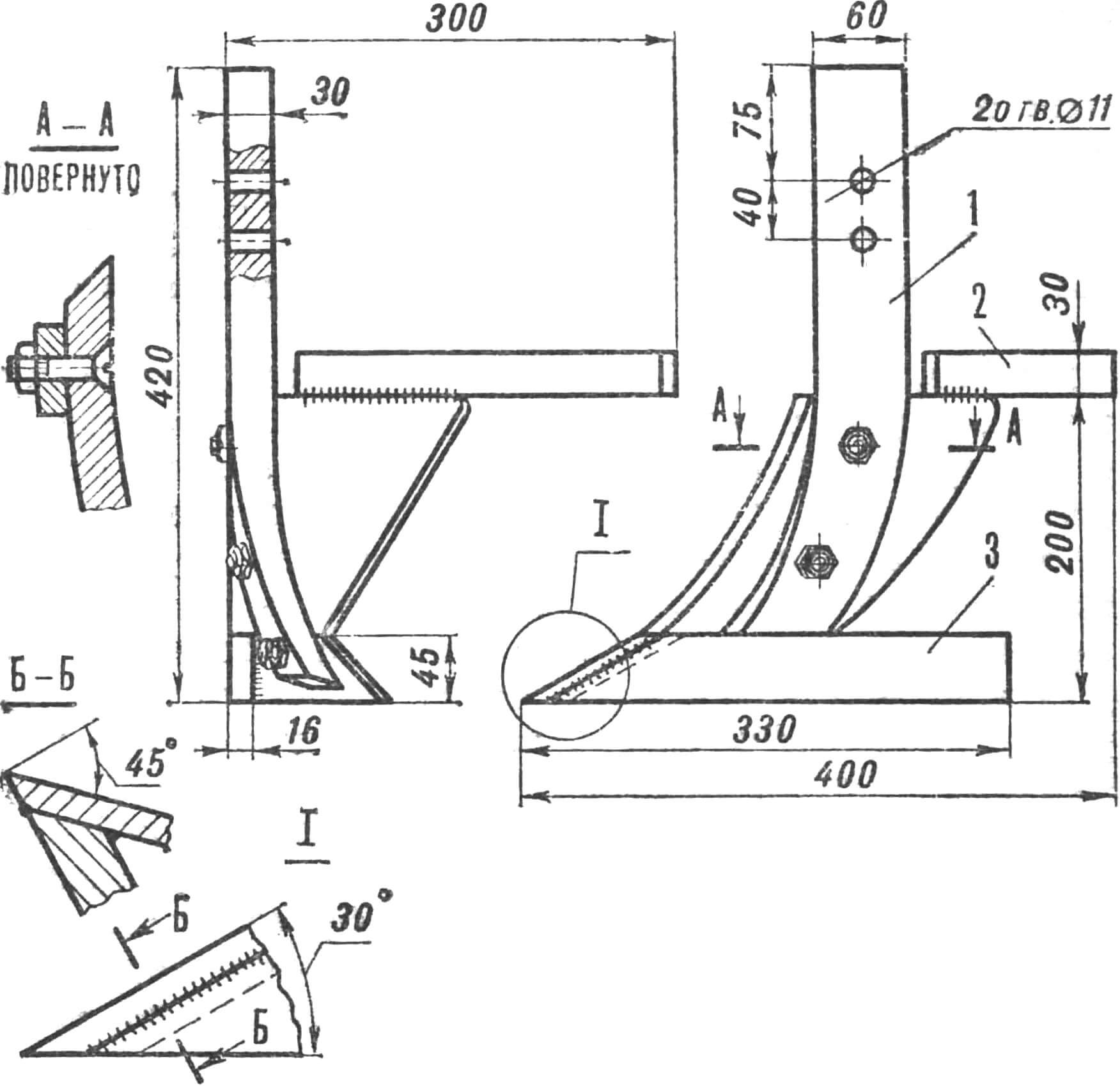
1 — colter, 2 — reflector, 3 — stop.
A block of intermediate sprockets is mounted on the left splines of the bridge shaft and secured with an M6×8 mm screw. The larger one has 64 teeth, the smaller one—18. The tooth pitch is the same—12.7 mm. The torque from the engine output sprocket is transmitted by chains from a “Java” motorcycle to the intermediate bridge, and from it—to the drive bridge. There, the sprocket has 30 teeth with a pitch of 12.7 mm and is made together with the left wheel mounting flange of the walk-behind tractor. It is mounted on the splines of the left end of the bridge shaft and secured with an M6×8 mm screw. The right wheel mounting flange is mounted and secured in the same way on the splines of the right end of the drive bridge.
The wheels on the “Vyatich” are scooter wheels (Fig. 6). Only the discs for mounting them to the flanges are homemade, cut from steel sheet. For better traction with the soil, the wheels are equipped with lugs—angles with 25 mm wide flanges (eight per wheel). The angles are of two types: half with tabs, half without tabs. They are attached, alternating, to two harvester chains put on the tires. To prevent the chains from slipping off, the tabs on the lugs are bent toward the wheels.
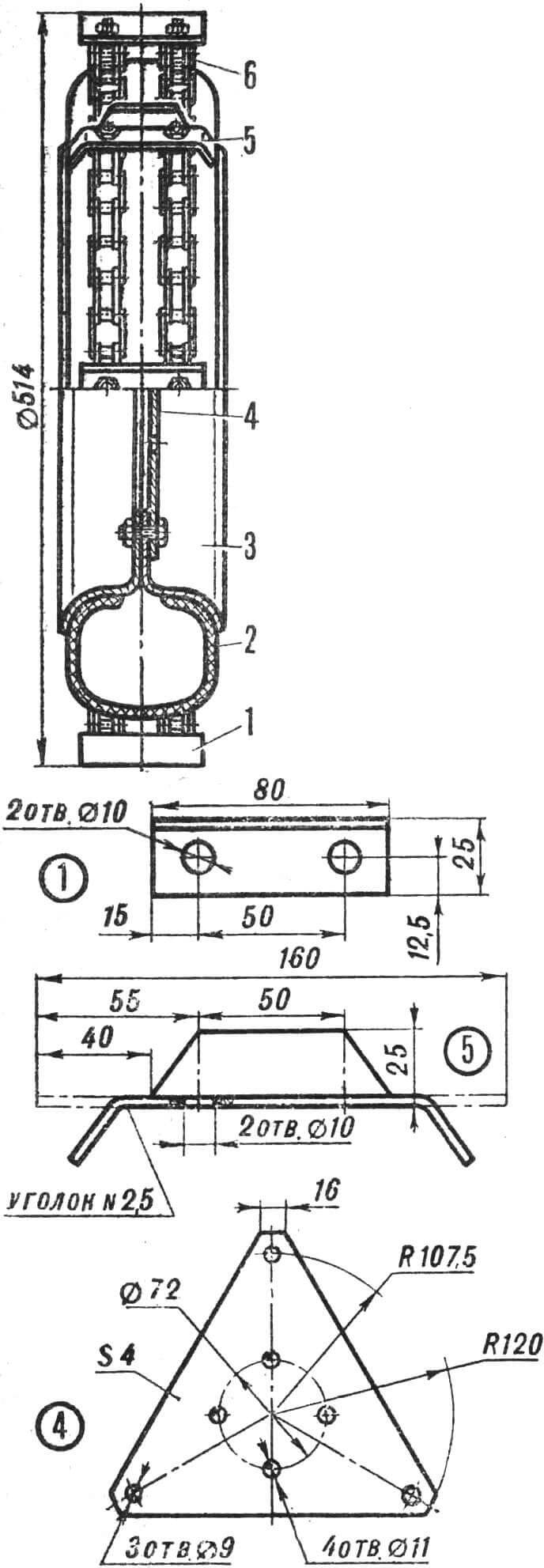
1 , 5 — lugs, 2 — wheel, 3 — rim, 4 — disc, 6 — chain.
When plowing, the left scooter wheel is removed and a support wheel is put in its place. It is entirely metal (see Fig. 1): the disc is cut from steel sheet, and the eight lugs are made from angle with 25 mm wide flanges. The angles are connected to the disc by welding. The support wheel is attached to the flange with the same bolts as the scooter wheel.
And finally, the last unit—the tool holder with controls. It is suspended on hinges at the rear of the frame. The unit is a welded structure (Fig. 7), the main parts of which are sections of pipe and channel No. 8. The holder is made directly from channels: from one, to the flanges of which a closing wall is welded, a housing is made (in which the tillage tools are mounted), from another—an adjustable bracket. The two lower holes of this bracket are made in the form of slots. If the mounting bolts in them are loosened, and the holder adjustment bolt is moved with nuts relative to the frame shackle, then the installation angle in the vertical plane, say, of the plow will change within 8°. The optimal installation angle of the plow for each type of soil is usually determined during operation.
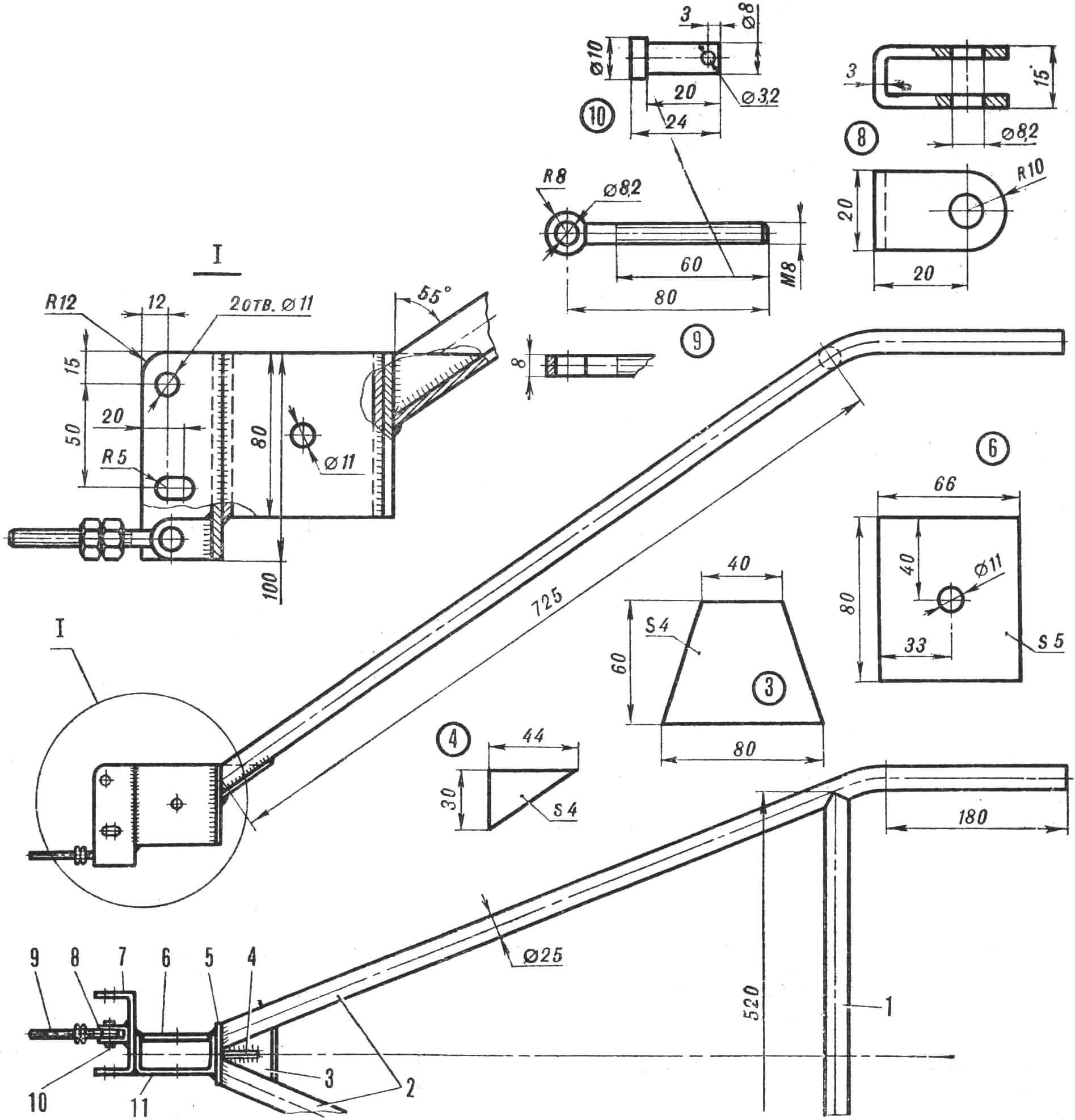
1 — crossbar, 2 — handles, 3 — gusset, 4 — stiffening rib, 5 — pad, 6 — housing wall, 7 — bracket, 8 — fork, 9 — adjustment bolt with nut, 10 — bolt axis, 11 — tool holder housing.
Control handles are welded to the holder pad. To make the connection reliable, the weld is reinforced with a gusset and a stiffening rib. Plastic or rubber handles are put on the ends of the tubes. In front of them, clamps for the walk-behind tractor control levers are secured with M5×8 mm screws: on the left, the clutch lever, on the right—the throttle. The cables from them go directly to the clutch and carburetor throttle of the engine. All these controls are from the scooter.
In conclusion, a few words about tillage tools. The chisel and cultivator-hiller are taken without modifications from a decommissioned cultivator. They are good for breaking up compacted soil crust and hilling potatoes. But the plow is homemade (Fig. 5). Its base is the colter of a conventional mounted plow. A stop made of a pointed steel plate is welded to it from below, and a reflector is welded to the moldboard from above. These additional elements help form the furrow correctly. To mount this tool in the holder housing, two holes are drilled in the colter post. Using them, the plowing depth can also be changed.
The “Vyatich” walk-behind tractor was built in 1972 and has been serving Ilyichev reliably ever since. Its construction has been continuously improved and now has the appearance described in this article. Therefore, it is sufficiently refined and can be recommended for replication by those who want to mechanize work on a household plot. If you don’t have exactly those units and parts listed above, that’s okay. The construction is so simple that it will withstand possible changes without harm. It is only important to maintain the main proportions and mutual arrangement of the units.
Proper maintenance of the walk-behind tractor is no less important. And then the little hero “Vyatich” will serve long and reliably.
Recommend to read
 “DONKEY”
The idea of creating our "Donkey" arose almost by accident. Once the chefs gave us a written off motorcycle To the 125 without wheels. Original spare wheels we had, we decided on the... EASY GOING
In the "Modeller-designer" has repeatedly published materials on woodworking machines-"circular saw" circular saw and planer, so necessary for the house masters. On this publication have...
