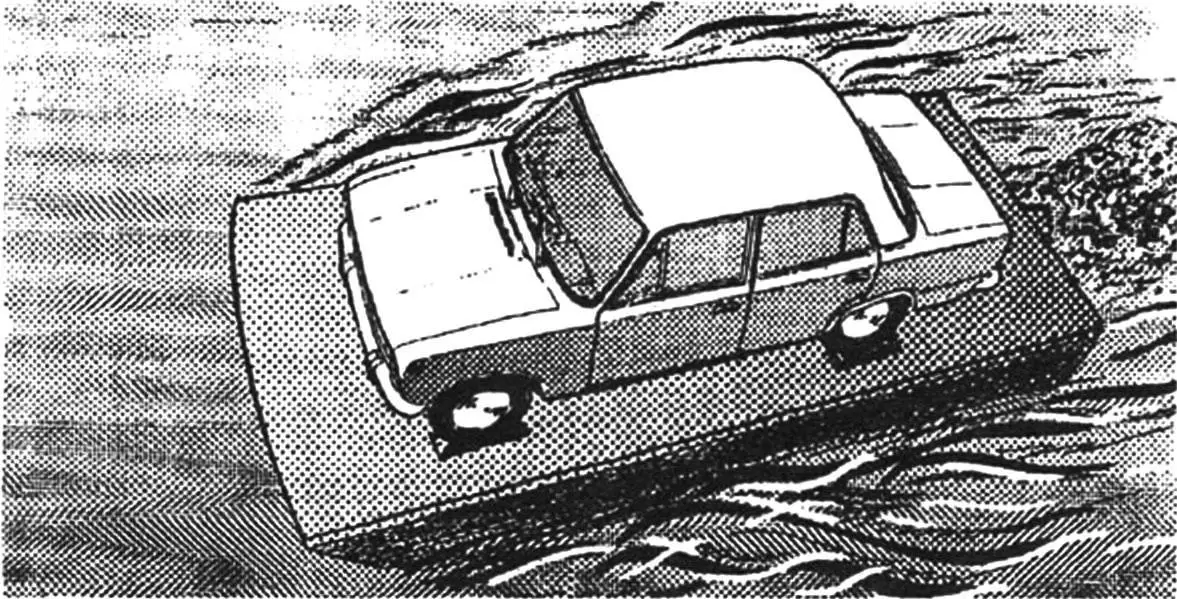
It’s good to live on the bank of a wide, full-flowing river! True, this convenient transport artery often becomes an annoying obstacle to communication between settlements. A motorist sometimes has to travel several hours to reach the desired city or village on the other side of the river. You can, of course, use a boat or motorboat, but then on the opposite bank you’ll have to walk…
In such cases, it’s good to have a self-propelled pontoon, for which the car’s engine is used for propulsion, and its steering system for course control. You drive up to the shore, drive onto the pontoon via a simple ramp, and secure the car on it. That’s it, you can cast off! The engine starts, you engage a gear — and the left wheel, resting on two drums, begins to rotate, driving the propeller, which is connected to the drum shaft by a bevel gear. Need to turn? You move the steering wheel, the front wheels move together with the support platforms located on the turning device, deflecting the rudder blade, which is connected by steering cables and a rigid rod to the lever of the left support platform. And if you need to slow down, engage reverse — and full throttle!
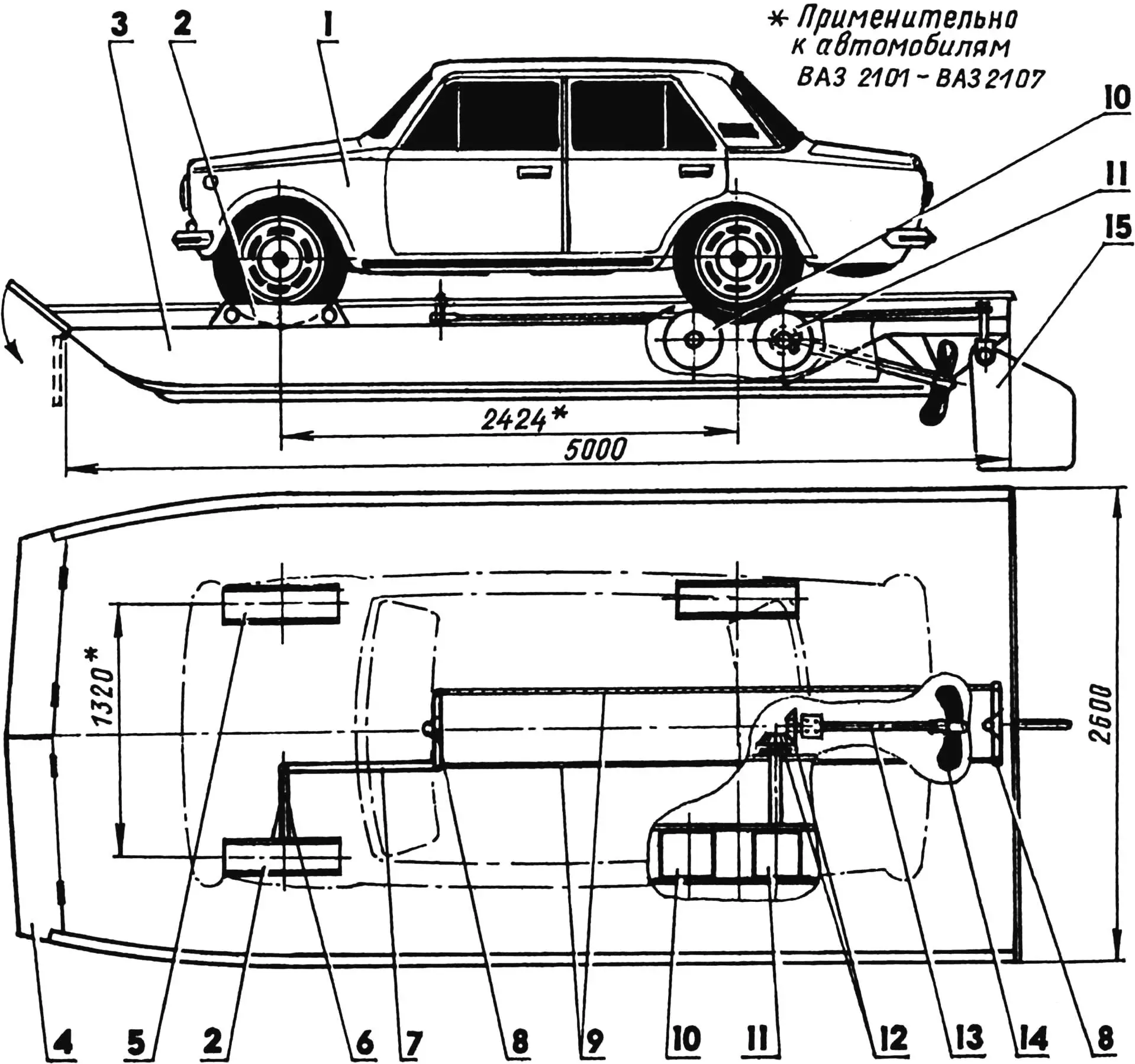
1 — passenger car VAZ-2101; 2,5 — hinged guides for front wheels;
3 — pontoon hull; 4 — wave deflector; 6 — steering drive lever; 7 — steering drive rod; 8 — double-arm levers of steering device; 9 — steering cables;
10 — support drum; 11 — drive drum for propeller drive; 12 — bevel gear pair for propeller drive; 13 — stern tube shaft; 14 — propeller; 15 — rudder blade
On such a pontoon, you can set out on fairly long voyages, though with one essential condition: at the destination point, the shore must be such that you can drive off the pontoon onto it, and then just as easily load back on.
Such a pontoon can be made from practically any available material. It would be good, of course, to weld it from sheet steel, but it’s simpler to assemble a wooden frame structure with plywood sheathing.

1,6 — horizontal frame elements (wooden blocks 40×40); 2 — upper truss flange (board 300×50); 3 — deck sheathing (plywood s5); 4 — stem frame element (block 40×40); 5 — front cross member (block 40×40); 7 — brace (batten 50×25); 8 — lower truss flange (block 50×50); 9 — bottom sheathing (plywood s5); 10 — bottom reinforcement (block 40×40); 11 — overlay (plywood s15); 12 — transom frame element (block 40×40)
The pontoon frame consists of two trusses and six frames. Each truss is assembled from a board 50 mm thick and 300 mm wide and a pair of wooden blocks connected into a single stringer with wooden braces.
After installing the trusses on a simple building frame (for example, on a pair of even boards or beams placed across the pontoon frame), pine blocks with a cross-section of 40×40 mm (horizontal frame elements) are joined to them with lap joints, and then the frame sides, which are connected to the horizontal elements with half-lap joints. Stringers — wooden blocks with a cross-section of 50×30 mm — are fastened on top of the latter with lap joints.
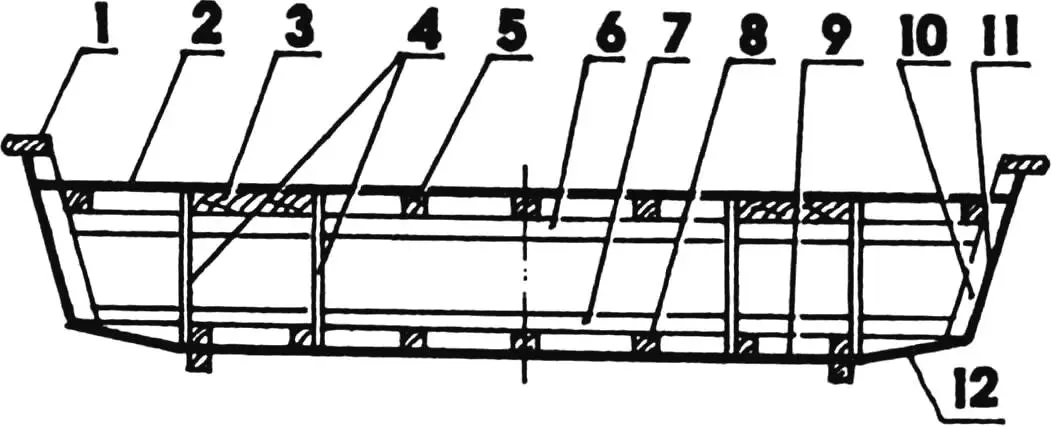
1 — edging (batten 50×25); 2 — deck sheathing (plywood s5); 3 — upper truss flange (board 300×50); 4 — braces (battens 50×25); 5,8 — stringers (blocks 50×40); 6,7 — horizontal frame elements (blocks 40×40); 9 — bottom sheathing (plywood s5); 10 — frame side (block 40×40); 11 — side sheathing (plywood s5); 12 — chine bottom sheathing (plywood s5)
The pontoon sheathing is made of 5 mm thick plywood. First, the flat part of the bottom is sheathed, then the chine parts, then the sides. The next stage is mounting the mechanisms in the pontoon hull: propeller drive drums, bevel gear pair, stern tube shaft and stern tube mounting bracket, as well as turning supports for the front wheels. The pontoon hull is coated inside with waterproof varnish — parquet or “Pinotex” — after which the deck sheathing is mounted (its inner surface is coated with varnish) and the entire hull is primed, puttied, and painted with several layers of waterproof enamel on the outside.
The deck must have hermetically closing hatches for inspecting the interior of the hull, ventilation, and repairs.
It’s unlikely that a completely watertight pontoon hull can be made, so it’s recommended to remove water from places where it can accumulate. This is easily done with an automotive fuel pump driven by a cam on the drive drum shaft.
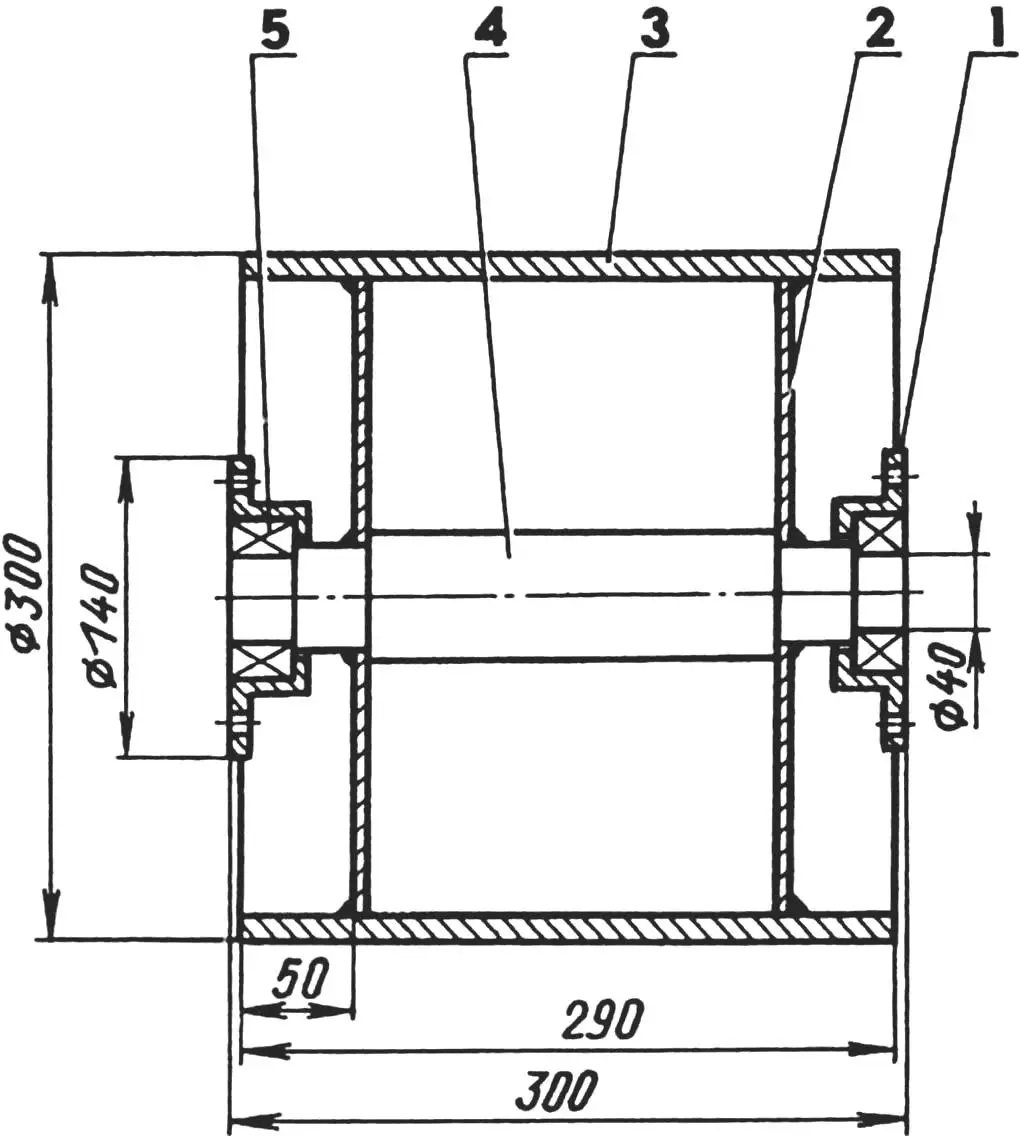
1 — bearing housing; 2 — disk; 3 — drum housing; 4 — shaft; 5 — bearing
The drums themselves are sections of steel pipe with a diameter of 300 mm, in which two steel disks and a stepped shaft are secured by welding. It’s better to select ready-made bearing housings from decommissioned construction or agricultural machinery, as well as a pair of bevel gears for a reducer with a gear ratio of about one.
A hole with a diameter of 34 mm is machined in the stepped shaft of the drive drum — it’s necessary for fixing a rubber coupling through which the torque is transmitted to the bevel pair. The coupling itself is a rubber bushing fitted onto a threaded shank.
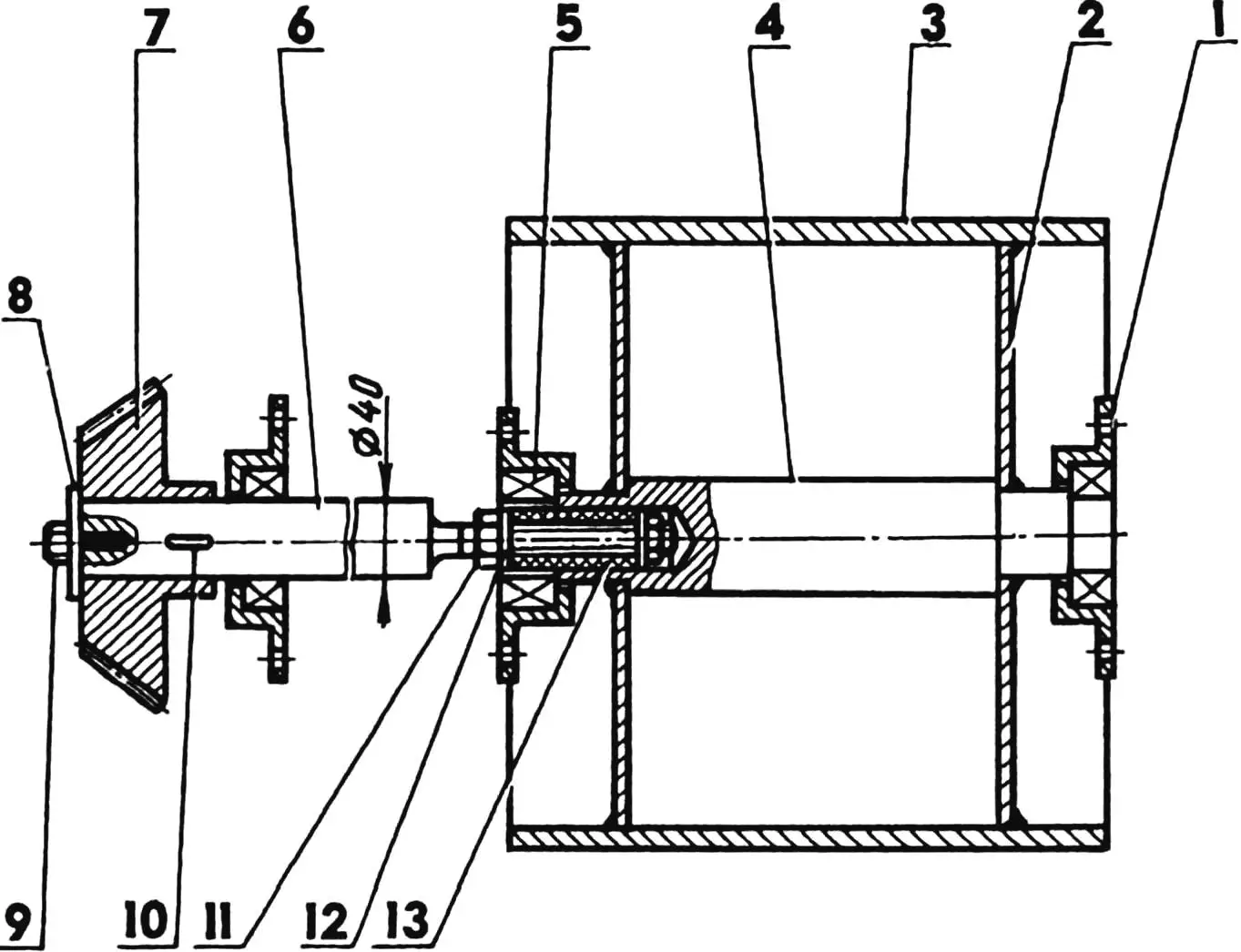
1 — bearing housing; 2 — disk; 3 — drum housing; 4 — shaft; 5 — bearing; 6 — drive shaft; 7 — bevel gear; 8 — fixing washer; 9 — fixing screw; 10 — key; 11 — elastic coupling clamp nut; 12 — washer; 13 — rubber coupling bushing
To fix the drums when loading or unloading the car, stoppers must be provided — steel rods that are inserted into holes drilled in the drum disks.
The steering device consists of two hinged supports, which are assembled based on “Zhiguli” front wheel hubs. Their modification is not complicated: all unnecessary parts are cut off, leaving only the hub bearing housings and the steering knuckle spindles. The bearing housings are fastened to the frame stringers with two 3 mm thick steel rings and bolts, and the guides, cut from suitable channel sections, are fixed with bolts on the spindle flanges.
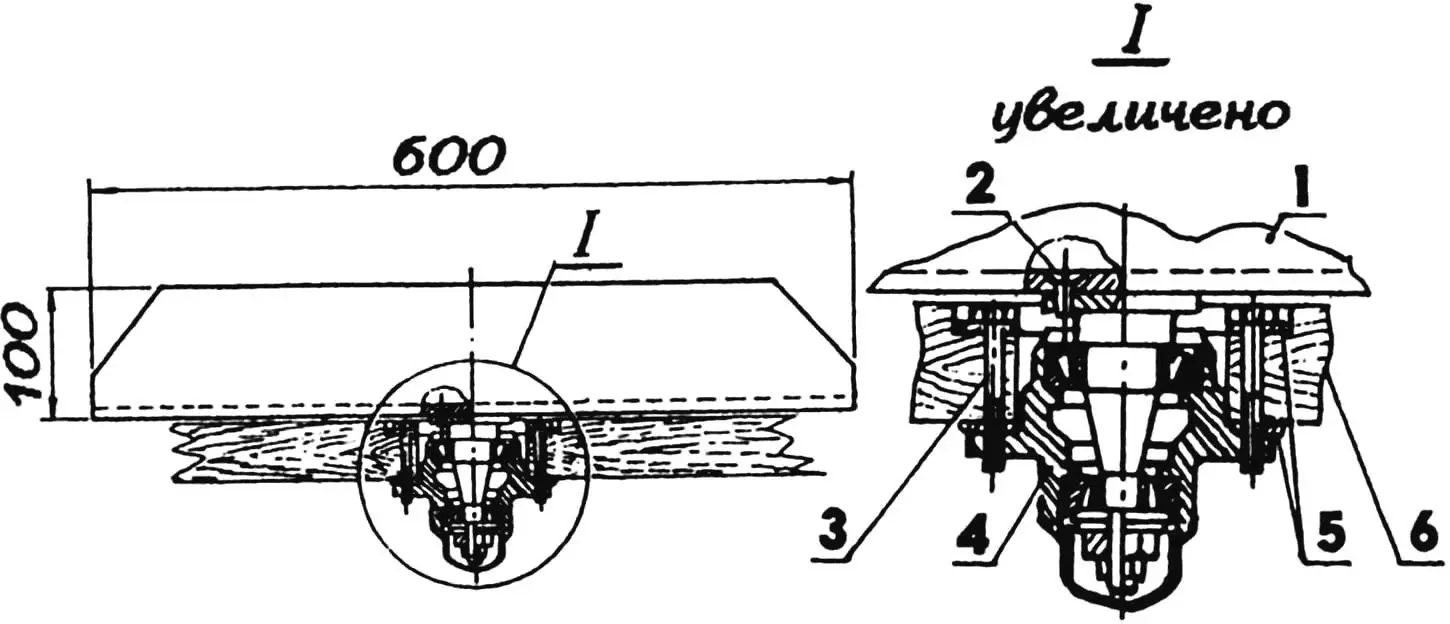
1 — guide (channel 250×100); 2 — guide-to-spindle mounting screw; 3 — hub-to-upper-truss-flange mounting bolt; 4 — hub; 5 — support rings; 6 — upper truss flange
The steering device blade is made of 12 mm thick plywood or 5 mm thick sheet duralumin. The blade is mounted on the steering shaft with a hinge — this makes it possible to avoid breaking it when moving in shallow water. The steering shaft itself is hinged in the gudgeon — a section of steel pipe equipped with bushings made of capron or fluoroplastic.
The steering drive uses a rocker, rigid hinged rod, intermediate double-arm lever, cables with turnbuckles, and an actuating double-arm lever fixed on the steering shaft. The drive kinematics are such that turning the car’s steering wheel to the right causes a right turn of the self-propelled pontoon.
I. MNEVNIK, engineer
Recommend to read
 RADIOPLAYER: HOW TO FIND THE OPTIMUM
Now we can safely say: RC model become the most popular in our country, turning from an object of elite hobby at a relatively affordable hobby for many athletes. The reason for this... “RESUSCITATION” BOOTS
Did not dare to write in a journal until I met a few tips, which at the time he thought of and successfully used. So we are — with a mustache? I am sending your advice on how to repair...
