In recent decades, the world has been experiencing a bicycle boom. Today, the bicycle is the number one means of transport on the planet, and even the car yields the palm: for every four-wheeled vehicle, there are two two-wheeled ones.
A bicycle does not pollute the atmosphere and improves health. The author, formerly an avid motorcyclist and car driver, switched to a bicycle long ago. Every year I “rack up” one and a half to two thousand kilometers and feel excellent!
A regular road bicycle, which I ride, suits me quite well. It is sturdy, easy-running, reliable, and durable. However, all its advantages fade as soon as I climb with it onto a commuter train platform. And in the metro it is even worse: you have to remove the front wheel, but where do you put it, and what do you do with the protruding fork?! Finally, a bulky road bike is also inconvenient in an apartment.
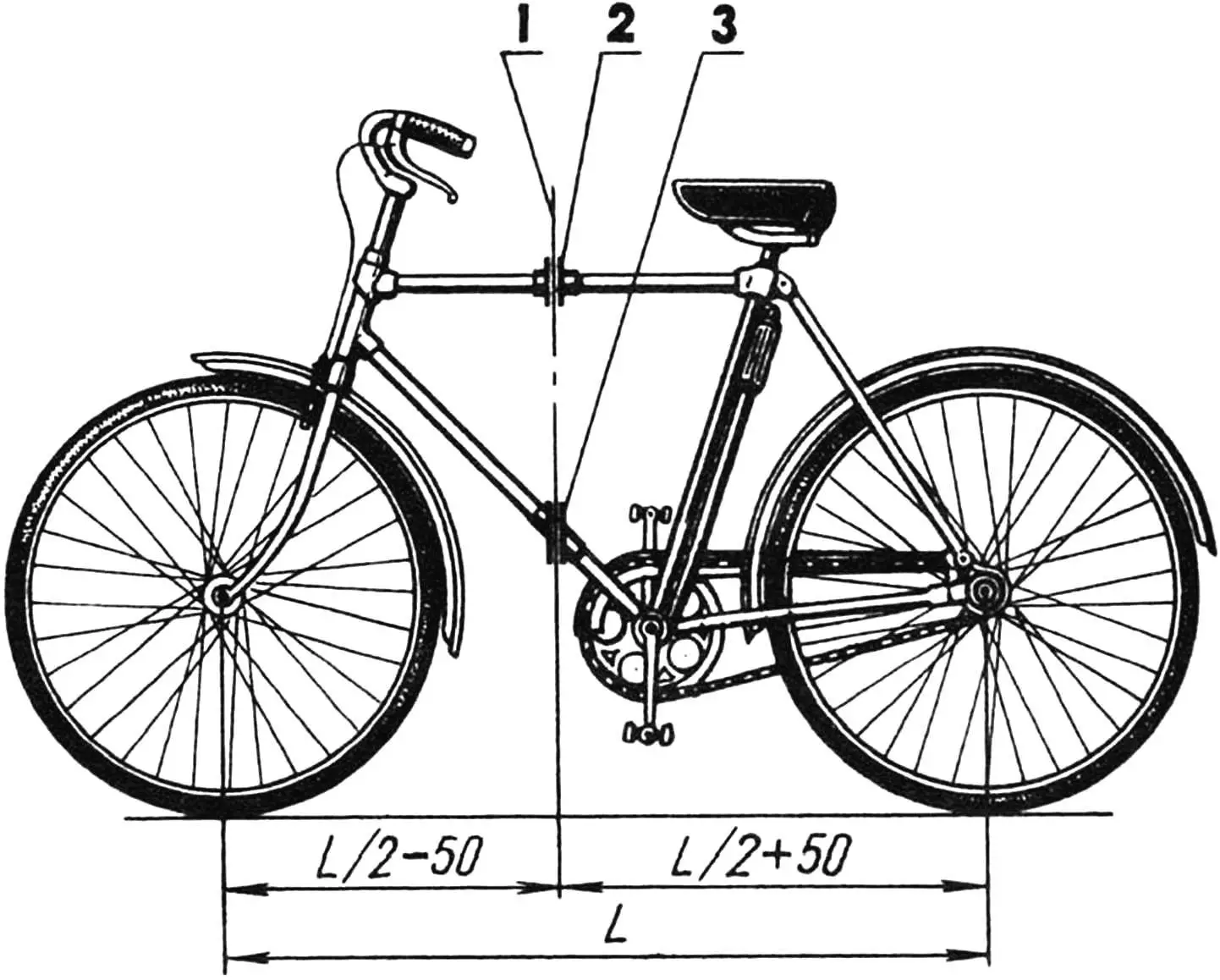
1 — cut line; 2 — upper hinge; 3 — lower hinge.
But you are not going to throw it away! And the thought inevitably crept in: make it a folding frame. The same as, say, the “Kama.”
I reviewed the literature on this topic (including a publication in “M-K” No. 3 for 1990) and remained unsatisfied – the recommended designs were too complicated. I had to develop my own, a simpler one. I tested it and now present it to readers for judgment.
Usually, a folding bicycle has two joints in the vertical plane: one on the horizontal frame tube, the other on the slanted tube. There are many hinge options for such joints. My task was to develop the simplest one. I settled on a loop-type design with a lock in the form of an ordinary bolt and nut, which can always be replaced in case of loss or thread wear.
The design and operation of the hinges are easier to understand from the drawings shown. Of course, even such simple assemblies cannot be made at home, so I ordered them from a workshop that had a lathe and a milling machine. The material for the parts was ordinary structural steel 35.
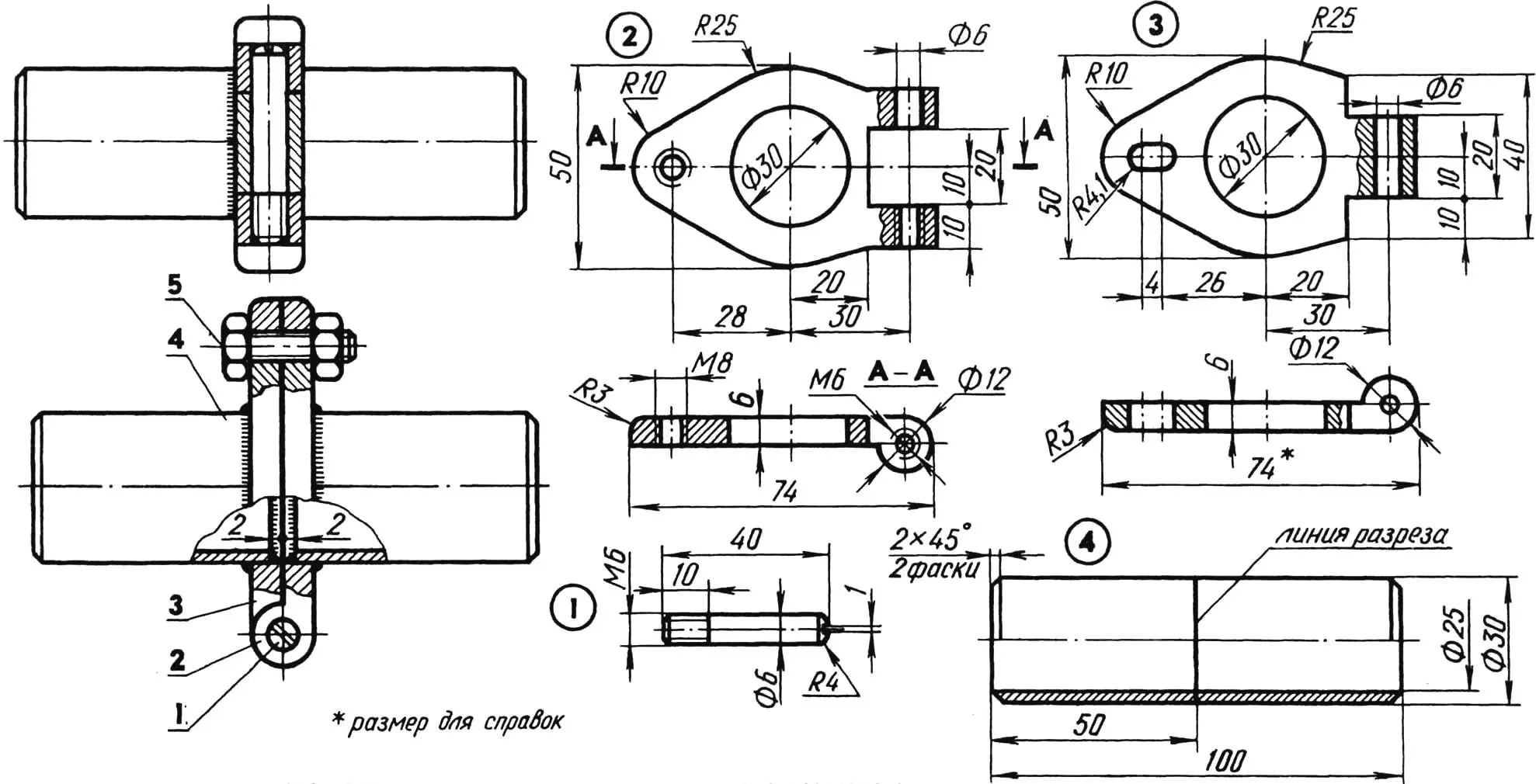
1 — hinge axis; 2 — front cheek plate; 3 — rear cheek plate; 4 — split bushing; 5 — bolt, M8 nut.
While my order was being completed, I modified the frame. Obviously, it is best to fold the bicycle in half. However, if you cut the frame along a line equidistant from the wheel rotation axes, the axes will run into each other and the folded bicycle will not be compact. Therefore, I shifted the cut line by 50 mm toward the handlebar, so that the lower hinge would be farther from the drive sprocket and it would not interfere with the frame folding freely. The hinge design provides folding of the bicycle from left to right (clockwise). In this case, the dirty chain is hidden between the wheels.
I brazed the hinges to the frame with brass using a gas torch. I used borax as a flux. For those who want to simplify this procedure, M6 bolts with nuts can be used instead of brazing. To do this, drill holes in the hinge bushings together with the frame tubes, after first checking that the hinges are installed correctly. Only during operation will you sometimes need to check and tighten the nuts. But if you peen over the protruding bolt ends, there will be nothing to tighten.
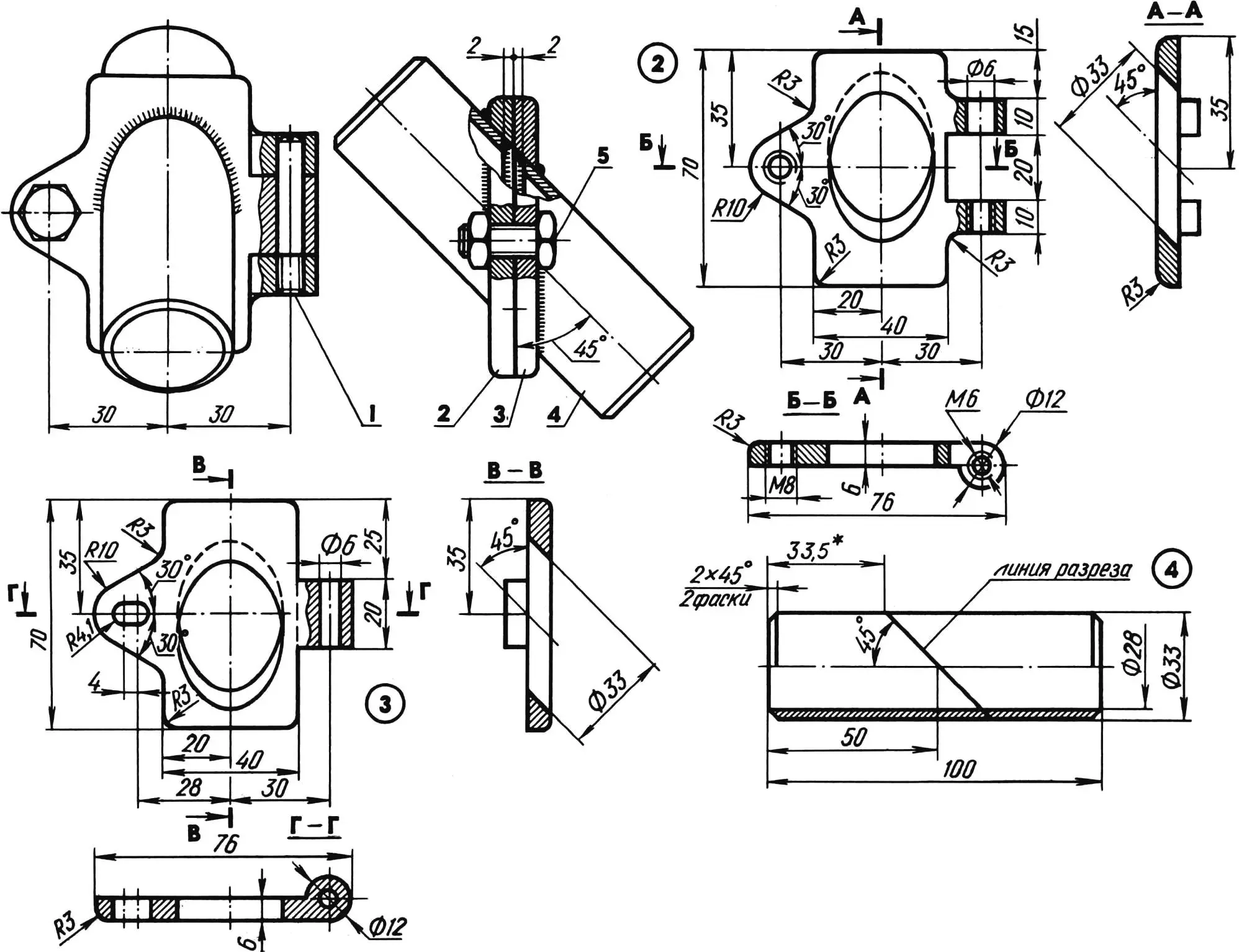
1 — hinge axis; 2 — front cheek plate; 3 — rear cheek plate; 4 — split bushing; 5 — bolt, M8 nut.
My bicycle folds simply: I unscrew two nuts on the hinges, and with a steering movement I move the front wheel clockwise until the frame folds in half. After loosening the fastening nut, I rotate the handlebar by 90°. In this position, I secure the bicycle parts with a strap so they do not spread apart. And I put the hinge nuts back in place so they are not lost.
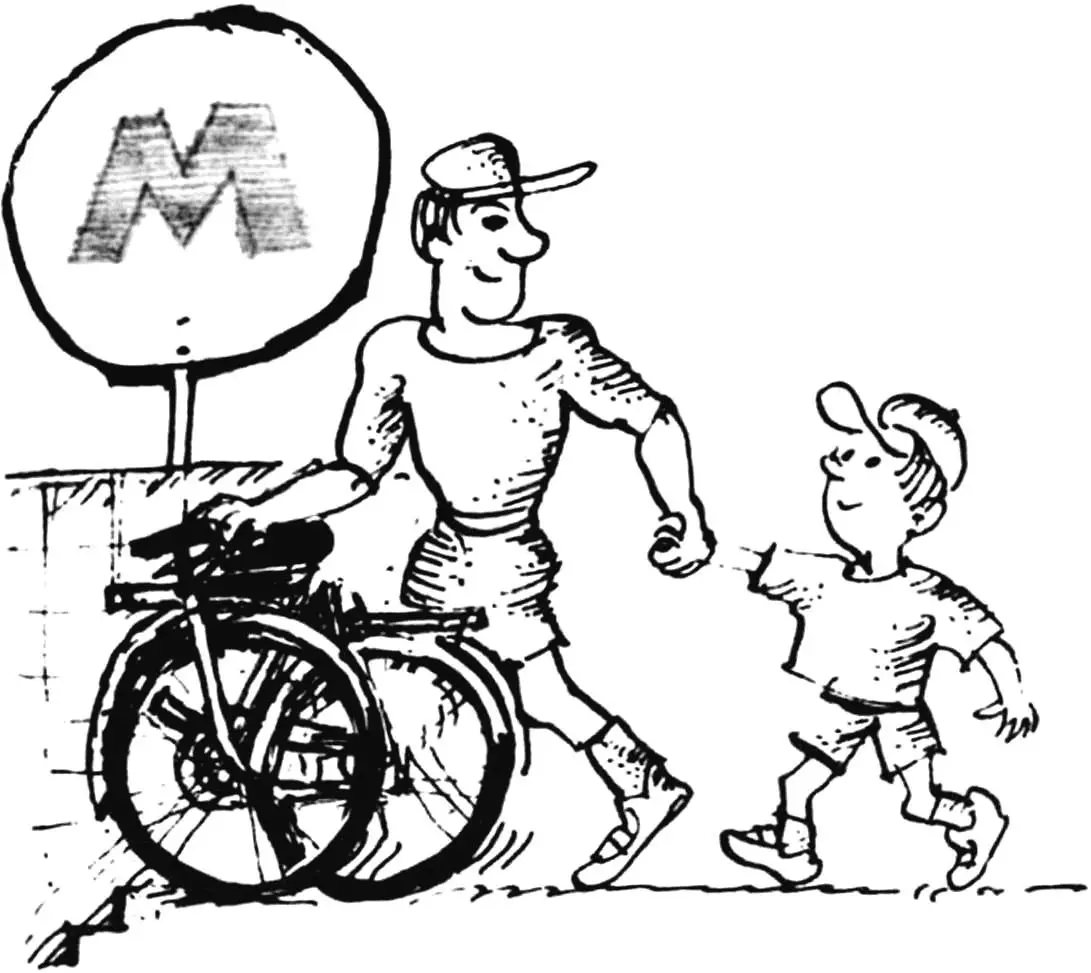
Now I have no problems with my road bike at all. Fold it in half, put it into a dense-fabric cover (no larger than 1×1 m), tighten the tape at the neck – and board the commuter train or go down into the metro. Convenient!
“Modelist-Konstruktor” No. 6’98, N. SHERSHAKOV
Recommend to read
 Kick scooter… for adults
How far can a person travel by pushing off the ground just once? If it is one step — on average less than a metre. If you build up speed and push harder, you can jump about four or five... KAMOV Ka-226
Universal multipurpose coaxial helicopter Ka-226 can be used in the transport, medical, agricultural and patrol variants. The multiplicity of application is provided not by modifying the...
