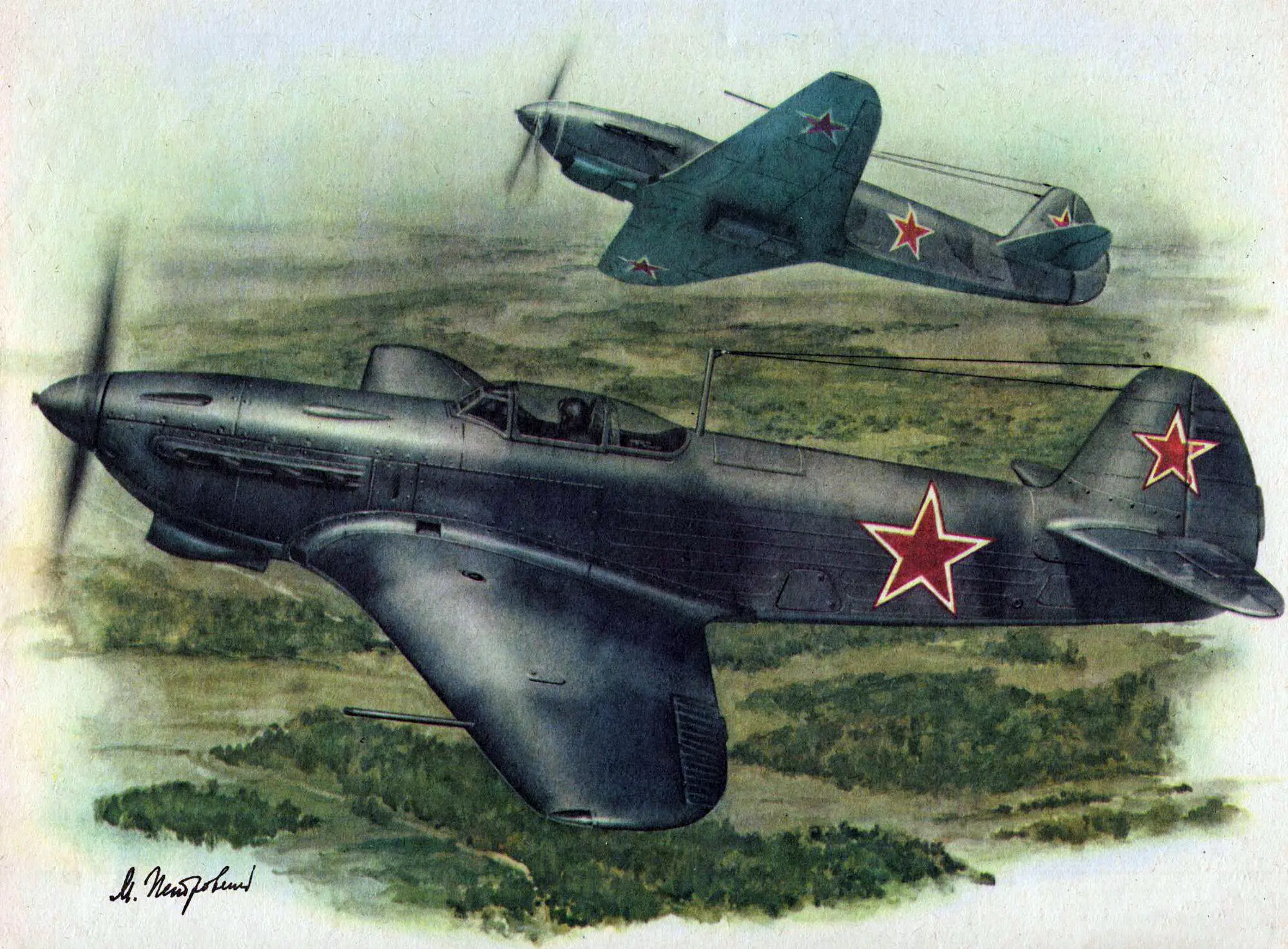
On September 18, 1943, Guards Junior Lieutenants Vladimir Bakulin and Anatoly Pakov took off in two MiG-3s from Murmashi airfield near Murmansk with the mission of photographing the Nazi air base at Luostari. The aircraft quickly reached the target, and the pilots began photographing. But within a few minutes, at an altitude of 5,000 m, the reconnaissance pilots spotted a formation of eight Me-109s. The odds were far too uneven: Pakov’s damaged MiG went down toward the front line, while Bakulin, defending desperately, shot down two Messerschmitts and, seizing the moment, escaped into the clouds in his damaged aircraft.
However, he was unable to land at Murmashi — an enemy bomber raid got in the way. The pilot then headed for an alternate airfield, but, overtaken by four Messerschmitts, he was forced to land in the hills. The pilot was saved — and with him, the invaluable photographic film… The Soviet bomber raid on Luostari was a success.
The idea of using fighters for reconnaissance was born as early as World War I. True, single-seat aircraft made poor reconnaissance planes and were used for that purpose only as a last resort. In those days, a pilot of a still rather unstable and unreliable airplane had to devote most of his attention to the act of flying itself, and there was simply no time left for observing the enemy on the ground: a moment’s distraction — and the aircraft would stall into a spin. Installing a camera on a fighter was not even considered: even the most advanced photographic system of the time required two completely free hands and a mind unoccupied by other concerns for successful use. Moreover, the weight and size of an aerial camera were quite considerable. And although Lieutenant Colonel V. F. Potte, an officer of the Russian army, had already invented a semi-automatic aerial camera, the time of single-seat reconnaissance aircraft had not yet come.
For many years, design thinking focused on improving two-seat reconnaissance aircraft. They became ever faster and more maneuverable; their armament was strengthened and their equipment improved. But neither designers nor military strategists even attempted to adapt a fighter for reconnaissance on the eve of World War II. Although compared with the machines of 1914 the new fighters had become considerably more complex, they were much simpler to fly. Such an aircraft could already be flown without looking at the instrument panel, with attention focused on searching for ground targets. And the camera had become so much lighter and smaller that it could easily be installed on a standard fighter with virtually no loss of flight performance. To operate the camera, one needed only to press a button.
And another important innovation appeared on fighters in the late 1930s — a radio set that provided stable and reliable communication with the ground command post. Moreover, the pilot himself, without an additional crew member, could dictate the coordinates of detected enemy objects by pressing a button on the throttle with his left hand.
Despite the fact that in the 1930s reconnaissance aircraft were being developed in almost every aviation design bureau and quite a few were built, at the beginning of the war our Air Force had no specialized reconnaissance aircraft. Life itself forced the conversion of single-seat fighters into short-range tactical reconnaissance planes. “Our regiment was assigned the task of photographing the Blue Line,” recalled Hero of the Soviet Union Lieutenant General of Aviation G. R. Pavlov. “Guards Warrant Officer G. Petrosyan took charge of preparing the equipment. We equipped three Yak-1 aircraft. The guardsmen flew about 70 reconnaissance sorties in them, losing one Yak to enemy anti-aircraft fire.”
In the course of hostilities, operational tactical air reconnaissance was given ever greater importance. Thus, in the Battle of Moscow reconnaissance flights accounted for about 3% of all combat sorties; at Stalingrad already about 10%; on the Kursk Bulge more than 30%; and in the final operations of the Great Patriotic War — over 40%. Accordingly, fighters were “rechristened” as reconnaissance aircraft no longer one by one, but by whole squadrons and regiments…
In early 1943, the 50th Fighter Regiment of the 15th Air Army received reinforcements, exchanged its patched and re-patched MiG-3s for brand-new La-5s, arrived at the front-line airfield of Prokhodnoye in the Kursk Bulge area, and there the pilots learned that by order of the front commander their regiment would henceforth be a reconnaissance unit. The news was met without enthusiasm: the young pilots were eager for combat, and here… “photographing ground landscapes.” But soon their attitude to the sorties changed completely, because situations of the “eight of them, two of us” type arose for reconnaissance pilots far more often than for true fighter pilots.
Nevertheless, excellent maneuverability, high speed, and powerful cannons served as good protection for fighter-reconnaissance aircraft against aerial opponents. And already in 1942–1943 the experience of using fighters for short-range tactical reconnaissance became widespread. Reconnaissance was conducted in both fair and adverse weather, visually and with aerial cameras. Since series production of the Yak-9R reconnaissance aircraft — which differed from the standard Yak-9 only in having an AFA aerial camera on board — was established only in 1944, the conversion of fighters into reconnaissance aircraft was carried out by airfield mechanics. As is well known, when the two-seat Yak-7 was modified into the single-seat Yak-7A and then into the Yak-9, a spacious compartment formed behind the pilot’s cockpit, which was often used during redeployment to transport a mechanic. It was into this compartment that the camera was installed. But the inventiveness of airfield mechanics went even further…
“One day Senior Lieutenant Komarov, a technician, came to me,” recalled Colonel General of Aviation V. I. Voronov. “‘Commander, I’ve got an idea to expand the Yak-9’s photographic capability. Instead of one camera in the cargo compartment, we should install two AFA-I cameras. That will almost double the coverage of a single pass.’ — ‘Tempting, but will two cameras fit?’ For two days the technicians worked tirelessly to realize their plan. And then the installation was ready. For the test I decided to photograph our airfield, which is quite large. A few hours later we were examining with interest a mosaic put together so skillfully that no flaws or differences from aerial photography done with a single camera could be found. The front-line mechanic’s invention became known to the command. His dedicated work and ingenuity were recognized with the Order of the Red Star.”
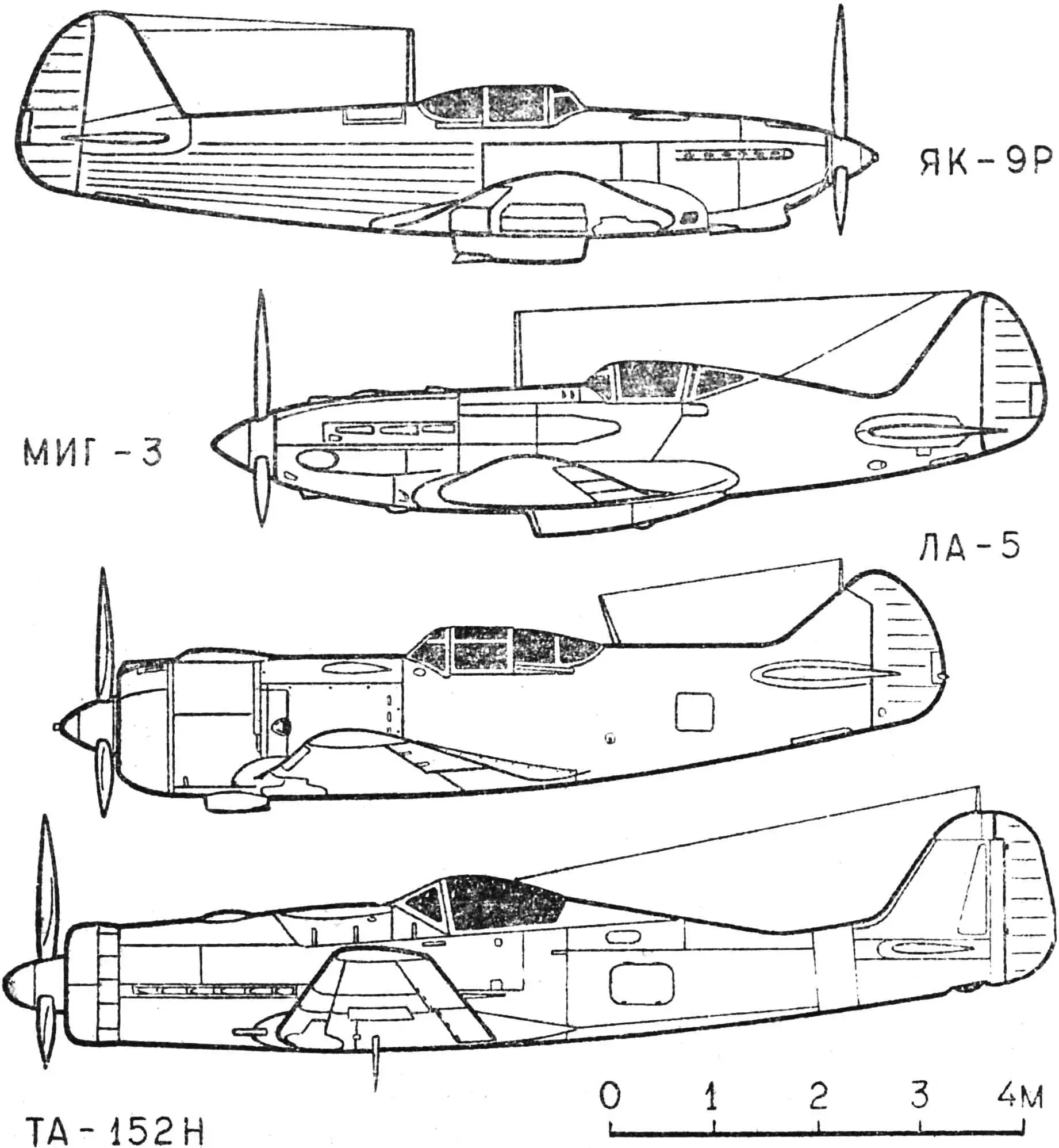
BASIC DATA ON SOME FIGHTERS USED AS RECONNAISSANCE AIRCRAFT
| Yak-9R, USSR | MiG-3, USSR | La-5, USSR | Ta-152H, Germany | |
|---|---|---|---|---|
| Year of production | 1944 | 1941 | 1942 | 1944 |
| Engine power, hp | 1250 | 1200 | 1700 | 1750 |
| Wingspan, m | 9.74 | 10.2 | 9.8 | 14.82 |
| Aircraft length, m | 8.5 | 8.25 | 8.67 | 10.34 |
| Wing area, m² | 17.15 | 17.44 | 17.42 | 23.5 |
| Takeoff weight, kg | 2900 | 3500 | 3360 | 4780 |
| Empty weight, kg | 2300 | 2655 | 2681 | 3920 |
| Maximum speed, km/h / at altitude, m | 590 / 3950 | 615 / 7800 | 580 / 6250 | 760 / 12,500 |
| Maximum speed at ground level, km/h | 505 | 466 | 509 | 557 |
| Time to climb to 5,000 m, min | 5.4 | 7.1 | 6.0 | — |
| Ceiling, m | 9800 | 10,600 | 9500 | 12,500 |
| Range, km | 950 | 820 | 1190 | 2000 |
| Armament | ||||
| cannons × caliber, mm | 1×20 | — | 2×20 | 1×30, 2×20 |
| machine guns × caliber, mm | 1×12.7 | 1×12.7, 2×7.62 | — | 2×13 |
| bombs, kg | — | 200 | — | — |
Two cameras made it possible to photograph a large area in a single pass, so the aircraft could spend less time in the zone of intense enemy anti-aircraft fire, sharply reducing the probability of being hit. However, combat experience with front-line reconnaissance aircraft showed that a more effective means of protection could be flying at very high altitudes beyond the reach of anti-aircraft shells and fighters. For a long time the technical difficulties in creating a high-altitude reconnaissance aircraft seemed insurmountable. Only in 1943–1944 did the first twin-engine high-altitude reconnaissance aircraft appear in Britain, Germany, and the United States. And by the end of the war, when Soviet fighters had overwhelming air superiority, single-engine German fighter-reconnaissance aircraft also had to climb to high altitudes.
In 1944, Focke-Wulf’s chief designer Kurt Tank developed a reconnaissance modification of the single-engine Fw 190 fighter under the designation Ta-152H. Tank’s reconnaissance aircraft had a high-aspect-ratio wing, a pressurized cabin, and a high-altitude engine. Moreover, the engine was fitted with special devices for injecting nitrous oxide and a water-alcohol mixture. Thanks to this, the aircraft could fly at altitudes up to 12,500 m at speeds up to 760 km/h. Although the Ta-152H was beyond the reach of Soviet fighters, this could no longer influence the course of the war.
In the postwar years the concept of using single-seat fighter-reconnaissance aircraft did not lose its importance, and today virtually all series fighters also have reconnaissance variants.
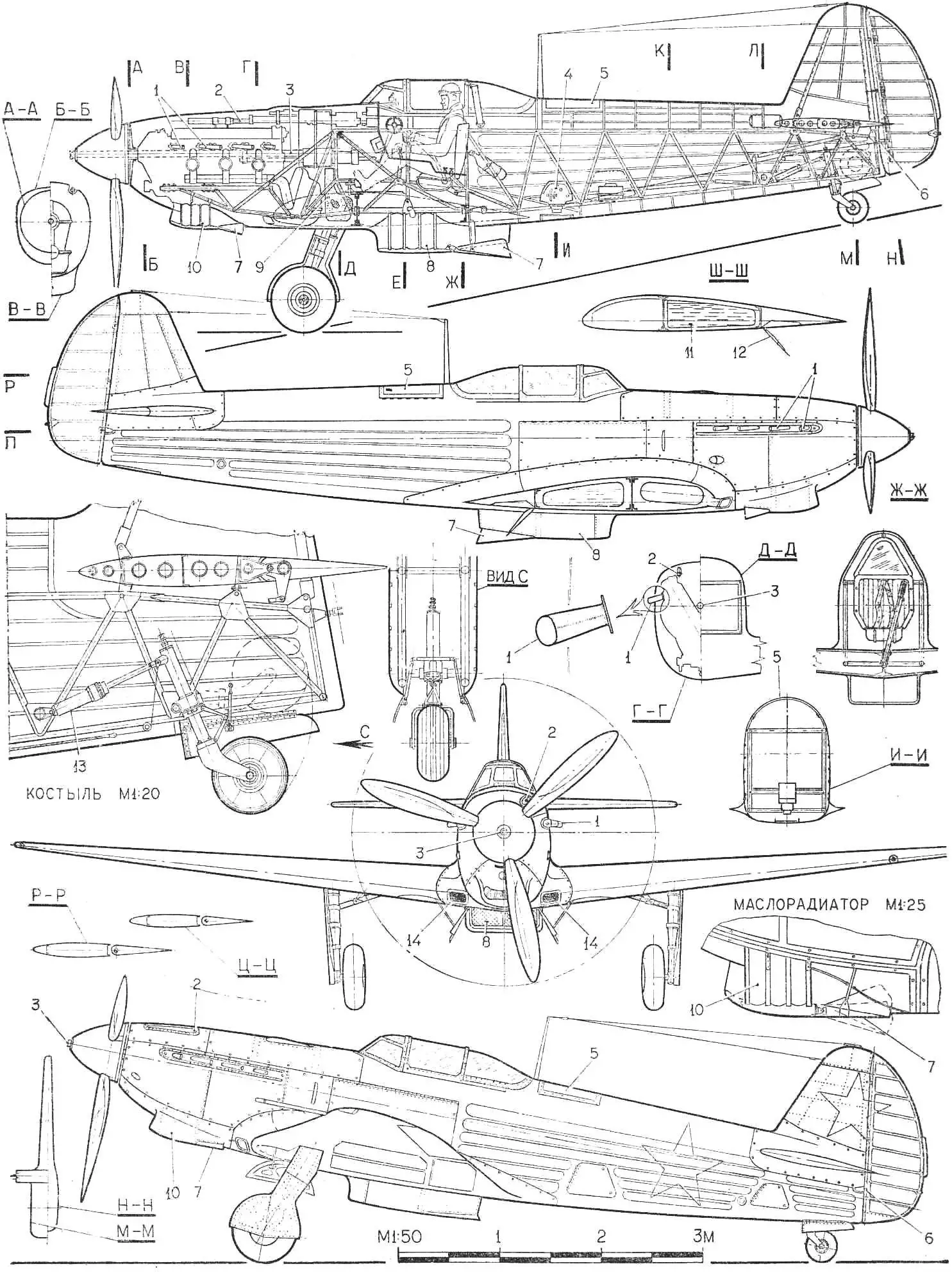
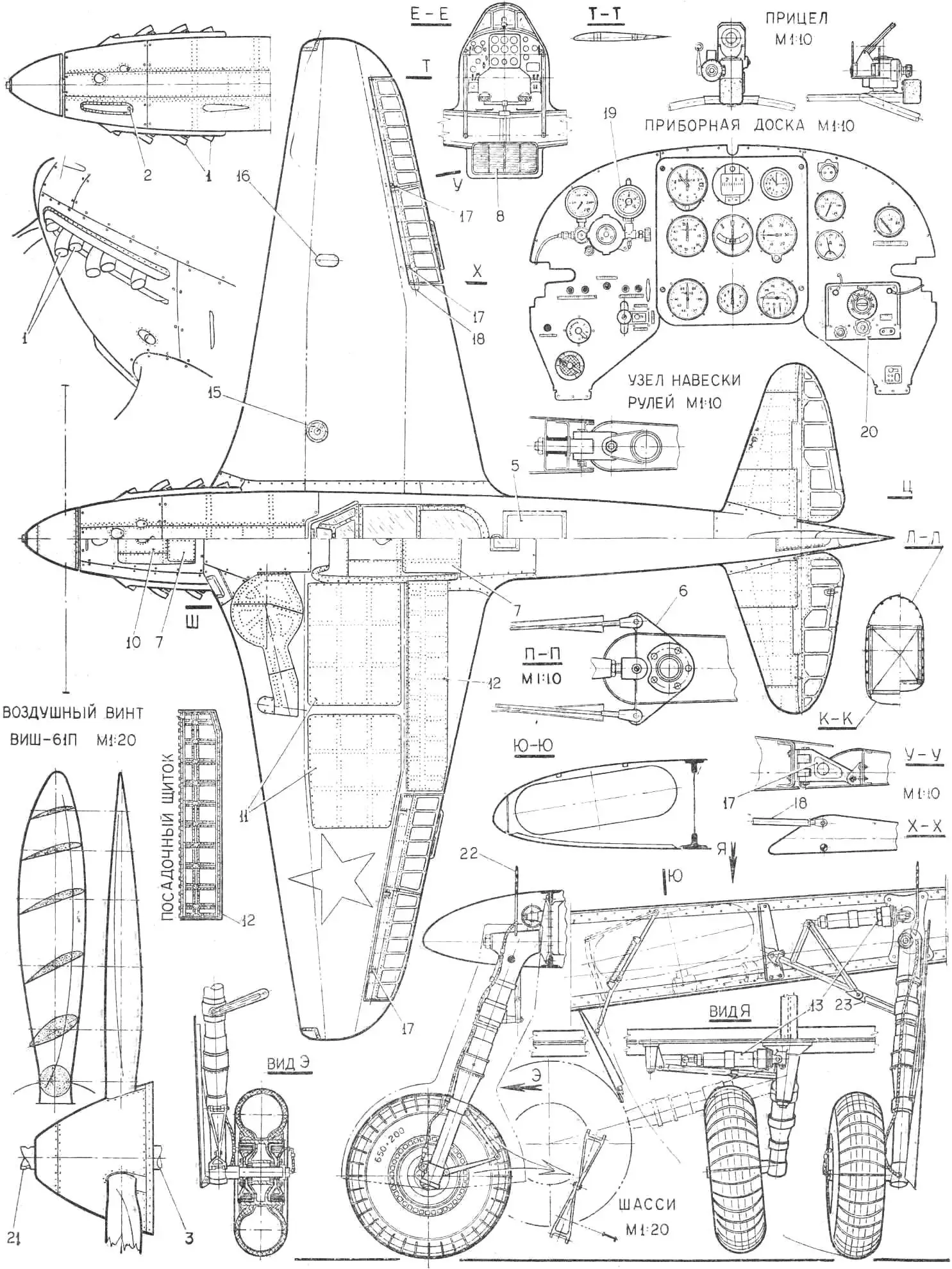
Yak-9R fighter-reconnaissance aircraft
The Yak-9 and Yak-9R are further developments of the Yak-1 and Yak-7 fighters. The main structural difference of the Yak-9 is metal wing spars instead of the wooden ones on the Yak-1 and Yak-7. Replacing wood with metal was necessitated by the need to substantially increase the internal volume of the wing for fuel tanks. This innovation was first applied on the Yak-7DI (long-range fighter). At the same time, tank capacity was increased by more than 200 liters, and the wing became 150 kg lighter. Accordingly, range increased by about 200 km. When put into series production, the Yak-7DI was designated Yak-9.
The wing skin on the “nine” remained plywood; the wing leading edges, which had a rather complex shape, were first made on a wooden form, and then the entire skin was glued to special plywood pads fixed to the metal spar flanges with rivets. The two-spar wing consisted of two detachable panels joined along the aircraft centerline. The tanks were located between the wing spars, secured with steel straps, and covered with duralumin panels. When retracted, the landing gear struts folded into the wing leading edge along the span.
The ailerons, like the control surfaces, were of metal construction with fabric covering. The wing was fitted with a flap that deflected 50° for landing. According to veteran pilots, the flap was sometimes also used in aerial combat, although this was not provided for in the instructions. A slight deflection of the flap increased the wing’s lift coefficient and accordingly reduced the turning radius.
The fin and stabilizer of the Yak-9 were all-metal, of duralumin; the fuselage was a steel truss. The rear fuselage was fabric-covered; the nose was enclosed by large easily removable cowling panels that provided good access, when needed, to equipment in the fuselage. Behind the pilot’s cockpit the Yak-9 had a large free compartment used to carry a mechanic and ground equipment during redeployment. It was in this compartment that the AFA-I camera was installed on the Yak-9R.
The Yak-9R powerplant consisted of a 12-cylinder V-type liquid-cooled M-105PF engine with a three-blade metal VISH-105SV constant-speed propeller. The armament of the Yak-9R fighter-reconnaissance aircraft comprised a 20 mm ShVAK cannon firing through the hollow propeller shaft and a synchronized 12.7 mm UB machine gun mounted above the engine.
“M-K” 10’87, V. KONDRATYEV, engineer
Recommend to read
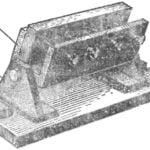 SWIVEL CLAMP
Designed for parts that are in processing it is necessary to fix in an inclined position. Clip design is simple: to steel base welded corners-brackets; on a coaxial screw-clamps rotated... AND DUST IS NOT TERRIBLE
Dust and dirt is, perhaps, the main enemies of nodes of the bike. Particularly affected by these uninvited abrasives bearings of the carriage. To significantly increase sroi their...
