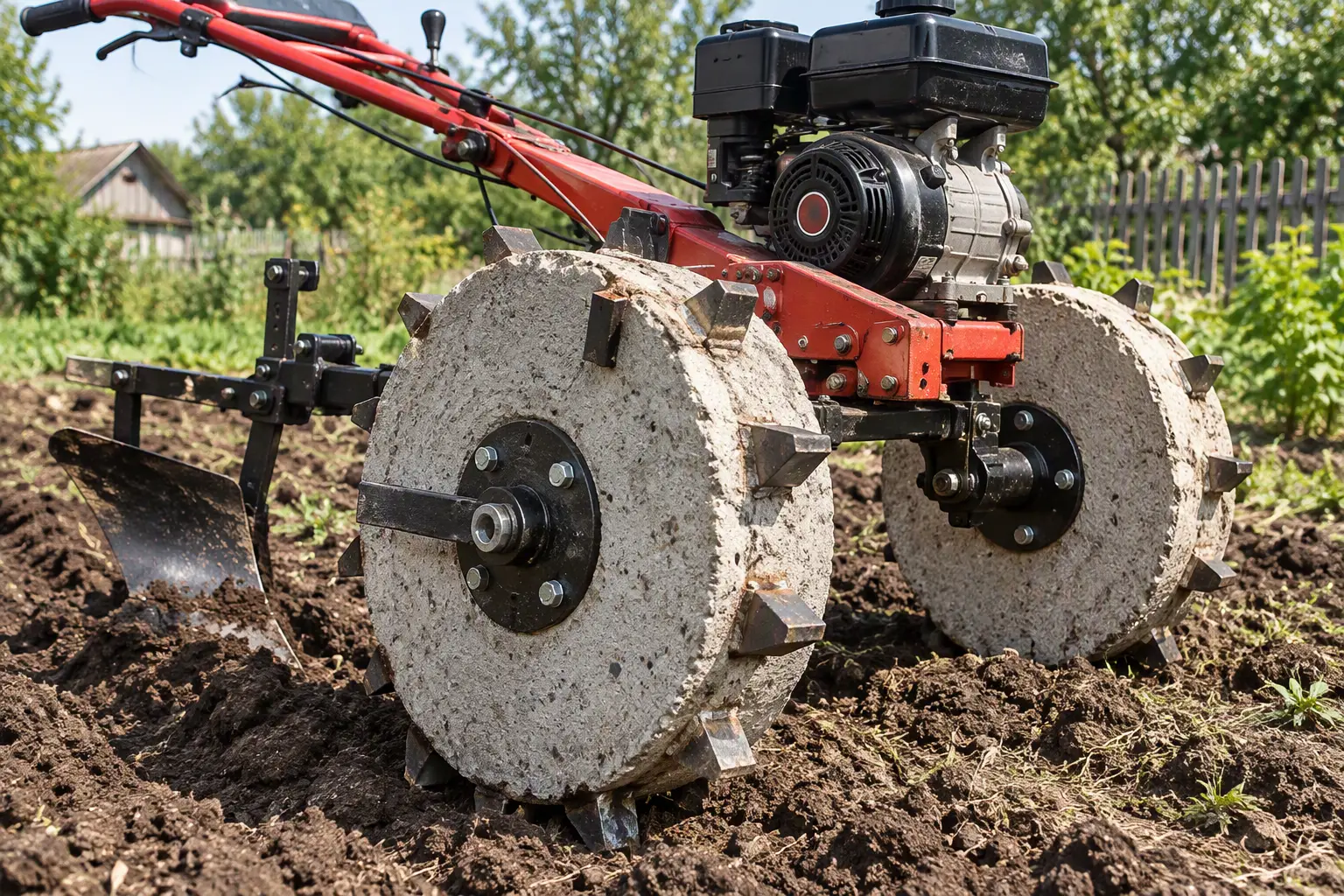
Small tillers with a rotary cutter as the working tool fare well: biting into the soil with their rotating blades, the cutter not only loosens the ground but also helps the tiller move forward, as if pushing it along.
A motor plow is another matter: the share that cuts and turns over a furrow of soil inevitably brakes, resisting the tiller’s motion, and its wheels start spinning in place. Attempts to fix this by hanging on extra ballast do more to hinder the work than to help it.
Hungarian craftsmen offer an original way to solve this problem: instead of ballast weights, replace the rubber tires with… concrete ones.
As can be seen from the diagram in the magazine “Ezermester”, such a wheel consists of two main elements: a metal rim with lugs and a concrete ring insert fitted into it.
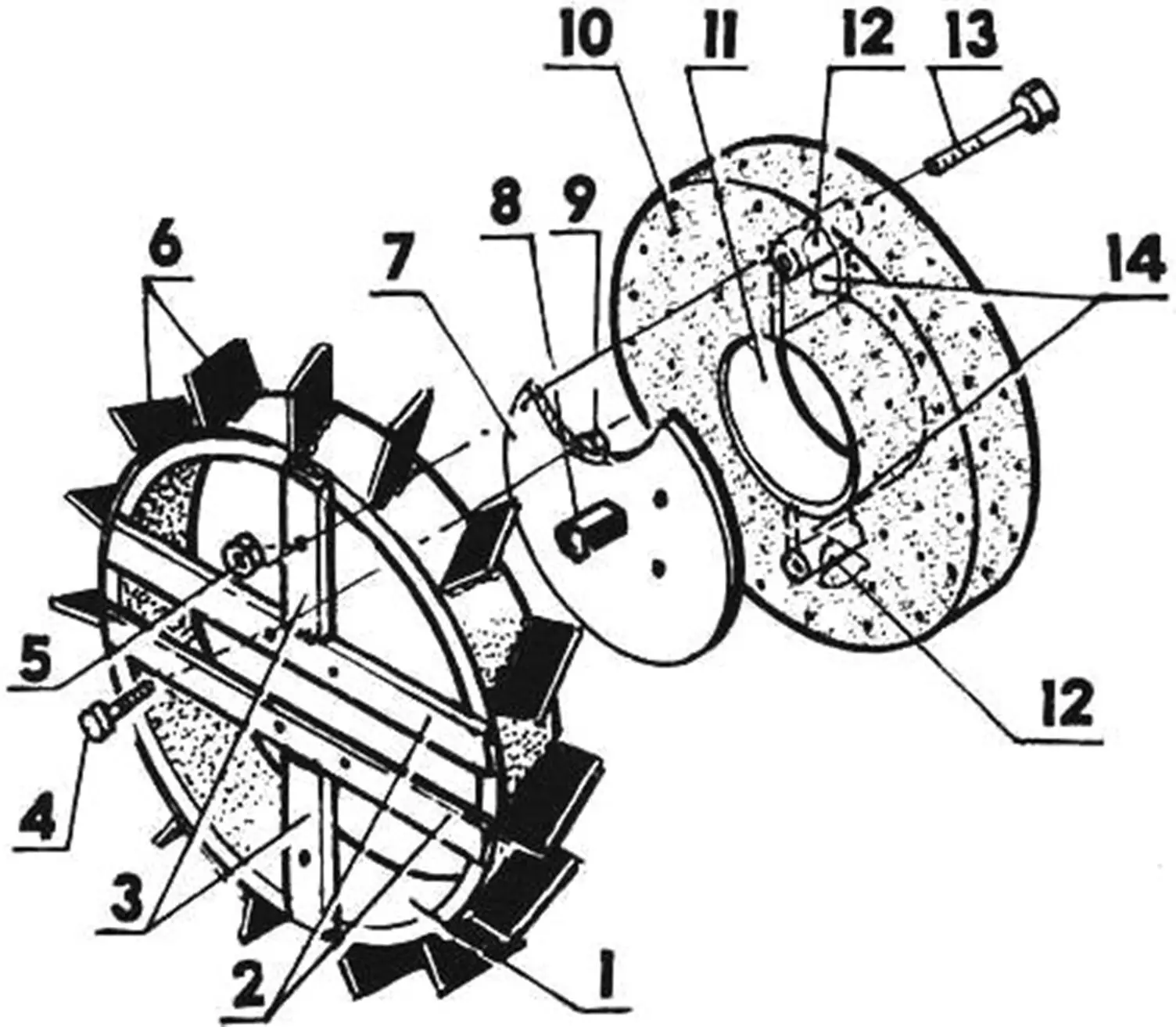
1 — rim (steel, strip 3×130); 2 — spokes (steel, strip 3×60); 3 — braces (steel, strip 3×60); 4,9 — hub mounting (M8 bolt with nut); 5,13 — concrete ballast washer mounting (M8 bolt with nut); 6 — lugs (steel, strip 3×130); 7 — hub (steel disc s5); 8 — tiller axle bushing; 10 — ballast washer (concrete); 11 — ballast washer cup (steel, sheet s5); 12 — ballast washer mounting guide; 14 — brackets for the ballast washer guides
Let us look at these components in more detail.
Rim
To make it you will need metal strips and a welding machine.
The rim itself is a ring about 400 mm in diameter, welded from a steel strip 3–4 mm thick and 130 mm wide. Plates — lugs made of the same steel strip — are welded to the outer surface of the ring; their height is about 40 mm.
The radial stiffness the rim needs is provided by braces welded on the side from steel strips of the same thickness as the rim ring. They are arranged crosswise and have holes for fasteners to attach the concrete insert and an intermediate disc for the tiller axle.
Disc
As already noted, it is intended for mounting the wheel on the axle; for this purpose a steel bushing is welded to one side of it, turning the disc into a kind of hub.
The disc is cut from 5 mm steel sheet; holes are drilled in it for bolting it to the rim’s cross braces.
Insert
It is cast from concrete separately, using any suitable mold (for example a basin, metal or plastic). For reliable mounting, the insert has a metal core: a length of pipe with bushings for fasteners welded to it on plate legs. The core is placed in the mold when the concrete mix is poured in.
The mix is prepared from cement and sand with crushed stone added. The mix is made in the proportion 1:2:3, where one part by volume of cement takes two parts of crushed stone and three parts of sand.
To get a good mortar, first mix the measured amounts of cement and sand thoroughly in a container or simply on a sheet of tin or plywood (on which a mound is made with a hollow in the middle for water). Water is added gradually, again mixing thoroughly, until a thick mortar forms — plastic enough, but not runny. Then crushed stone is added, mixing thoroughly again and adding water if needed.
The finished mix is placed in the mold and left until the concrete has properly set (about three to seven days), occasionally wetting the surface to avoid cracking. For the same reason the mold can be covered with film.
Assembly
When all the wheel parts are ready, it remains only to join them with bolts and nuts. The sequence is simple: first the hub disc is fastened to the rim’s cross braces, then the concrete insert itself is fastened into its seats on the same cross braces.
With such wheels the tiller will not spin even on freshly plowed ground.
«Моделист-конструктор» № 1’2005
Recommend to read
 JEEP-THE FARMER
Such a "tractor" configuration of the machine selected for purely practical reasons, dictated by life itself: the farm was necessary and a tractor, and a SUV, and I decided to combine... A Washing Machine… Made from a Bucket
When my second child was born, we once again faced the problem of washing diapers, baby undershirts, and romper suits. Wash by hand? Long and tedious. Wash in a large washing machine? That...
