
On a summer cottage plot in bad weather you can take shelter indoors.
However, even on a sunny day you sometimes want to hide — from the scorching rays. And if there are no large trees on the plot that would provide welcome shade, you don’t have to build a solid permanent gazebo, as is often done. You can set up a rest area with simple awnings, like those shown in the drawings. It is not at all difficult to find such affordable designs that will not only provide relief from the heat but also beautify the plot.
Here is the simplest canopy on four supports, covering a small area paved with concrete slabs or linoleum or relin sheets. Such an airy gazebo is good in that it does not require much labour or materials to build, and will serve no worse than a permanent one, with many advantages over the latter. Above all — it is extremely easy to make yourself. Eight wooden poles or lengths of pipe — and you have a lightweight frame consisting of four posts and an upper frame for a tensioned awning.
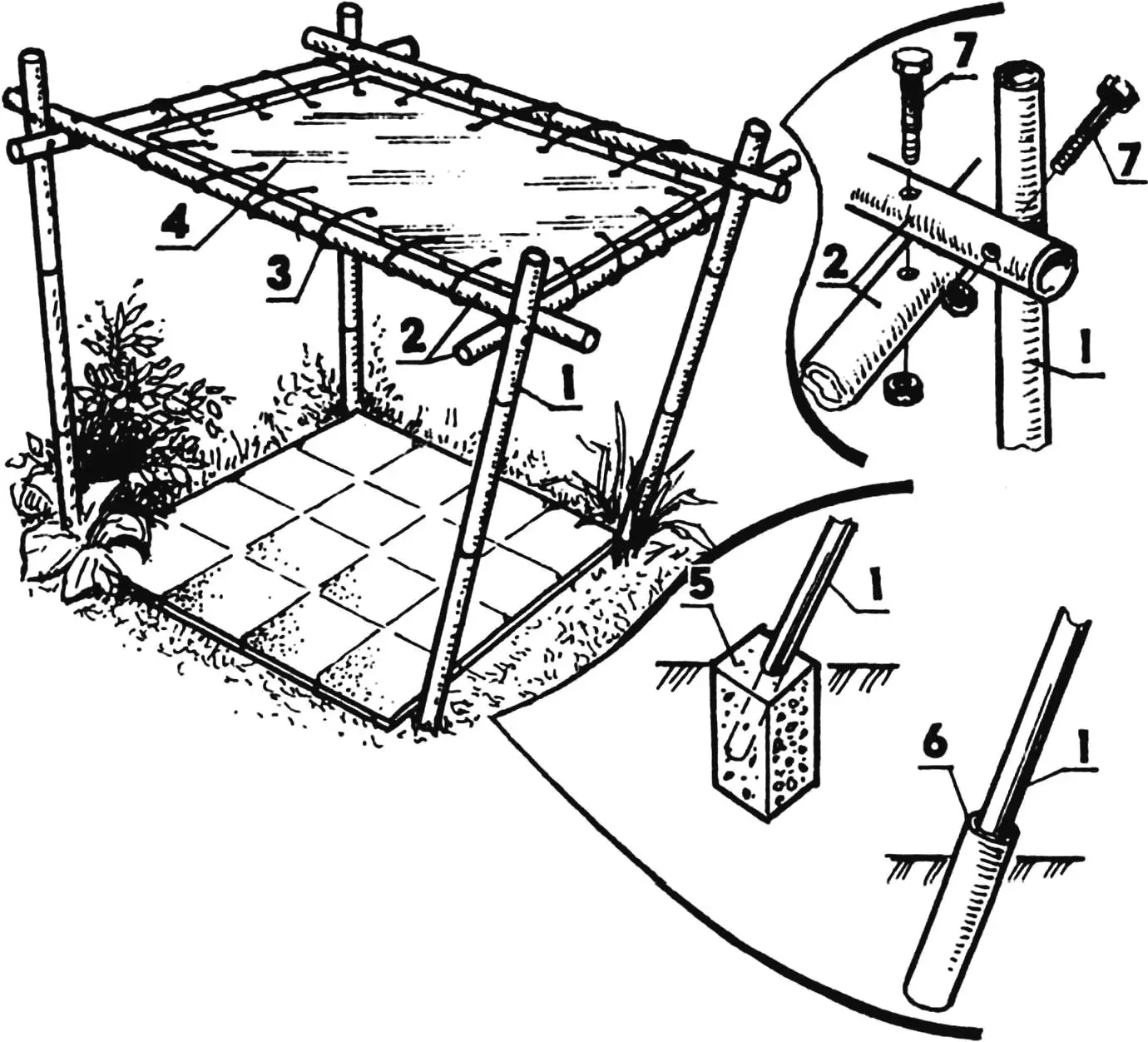
1 — posts; 2 — roof frame elements; 3 — cord for awning tension; 4 — awning; 5 — concrete post base; 6 — tubular post base; 7 — gazebo frame mounting bolts
Posts and frame elements are connected with suitable bolts and nuts. Post fixing can be simplified, as plain embedment in the soil, or with rubble stone and concrete infill. A demountable version is also possible. Its base will be lengths of pipe fixed in the ground, into which the posts are simply inserted at the start of the season and removed for the winter for better preservation.
Various materials can be used for the awning — from oilcloth to curtain or upholstery fabric. Rows of holes are made along the edges, a cord is passed through them, and the awning is tensioned onto the upper frame with it.
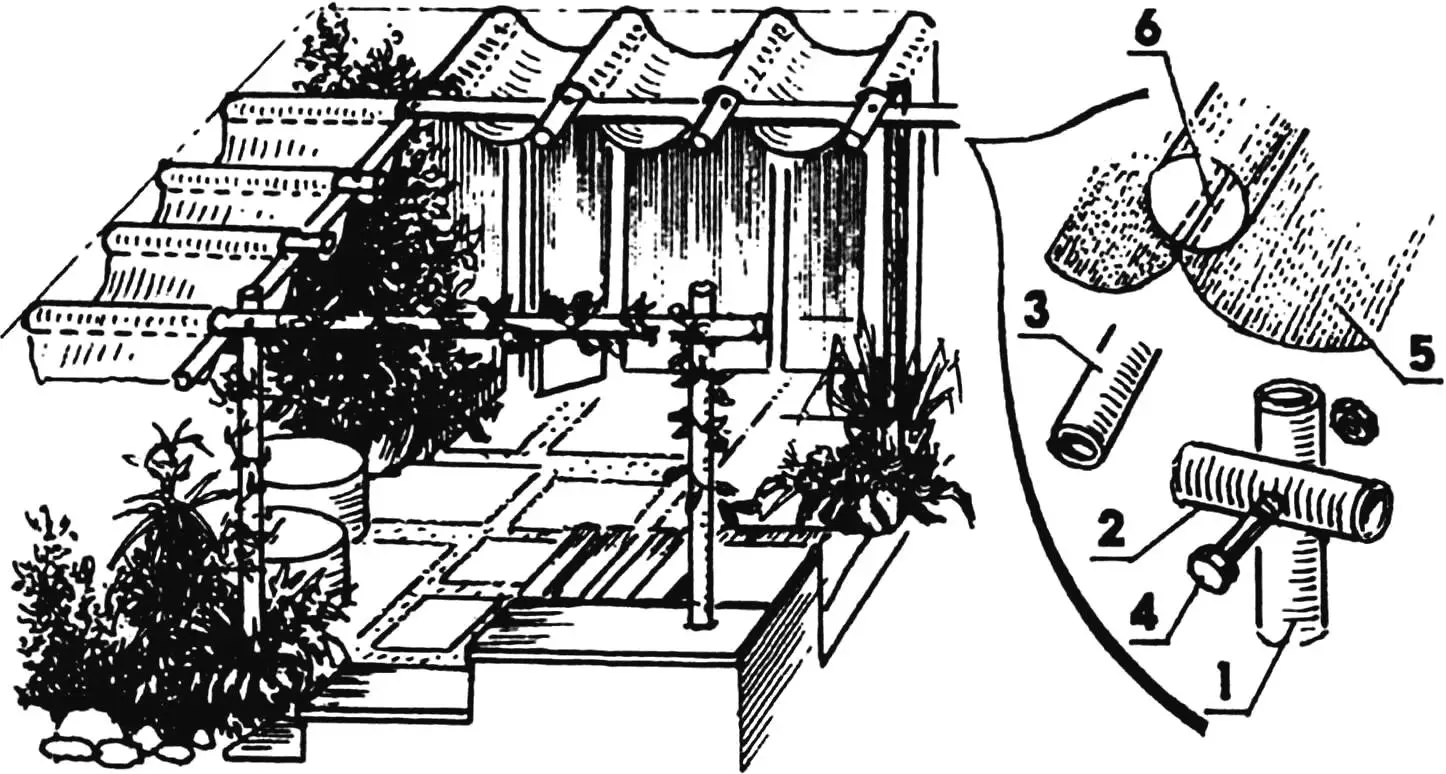
1 — post; 2 — purlin; 3 — crosspiece; 4 — canopy frame mounting bolt; 5 — awning; 6 — batten pocket seam
A canopy arranged against the house wall can also act as a shaded terrace. This requires several posts made from poles and the same horizontal purlins with sparse crosspieces. This structure is enough to drape suitable panels on top, for example matte film used for greenhouses, or fabric “runners”, if denser shading is needed. The panels need not be tensioned — fixed only at the ends, they may sag if the canopy is on the lee side. For greater reliability, however, it is better to sew batten pockets on the panel beforehand for crosspieces laid on the canopy roof purlins.
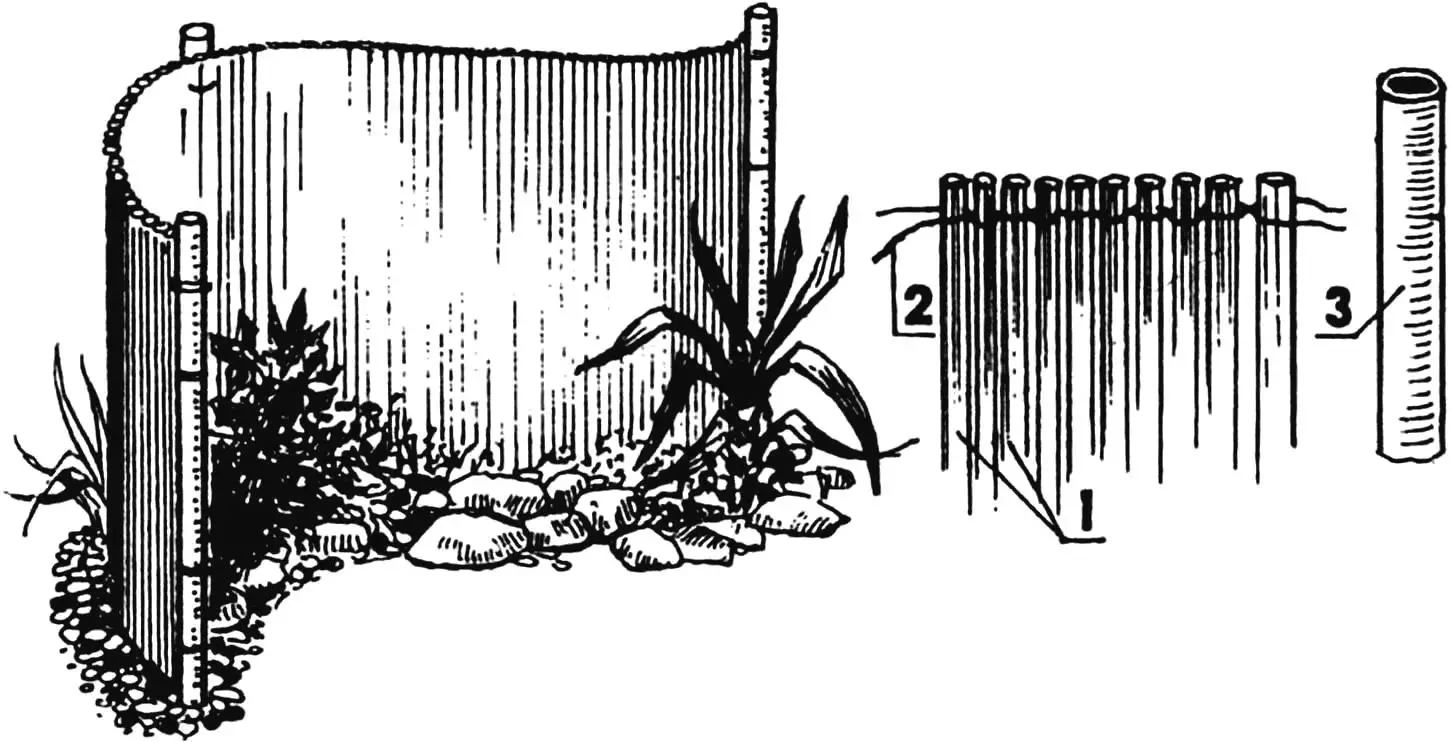
1 — slats; 3 — cord weaving the slats; 3 — post
It is easy to shelter a rest area from the wind too by building a light, attractive screen from thin poles or slats. Two or three poles dug in will serve as the screen support and keep it stable. The screen itself is formed by poles or slats set close together and woven at top and bottom with cord; they may simply rest on the ground. Fastened with the same cord to the support poles, such a screen not only creates a sheltered corner but also acts as a decorative element on the plot.
«Modelist-Konstruktor» No. 4, 2003, B. REVSKY (from foreign press)
Recommend to read
 “The NUTCRACKER”
Existing devices for cracking nuts provide only two or three times the balance of power. We offer universal Nutcracker allows you to crack nuts of all sizes, ranging from small — Ø5 mm... SIEVE THE CONTRARY
Who did the repair, he knows how hard it is to drain the old paint to separate it from the films and clots. However, there is a way not to do the dirty and unpleasant work. Take a piece...
