In technical hobby clubs there is often a need for wooden workpieces with an even, smooth surface. Getting a well‑sanded board is not easy: hand processing is labor‑intensive and requires certain skills.
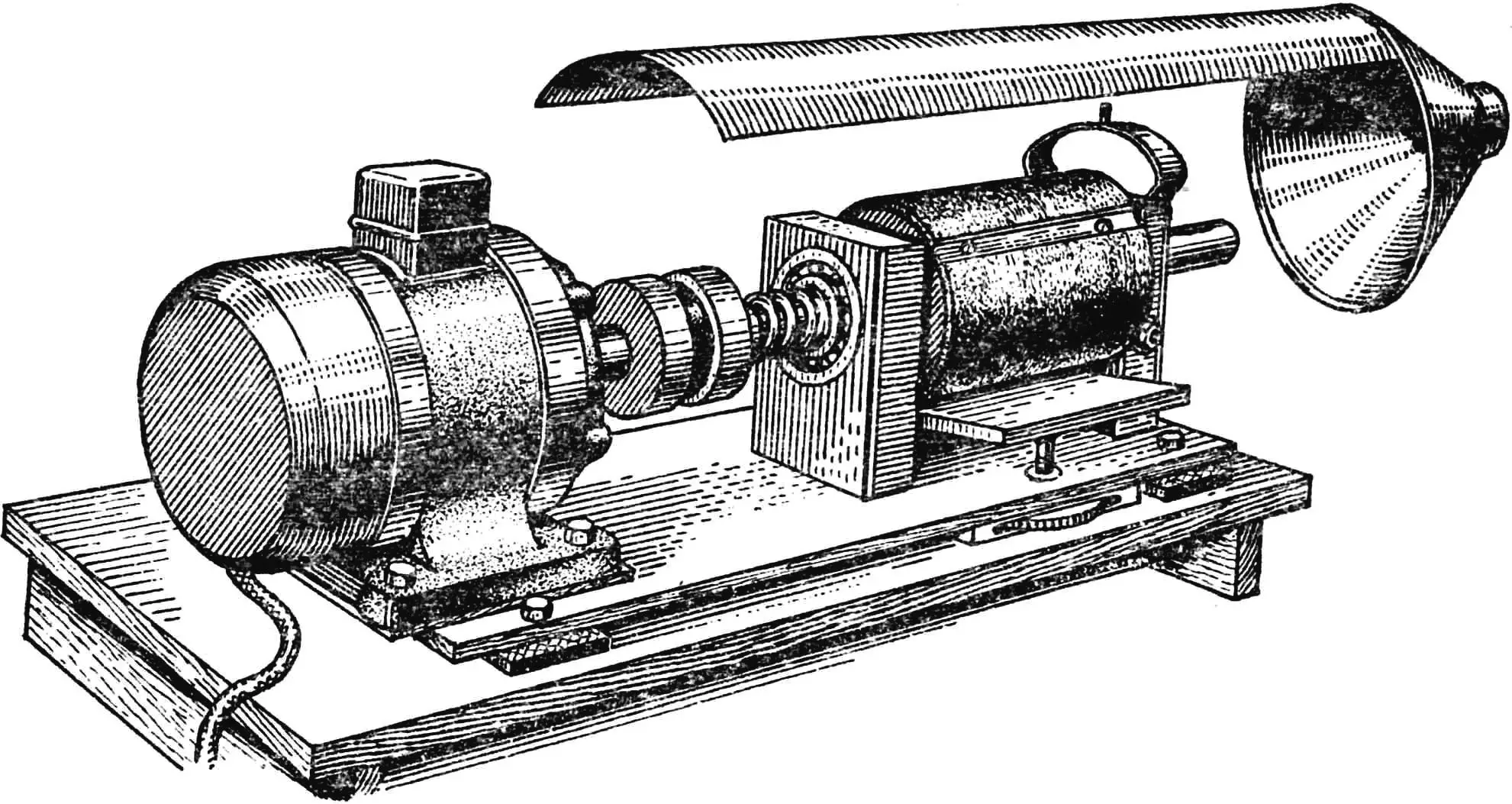
The machine designed in the rocket and space modeling laboratory of the Kazakhstan Young Technicians’ Station makes it possible to mechanize the sanding of wooden parts.
The design of the machine is clear from the drawing. The drive uses an electric motor of type AOL‑21‑4 with a power of 0.27 W at 1400 rpm, but any other motor with similar characteristics can be used.
The working drum is turned on a lathe from steel grade 3. With a three‑edge milling cutter a groove is cut in it, where the abrasive belt will be clamped by a pressure bar. The bar is inserted into the groove, after which the drum is balanced. This is done as follows: holes are drilled in the end faces, removing excess metal until the drum is balanced, that is, it rolls, for example, along the edges of rulers smoothly, without beating.
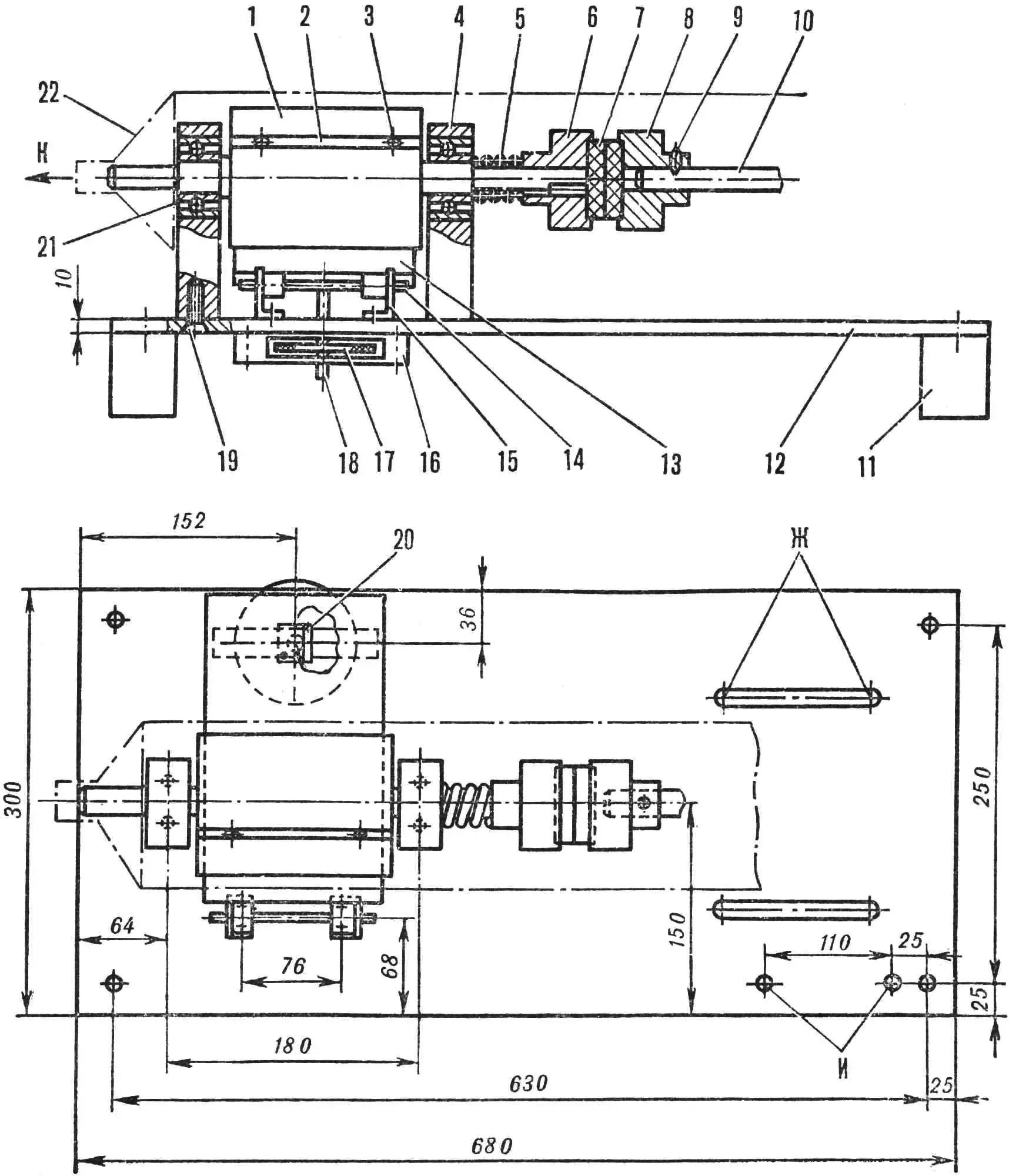
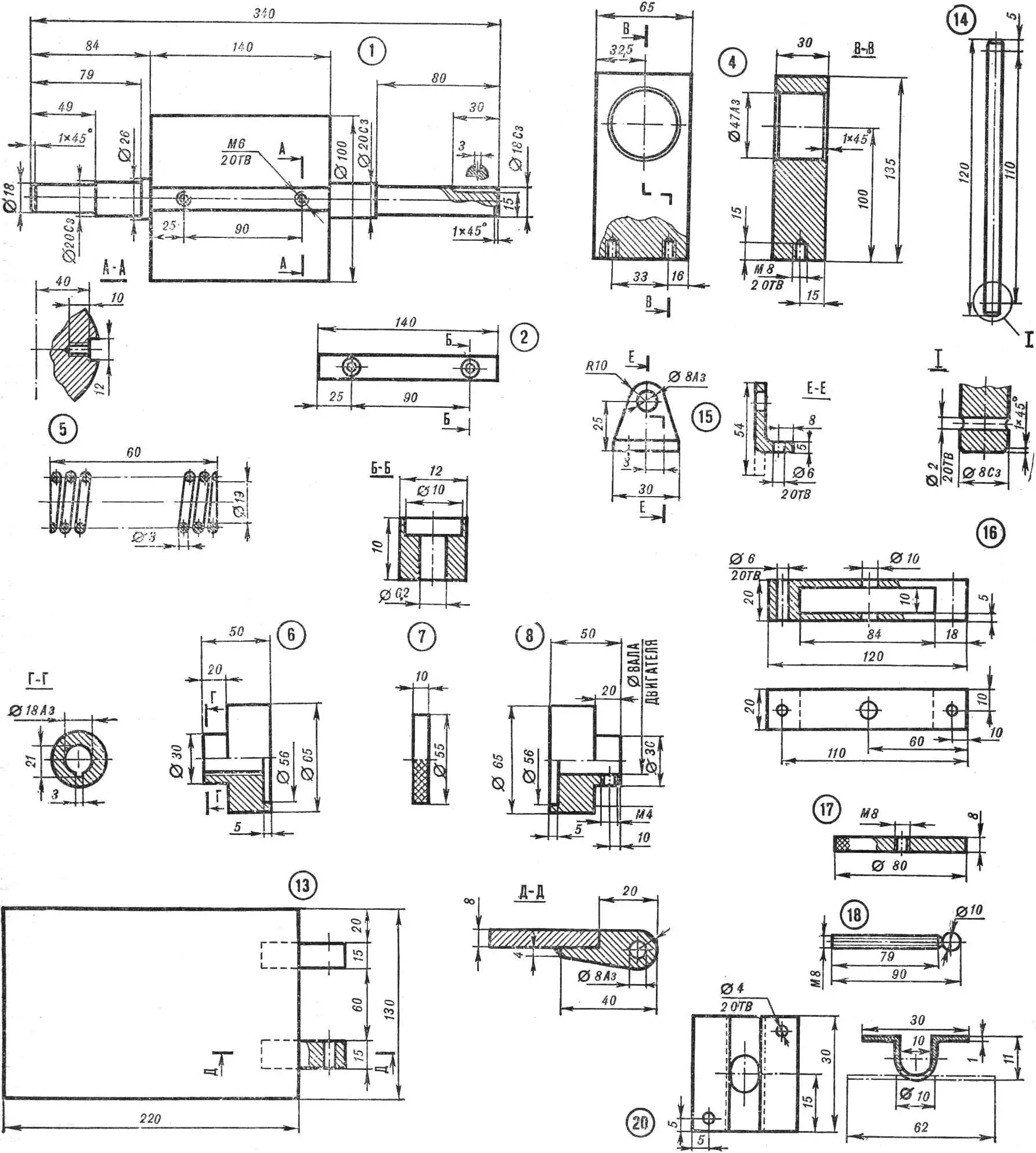
1 — working drum, 2 — pressure bar, 3 — screw M6×10, 4 — bearing housing, 5 — spring, 6, 8 — clutch discs, 7 — rubber inserts, 9 — locking screw M4×8, 10 — motor shaft, 11 — bed support, 12 — bed, 13 — work platform, 14 — axis of the work platform, 15 — bracket, 16 — regulator body, 17 — regulator nut, 18 — adjusting screw with ball head, 19 — screw M8×15, 20 — holder of the adjusting screw, 21 — bearing 204 GOST 8338–57, 22 — protective cover, Zh — holes for fastening the motor (mark in place), I — place for the magnetic starter, K — vacuum cleaner connection.
The bearing housings are made of steel grade 3. The seating holes in them are milled on a machine using a special mandrel. Ready‑made housings can also be selected.
The clutch discs are likewise turned on a lathe from steel grade 3. Rubber inserts are placed in the end recesses of the discs to provide an elastic transmission of torque. One disc is fixed on the motor shaft with a locking screw; the other, movable one, is mounted on a sliding key of the working drum shaft. The discs are pressed against each other by a spring. Its force should be within 5–8 kgf. The clamping force can be adjusted by moving the clutch disc along the motor shaft.
When the machine is assembled and adjusted, the drum is wrapped with an abrasive paper belt of the required grit. The belt length is equal to the drum circumference plus 15 mm for fastening it in the groove.
The thickness of the wood layer removed in a single pass depends on the type of abrasive and is set with the adjusting nut. In this case the work platform, turning around a fixed axis, is raised or lowered.
The machine is connected to a three‑phase power supply in the usual way, through a magnetic starter with push‑button switch.
For safety, the rotating parts of the machine should be enclosed in a protective cover. It can be made of sheet metal or thin aluminum. The waste generated during sanding is removed by a stationary extraction unit. Where there is none, an ordinary household vacuum cleaner can be used.
“M‑K” 1’81, E. MAKLETSOV, P. TRESKUNOV, Alma‑Ata
Recommend to read
 INSTEAD OF SAIL — ROTOR
Apparently, in the technical work appeared in the phenomenon that can be called bottle-modeling. The fact that modelers in different fields are increasingly used... plastic bottles. From... HIDDEN SWITCH
Instead of installing switches ship modelers often put on the deck bare conductors or put the bulky switches. Naturally, these alien items spoil the appearance of the model. At the...
