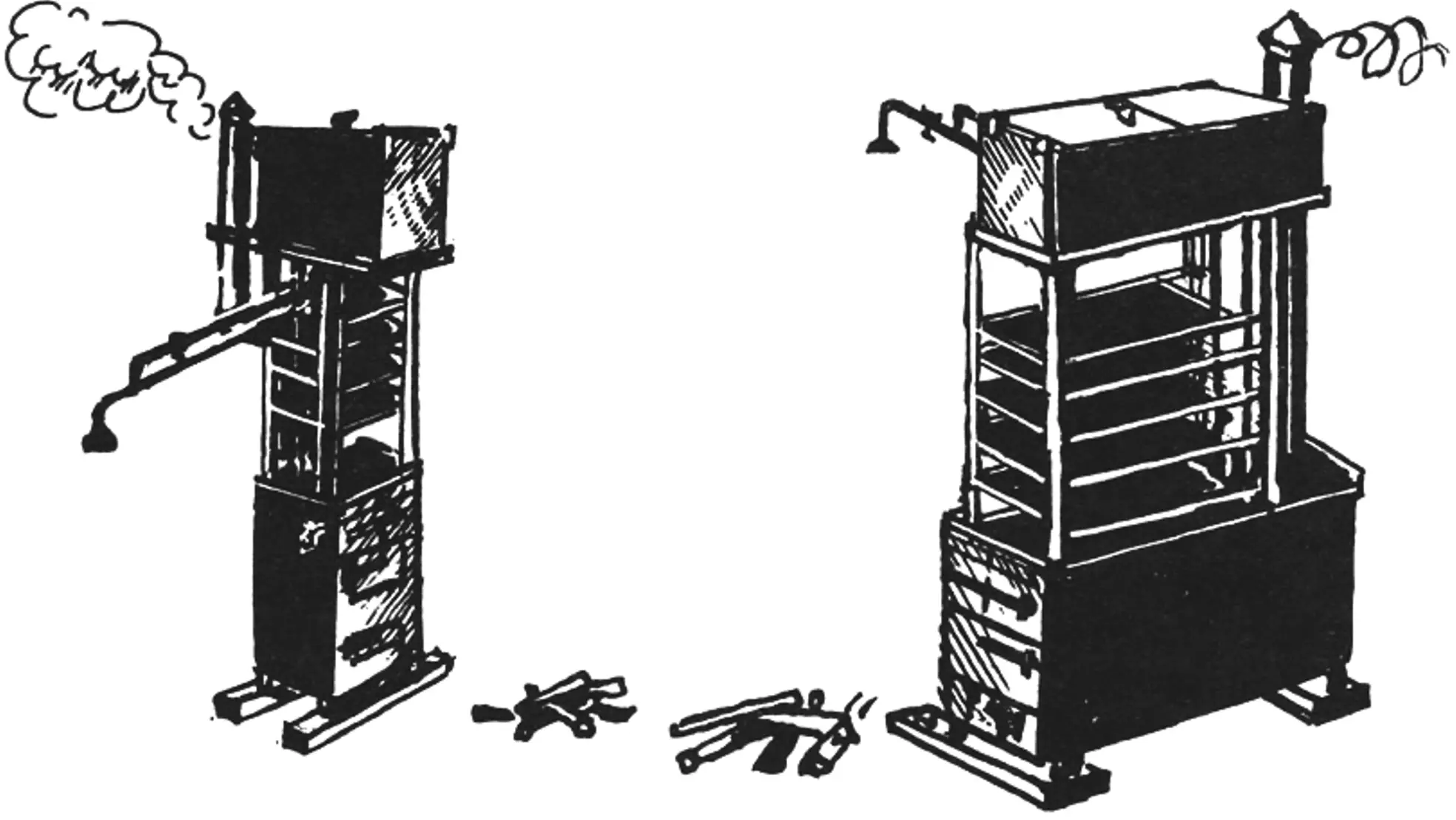
Needless to say, it is pleasant to warm yourself on a damp or cold day by the home hearth (whether a Dutch stove or a European fireplace), and to admire it as well, if it is skillfully made. A Russian stove is also fine — heat-retaining and multifunctional. But it requires a lot of space, and building one, like a fireplace, is probably within the power of only an experienced professional.
But in a household — a dacha, garden, or rural one — you cannot do without a simpler stove that helps solve, besides heating rooms, many everyday tasks: cooking food for the family and feed for domestic animals, heating water, drying berries and fruits, as well as clothing and footwear. In such a case, a stove without refinements but universal can help, installed, of course, not in the living room but in some utility room or a separate building: a bathhouse, summer kitchen, utility shed, or even under a canopy.
The designs of two such steel welded stoves are presented in this publication. Among the disadvantages of metal (steel) stoves is their low thermal inertia, i.e., poor heat accumulation. This is true for heating stoves when they are required to accumulate a significant amount of heat during firing and then gradually release it over a long time, which is necessary in permanently occupied homes.
But this disadvantage in many cases turns into an advantage when, for example, rapid heating of a room is needed already during kindling and a short cooling-down period after firing ends. This quality of the stove is desirable in dacha and garden houses where the owners visit only briefly in cold weather. Prolonged heating is achieved by economical slow firing in a “gas-generator” mode.
At first glance, the proposed stoves resemble each other, since they are made of the same materials and consist of similar functional blocks connected together: a boiler, a drying rack, a water tank, and a chimney, the dimensions of which differ only slightly.
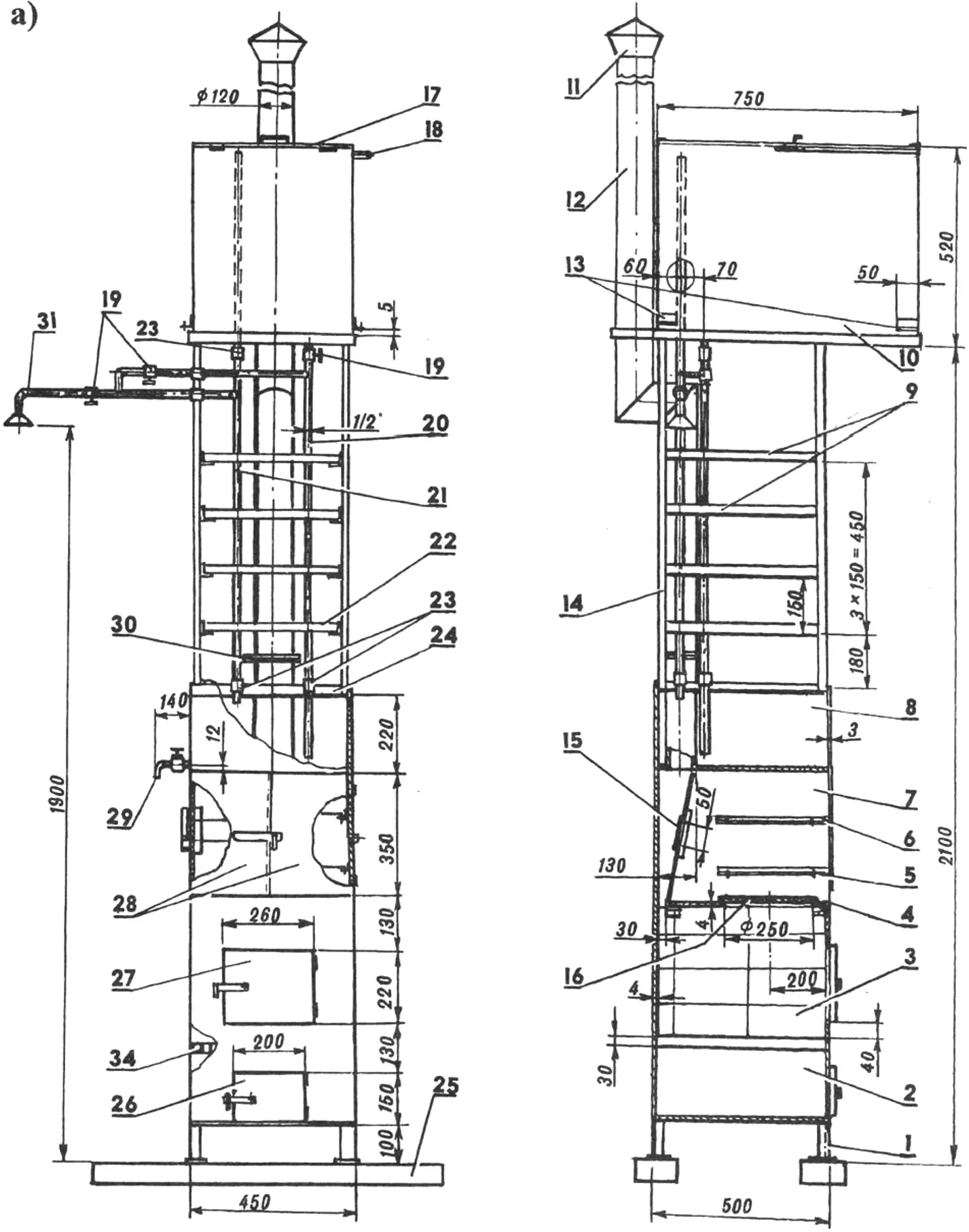
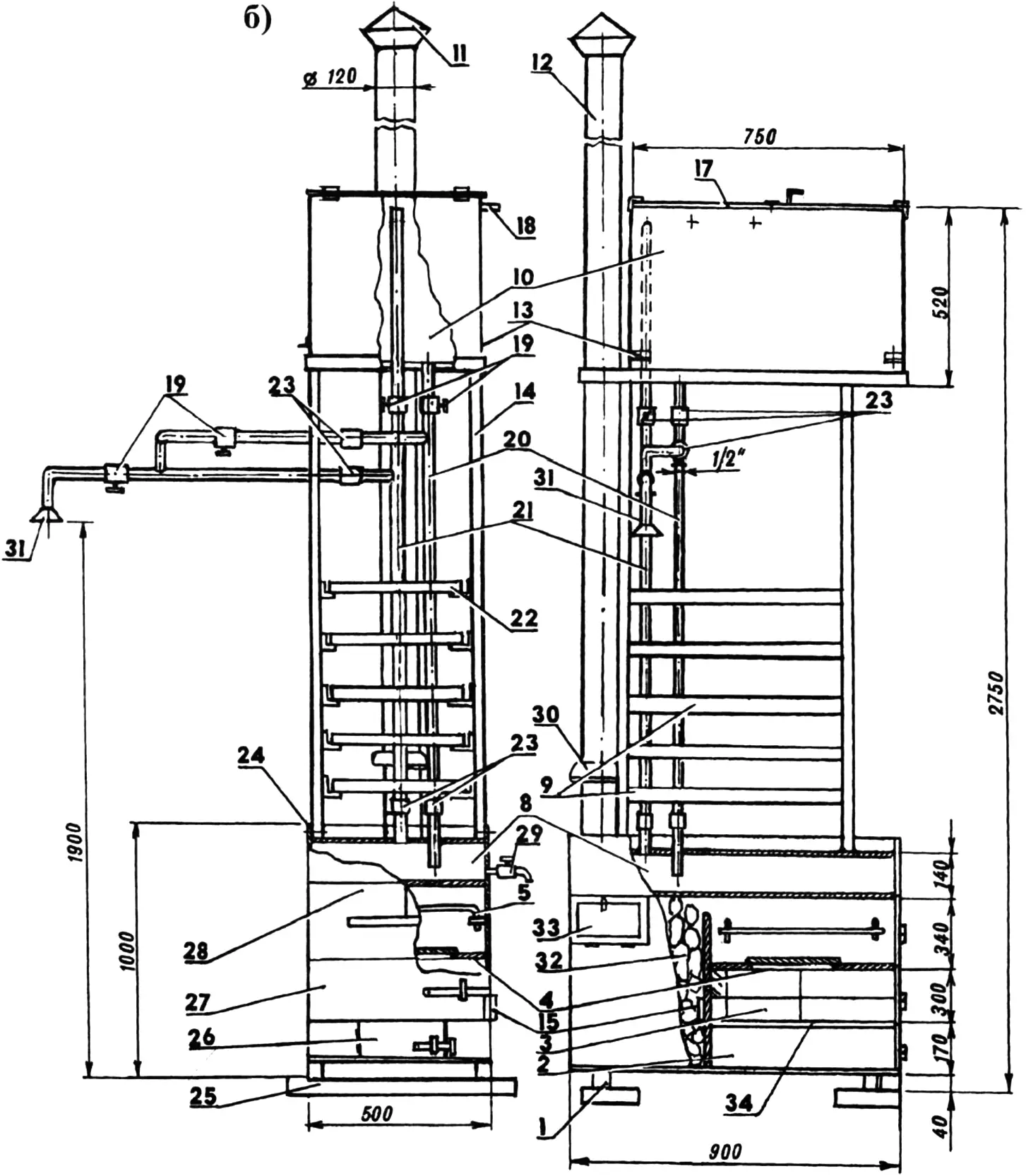
1 — leg (steel angle 50×50); 2 — ash pan; 3 — firebox; 4 — cooktop (in variant “a” — removable, in variant “b” — fixed); 5 — skewer rack (supports for shish kebab skewers); 6 — roasting pan; 7 — oven; 8 — water heater tank; 9 — guides for baking trays (steel angle 25×25); 10 — water container (steel sheet s2); 11 — chimney cap (sheet metal s0.8); 12 — chimney (sheet metal s1); 13 — mounting brackets (steel angle 50×50); 14 — support post (steel angle 50×50); 15 — damper flap; 16 — slide valve; 17 — container lid (steel sheet s2); 18 — pipe fitting (1/2″); 19 — valves (1/2″); 20 — cold water riser (pipe 1/2″); 21 — hot water riser (pipe 1/2″); 22 — baking tray; 23 — couplings (1/2″); 24 — fastening parts (clamp, bolt); 25 — foundation beam (reinforced concrete beam); 26 — ash door; 27 — firebox door; 28 — oven doors; 29 — drain tap; 30 — slide valve; 31 — shower head; 32 — stone bunker; 33 — steam room door; 34 — grate bars. Flat boiler parts are made of steel sheet s4
The main differences are in the designs of the heating blocks (boilers), with which we shall begin the description of both stoves. In the first of them (fig. a), the boiler is welded from 4 mm steel sheet and consists of the following units, or rather chambers: an ash pan (also the air inlet), a firebox with grate bars at the bottom and a removable cooktop with a burner ring at the top, an oven with supports for a roasting pan and skewers, and a water heater tank.
The burner ring lid and the damper flap can be used to regulate the direction and flow of flames of combustible gases from burning fuel or the heat of smoldering coals.
Draft in the stove is regulated by opening the ash door (the size of the air inlet opening).
The base of the chimney passes through the water heater tank, which ensures faster water heating and increases the stove’s efficiency.
The firebox walls are lined with firebrick, which protects them from rapid “burn-through” and somewhat increases thermal inertia.
The heating block of the second stove is slightly lower but “deeper.” It has the same set of units (chambers) as the boiler of the first stove, plus a stone bunker. The latter unit makes it possible to use this heating device also as a sauna stove in a bathhouse or sauna. The mass of stones also significantly increases the stove’s thermal inertia.
There is a door on the outside of the bunker. Through it, stones are initially loaded into the bunker and, most importantly, water is supplied to produce steam. In the partition separating the bunker from the other boiler chambers, there are two openings for the passage of combustible gases: the first — from the oven, the second — from the firebox. The latter opening, when necessary (when heating the stone mass is not required), is closed with a slide valve, having first opened the burner ring in the oven cooktop to allow heated air from the firebox to pass into the chimney.
The drying racks of the stoves, as well as the upper water containers, are similar in design and differ only in size depending on the main blocks — the boilers.
The rack posts are made of 50×50 mm steel angle. Such a large cross-section was chosen because the posts serve as supports for heavy water containers. Side horizontal guides are welded to them, on which baking trays are placed. The posts are mounted on the water heater tank lid and bolted to the flanges (wall projections) of the heating block. At the top, the posts are tied with a frame of the same angle, which serves as a platform for the container. To heat water, this reservoir is connected to the water heater tank by “cold” and “hot” risers, forming a water circulation system. To quickly obtain hot water in the lower tank, the system is shut off with two valves on the risers.
For a shower, branches with their own valves are made from the hot and cold water risers. The branches are connected to a mixing shower head.
To heat greenhouses or rooms with a water heating system, pipes of this system are connected to the risers, through which heated water circulates.
The chimneys of both stoves are made of sheet metal and are of the socket type (without a separate foundation).
The proposed stove designs have been tested on experimental models during many years of operation.
“Modelist-Constructor” No. 2’2002, V. KHORT, Kyiv
Recommend to read
 GENTLE GRIP
Details of the processing of tin will need a small jig from two pieces of plexiglass with holes for pins. The sheet metal of the workpiece is placed between the strips connected on the... ON THE WATERS — THE RHYTHM OF THE WALTZ
Catamaran-vetrohod with hybrid propulsion. Despite the almost complete power supply equipment heat engines, shipbuilders are still hoping to create a workable ship, driven by wind. Only...
