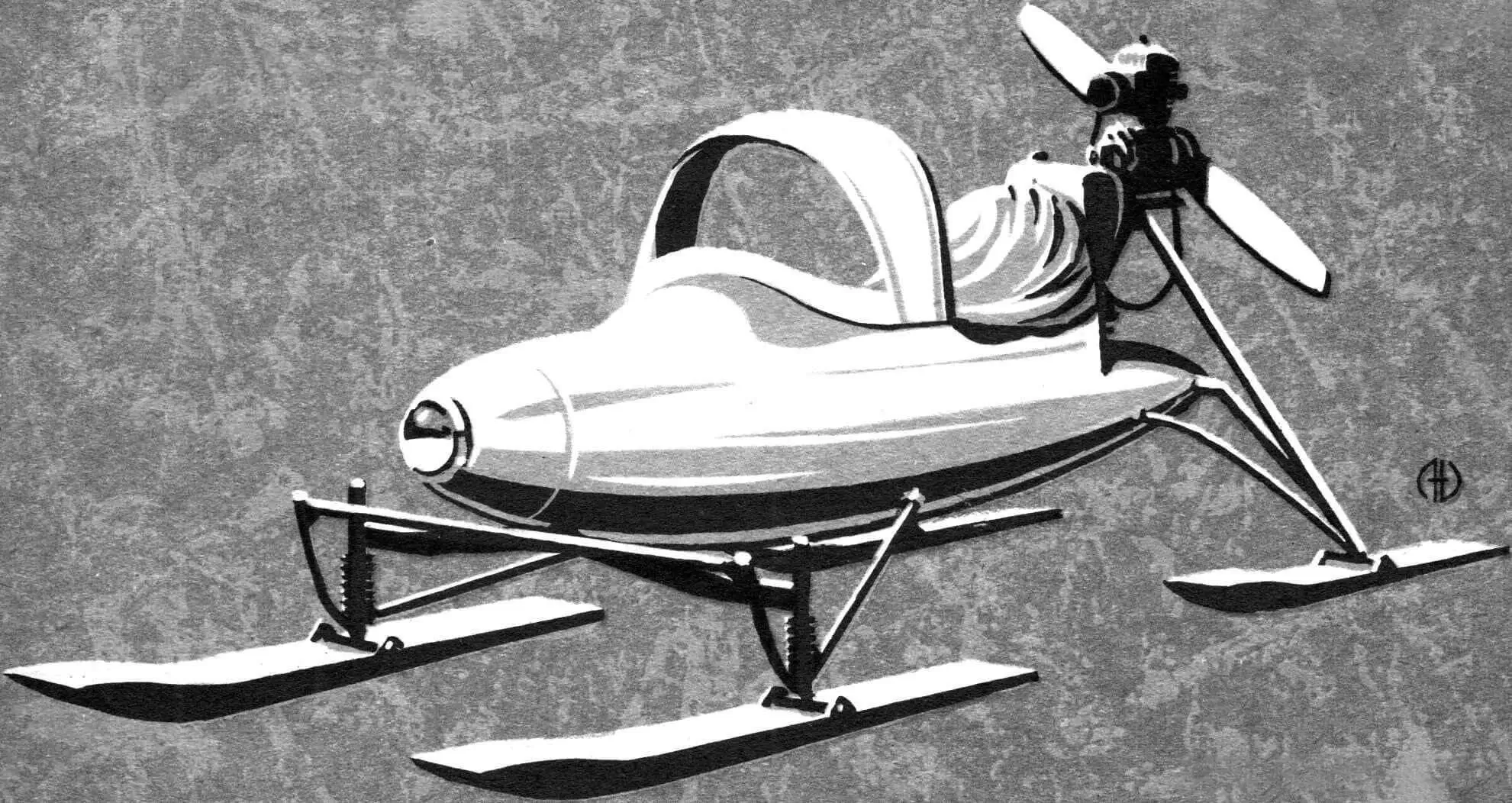
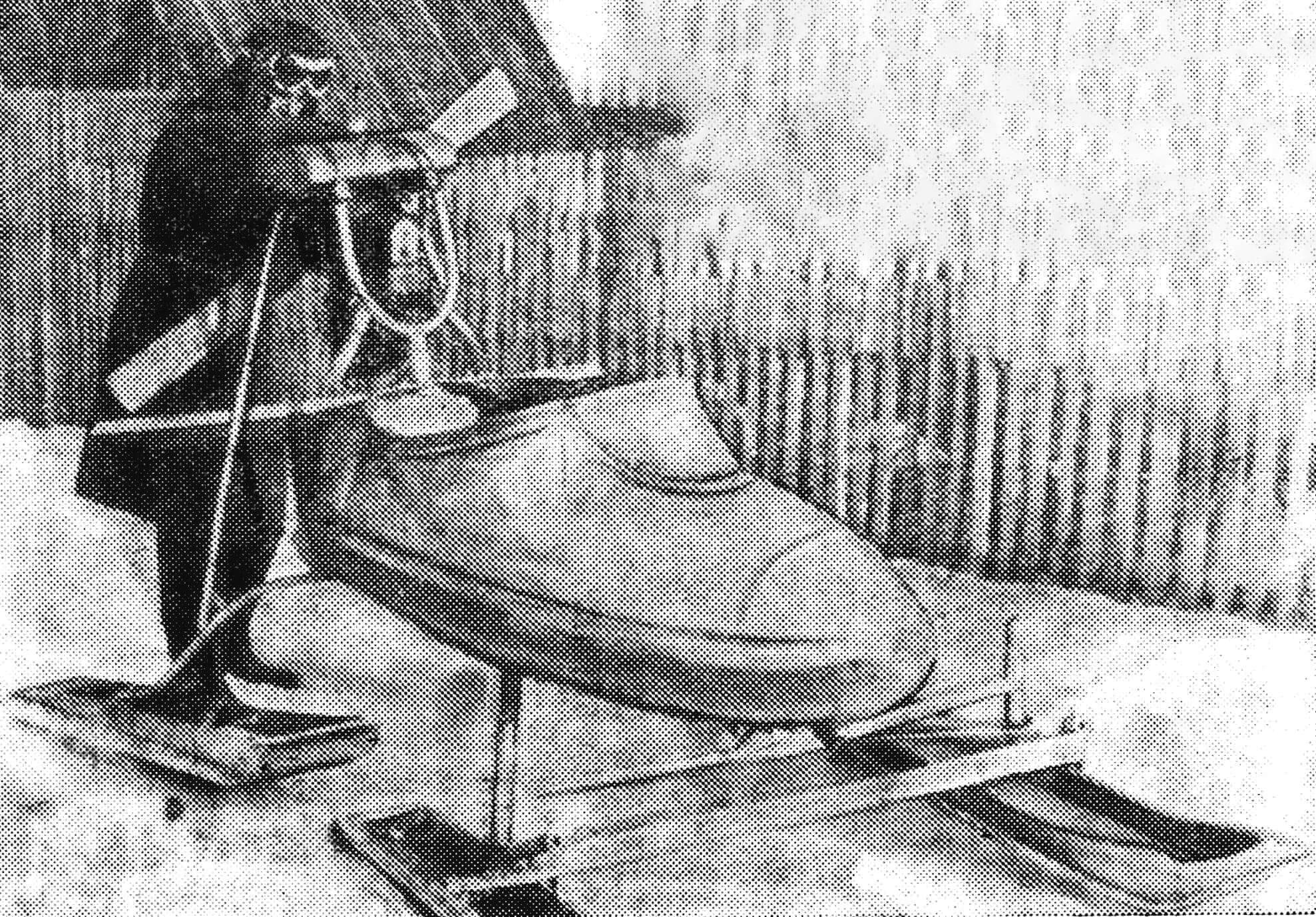
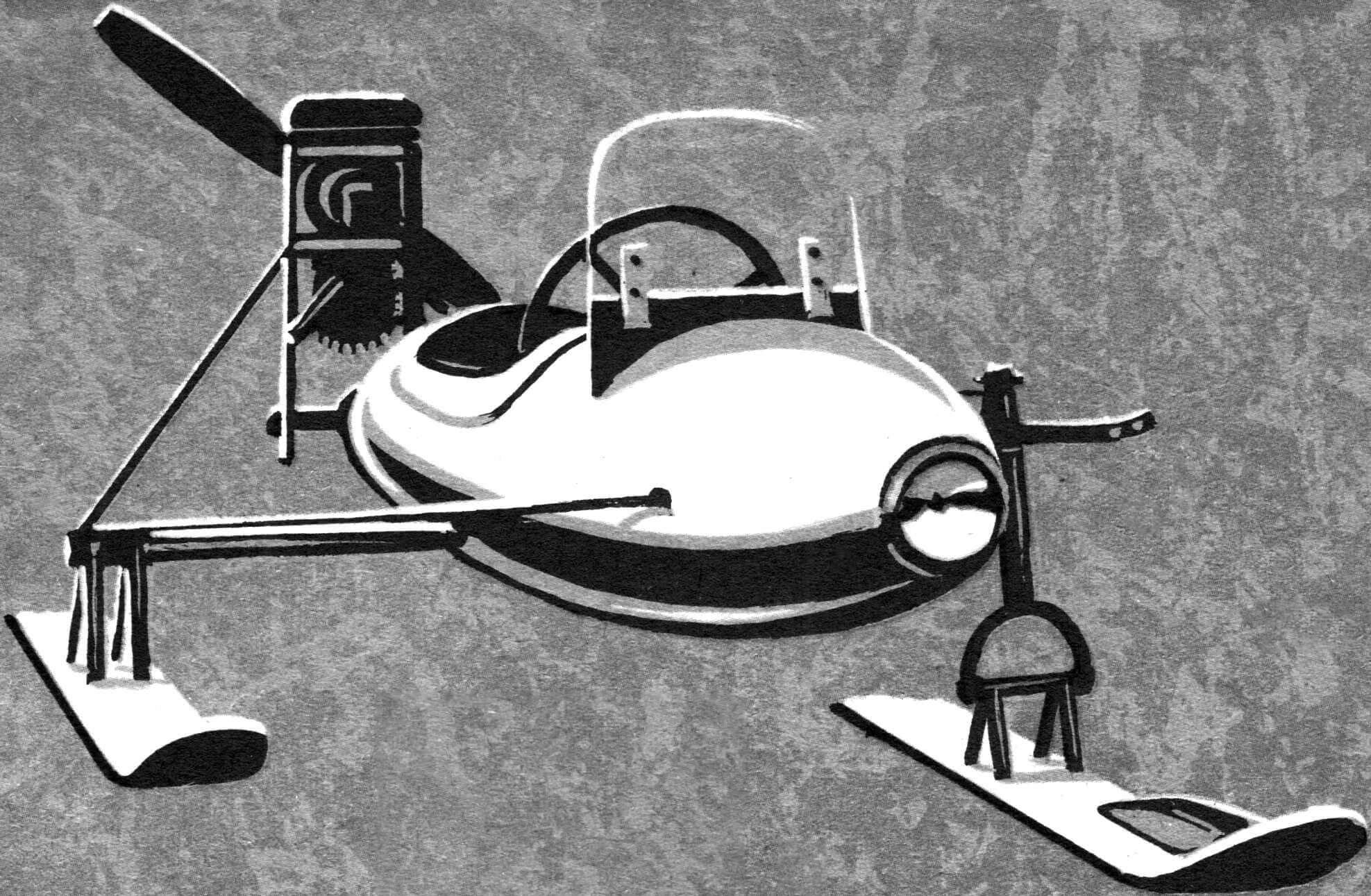
Among the large family of “Lebed” (Swan) designs by Vitaly Konstantinovich Savitsky, the “Lebed-7” stands out for its bold layout of components and assemblies, successful centering, good streamlining, and smooth ride.
The sled (see figure) is a four-ski design with steerable front skis. The steering is automotive-type, with a worm gear and steering linkage. The ski suspension is provided by springs and hydraulic shock absorbers from an IZH motorcycle. The rear skis are on lever shock absorbers. The system of load-bearing tubes allows them to be maximally loaded with the weight of the engine, whose center of gravity is located practically above the center of the skis, which facilitates starting from a standstill.
The sled body is riveted duralumin. It has good streamlining. The designer provided protection for the driver and passenger with a deep windshield and a removable canopy.
The engine is motorcycle-type. This is the widely used PD-10 used by aerosled builders with a cylinder from an IZH-56 motorcycle. Its power is 16 hp. The transmission to the propeller is direct. The propeller is solid, wooden, with a diameter of 1050 mm, providing acceleration of the sled to a speed of 60 km/h. A notable feature of the “Lebed-7” is the installation of a magneto, which allows starting the sled’s engine without leaving the cabin.
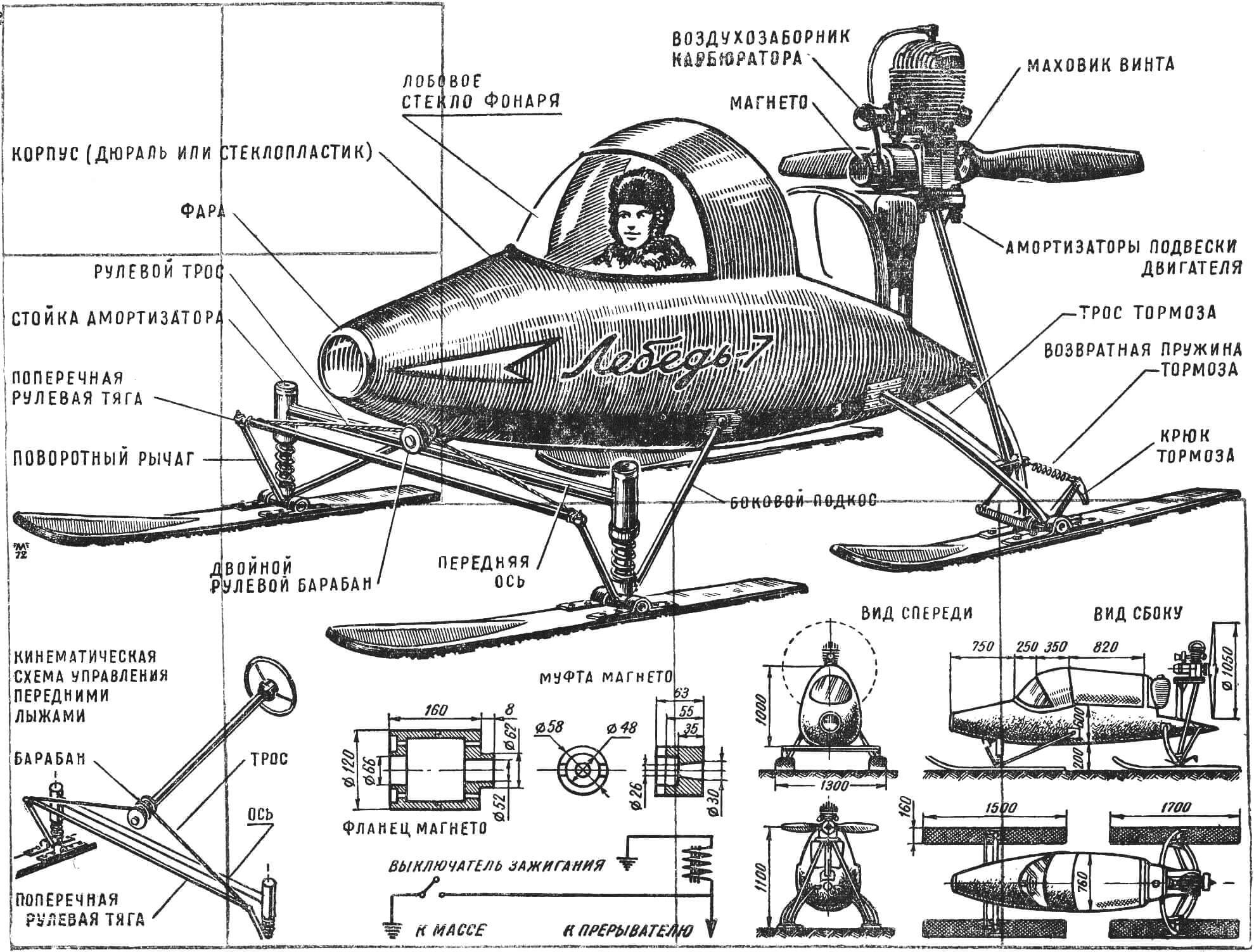
Since the fuel tank was placed behind the cabin and below the engine, it was necessary to install a fuel pump from a “Moskva” boat motor.
The installation of supercharging ducts should also be noted, which significantly improved the engine’s traction characteristics.
“Lebed-7” is the last four-ski aerosled by V. K. Savitsky. After them, the amateur designer built another sled with a more powerful—forced—18 hp engine. And now he has moved on to designing a “Penguin”-type snowmobile.
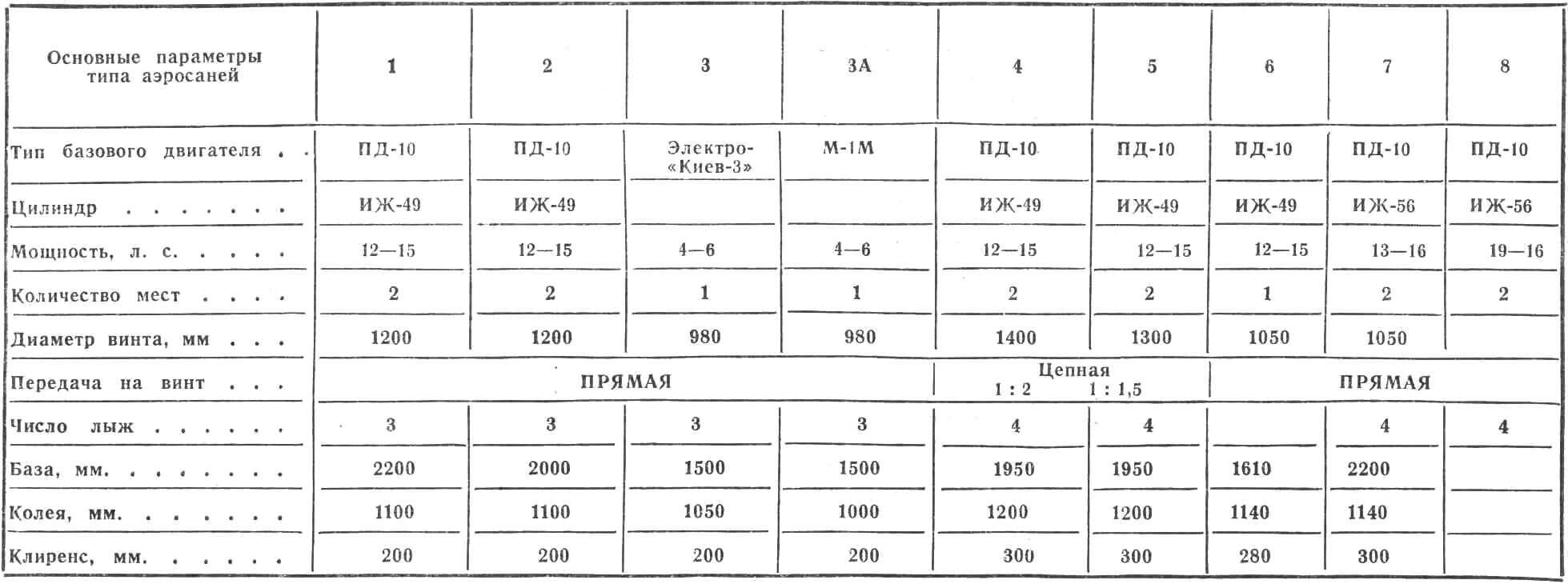
A small table provides brief reference data on the “Lebed” family by V. K. Savitsky. This table is of interest because for each design, an optimal variant was chosen both in terms of dimensions and engine power, and in other parameters.
TECHNICAL SPECIFICATIONS OF AEROSLEDS «LEBED» BY V. K. SAVITSKY
The figure itself is remarkable: the number of aerosled builders now numbers hundreds and hundreds. And many have built not one, but three or four machines.
So why are we talking here specifically about Savitsky, who, let’s be honest, did not make a revolution in aerosledding and did not set any special records on his “Lebed”?
You can design—whether it’s a radio, a car, or aerosleds—for yourself. You built it—use it. Didn’t like it—make a new model.
You can start building for yourself, and then—imperceptibly—find yourself surrounded by friends, first supporters, then fellow builders, initially students, and then already masters, enthusiasts, ready to share materials and give useful advice. This is the most common variant of amateur construction, when one enthusiast “grows” a team of helpers and comrades, and the machines turn out—you can’t tell who made what, where whose idea came from. You can even become the initiator of a movement in your district, city, or region. This is exactly what happened in its time with B. M. Derkachev, whose purely consumer idea—to build himself a car—grew into a city-wide movement of amateur car designers—with exhibitions and reviews of regional scale, with participation in rallies—regional and even all-Union, with a wide platform and fame throughout the country.
This is exactly how—from the simple (“I’ll make myself some aerosleds to go fishing”) to a mass regional movement—the work that captivated the labor teacher from the Kinel boarding school developed.
News spreads quickly in a small town. And just a few weeks after Savitsky’s first aerosled run, curious people came to him: first the Kinel residents—Kulkov, Shkuratov, Malinin—then petitioners from other villages and towns in the region. The regional newspaper printed a few lines about Savitsky’s sleds—letters poured in from all corners of the country.
There are about four hundred of these letters. Business letters. Inquiring in detail about design features, about calculations of the propeller-motor group, about ski suspension. Many sent descriptions of their sleds, shared successes and incidents of their operation. Asked for advice, gave advice.
The power of these letters is great. After all, there is no specialized aerosled magazine, and publications in other technical journals appear from time to time, and you can’t always get these journals. And you don’t always find exactly the design that appeals to you, that you can implement. It seems that if we collected all these hundreds of letters that amateurs exchange, we could publish not just a book—an encyclopedia, because they contain everything: theory and practice, drawings and technological recommendations. And most importantly—not down-to-earth, but living, creative thought of amateur designers, who sometimes did not become professional designers of this technology due to purely everyday circumstances, talented finds that even a solid modern design bureau could be proud of.
From the letters also came the idea of holding “Kinel-Aero” review-competitions. This year they were held for the third time—Vitaly Konstantinovich participated in them both as a teacher of many aerosled builders, including his daughter Nina, who started on sleds of his design, and as an athlete, and as an expert judge, and as the initiator of “skiering”—races of skiers behind aerosled-tugs.
Now the review-competitions in Kinel have already outgrown city scale: the first regional ones are not far off, and then, perhaps, it will be possible to expand even wider. There are considerable grounds for such a conclusion: only in the middle Volga region there are four or five centers of aerosled construction, and how many more there are in other regions, in Kazakhstan, even in the Baltics—in particular, in Estonia.
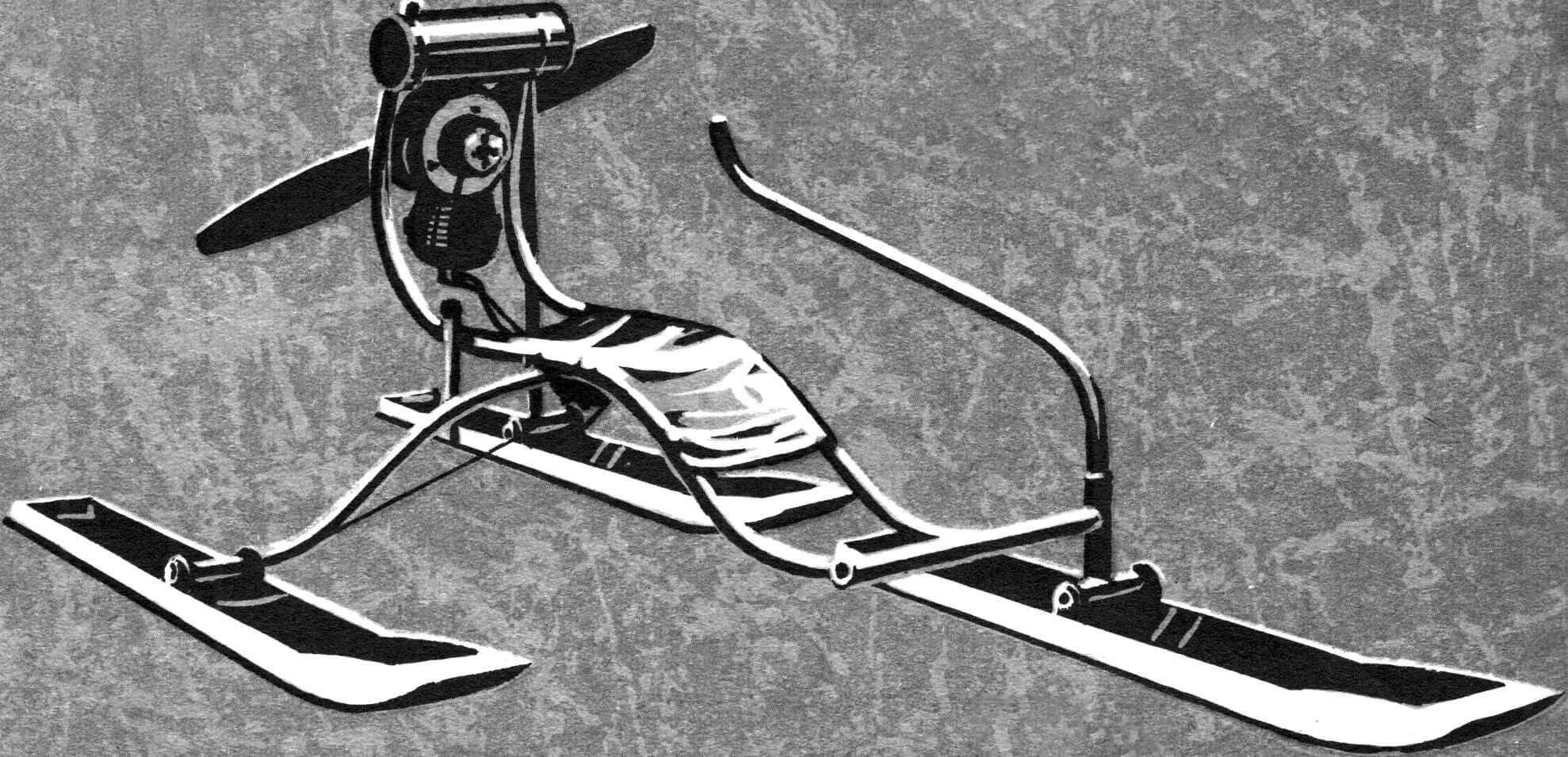
Estonians, by the way, don’t particularly favor classic aerosleds. They invented something like a symbiosis of sleds and a motorcycle: skis in front, a studded wheel in the back. They claim that such machines are more convenient for traveling on ice.
One of the experimental paths led some aerosled builders away from classic schemes in Kinel as well. Even Vitaly Konstantinovich himself “wavered”: his next winter machine, “Lebed-9,” will be without an air propeller, on tracks. Last winter we already saw its frame in the boarding school workshops. And by the “Kinel-Aero-73” competitions, the machine will come out on snow tracks.
THE MOST IMPORTANT THING
Being the initiator of a movement is a great honor, a great thing. And many would stop—and do stop—at this stage. There are followers, new and new experimental and long-term operation machines are being created. Review-competitions are held. Even some all-Union fame has come.
What more, it would seem?
For Vitaly Konstantinovich, all this external trappings are not even half the work, but rather—nothing to attach it to.
The main thing for him is the kids. First those who studied in the small school of the village of Lebed, and now—the boarding school children, children of railway workers, whose mothers and fathers are in construction trains, on long trips, in endless moves. For them, these kids, Savitsky became not just a labor teacher, he became a second father to them—kind and demanding, sharing all his knowledge with them and at the same time not showing his superiority in any way.
It is them he takes for rides on the sleds on the first snow. He even lets many of them take the wheel. And both boys and girls from the boarding school have every right to this. Because—and this is, in fact, the main thing in what we’ve told—they are co-authors of the designer. It was together with them in excellently equipped workshops that new designs were born. In each such machine there is a share—and not a small one—of their labor.
What doesn’t Vitaly Konstantinovich teach his charges! Drawing and working on machines—that’s natural, that’s what the program “requires.” But the creative approach to work, the endless debates about how this or that part should look, how to simplify the design of this or that unit, how to boost the engine—you can’t plan for that. This, to the best of his ability, every “labor teacher” must instill in the minds of his students.
Equal participation—this is the basis of Savitsky’s methodology. Equal—doesn’t mean that everyone will have to do things of the same degree of complexity. Equal—is with the same measure of interest, with the same feasible contribution, with the same sense of collective responsibility for the work. And with the same inventiveness.
It must be said that Savitsky’s interests are very diverse.
A man of ordinary biography: teacher—soldier—teacher again, he diversified his world with many hobbies. Vitaly Konstantinovich is an ardent opponent of all narrowness. He is passionate about painting, and an ardent photographer—the club at his school, both in equipment and in “output” of photographic products, is one of the best among those that have been seen over the past years. With his active participation, a garden was laid out at the boarding school. The shelves at home are bursting with books.
And all this—together with the kids, with a noisy, restless (sometimes you have to shout!) gang of constantly changing, growing kids, everywhere in a crowd accompanying their beloved teacher.
They are the main concern, they are all of Savitsky’s strength. In teaching them to think, to create, in raising them to be real people, he sees his main task in life.
Y. BEKHTEREV
Recommend to read
 CUTTER “PUSHPULL”
Remember PushPull fabulous animal which could jump not only forward but also backward, because instead of a tail he had a second head? About it can not help reminiscent of the original... CLOTHESPIN… FOR CHIPS
Chips, widely used in the electronics industry, are increasingly used in Amateur practice. However, when itike them in charge or replacement from the wizard, you need increased accuracy,...
