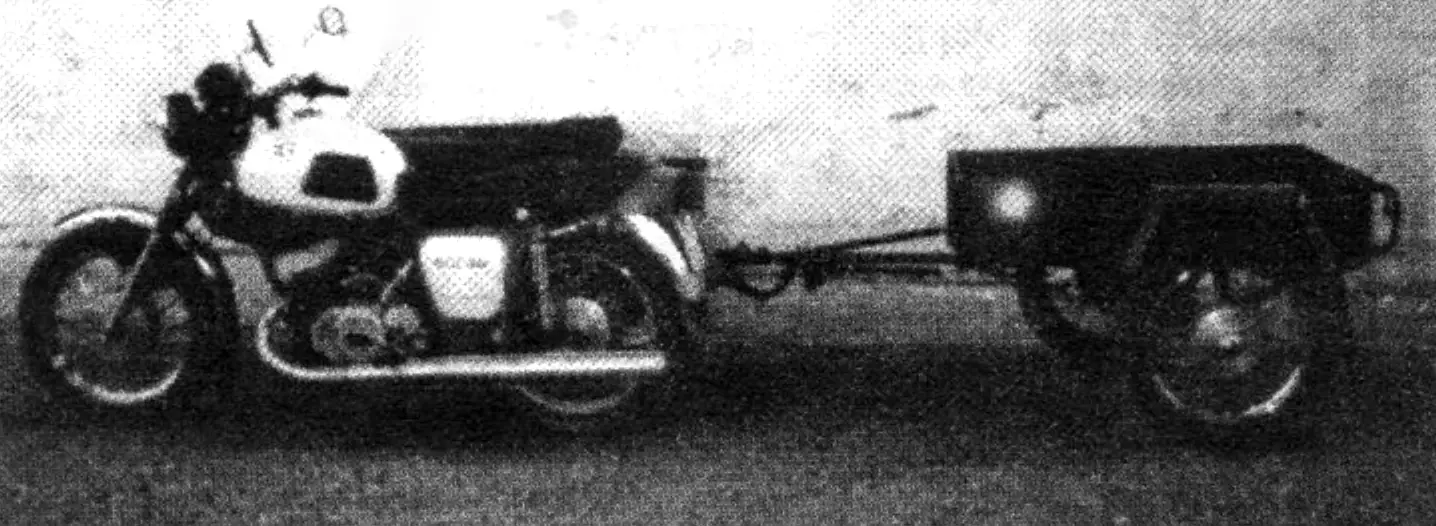
Owners of a motorcycle with a sidecar often wonder how to increase its payload. An original solution was proposed by our magazine’s reader A. Tatarnikov in his article “The Obedient Trailer,” published in Modelist-Konstruktor No. 12, 1992. The design of his motorcycle trailer with an offset hitch and a track matching that of the towing motorcycle became quite popular among motorcyclists. Over the years many modifications of the famous trailer have appeared. The one published today is among the latest and most interesting.
I read A. Tatarnikov’s article several years ago. I liked the layout of a trailer that follows exactly in the motorcycle’s track. By then I already had a plot of land and an IZH-Planeta motorcycle with a sidecar. You cannot haul much on a Planeta, so an extra cargo trailer was simply necessary.
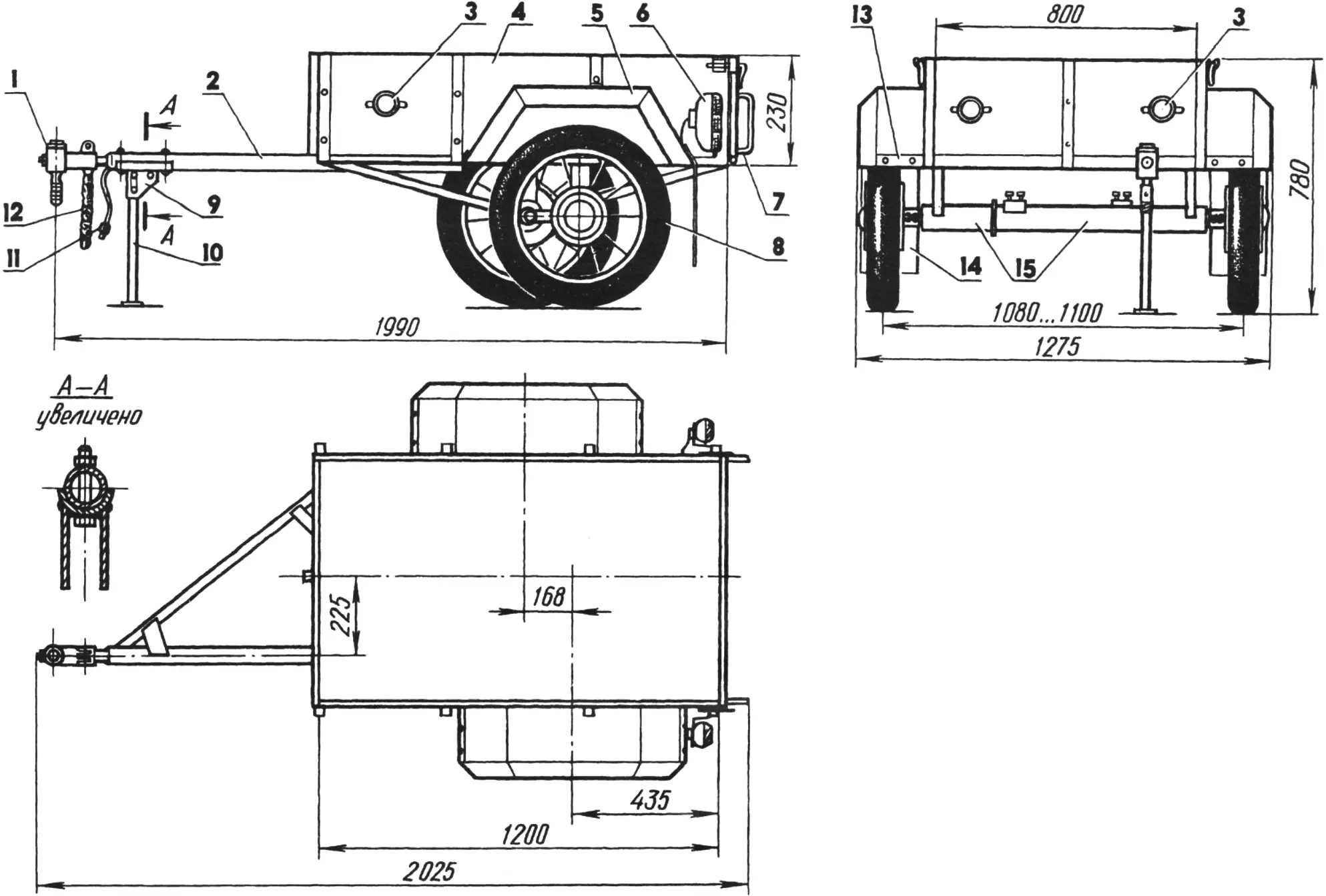
1 — ball joint; 2 — drawbar; 3 — reflectors (6 pcs.); 4 — body side (plywood, s16); 5 — fender (steel 15, s2); 6 — lamp FP-132; 7 — clamp (St3, rod Ø10); 8 — wheel (3.5×18″); 9 — front support mounting bracket (St3, sheet s5); 10 — front support (steel 15, tube 20x20x2.5); 11 — electrical connector ONTs-VN; 12 — safety chain; 13 — fender mounting bracket (St3, strip 40×5); 14 — mud flap; 15 — torsion units.
When I got down to building it, I ran into technological and financial difficulties. Tatarnikov’s design often uses lathe work, in particular on the bushings of the wheel-suspension equalizers. I also needed to buy eight Moskvich silent blocks, four rear motorcycle shock absorbers, and electrical and lighting equipment. All of that is not cheap.
So I decided, taking the author’s idea as a basis, to build a trailer of my own design. Moreover, one that could be made even at home with minimal use of metal-cutting machine tools — needing only a welding machine, an electric drill, and bench tools.
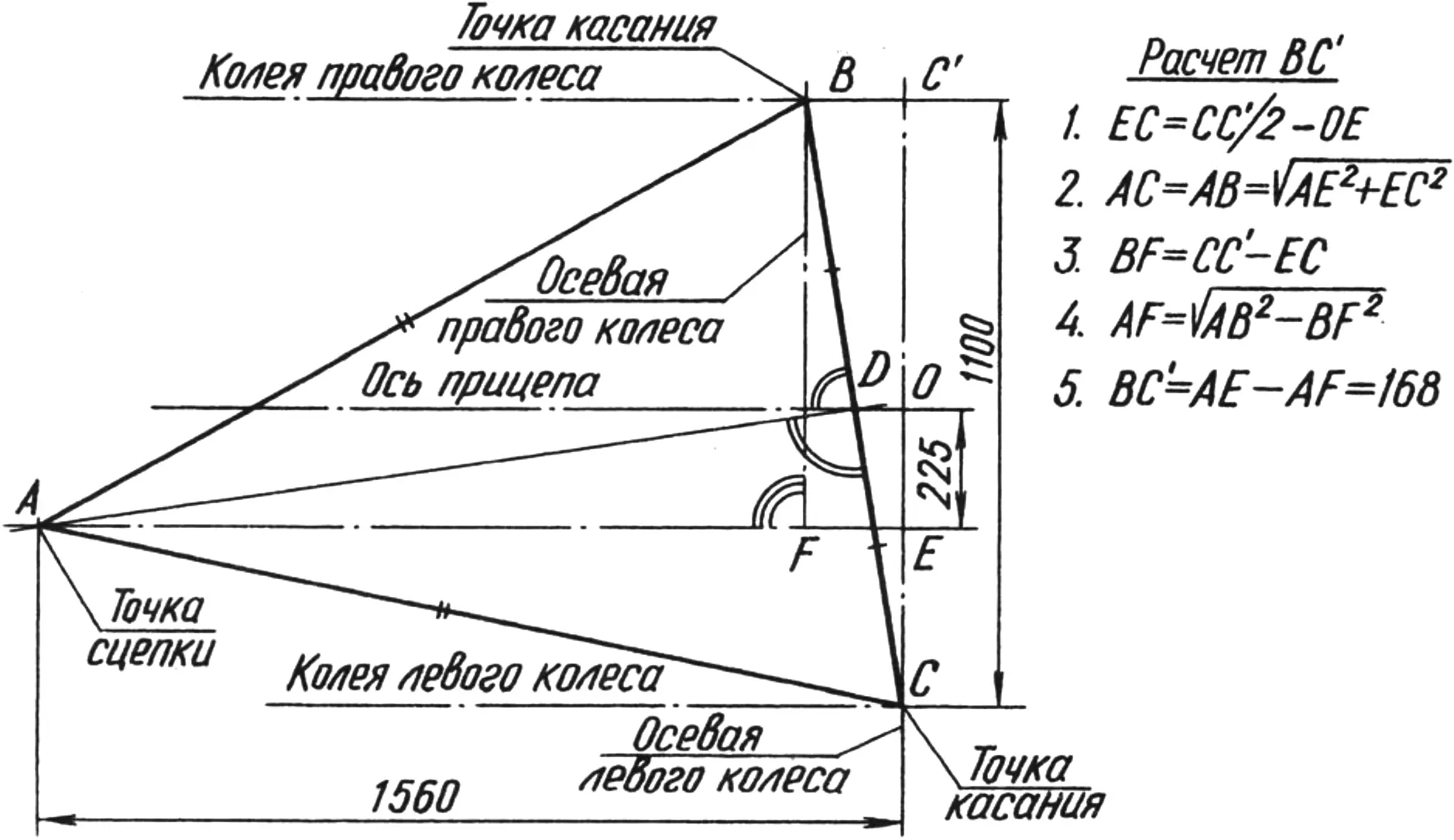
I had to abandon equalizer-arm wheel suspension and use torsion suspension. Making a torsion bar by hand is difficult, so I took two such units from old motorcycle sidecar trailers BP-65. I removed the collet attachments to the sidecar frame and fitted plugs instead, then joined the housings with six cross-members. The 168 mm distance between the torsion axes and the corresponding wheels was found purely geometrically: a perpendicular dropped from the hitch point onto the line connecting the wheel contact points on the road (with the trailer and tractor tracks coinciding) bisects that line; track width is 1100 mm; hitch offset from the trailer centerline is 225 mm, and the distance from the hitch-unit center to the left-wheel axis is 1560 mm. The result was a good rigid axle.
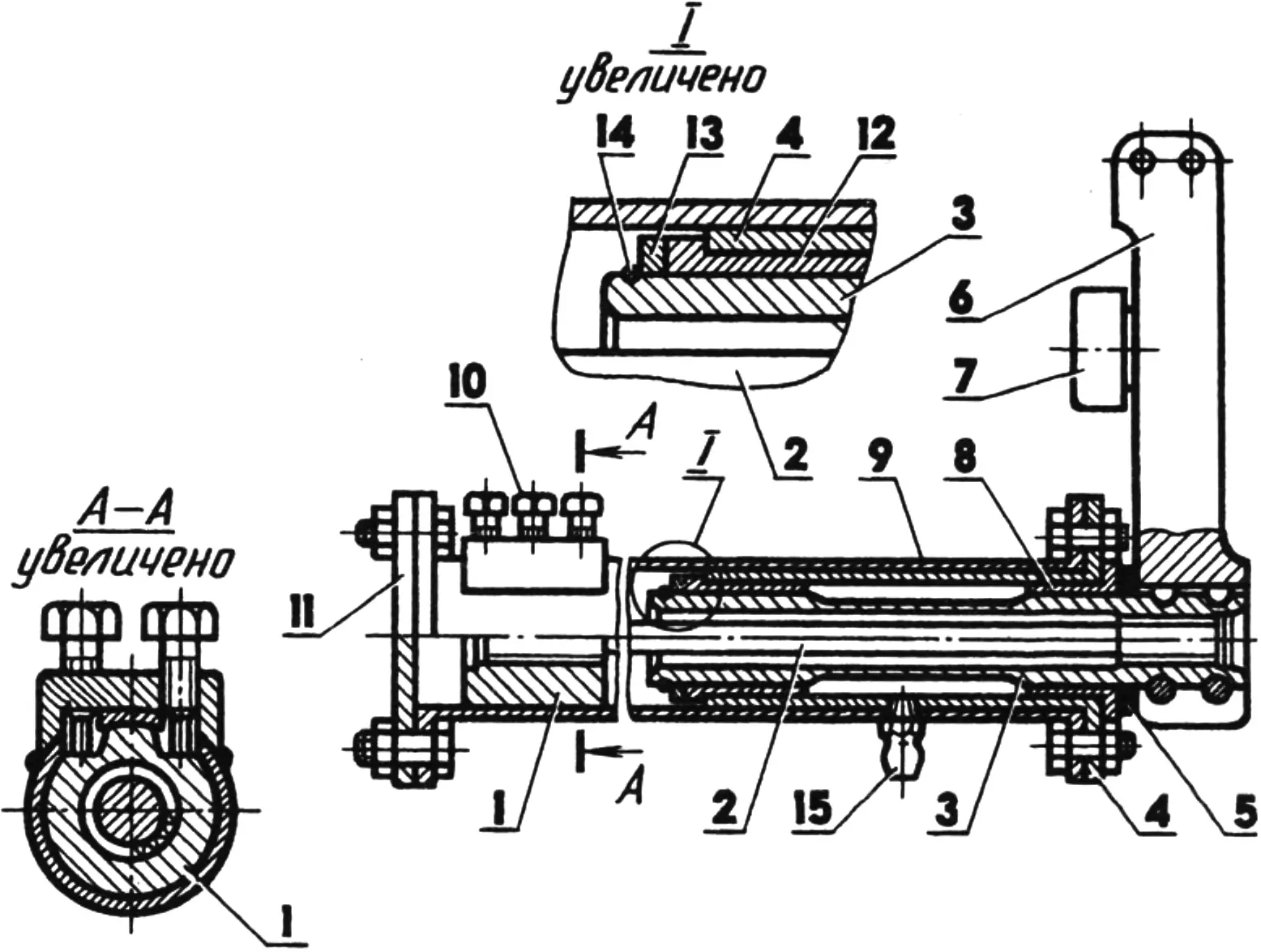
1 — torsion-shaft coupling; 2 — torsion shaft; 3 — connecting-rod axis; 4 — flanged bushing; 5 — oil seal; 6 — connecting rod; 7 — buffer; 8 — small flanged bushing; 9 — housing; 10 — adjusting bolt (3 pcs.); 11 — plug (St3, sheet s5); 12 — shaft-support bushing; 13 — thrust washer; 14 — retaining ring; 15 — grease nipple.
The trailer’s welded frame, made mainly of rectangular-section steel tubes, consists of the cargo-platform frame with side-post uprights, a drawbar with a brace, and supports to which the axle is welded, also reinforced with braces. The length of the front and rear braces depends on which side of the trailer it is — left or right.
The body is made of plywood. Its front and side boards are fastened to the cargo-platform uprights with bolts and screws, and the rear (drop) board hangs on four hinges. Homemade trailer fenders are welded from sheet steel and each is fixed to the frame with three clamps.
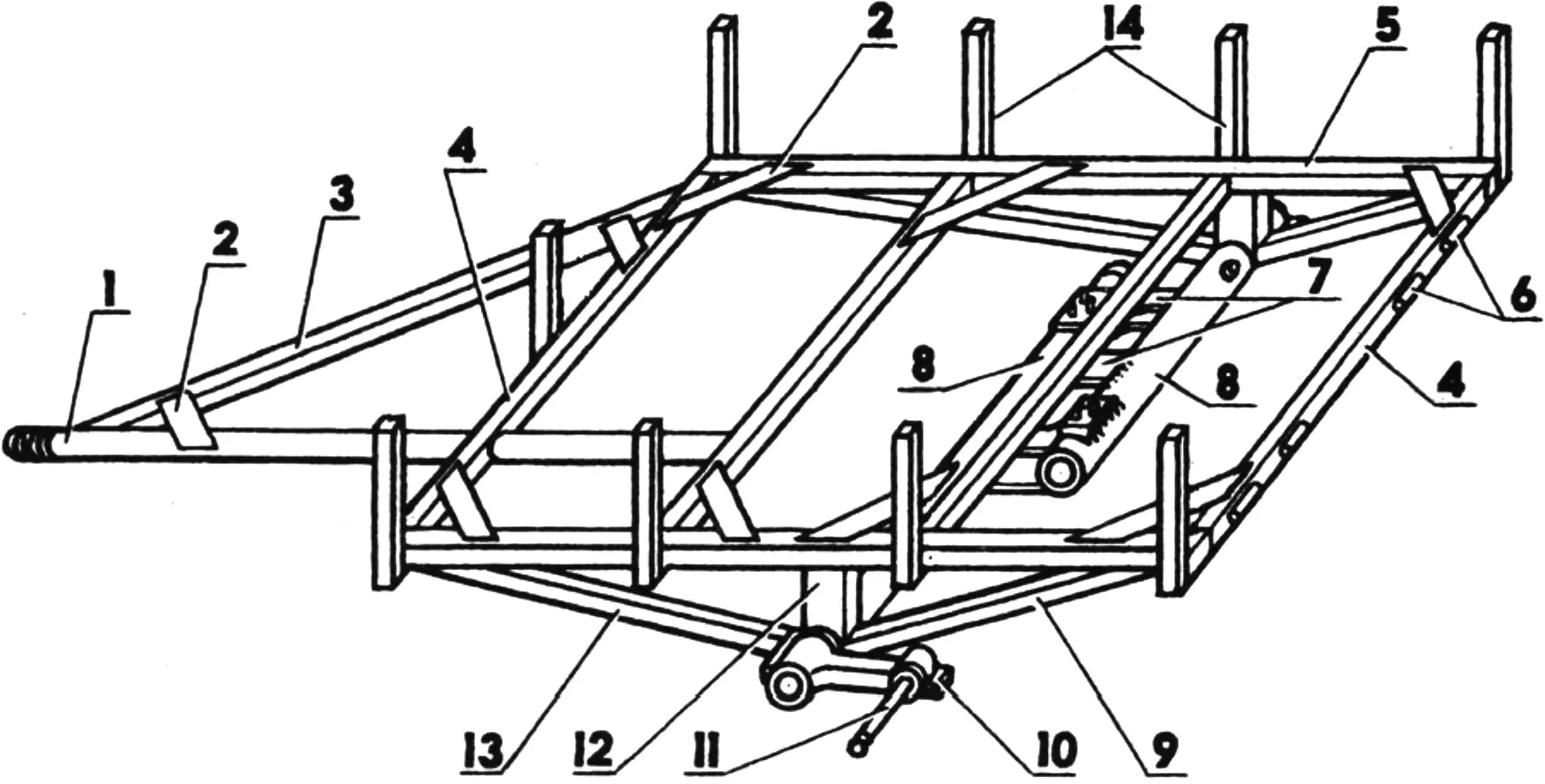
1 — drawbar (steel 15, tube 40×4); 2 — gussets (St3, strip 40×5); 3 — drawbar brace (steel 15, tube 20x20x2.5); 4 — cross members (steel 15, tube 20x20x2.5); 5 — side member (steel 15, tube 20x20x2.5); 6 — rear-board hinges; 7 — torsion-unit cross-members (St3, sheet s5, 6 pcs.); 8 — torsion units; 9,13 — support braces (steel 15, tube 20x20x2.5); 10 — wheel-suspension connecting rod; 11 — wheel axle; 12 — support post (steel 15, tube 40x20x2.5); 14 — side-board posts (steel 15, tube 20x20x2.5)
The wheels are the same as on the towing motorcycle and have drum brakes actuated from the foot-brake pedal by cable.
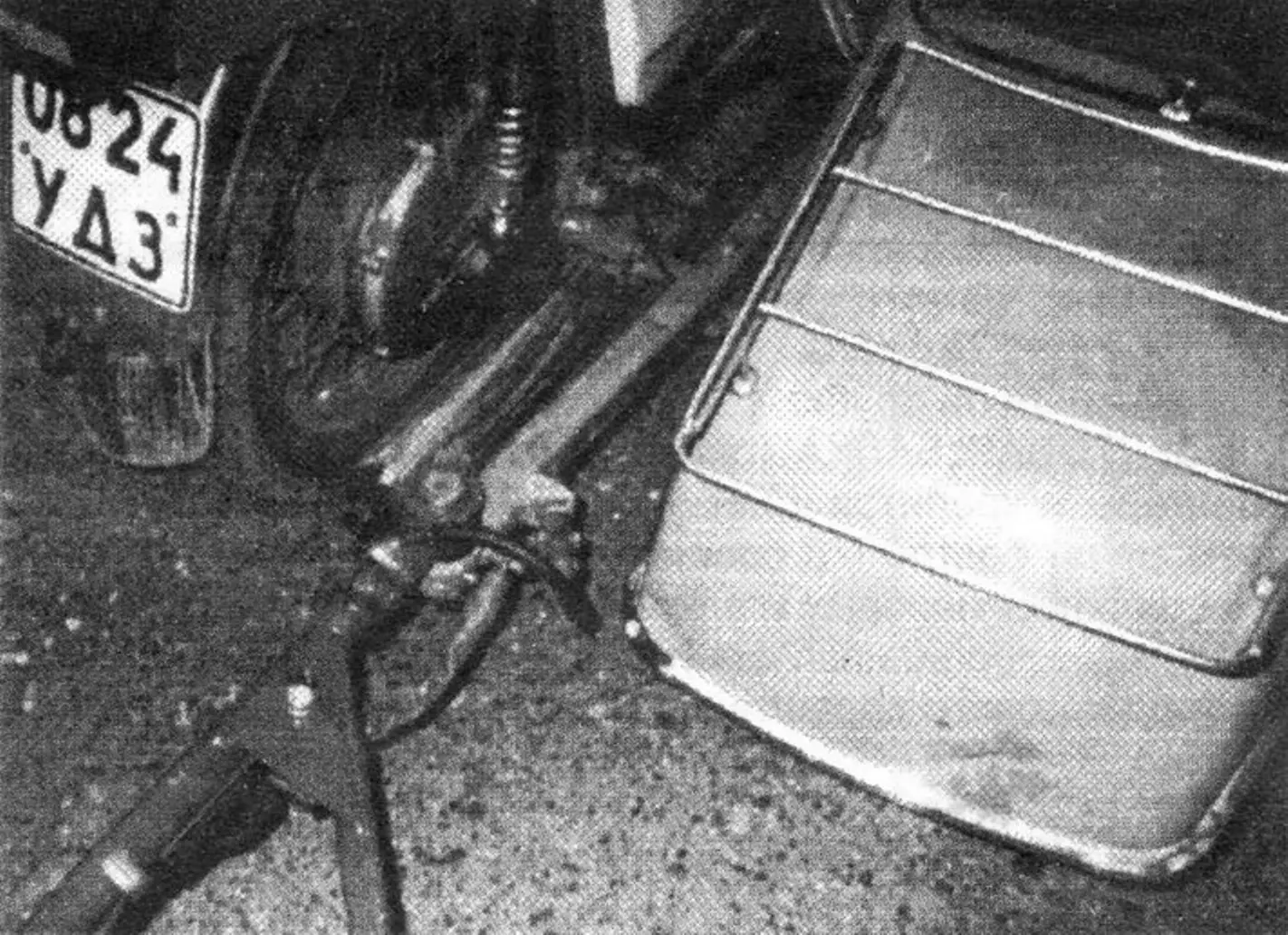
The hitch is also the same as on A. Tatarnikov’s trailer (only a steel chain is used instead of a safety cable). This device has proved itself well — it is very reliable even on a dirt road with a slightly overloaded trailer.
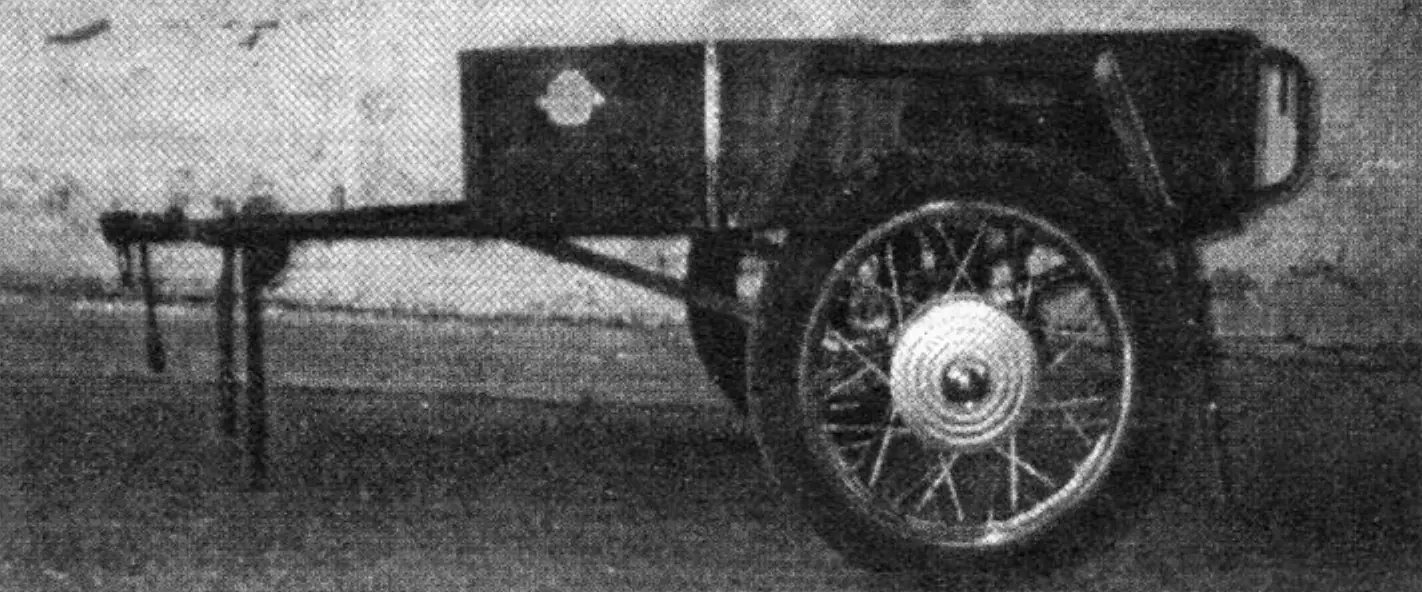
The trailer’s electrical system is a single-wire circuit and connects to the motorcycle through a connector mounted on the motorcycle’s towing tube. The combination’s lights are two integral lamps with marker, turn, and stop functions.
The trailer became an indispensable helper in the garden, the vegetable patch, and while building a country house. I especially like how “obedient” it is: it follows exactly in the motorcycle’s track, making the combination easier to control and improving its off-road ability.
MOTORCYCLE TRAILER SPECIFICATIONS
Curb weight, kg … 92
Maximum weight, kg … 182
Maximum payload, kg … 85
Maximum towing speed, km/h … 40
Cargo platform area, m2 … 0.96
Body volume, m3 … 0.22
Modelist-Konstruktor No. 6’99, Yu. KHOLMOGOROV
Recommend to read
 THE CURRENT COLLECTOR ON THE LINE
There many important components and parts to trace in the box? Yes, almost everything — so I will answer any, even the young athlete. But surely he's really isolated from all the other... BUILDER’S ASSISTANT
We first lived in an apartment in a three-story building, and then decided to move to a house of the estate type. But it required serious repairs, and the outbuildings were subject to...
