After building a country house, we try to protect it from the destructive effects of fire: we use heat-resistant finishing materials, buy fire extinguishers, and install a fire alarm system. Yet lightning protection is often overlooked.
One possible reason why our compatriots pay little attention to this issue is that building codes do not consider lightning protection for buildings under 30 m in height mandatory. In addition, many people are used to relying on “maybe”: they convince themselves that the chance of an electrical discharge striking their country house is practically zero.
However, lightning can cause very serious damage even if it strikes several dozen meters away from the home. Besides the serious danger to people and fires in residential and utility rooms, it can also take out expensive computers, video surveillance systems, engineering communications, and more.
From 5 to 20 thousand thunderstorms rage in the world every day. Meanwhile, protecting your home and yourself from such an unpredictable natural phenomenon is quite possible: all you need is to use a special lightning-rod engineering system and install it properly. Then no thunderstorms will be frightening.
That is why the most advanced homeowners and cottage owners prefer not to take risks and install a protective system — external (to protect the building from a lightning strike) and internal (so that the house’s rooms are safe from secondary effects of an electrical discharge). External protection, in turn, is divided into classic and active. Each type has its own features that must be considered when equipping an individual house or a cottage with lightning-safety equipment.
Proven by time
Other names for the classic external lightning protection system, known since the 18th century to the American statesman Benjamin Franklin, are passive and mechanical. It consists of three linked elements: a lightning receiver, a down conductor, and a grounding electrode (fig.1).
A lightning receiver (or lightning rod), which takes on the electrical strike, is made as a cable on the roof or a mesh thrown over the building, but most often — as a steel spike or rod with a diameter of about 12 mm and a length of 0.2 — 1.5 m. It is installed on insulators and fixed to the highest point of the roof.
A rod lightning receiver is easy to make yourself — from a steel bar or a pipe. If the part is hollow, its end must be welded shut; otherwise, lightning will pass inside the cylinder and trigger roof ignition.
It is best to think through the design of the lightning protection system at the same time as designing the house — before construction. This helps avoid many errors and technological problems that often occur when installing reinforcement on an already built structure.
To the lightning receiver they weld a down conductor (downlead) — a conductor made of round or strip steel with an anti-corrosion zinc coating. The connection must withstand approximately up to 200 kA. Then the down conductor is run down from the roof, attaching it to the building wall with insulated metal brackets.
The other end is firmly welded to the grounding electrode — a metal rod, a profile offcut, a sheet, a pipe, or an entire system of angles, rods, and channels buried in the ground to a depth of 2 — 3 m that neutralize the electrical discharge. The down conductor is best laid along the back wall of the building, and the grounding electrode should be buried farther away from the house foundation and outbuildings.
The main advantages of the classic lightning protection variant are reliability and an affordable price, affordable for most owners of country real estate. The drawback is that the appearance is not very attractive: steel reinforcement does not blend well with the building’s architectural look.
In the activity zone
Relatively new for our country, the system of active external lightning protection has already earned the recognition of specialists and attracted consumers. Compared with the classic one, it covers a much wider area due to a different operating principle of the lightning rod. This element does not wait idle for a direct lightning strike; it constantly works — it ionizes the air space around itself, thereby forming an extensive active protection zone. As a result, a lightning electrical discharge that occurs anywhere within this zone will inevitably be drawn to the roof antenna-receiver, run along the down conductor, and safely ground itself.
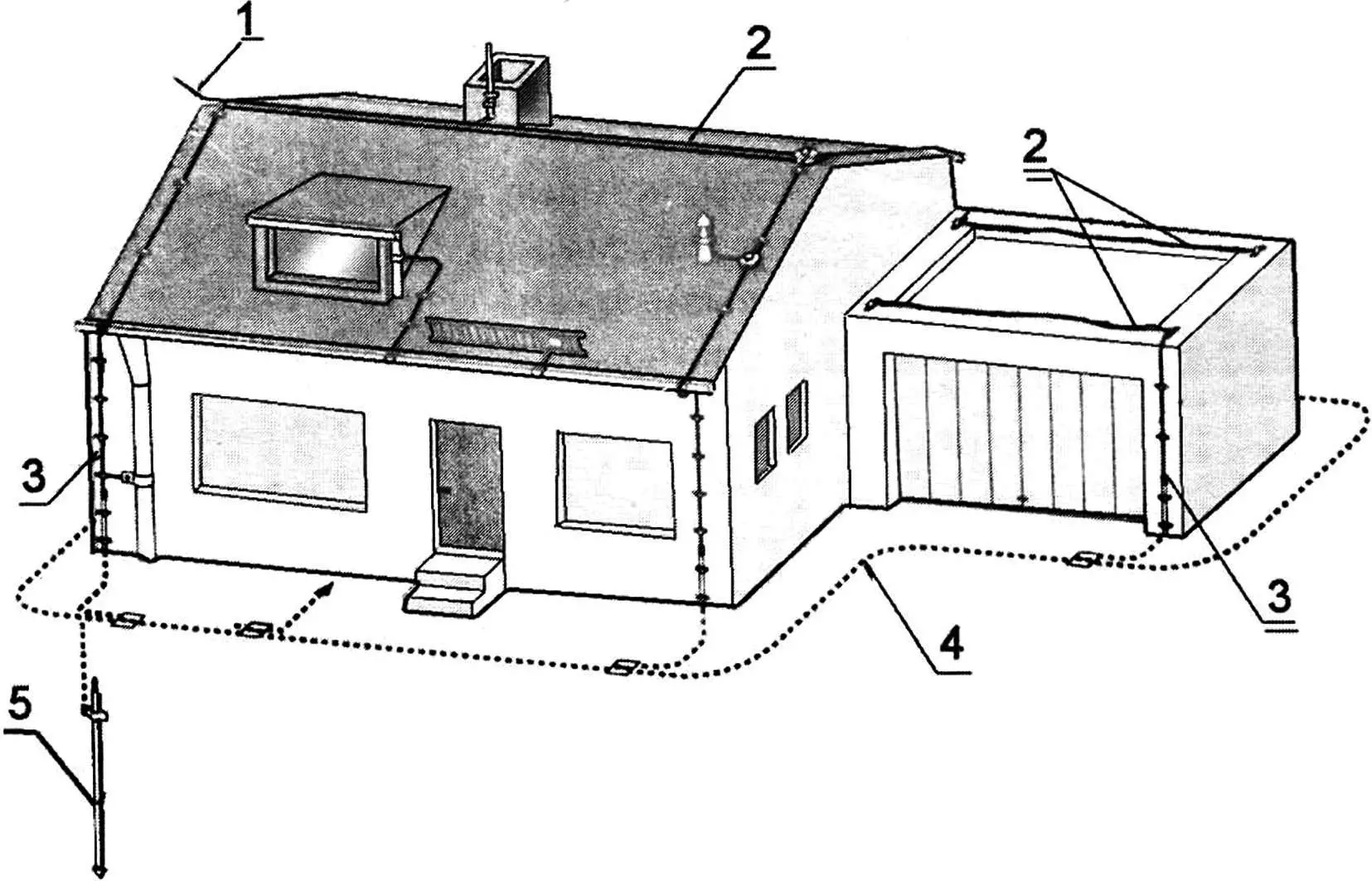
1 — rod lightning receivers; 2 — cable lightning receivers; 3 — down conductors; 4 — down conductor bond (buried); 5 — grounding electrode (buried metal rod)
Pros: such systems are capable of protecting buildings of considerable area from lightning; they are characterized by high reliability, durability, and environmental friendliness. In addition, their lightning rods are compact and do not spoil the appearance of the structure. But active devices have one significant drawback — a high price. That is why not everyone can afford their installation.
Internal control
No less important is to take care of installing the internal lightning protection system of a cottage or a country house: this equipment protects the home property from secondary manifestations of thunderstorms — dangerous effects of the electromagnetic field and voltage fluctuations in the electrical network that can seriously damage wires, engineering communications of the building, and modern equipment (computers, audio and video players, TV receivers, video surveillance or security alarm systems, heating, and air conditioning).
Such systems include surge protection limiters, or lightning discharge arresters, installed in the house on a special incoming-distribution panel. Their basis is semiconductor resistors that change their resistance depending on the applied voltage and, when it surges at the moment lightning strikes, completely burn out (after which they are simply replaced with new ones). In addition to one-time devices, there are also more expensive reusable limiters that self-recover after a discharge.
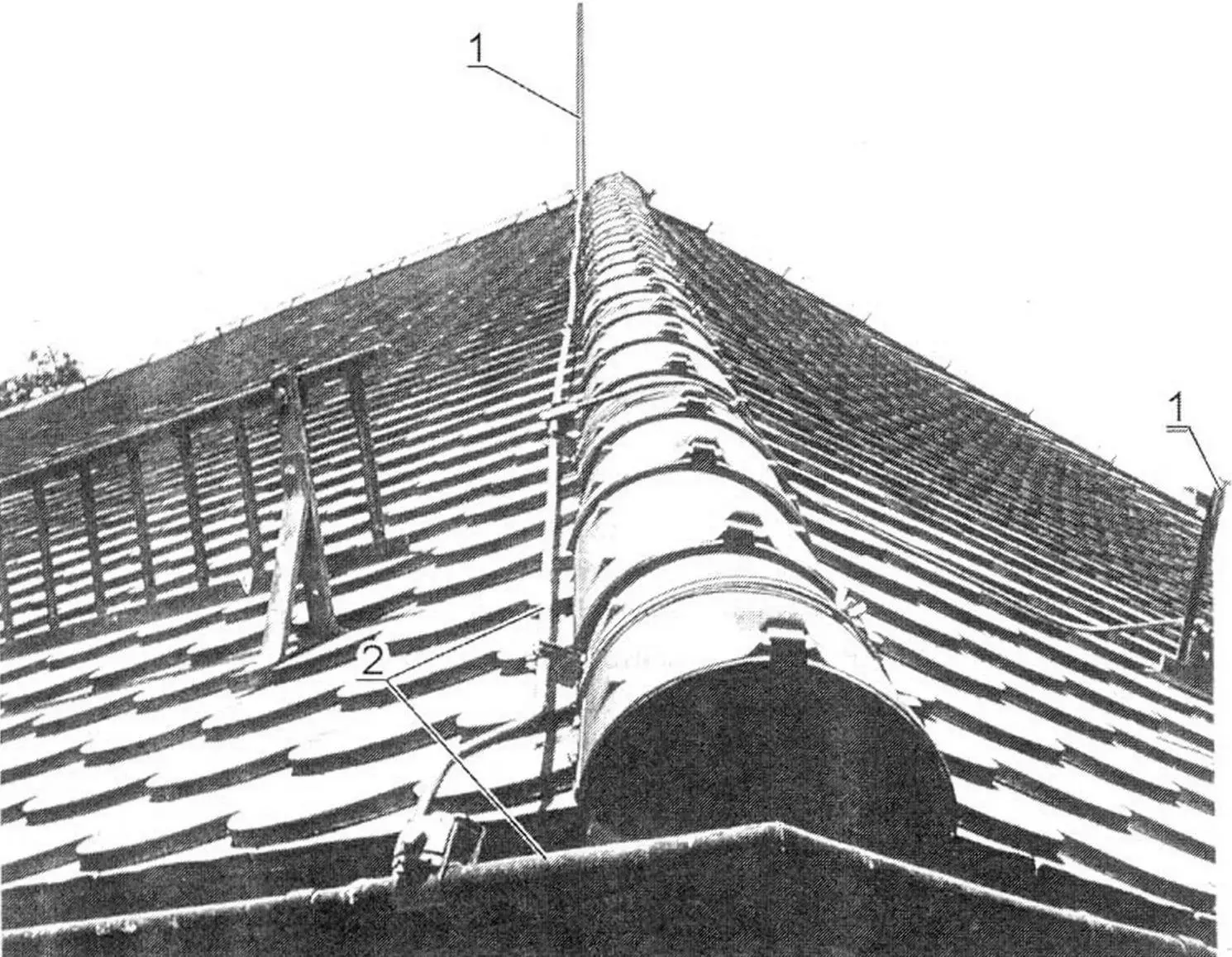
1 — rod lightning receivers; 2 — down conductors
Elements of the internal system also include devices for protection against impulse overvoltages (SPDs). They prevent expensive home appliances from the destructive action of induced voltage caused by a thunderstorm.
In addition, internal lightning protection makes it possible to equalize the potentials of individual electricity consumers. To do this, all current-receiving devices are connected to a single grounding busbar; otherwise, the induced voltage itself will tend to do the same, but with irreversible consequences for household equipment.
Choosing the “panel”
Today, the domestic market offers a wide selection of all kinds of lightning protection systems. How can you tell which system is optimal for a particular cottage or country house?
First of all, you should base your choice on the building’s location and the surrounding natural conditions. If, for example, the house stands in a forest or in a lowland where lightning strikes rarely, you can use a simplified protection option — for instance, install a lightning rod on the tallest nearby tree. It will take the strike during a storm, while the down conductor with the grounding electrode will reduce the risk of fire to almost nothing. If the building is located in an open elevated area, you cannot save on lightning protection — it makes sense to install both internal and external (preferably active) systems.
Installing a lightning protection system is a very labor-intensive and responsible job that requires preliminary calculations and design. Therefore, you must consult professionals and listen to all their recommendations. Otherwise, if you take on the work yourself without the proper knowledge, the installed equipment will not only fail to protect the house during a thunderstorm, but can also become a potential source of danger.
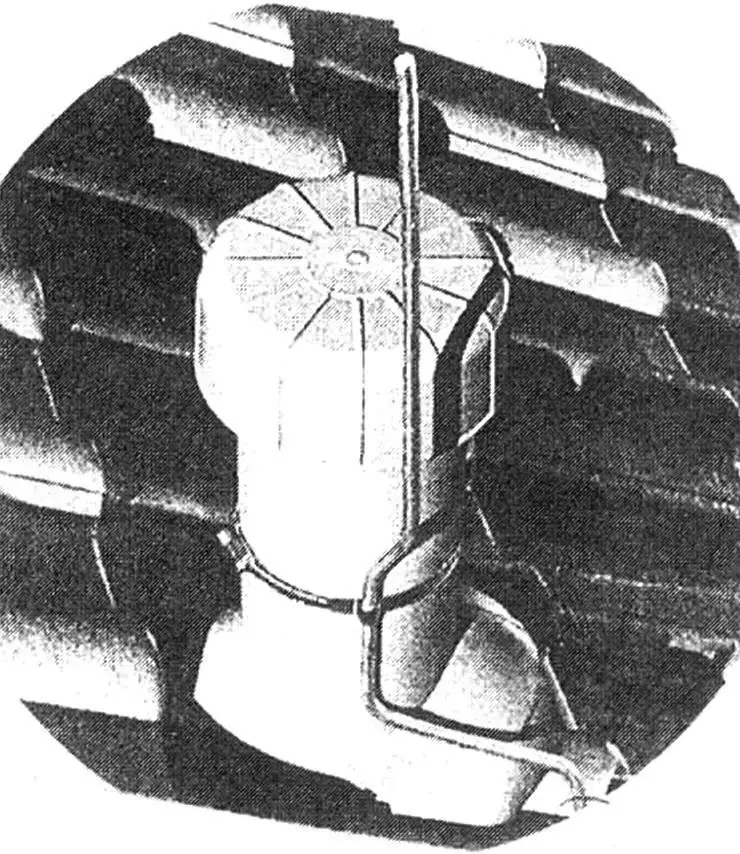
With average thunderstorm activity of more than 20 hours per year (in the middle belt it ranges from 20 to 80 hours), lightning protection must be provided. A lightning protection system consists of a lightning receiver, a down conductor, and grounding. The lightning receiver receives a direct lightning strike and must withstand thermal and dynamic loads. For these purposes, strip and round steel can be used. The smallest lightning receiver cross-section is 60 mm2 with a length of at least 200 mm.
For the down conductor, galvanized round steel wire with a diameter of not less than 5 — 6 mm is used. It is connected to the lightning receiver by welding, soldering, riveting, or bolting; but to the grounding electrode only by welding or by soldering with a hard solder. The contact area must be no less than double the cross-sectional area of the parts being joined. The down conductor is laid along the shortest route in the places most likely to be hit by lightning (roof ridges, projections, and the edges of gables). They are fixed with brackets, clamps, or nails. For roofs that are easy to ignite, the down conductor must be kept 150 — 200 mm away from the roof surface.
The grounding electrode that serves to carry lightning current into the ground must have low electrical resistance. It is placed at a distance of at least 5 m from the porch and pedestrian paths. In dry soils and at a low water table, vertical grounding electrodes are arranged as two rods of length 2 — 3 m, driven into the ground at a distance of 3 m from each other and connected by an underground jumper with a cross-section of 100 mm2 at a depth of at least 0.5 m. The down conductor is connected to the middle of the jumper, and all connections are made by welding.
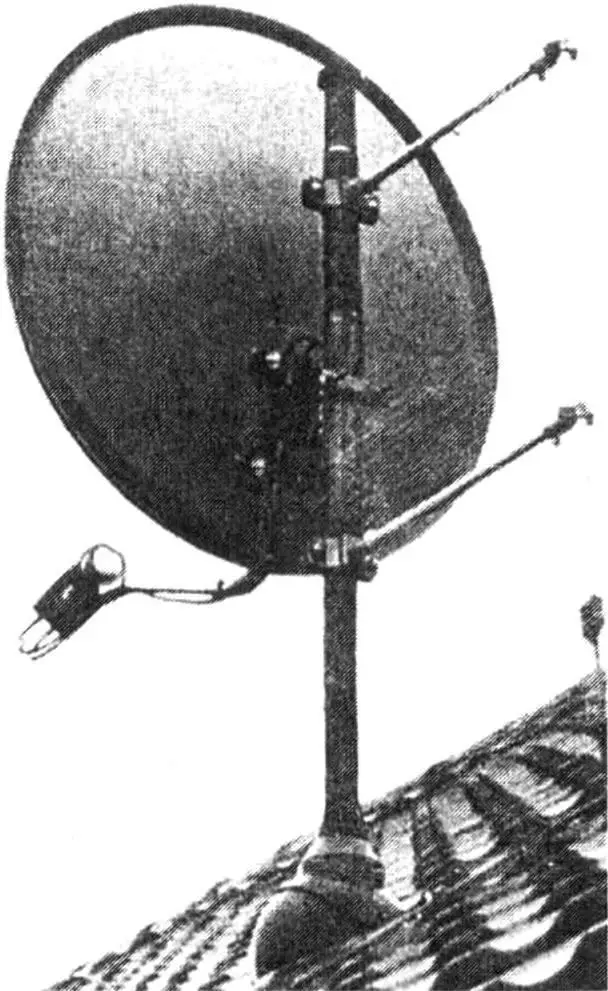
In wet soils and where the groundwater depth is less than 1.5 m (as well as on peat bogs), horizontal grounding electrodes are made. These are metal pipes, angle brackets, strip steel, etc., laid to a depth of at least 0.8 m. The end of the down conductor itself, laid at a depth of at least 1 m, can also serve as the grounding electrode. The longer it is in the ground, the more reliably the lightning protection will work.
Internal and external lightning protection systems must be grounded separately from each other. In houses with non-metallic roofing, lightning protection can be arranged as a steel wire stretched along the roof ridge with lightning receivers. The wire is pulled between wooden posts at a height of 250 mm above the ridge. The posts are attached to the gables.
For equipping external lightning protection, tall trees standing nearby can be used. In that case, lightning protection is made from a single piece of wire with a diameter of 5 — 8 mm, with a one-sided downlead and grounding in the form of a loop. In this case, the zone of rod lightning protection is determined at ground level by a radius R = 1.5L (where L is the lightning rod height).
Lightning protection systems must be periodically inspected in order to verify the reliability of connections.
Permissible options
All external lightning rods, despite some differences in construction, consist of a support, a lightning receiver, a down conductor, and a grounding electrode. Lightning receivers are usually rod and cable types. Rod lightning receivers are made from round steel with a diameter of 12 mm, square steel 10×10 mm, or from water-gas pipeline pipes. The minimum cross-sectional area of such a receiver must be at least 100 mm2, and the length — 200 — 1500 mm. When using pipes, their upper end is hermetically welded, flattened, or closed with a metal plug; to prevent rust, they are painted with oil paint.
A cable lightning receiver is a steel cable of the grade specified by GOST 3063-55, with a cross-sectional area of 48.2 mm2. The metal cable with the supporting lightning-rod structure or with a separate down conductor is connected using stamped clamps of the type PS-2A.
Down conductors — connections between the lightning receiver and the grounding electrode — are usually made from steel with a cross-sectional area of at least 35 mm2, or from a multi-strand cable of the same cross-section.
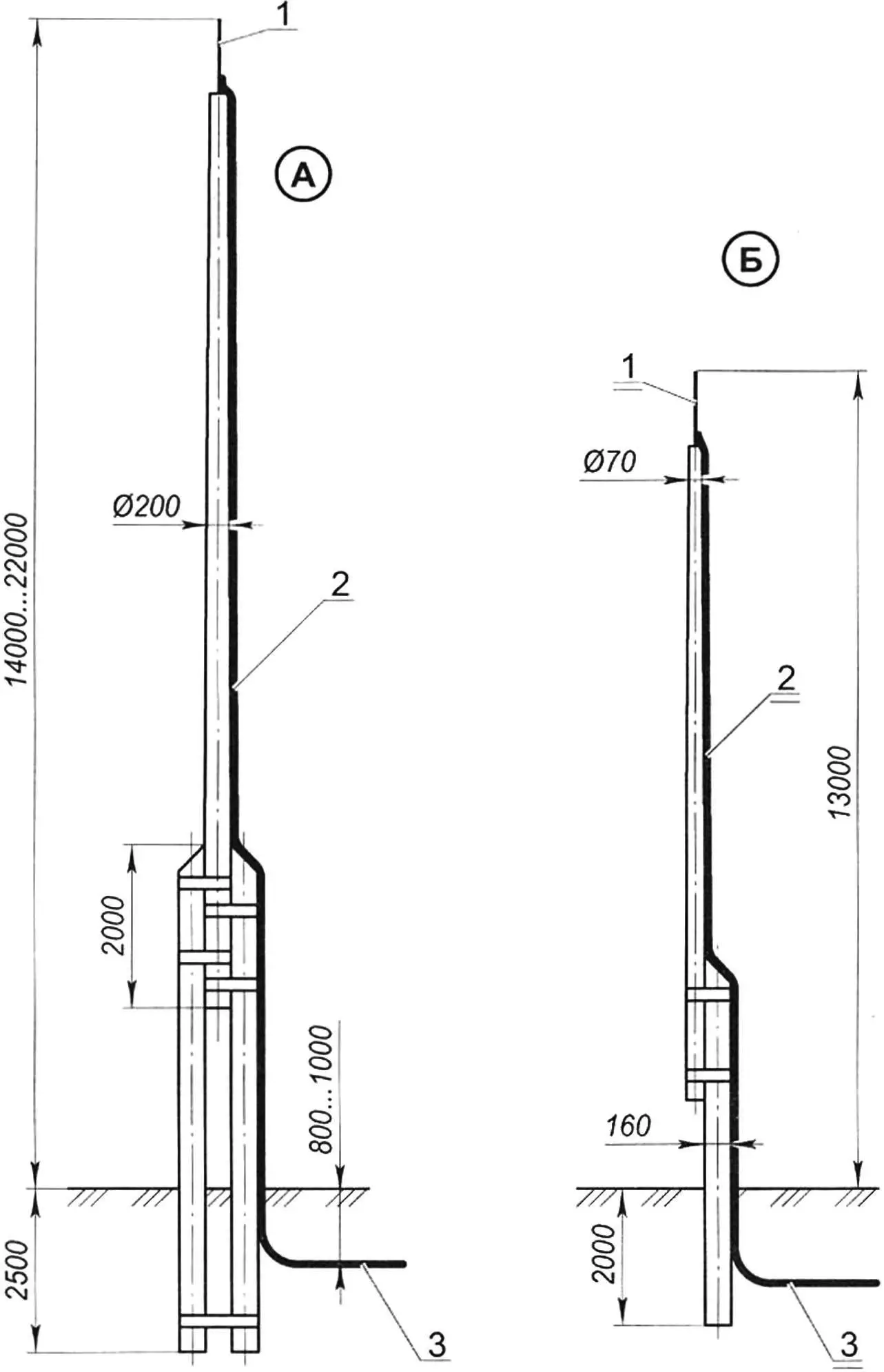
1 — rod lightning receivers; 2 — down conductors; 3 — grounding electrodes
Down conductors are laid along the shortest route, keeping them as far away as possible from electrical wiring. All connections of current-carrying elements must be made by welding. The welded contact area must be at least twice the cross-sectional area of the down conductor.
Existing metal structures of the building can be used for down conductors: fire ladders, frames, and reinforcement of reinforced-concrete elements. Spruce, pine, deciduous, and fir supports are convenient for rod lightning receivers. Using a tree standing close to the building for cable lightning rods is not appropriate.
Down conductors are routed directly along the walls and roofs of the building while keeping them as far away as possible from electrical wiring; their ends are grounded in hard-to-access places.
Lightning-rod supports can be made from wood, reinforced concrete, and metal.
Wooden supports are used for rod-type lightning rods. A lightning-rod support can also be a tree located at a distance from the house. For attachment in this case, use branches and irregularities of the trunk. The height of the lightning rod on the tree is additionally increased by attaching a pole with a lightning receiver and a down conductor to the tree.
| Building dimensions, m | Lightning rod height, m | ||
|---|---|---|---|
| Height | Length | Width | |
| 8 | 6 | 6 | 12 |
| 8 | 7 | 7 | 13 |
| 10 | 7 | 5 | 10,5 |
| 10 | 10 | 7 | 14 |
| 12 | 6 | 6 | 13 |
| 12 | 7 | 6 | 13,5 |
| 12 | 7 | 7 | 14 |
| 14 | 7 | 5 | 12 |
| 14 | 12 | 7 | 14 |
| 16 | 6 | 6 | 14 |
| 16 | 8 | 5 | 13 |
Grounding electrodes come in vertical (driven into the ground as rods), horizontal (as rays or rings made of steel strips), and combined types.
The length of vertical grounding electrodes is 2 — 3 m: they are driven into pits 0.7 — 0.8 m deep, and then the pits are backfilled. Horizontal grounding electrodes are laid at a depth of 0.6 — 0.8 m. For simplified lightning protection, grounding electrodes made of round steel with a diameter of 5 — 6 mm are used. For grounding a large lightning rod, round steel with a diameter of 15 — 20 mm, steel pipes with an outside diameter of 30 — 60 mm and a wall thickness of at least 3.5 mm can be used, as well as strip steel 20 — 40 mm wide and 4 mm thick, angle steel No. 4 — 6, and so on. Coating the grounding-electrode elements with varnish or bitumen is prohibited. They are connected into a single grounding system only by welding. As a rule, grounding electrodes are located outside the building at a distance of 0.8 — 1 m from the foundation.
A metal roof of a house can itself serve as a lightning receiver; in the vicinity of chimneys and ventilation channels, separate protective rods are installed.
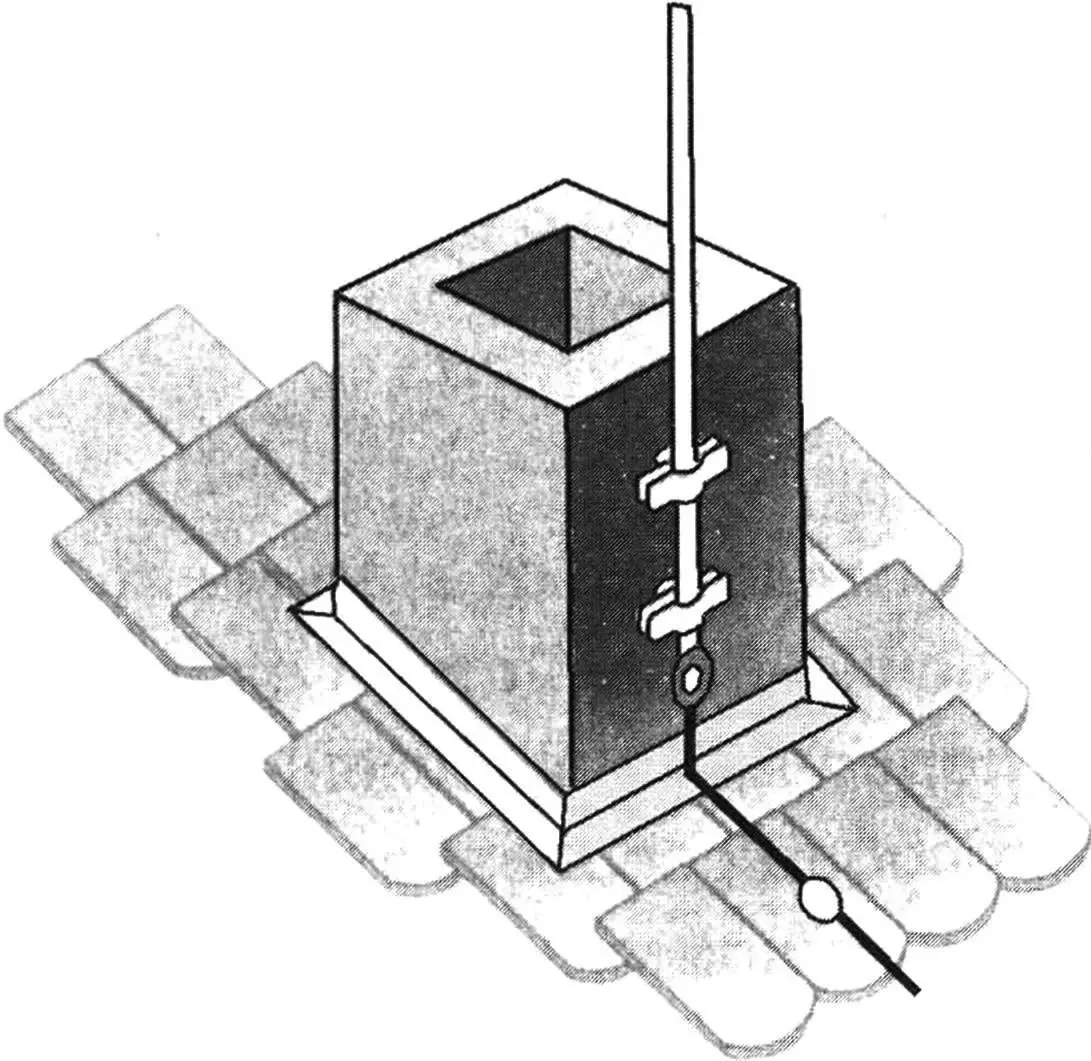
To protect chimney stacks, a lightning rod made of steel wire with a diameter of 5 mm is arranged; it is attached to the pipes using a “fork” made from the same wire.
“Modelist-Konstruktor” No. 2’2011, B. VALENTINOV (Based on materials from industry publications)
Recommend to read
 ATHLETE IN THE BRANCHES
In the Arsenal of various tools gardeners must have some version of the shears — a special "powerful" scissors that facilitate cutting of branches of fruit trees and shrubs in the... “REVIVAL” ENERGY-SAVING LAMPS
Fluorescent energy-saving lamps in recent years become increasingly popular, despite its relatively high cost. Indeed, all the good these lights are, but the one absurdity of spoiling...
