
In rural estate-type houses, and even in simple country cottages, of which there are countless numbers today, it’s unlikely to get by without some kind of stove — Russian, Dutch, or a simple “burzhuyka” — even if “we have gas in our apartment.” It’s just that “blue fuel” is still far from available everywhere and to everyone. But even if gas is connected to the house, standing at the stove in the kitchen and cooking food in the summer heat is a real punishment. And yet, as we know, this has to be done more than once a day.
Therefore, having mentally calculated the design and selected suitable materials from what was available in the shed, I set about building an outdoor stove (or rather — a cooking stove in the garden).
First of all, I determined the most suitable location on the plot for the future stove. I chose it not only from the point of view of convenient access, but also taking into account the prevailing summer wind — on the leeward side from the house and away from wooden outbuildings.
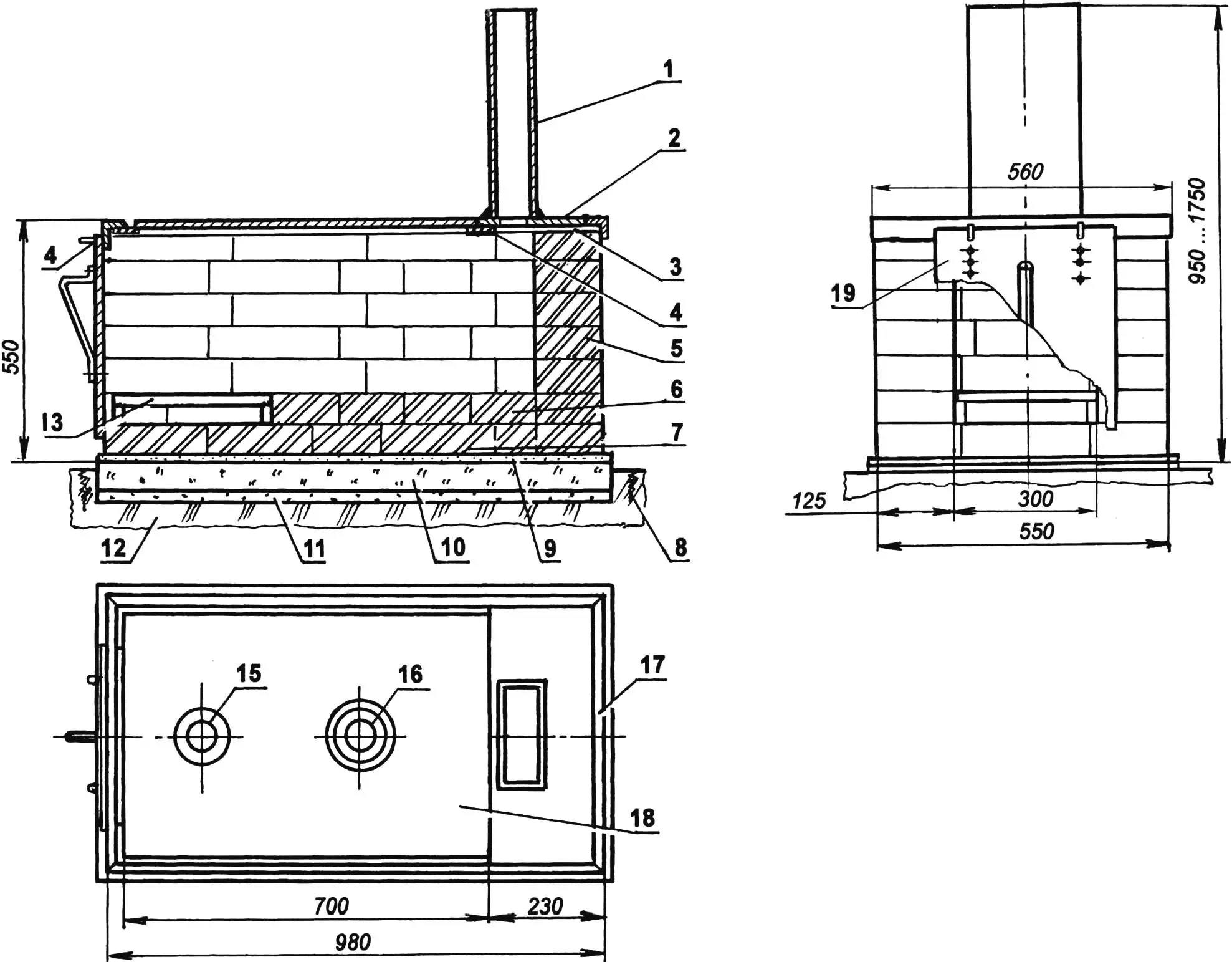
1 — chimney; 2 — chimney support plate; 3 — screed (mortar); 4 — support ledge (2 pcs.); 5 — firebox wall (solid ceramic brick, as needed); 6 — hearth (solid ceramic brick, as needed); 7 — base (solid ceramic brick, as needed); 8 — topsoil; 9 — leveling layer (mortar); 10 — foundation (concrete); 11 — subbase layer (sand); 12 — native soil (clay); 13 — grate; 14 — damper hook (2 pcs.); 15 — small burner; 16 — large burner; 17 — frame;
18 — top plate (steel, sheet s4); 19 — damper
Although the stove is a small structure, it is massive, so I decided to make a slab foundation for it. I removed the topsoil to a depth of about 150 mm (to the native clay soil), added a layer of sand about 7—8 cm thick at the bottom, and poured concrete slightly above the ground surface. I used broken red (ceramic) brick as filler.
After that, I let the foundation strengthen for a couple of days and began the masonry. I did it from solid ceramic brick measuring 250x125x65 mm (but I also used three-quarter pieces and even halves) on a lime-clay mortar about 10 mm thick. Approximate mortar composition: 1 part clay + 1 part lime milk + 2 parts sand.
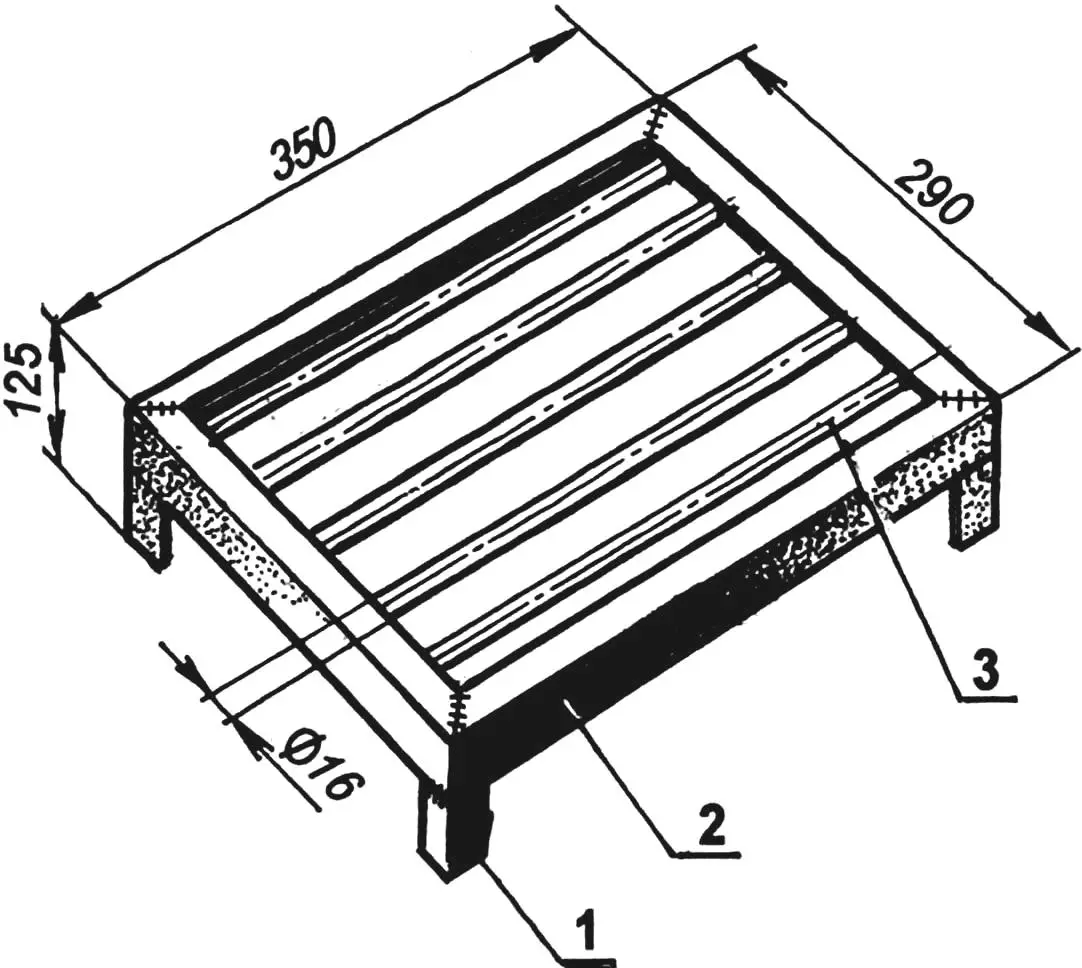
1 — leg (4 pcs.); 2 — frame; 3 — grate rod (rod Ø16, as needed)
The first row formed the bottom of the stove. I laid it almost over the entire foundation area, carefully filling the joints with mortar. The second row — I laid it over the area of the first with overlapping joints, leaving only a recess (ledge) in front for the grate. In doing so, as with the bottom masonry, I used whole bricks, three-quarter pieces, and even halves.
I continued the firebox wall masonry around the perimeter, only half a brick thick — after all, thermal inertia is not required from a garden stove. I again did the masonry with overlapping joints, using three-quarter brick pieces where needed. Having raised the walls to five rows, I considered the firebox height sufficient. The flames from the burning fuel should, according to my calculations, be located somewhere slightly below the plate covering the firebox.
Leaving the brickwork mortar to dry, I set about making (cutting and welding) the steel parts: frame, plate, pipe, grate, and damper.
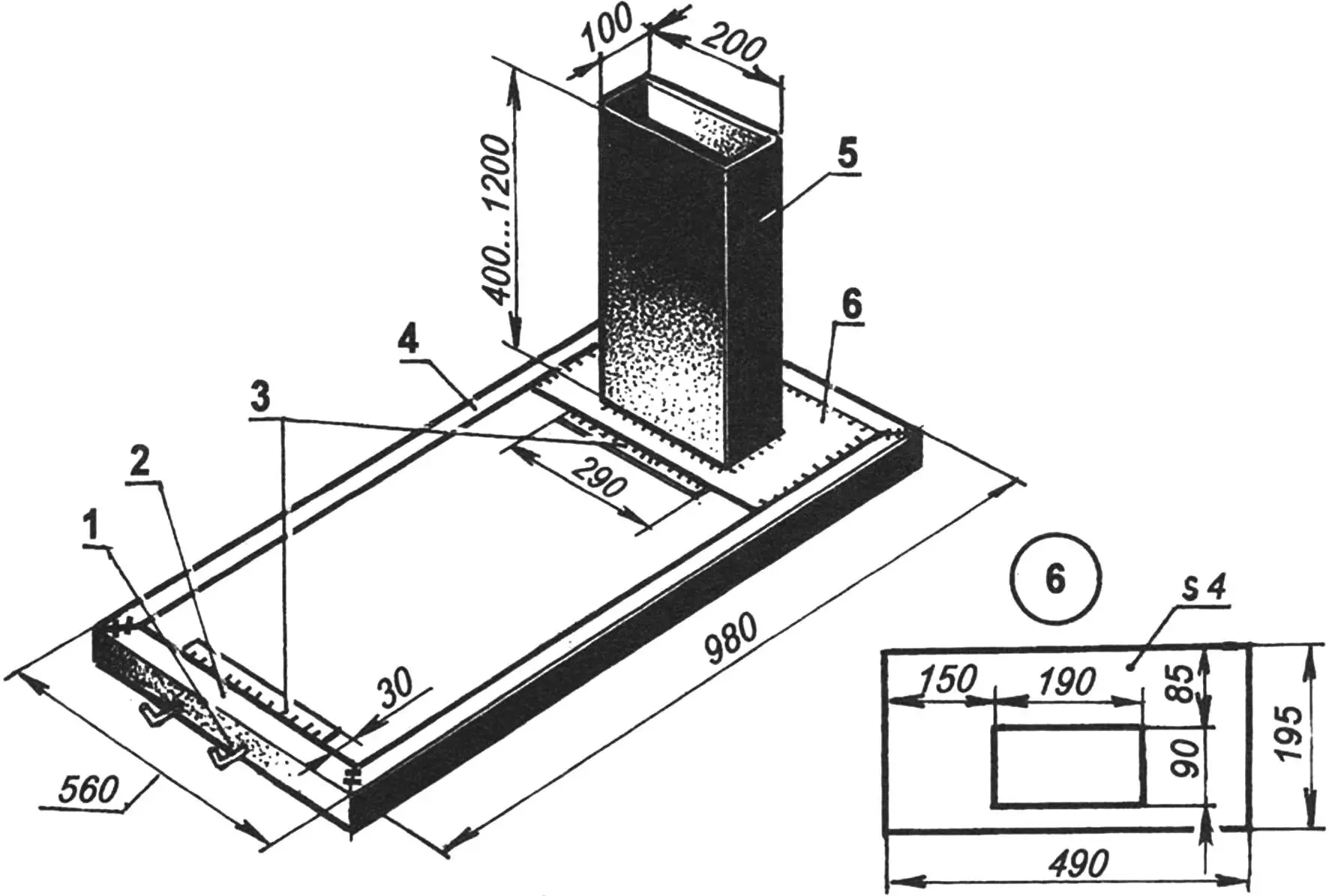
1 — damper hooks (steel wire Ø6); 2 — frame cross member (35×35 angle, 2 pcs.); 3 — top plate support ledges (steel strip 290x50x3); 4 — frame beam (35×35 angle, 2 pcs.); 5 — chimney (steel sheet s2); 6 — chimney support plate (steel sheet s4)
I welded the frame from 35×35 mm angle, welding a support strip — a support ledge for the top plate — to its front part. I set the frame on the masonry with a screed — a layer of mortar. From the same 35×35 mm angle, I also welded the grate frame, and made its grid from rods 16 mm in diameter.
I cut the top plate from a 4-mm thick sheet, and the damper and chimney support plate — from a 3-mm sheet.
In the top plate, I made two round burner holes. I used the cut-out circles to make burner lids. Looking ahead, I’ll say that the top plate is removable. If desired, food can be cooked with “smoke” over an open fire (for example, cooking fish soup) or the stove can be used as a grill (for example, grilling shashlik).
I also made the damper removable. But this was more out of necessity — I didn’t have and couldn’t get a firebox door or an ash pan. I drilled several pairs of holes in it (the damper).
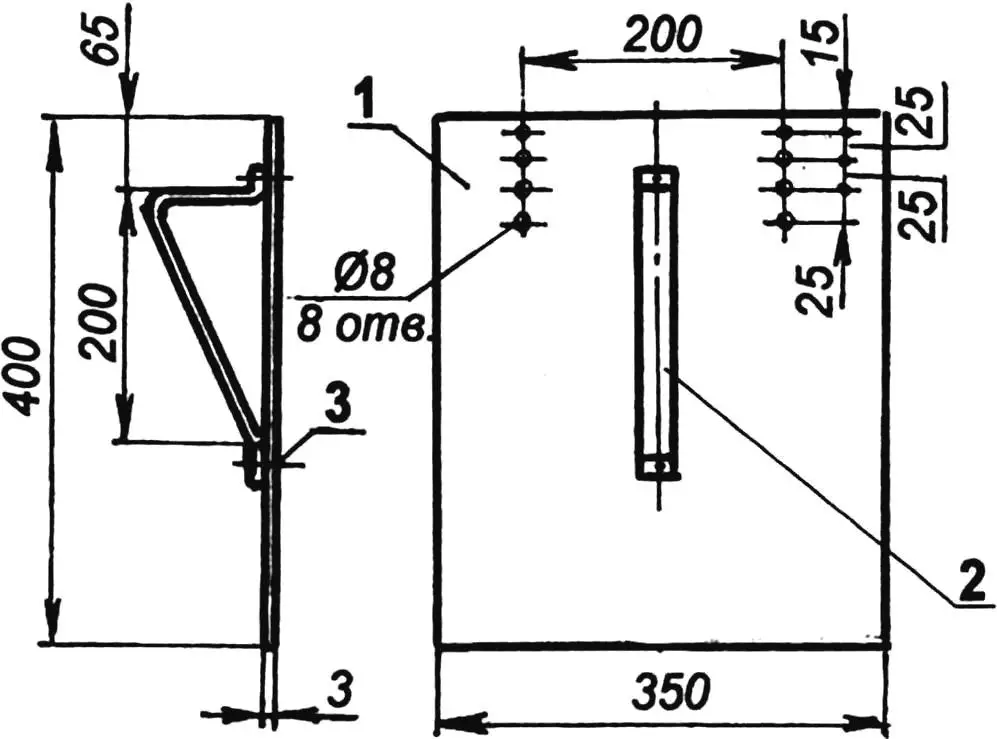
1 — damper (steel sheet s3); 2 — handle (steel strip 300x25x3); 3 — rivet (2 pcs.)
Now, by moving the damper on the hooks welded to the frame, from one pair of holes to another — I regulate (increase, decrease, or completely close) the opening of a makeshift ash pan, thereby changing the draft in the firebox.
As for the chimney support plate, having first welded to it, as well as to the frame, the top plate support ledge and the pipe itself, I “permanently” connected it by welding to the frame angles.
I initially wanted to make the chimney welded, rectangular in cross-section, and even cut a corresponding hole for it in the support plate (this is the version I show in the drawing). But then I found a ready-made cylindrical (200 mm diameter) pipe and welded it to the support plate through a rectangular adapter.
For protection from rain and for winter, I cover the stove from above with a sheet of flat slate with a hole cut for the pipe, and the pipe itself — with a cut-out piece.
For fire safety purposes, I built a small pool from an old tractor tire not far from the stove.
A. MATVEYCHUK
Recommend to read
 HOMESTEAD TRUCK
I've been a longtime reader and a regular subscriber of the magazine "modelist-Konstruktor". For nearly forty years, not only got acquainted with the machines and mechanisms for... NEW LAMP MADE FROM OLD PARTS
Fluorescent lighting is much more economical and durable than conventional incandescent lamps. Especially when equipped with modern fluorescent lamps (LDS) with a cap, which fits easily...
