Many people know or suspect that any lock, even the most expensive one, can be opened with certain skills and tools. The design of the proposed lock is simple, but it will give an experienced burglar maximum “pleasure” before he “cracks” it.
People who have ever taken an interest in these matters are surely familiar with a lock whose key is of the “sea bolt” type (a folding bolt): teeth (grooves) are cut on the upper face of the latch or an ordinary slide bolt; the “dropping” part of the key engages them, and when the key is turned the latch is drawn back. Everything here is fine, except that if needed — or with malicious intent — the required length of the free end of the key can easily be found in two or three attempts…
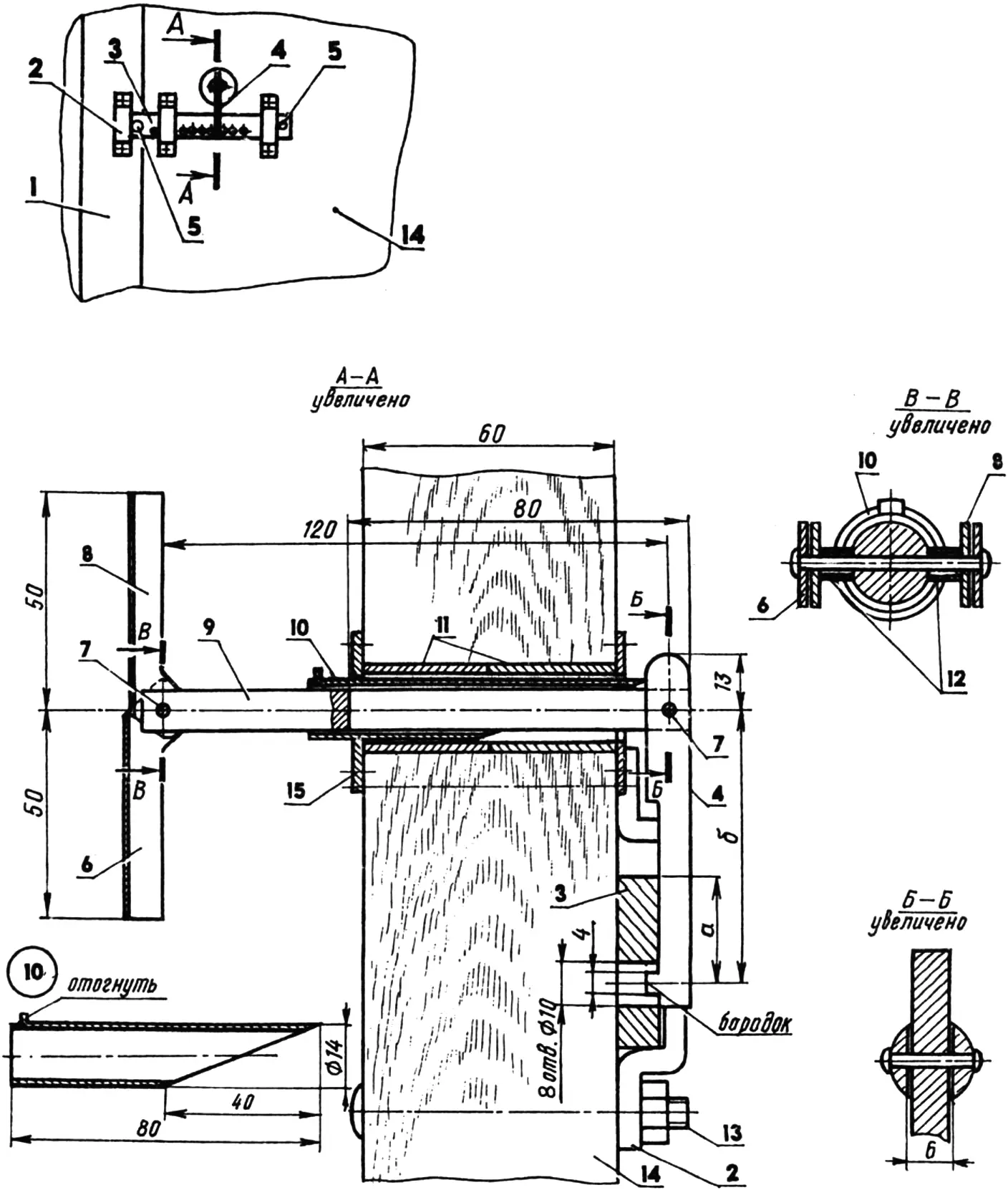
a, b — secret dimensions; 1 — door jamb; 2 — bracket (strip 40×5, 3 pcs); 3 — latch (strip 40×10); 4 — key bit (strip 10×4); 5 — travel stops; 6 — lower key lever (tube 22×2, L58); 7 — axles (rod Ø3, 2 pcs); 8 — upper key lever (tube 18×1.4, L58); 9 — key stem (rod Ø10); 10 — slider; 11 — keyhole bushings (tube 16×1); 12 — hinge bushings (tube 6×1); 13 — M8 bolt; 14 — door; 15 — cover plate (sheet s2, 2 pcs).
In our case everything is somewhat different. Brackets are fastened to the door jamb and to the door itself (preferably with through bolts that have a flat smooth head), and a latch with a series of holes drilled in it is inserted into them. The number of holes, their pitch, and their position relative to the upper edge of the latch (dimension “a”) are chosen arbitrarily. In the door, above the latch, at a distance “b” (60 — 100 mm) from the axis of the holes and midway between the door brackets, a hole is drilled — the keyhole. It should be borne in mind that the higher it is above the latch, the longer the key will be. Bushings glued into the hole will prolong the life of the door.
Now about the key design. It consists of a cylindrical stem with a slot, two levers made from halves of a tube cut along its axis, a tubular slider with an oblique cut, and a bit. The hinged connection of the key parts, the stem slot, and the slider cut serve to fold the key. The unequal-arm bit has a beard whose position (dimension “b”) is determined by the relative positions of the keyhole and the holes in the latch. Since the slider has to be turned 180° while opening and closing the lock, it is rather difficult to keep track of its position. For this purpose a part of the edge at the free (left in the drawing) end of the slider is bent slightly, showing where the slider’s nose is (instead of the bend, a saw cut can be made). To keep the slider from sliding off the stem, the rivet heads that hold the bit are best made tall.
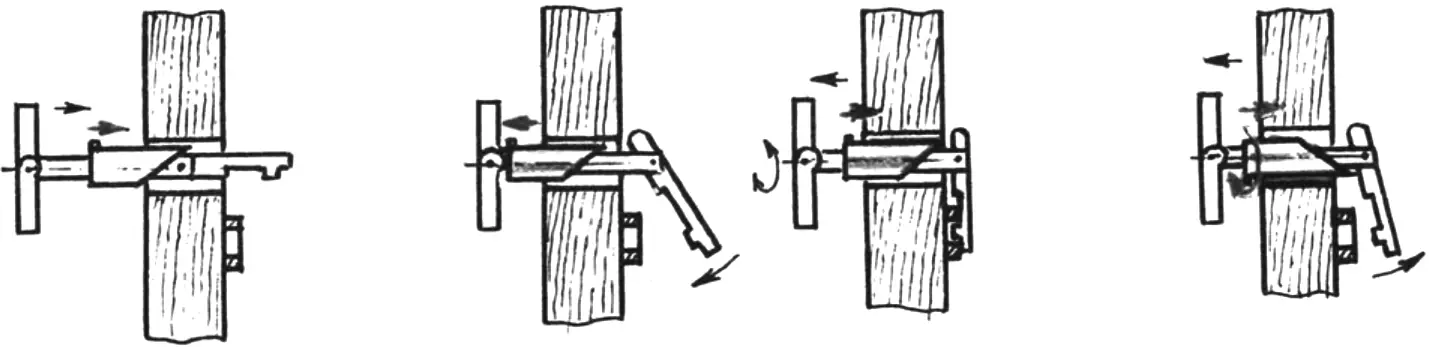
The virtue of this design is that it is practically impossible to feel the holes in the latch from the outside of the door with anything except the “native key.” However, it remains possible to “compute” the latch position from the heads of the bracket-fastening bolts. To prevent this, the brackets are made asymmetrical or with long legs, and so that an ill-wisher cannot examine the lock’s secret from the inside (when the door is open), the mechanism is covered with a box or a rubber sheet.
«Modelist-Konstruktor» No. 7’98, V. KUDRIN
Recommend to read
 THE ASTUTE PARTNER
The weight started with the fact that the employee of the bell States telephone laboratories in new Jersey (USA) D. Hagelbarger created in the early 50-ies of the cybernetic device to... SHOES FOR THE CHRISTMAS TREE
For setting up a small Christmas tree to make the d-pad is not a problem. I set out to build a universal that is not dependent on the thickness of the barrel. Took two cut a metal...
