
Submersible vibration electric pumps “Malysh” and “Rucheek” are a common choice for autonomous water-supply systems of small households, including farms. They are compact, convenient to operate, and reasonably priced. But there is a problem: such pumps cannot cope with subzero temperatures. When the pump is switched off in winter, water is trapped in the supply hose and, having no drain back into the well, freezes.
A drain hole in the lower part of the hose might seem to help. However, if it is too large, the pump’s working pressure will be weak; if it is too small, the water will still freeze in severe frost.
“Modelist-Konstruktor” once recommended, as one solution, fitting an automatic drain valve into the pump hose (see issue No. 7’86 of the magazine). Practice has shown that this solution works — with this device, frost is no longer a threat.
The drain valve works as follows.
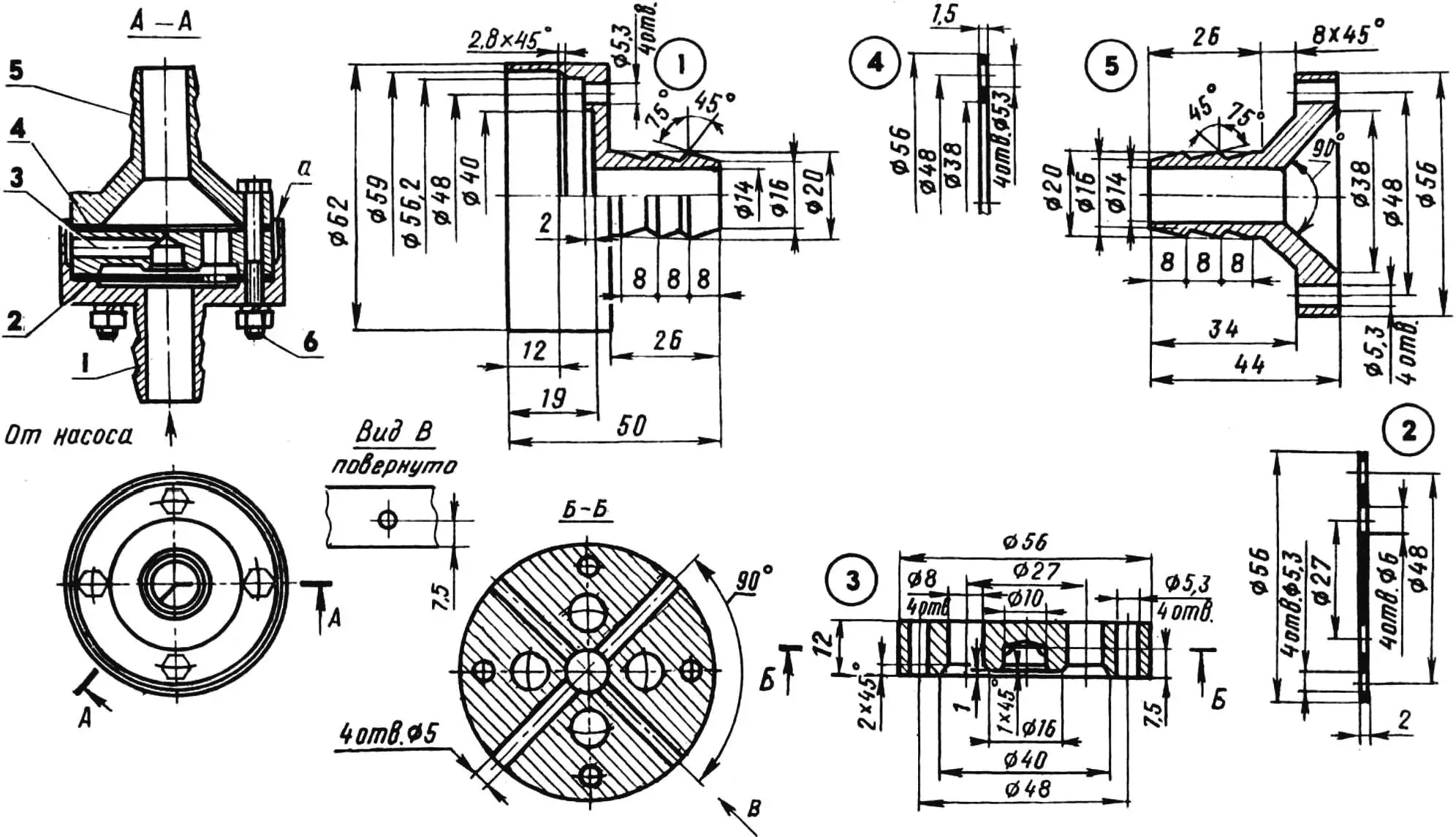
1 — body, 2 — diaphragm, 3 — insert, 4 — gasket, 5 — cover, 6 — M5 bolt (4 pcs).
Parts 2 and 4 are made of rubber; the rest are brass or bronze.
Water enters the body cavity and, due to a sufficiently strong pressure, bends the diaphragm upward, pressing it against the insert. As a result, the insert’s central opening and the radial openings extending from it are closed off.
The water then flows through four 6 mm openings in the diaphragm and four 8 mm openings in the insert into the cover cavity and rushes out through the connecting hose.
When the pump is switched off, the diaphragm straightens, the central and radial openings in the insert open, and the water drains through gap “a”. Thanks to the design of the gap, however, there are no powerful side jets during draining. This means that neither the turbidity of well water typical of a deeply submerged pump nor the undesirable washing of the well casing walls occurs.
Equipping an individual water-supply system with such an automatic drain valve is within the capabilities of even a beginner DIY maker. Few parts are required, and they can be made in any workshop. The unit starts almost instantly, and when switched off, draining a 25 m network takes less than a minute. Therefore even the hardest frost does not have time to freeze the water in the system. You only need to make sure that the hose running from the house to the pump has no kinks and a constant downward slope. The rest is a matter of technique.
“Modelist-Konstruktor” No. 1’98, V. KAZIN
Recommend to read
 WHEN PIPE — BUTT
Capacity pipes through their joints is a matter that must face not only the professionals who build and service pipelines. Many homebrew, rural residents, gardeners-gardeners are forced... SHOWER… PNEUMATIC CHAMBERS
As known, the base year is country soul tank of adequate capacity. Most often used metal barrels, baby baths or any other suitable containers. However, few people know that the best tank...
