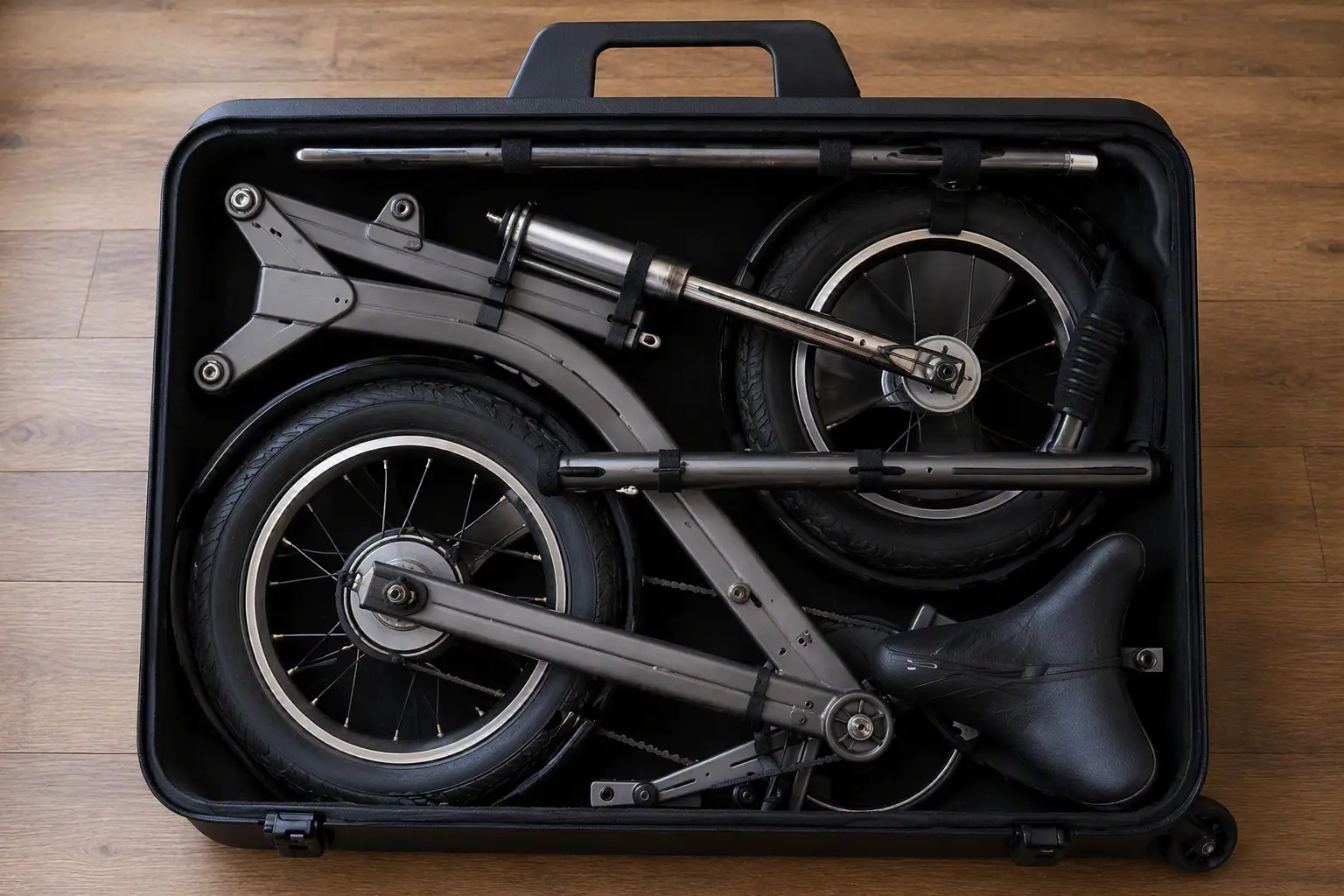
A folding bicycle is nothing surprising today. However, even when folded, its dimensions are not that small, and storing it at home — let alone carrying it on a bus or tram — is not always convenient.
I set out to develop a convenient folding bicycle with the smallest possible folded dimensions. I wanted it to transform easily into a suitcase the size of a familiar “diplomat” briefcase. I will say right away that this goal was not achieved, but I did manage to design a two-wheeled machine that, after transformation, fits into a suitcase or bag measuring 650x450x150 mm.
The product uses tubeless wheels from a children’s bicycle (or scooter) with tires marked 250×56. If you happen to have different wheels, you will need to modify the folding bicycle design.
The bicycle frame is of the backbone type; it is bent from a tube with an outside diameter of 40 mm and a wall thickness of 2 — 2.5 mm. At the front of the frame there is a hinge-and-coupling unit consisting of two shaped three-millimeter steel plates. The plates are attached to the frame by welding. Holes for the hinge and locking bolt are drilled in the plates and finished after welding. On the opposite side of the backbone tube, the bearing unit of the driving sprocket — the bottom bracket shell — is welded on. There is no need to make it yourself — a bottom bracket from almost any bicycle will do. Near the bottom bracket, a locking device is welded to the frame, with which the rear fork is securely coupled to the frame. Note that this unit is best mounted “in place” during bicycle assembly. This will ensure that the mating parts — both the one on the frame and the one on the rear fork — align precisely when the bicycle is folded. I will explain how this is done later, when assembly of the two-wheeled machine is discussed.
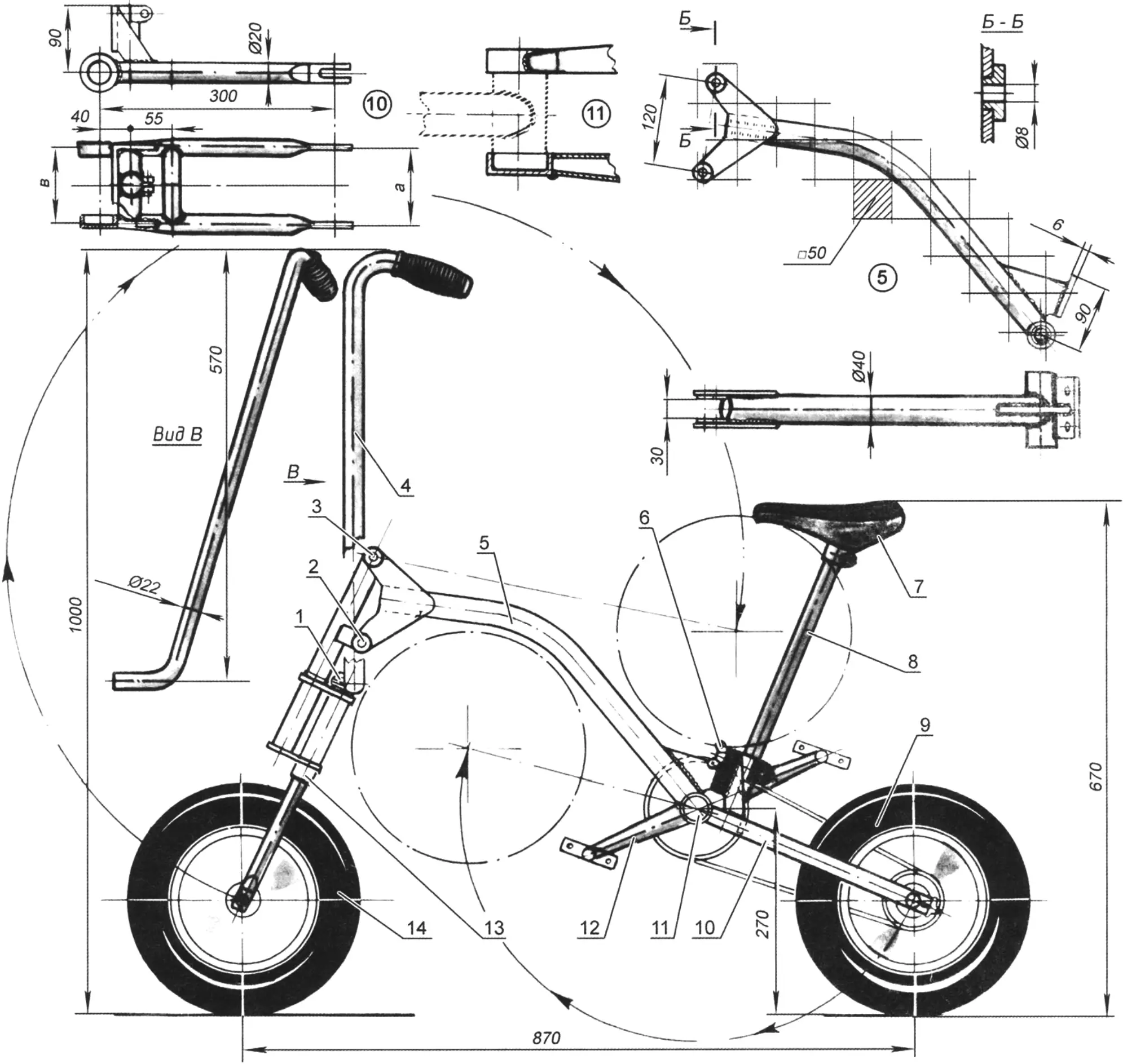
1 — clamps for securing handlebar half-arcs; 2 — locking unit; 3 — front fork rotation unit when folding; 4 — handlebar; 5 — frame; 6 — wing nuts with bolts of the central locking unit; 7 — saddle; 8 — seat post; 9 — rear wheel; 10 — rear fork; 11 — rear fork rotation unit; 12 — pedal unit (from any bicycle); 13 — front fork; 14 — front wheel
Dimensions “a” and “b” are selected according to the size of the wheels used; dimension “c” is determined by the bottom bracket used in the design
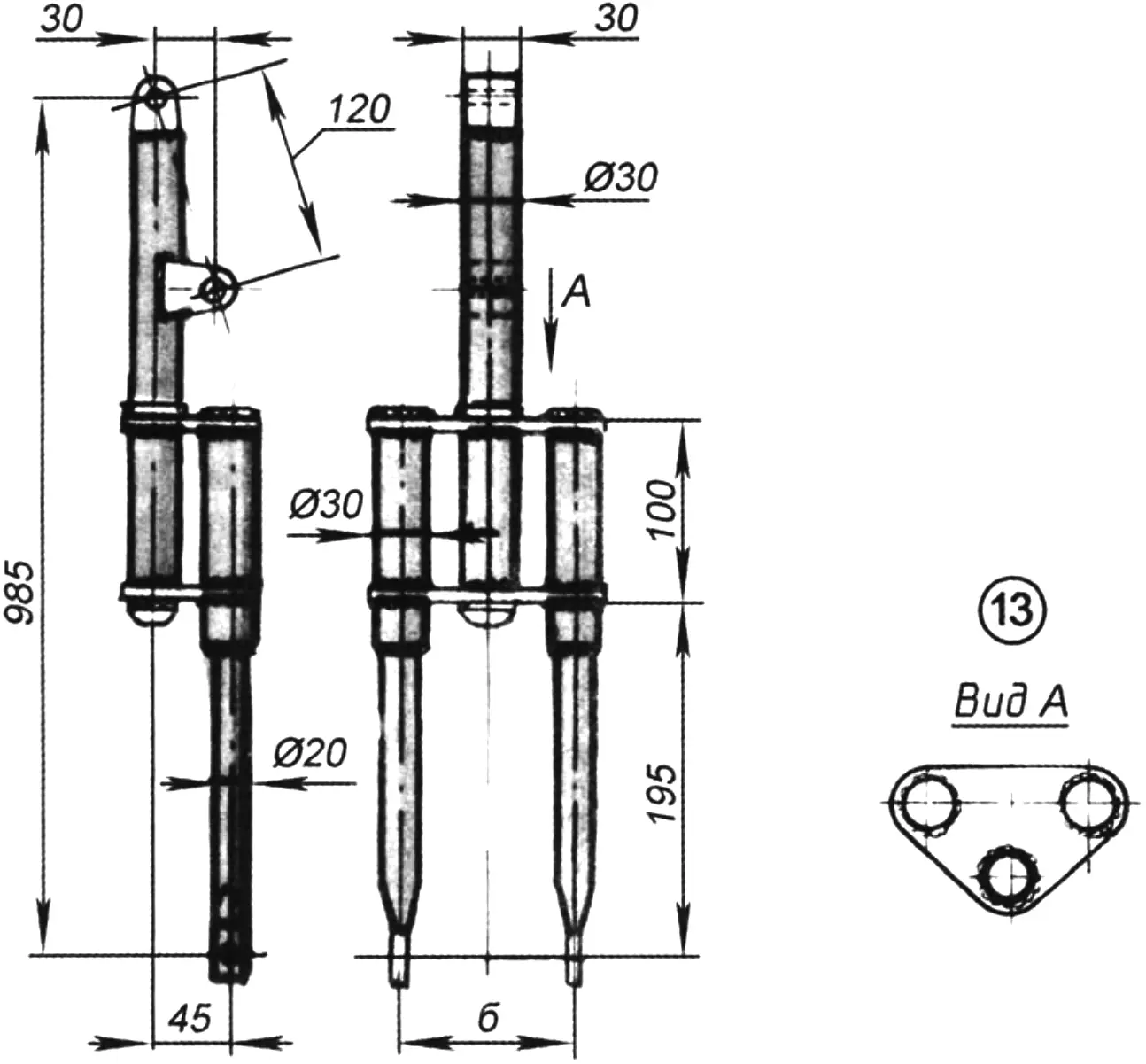
The front fork in design resembles a moped fork turned 180°. It consists of a fixed part and a rotating part. The rotating part is welded from a bicycle head tube (cut from an old bicycle frame) and two blades, each welded from two tubes that telescope into each other. The outside diameter of the larger tube is about 30 mm, wall thickness 2 mm; the inside tube diameter is about 20 mm, wall thickness 2 — 2.5 mm. The blade ends are flattened, and holes are drilled in them to match the bicycle wheel axle diameter. The head tube is welded to the blades using two bridges — plates about 3 mm thick with holes drilled for the head tube and blades.
The fixed part of the front fork is a steel tube whose outside diameter is the same as that of the bicycle head tube welded into the rotating part of the fork. Another tube is inserted into the latter and secured by welding — of such diameter that bicycle head tube bearings can be fitted onto it. The rotation unit, about which the front part of the bicycle folds, is also mounted on the fixed part of the front fork, as well as an “ear” for the locking bolt that holds the front fork in the working position.
Two clamps are mounted on the upper bridge of the front fork to secure the handlebar half-arcs — they can be bent yourself from sheet steel or purchased at a shop that sells moped and motorcycle parts.
The rear fork is welded from two blades — sections of steel tubes 20 — 22 mm in diameter with a wall thickness of about 2.5 mm. At the rear, two shaped steel plates 3 mm thick with a longitudinal slot are welded in — the rear wheel is secured in them. At the front, two steel rings are welded, which together with the bottom bracket serve as a hinge. The right and left blades are joined into a single welded unit by two tubular cross members. Note that the hinge connection of the rear fork and frame is non-detachable. It is best done as follows. First, prepare the right and left fork blades — that is, weld the hinge rings and shaped plates to the tubes. Then the blades are installed on the bottom bracket and temporarily connected with a wooden block and a steel wire tie. Check the hinge operation carefully — the frame and rear fork should rotate easily relative to each other and have no large play. Next, fit the cross members to the blades and tack them with two or three weld spots. After removing the wire tie and the wooden block, make sure the hinge works reliably and finish welding the unit joints.
The bicycle handlebar consists of two half-arcs secured by two clamps on the upper bridge of the front fork. Thin-walled steel tubes 22×1.5 mm are suitable for the handlebar. They should be bent after first filling them with sand and heating with a blowtorch or in a forge.
The saddle is ordinary, bicycle-type. The seat post is elongated compared to usual ones. Its length is about 400 mm. It is secured in a split tube to which two “ears” with an 8 mm through hole are welded. This forms a kind of collet tightened with an M8 bolt and wing nut.
Assembly. First, mount the locking device on the frame and rear fork. It consists of two mating parts connected when unfolding the bicycle into the working position by two bolts and wing nuts. The first is two steel plates 6 mm thick welded in a T shape. The second is a section of steel channel with a U-shaped profile, also with a wall thickness of about 6 mm.
The locking device is mounted on the bicycle, as already mentioned, “in place.” For this, after making its mating parts, they are connected with bolts and fitted to the frame and rear fork set in the position shown in the drawing. After that, the locking device is tacked to the frame and rear fork, its operation is checked, and it is finally welded.
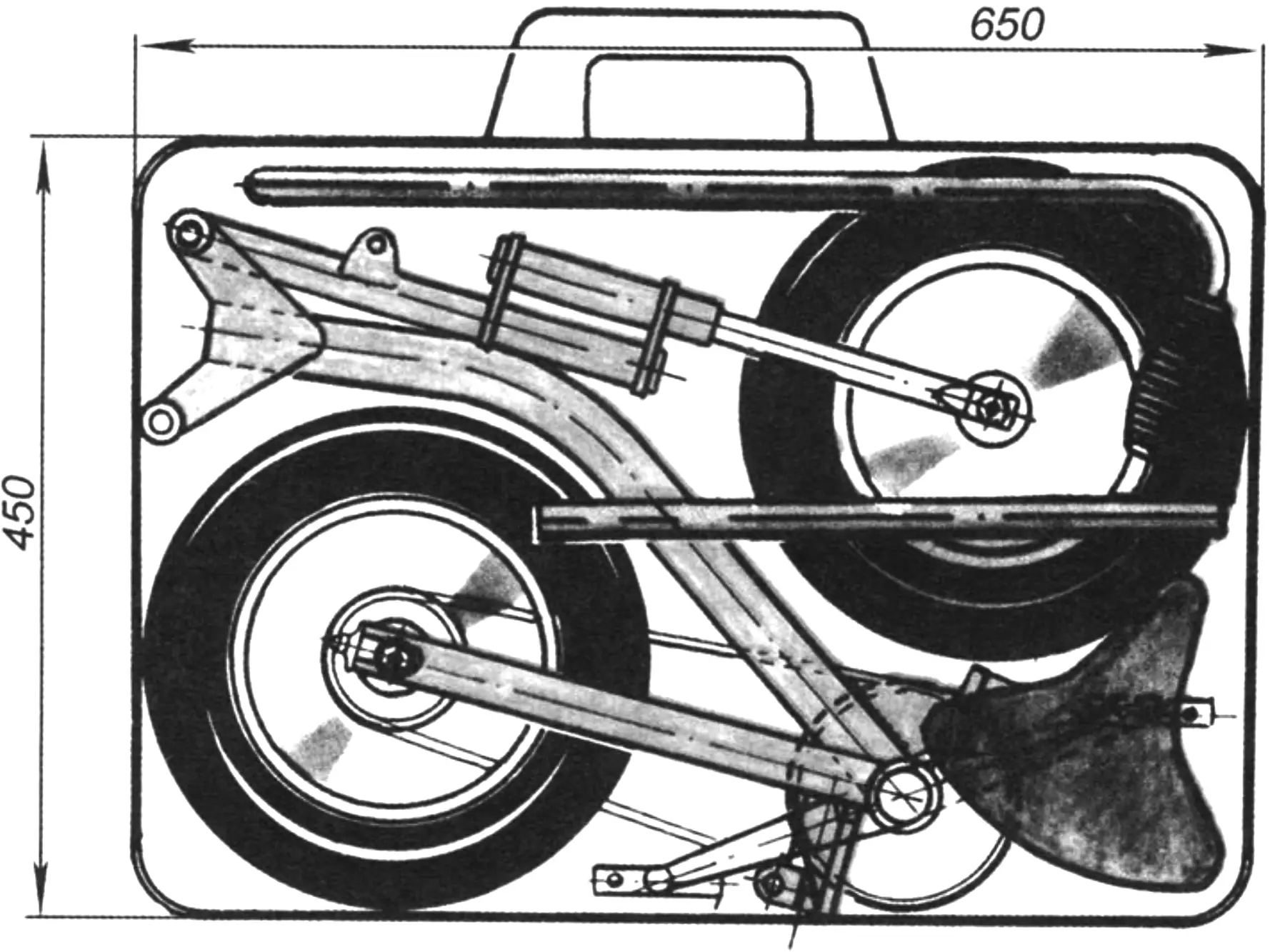
To store or transport the folding bicycle, you will need a suitcase measuring, as already stated, 650x450x150 mm. If you cannot find one, a bag of these dimensions can be sewn yourself — from artificial leather or canvas. To help it hold its shape, 5 mm steel wire is sewn in around the perimeter (on the side view), and a plywood panel is placed in the upper part (under the handle).
The bicycle is folded as follows. First, loosen the wing nut on the locking bolt that secures the front fork in the working position. The handlebar half-arcs are disconnected in the same way, and the saddle is removed. Next, the front fork is rotated clockwise until it stops. Then the wing nuts of the central locking device are loosened, and the rear fork is rotated clockwise until it stops. The saddle is disconnected from the seat post. The pedals are unscrewed and screwed in from the inside of the cranks. All bicycle parts and units fit freely in the same suitcase. Assembly and disassembly take no more than ten minutes.
«Modelist-Konstruktor» No. 4’2014, Z. SLAVETS, engineer
Recommend to read
 “DRAGON” TANK DESTROYER
Question about creating a tank with a missile weapon for the first time raised the Deputy Chairman of the USSR Council of Ministers, V. A. Malyshev at the meeting with representatives of... OPEL ASTRA CABRIO
Premiere of the OPEL ASTRA CABRIO was held at the Geneva motor show in 2001. It is worth noting that the firm already supplies Opel to market hatchbacks, sedans and coupes of the family...
