Today we present pages from our popular section “Small Mechanization” by the club leader K. I. Kruglikov. He describes two original devices for watering garden and vegetable plants.
Experienced gardeners water their garden and homestead beds only with warm, settled water. For this, they fill barrels placed around the plot in the morning and use the water in the evening or a few days later. Naturally, they have to carry it in buckets or watering cans — hard, low-productivity work.
Of course, water containers can be placed, say, on a shed roof or on a special tower. But, first, the height is not enough to get the same pressure as from a water main; second, even a two-hundred-liter barrel is too small even for watering a medium-sized vegetable garden. The designs offered in this issue are free of the listed drawbacks.
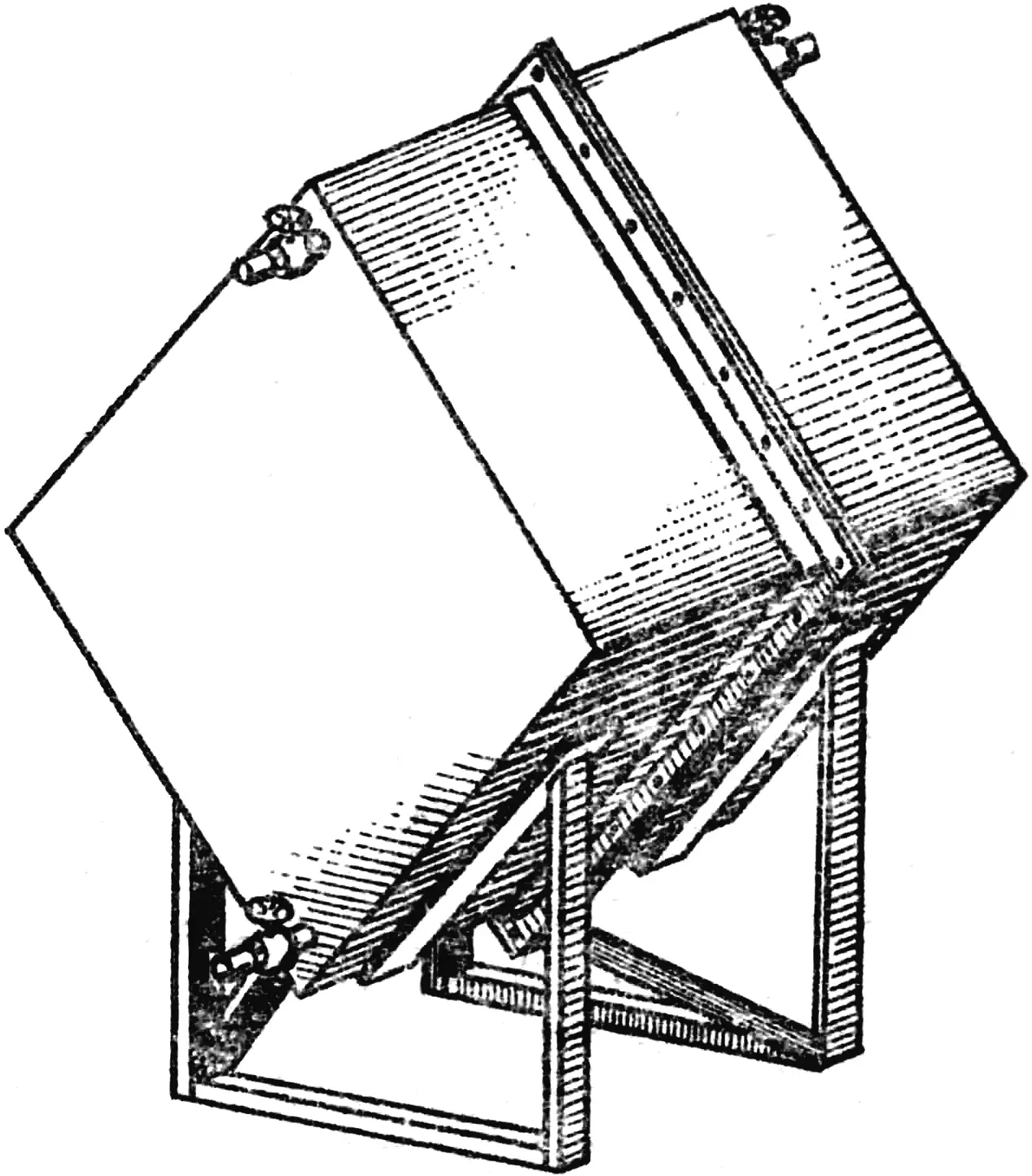
The first is a cube with a side of 1000 mm, welded from 2 mm sheet steel. In principle, the container shape can be any: cylindrical, rectangular, or spherical. The cubic shape was chosen only because it is the most convenient to manufacture.
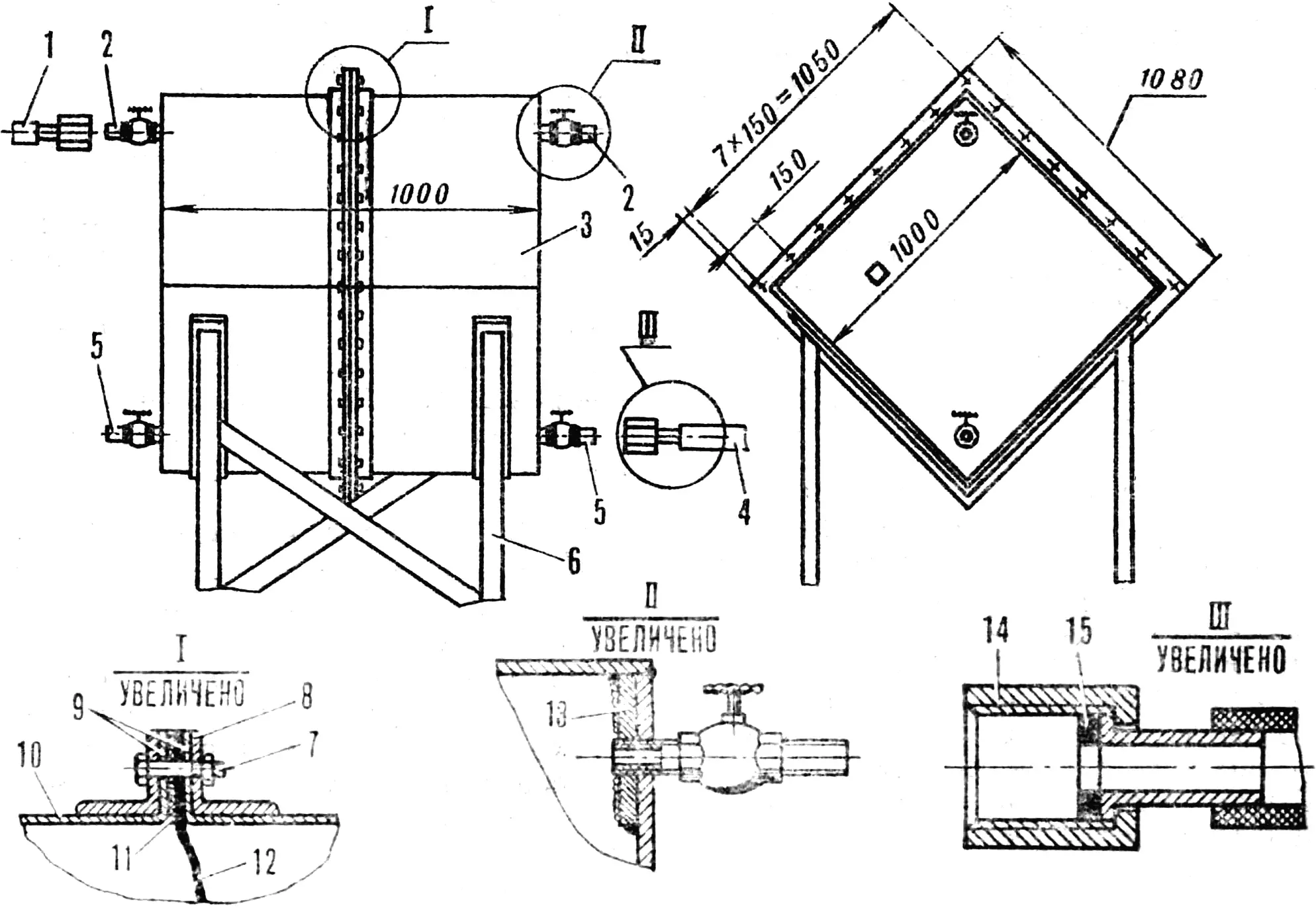
1 — irrigation hose, 2 — drain couplings, 3 — tank, 4 — pressure hose, 5 — pressure couplings, 6 — stand, 7 — M10 bolt, 8 — 40X40 mm angle, 9 — butt joint flange edges, 10 — tank wall, 11 — sealing gasket, 12 — bag-membrane, 13 — reinforcing gusset, 14 — sliding coupling, 15 — gasket.
The container consists of two “shells” clamped together with M10 bolts. The butt flanges are made as flanges reinforced with a 40X40 mm angle. Between them are clamped a rubber sealing gasket and the edges of the membrane — a bag made of rubberized fabric that follows the contour of one half of the tank with a small allowance.
Four couplings are welded into the end walls of the tank. Valves are screwed onto them, and in turn, nipples with a 3/4″ thread are screwed into the valves. Hoses supplying water from the water main are attached to the lower ones; irrigation hoses are attached to the upper ones.
The cube is placed on a stand made of metal angle. On the outside it is painted black so that the water heats up faster in the sun. The heating process can be accelerated using the so-called greenhouse effect — by placing the cube under a light wooden frame covered with polyethylene film. The layer of air between the film and the tank retains the heat of the warming metal wall well.
The working process proceeds as follows. One of the lower couplings, for example the left one, is connected to the water main or a pump. Cold water begins to enter the left half of the tank, presses on the bag-membrane, and displaces the warm water through the right upper coupling for irrigation. On the next watering, everything is reversed: the pressure hose is attached to the right lower coupling, and the drain hose to the left upper one. The water warmed over a day is used again, and fresh water fills the tank.
«M-K» 7’86, K. KRUGLIKOV
Recommend to read
 ELECTRIC MICRO MOTOR
Good motorists! Easy turn of the ignition key and the starter turning the crankshaft starts the engine. Of course, we do not encourage modelers to install an electric starter on the... “VALGA-KOMBI” — A CAR MADE OF PLYWOOD
Autocostruzione — a long-standing passion of Krasnoyarsk Vladimir Alexandrovich Hassan. The readers interested in self-made machines, will probably remember and "Mini-Valga", and...
