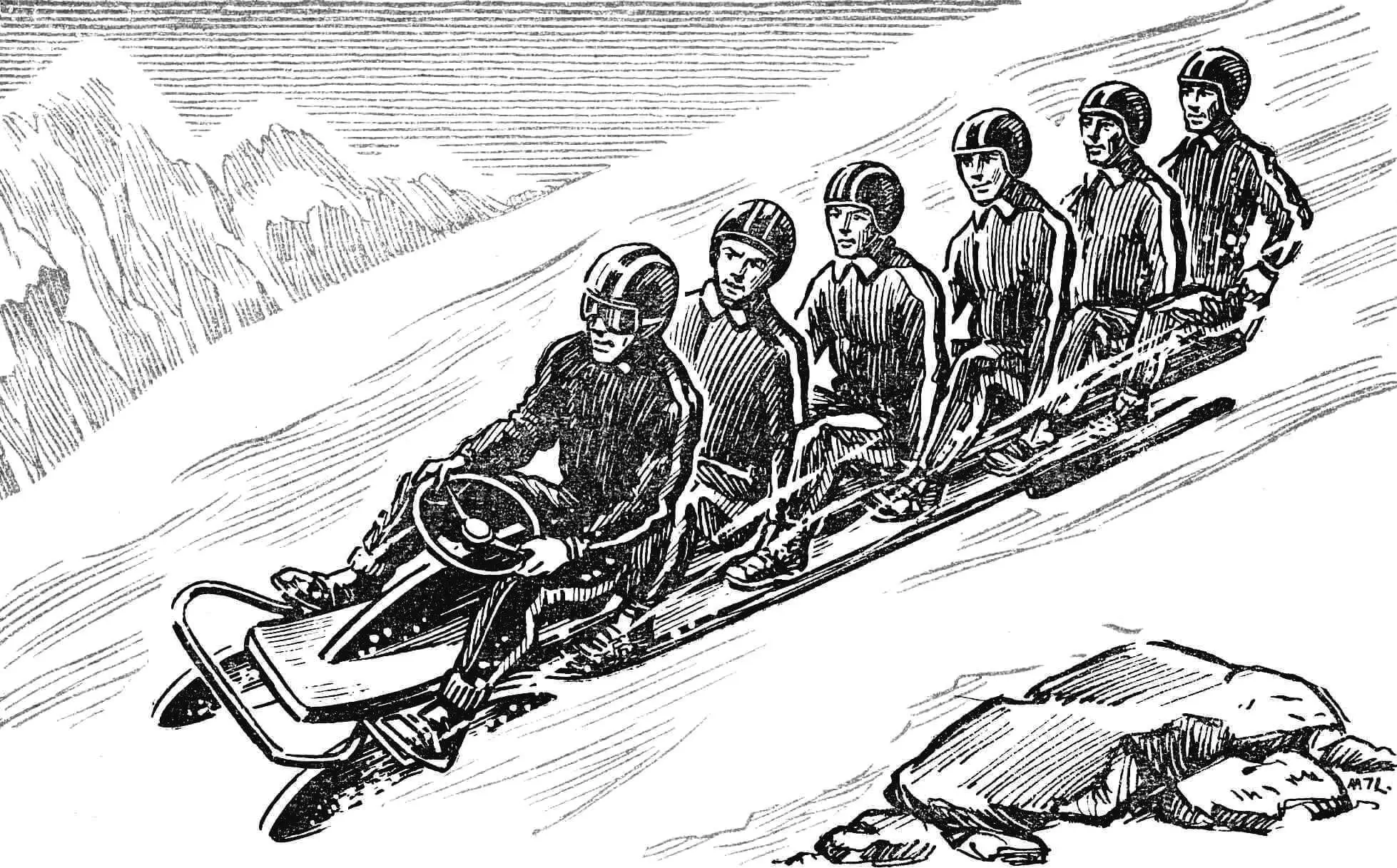
Of all types of sledding sports, bobsledding was the first to gain international recognition — steerable sleds for several passengers. It appeared on ice tracks at the end of the 19th century. Russian athletes rode bobsleds as early as 1910—1912, mastering the slopes of Vorobyovy Gory. Since the first Winter Olympic Games in 1924 in Chamonix (France), almost no Winter Olympics has been without bobsled team performances. The upcoming 1972 Winter Olympics in Sapporo (Japan) also includes races on these sleds in the program.
We offer drawings of a large bobsled — steerable sleds (see fig.). They are simple to manufacture and durable. Their body, made in the form of a flat box, accommodates a crew of 6—7 and even 8 people. They sit so that an experienced helmsman — the captain of the snow ship, who knows how to choose the most convenient track — is in front. Behind, at the stern, another experienced crew member is placed. He must brake in time and help the captain overcome the ice track: where to push, and if necessary, slow down the sled.
The front, steering, sleds consist of two runners connected by a crossbar. The steering wheel for the bobsled is best taken round, like an automobile type. The front runners are equipped with a tubular metal arch — a support for the helmsman’s feet, which also serves as a shock absorber. The rear, main, sleds are connected to the steering ones by the body — the bobsled seat. The seat is made of pine boards 23—25 mm thick. Under it, on the right and left, a panel is attached. This is a wooden board 25—30 mm thick, its edges are protected by an iron strip. During sharp turns, passengers can be thrown onto the sled track by inertia. To prevent this, everyone has the opportunity to hold on not only to each other, but also to the ropes coming from the front sleds.
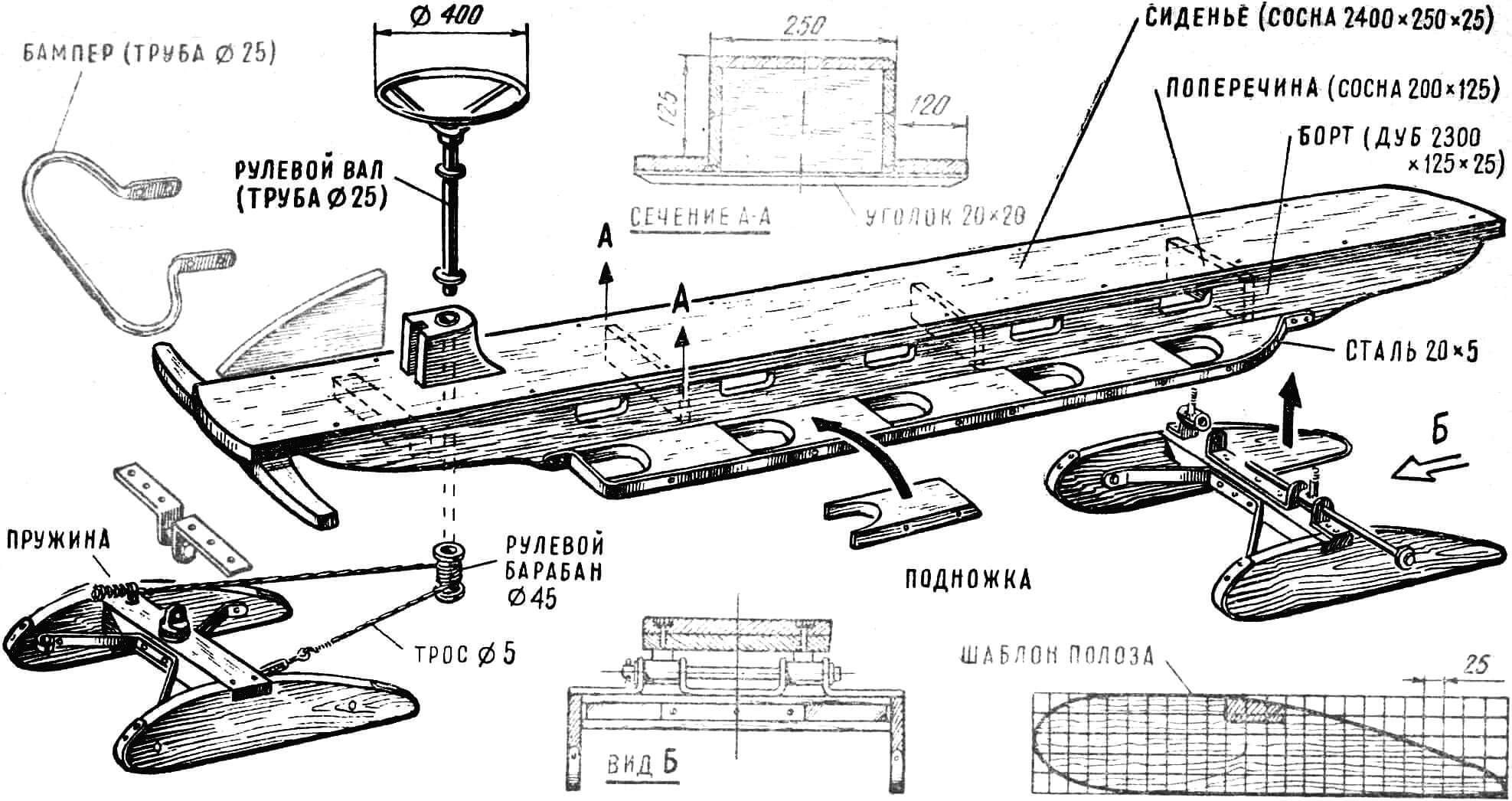
When starting to assemble the body of a six-seat bobsled, one must strive to ensure that each part of the sled seat is tightly fitted. It is necessary to adjust the steering device so that turns are performed easily, without excessive effort. The runners must be the strongest. Oak and maple are best for them, and only in extreme cases birch. The passenger board can be made of softer wood, such as pine or spruce.
Both the front and rear runners of the bobsled must be clad in metal. The metal “sole” makes them faster.
For painting the body and skis, it is best to use nitro- or enamel paints. They are more resistant at low temperatures, and, in addition, scratches that appear as a result of sled operation can be easily repaired.
Bobsleds are ridden from any ice-covered mountain, but it is more interesting to arrange rides and races on a specially equipped track. That’s why bobsleds are built where the terrain is mountainous.
The famous specialist in sports facilities Rudolf Ortner, whose book was published in Russian translation under the editorship and with a foreword by engineer, Lenin Prize laureate, Honored Master of Sports V. P. Polykarpov, gives the following recommendations: “For bobsledding, a large height difference between the start and end of the distance is needed, so the track can only be laid in mountainous terrain. The length of the distance is from 1500 to 3000 meters, with an average slope of 10% and a maximum (on short sections of the distance) — 22%. The track is built from snow and ice, in most cases on special support structures (elevation on turns). Earth embankments are reinforced with wooden or stone retaining walls to prevent landslides.”
MINI-TOBOGGAN
In many countries, Indian sleds — toboggans, whose entire bottom serves as a runner (see fig.) — are very popular. They are adapted for riding from snow-covered mountains. Toboggans are fairly large sleds; they come in multi-seat and single-seat versions.
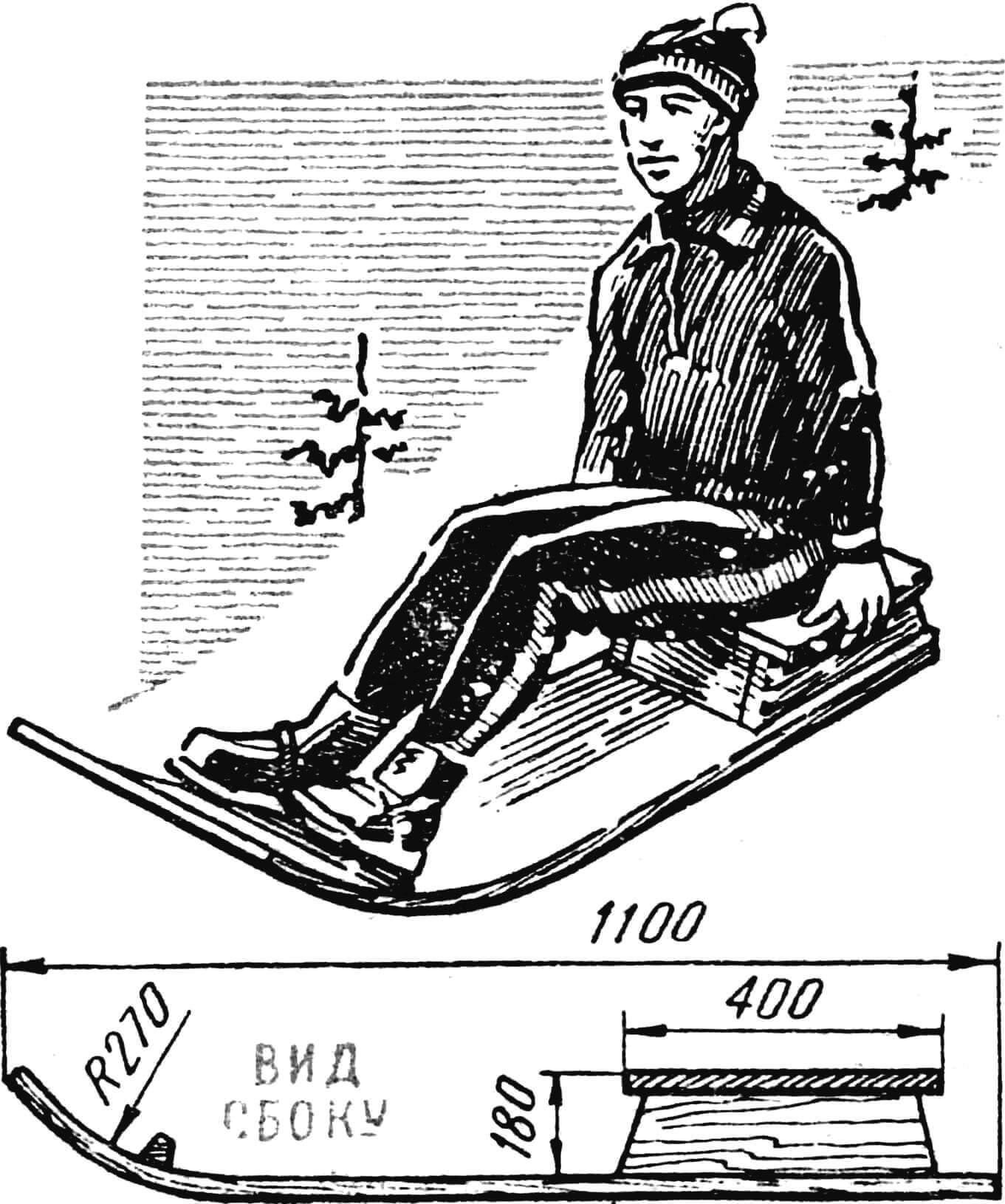
Along with “standard” toboggans in Canada, the USA, Czechoslovakia and the GDR, mini-toboggans appeared. Their width is 300—400 mm, length about 1000 mm. Such “transport” can be carried under the arm. A small block — a bench — is attached to the rear of the toboggan. Sitting on it, the athlete rests his feet on the front of the sled, and leans his body back.
S. WOLF
Recommend to read
 Bath grate
Over the twenty years since the collapse of the Soviet Union, we have become accustomed to running to the store for ready-made products at the slightest thing. The managers who appeared in... WITCHED
Skis kept slipping off... Leaning on a stick, he made a hesitant step forward, but only tried to pull foot slipped, and I had to start all over again. I waved to him, and, intending to...
