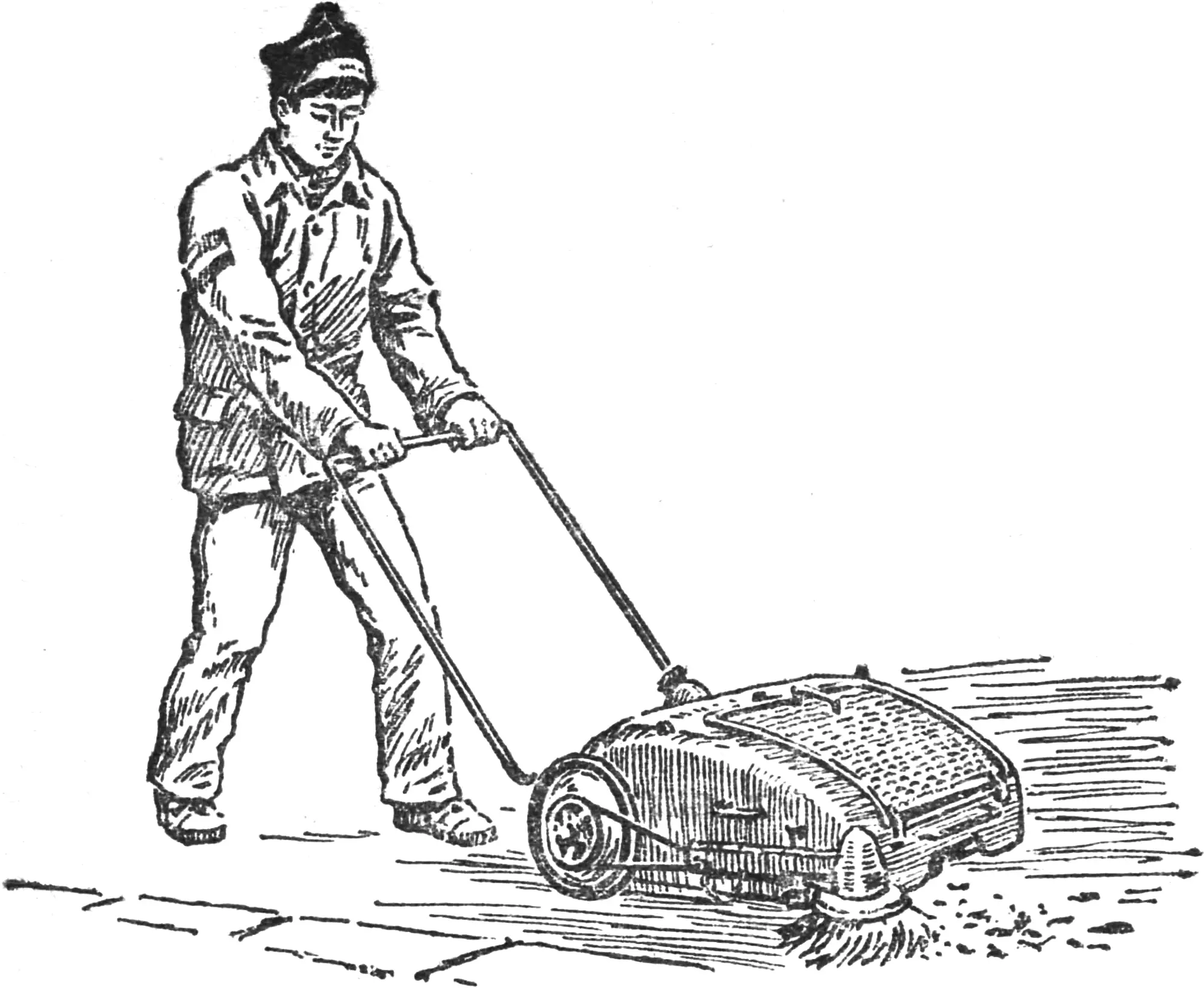
In “M-K” No. 4 for 1982, an article was published about the young technicians club at housing management office No. 8 in the city of Vitebsk, and about the amusing and useful machines created by its members. Among the most original devices mentioned was the mechanical sweeper MPM-1.
It was conceived as a means of easing the hard work of cleaners and janitors. Under the guidance of V. M. Nebozhak, who heads the club, MPM-1 was built by ten schoolchildren aged 13 to 16. They are three Sashas — Lyudvikov, Odnorukov, and Slemnev, Kostya Abramov, Grisha Alekseyev, Edik Zubritsky, Seryozha Razumov, Dima Roshchin, Andrey Sochivko, and Vitya Kharitonenkov. They all became holders of the “Young Participant of the USSR VDNKh” medal, since their mechanical broom made a proper impression not only at the republican exhibition, but also at the country’s main exhibition.
SIMPLE AS TWO TIMES TWO
“But it’s a vacuum cleaner!” — that is exactly what someone present exclaimed at the first test of the freshly assembled and still unpainted MPM-1. The trial was conducted right in the club workshop on the floor littered during classes.
They rolled the machine back and forth and gasped: not a speck was left behind it, even swept clean from the gaps between the boards! They calculated: in one hour, with the help of MPM-1, you can clean a room or an open area measuring 50×50 m — two and a half thousand square meters. By hand with a broom or brush, that is hardly possible!
I must admit that when the machine was opened and its design was shown, at first there was a slight feeling of disappointment. MPM-1 had seemed like a complex unit packed with clever mechanics. But inside there turned out to be only a drum with brushes and a dust hopper. Indeed, everything is simple, as two times two. Moreover, many parts of the machine looked familiar, having been encountered more than once before.
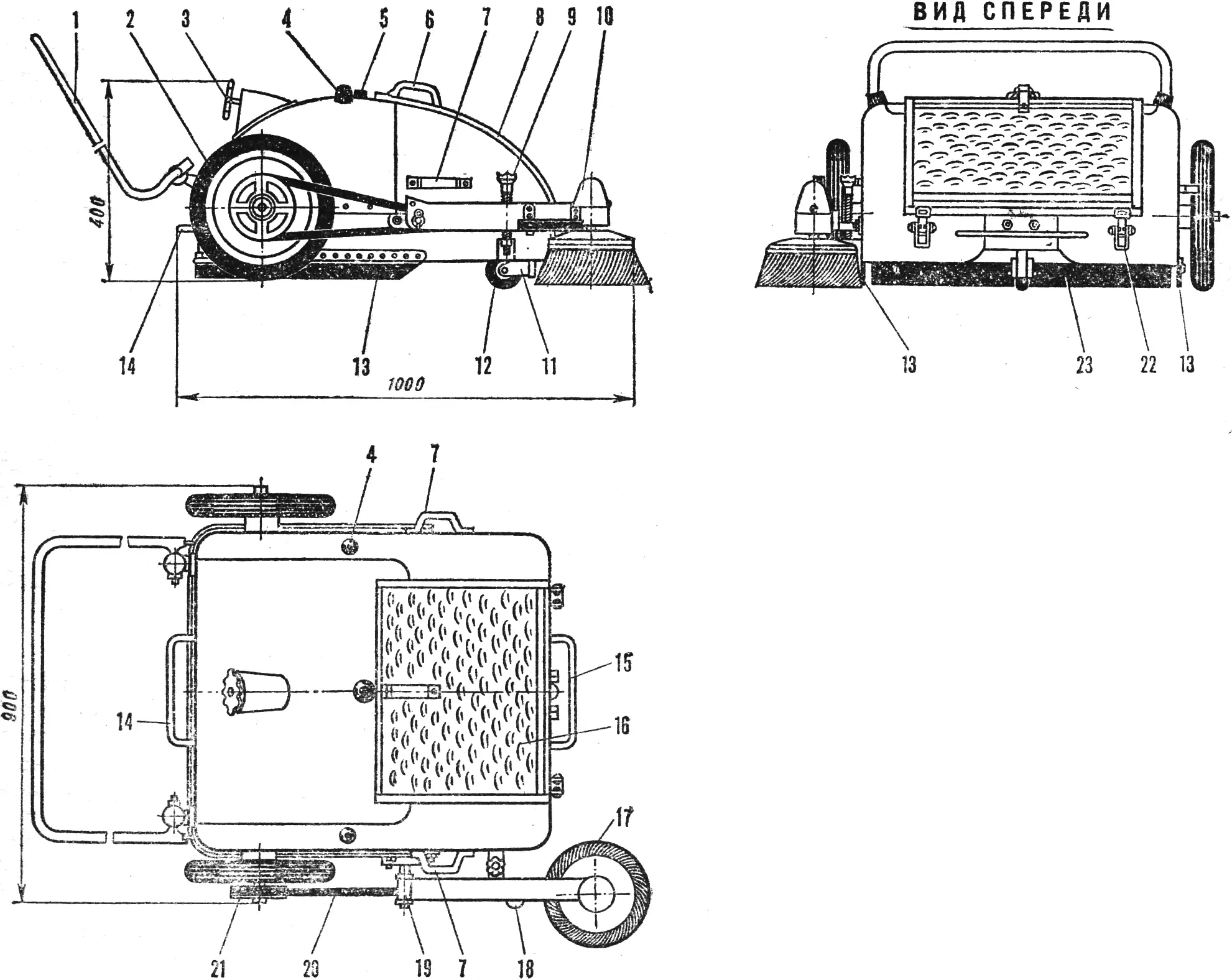
1 — folding drive handle, 2 — wheel, 3 — brush drum lifting screw, 4 — folding handle supports, 5 — rubber hood handle support, 6 — hood handle, 7 — container handles, 8 — hood, 9 — curb brush lifting screw, 10 — protective casing, 11 — steering linkage, 12 — front wheel, 13 — side rubber seals, 14, 15 — carrying brackets, 16 — filter mesh, 17 — curb brush, 18 — roller, 19 — curb brush console axle, 20 — V-belt drive, 21 — pulley, 22 — toggle latch, 23 — rubber pickup flap.
And so it was in reality. V. M. Nebozhak touched this or that part and named it: sprockets, chain, wheels — from a children’s bicycle, only the spokes were removed and replaced with discs from record players; pulley — from a washing machine; gears — from a large hand drill; folding drive handle and frame elements (tubes and angle bars) — from a folding bed and children’s sleds; here in the body construction, elements of street lamps, motorcycle fenders, a bread box, and sheet aluminum were used; the hopper was cut and riveted from a zinc tray; front wheel — from a cargo cart; all handles — window handles; brackets and toggle latches — from instrument cases; dust hopper mesh — from an acoustic speaker; and finally, brushes — for sweeping floors.
SO, THE DESIGN
The MPM-1 chassis is three-wheeled. All wheels are independent of one another, although the rear ones sit on one axle. The right one is the drive wheel. When moving, the pulley, by means of a V-belt through a system of rollers hidden in the console, transmits rotational torque to the curb brush, and it throws debris away from baseboards or curbs along the machine’s path. The rotation speed of this brush depends on the machine’s travel pace, and the friction force against the floor — on the brush height above it, adjustable by a screw on the console. If necessary, the curb brush can be taken out of operation by swinging the console into the vertical position.
Inside the machine there is a brush carriage. It consists of two cheeks — aluminum plates joined along the sides by four horizontal tubes. The two upper ones serve as the frame, the lower ones as axles: on one the carriage turns (the wheels and large sprocket are also mounted here), on the other the brush drum rotates. These axles run in bearings.
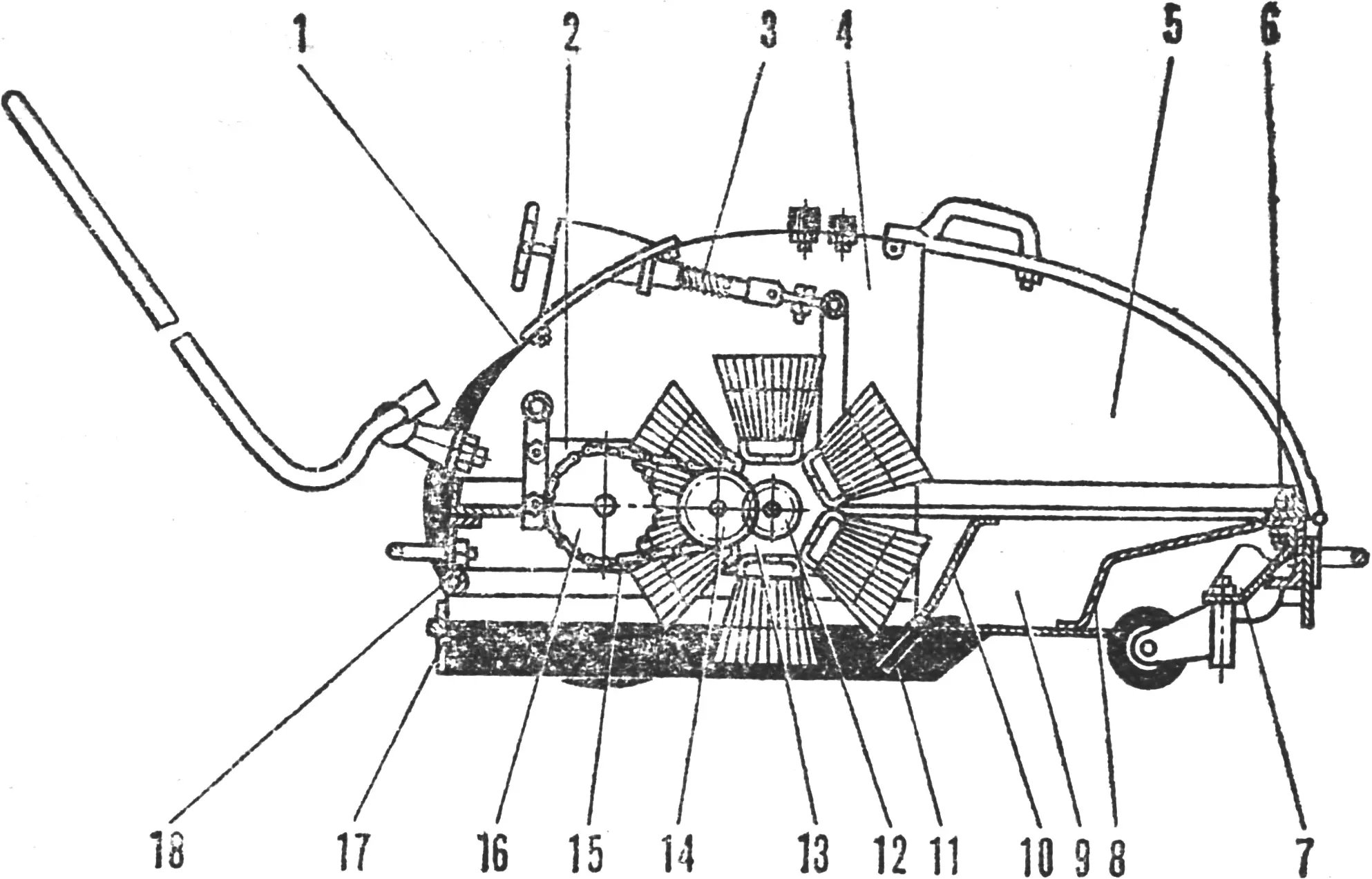
1 — top panel, 2 — brush carriage cheek, 3 — brush drum lifting mechanism, 4 — side panel, 5 — removable container, 6 — locking pin (2 pcs.), 7 — front wheel steering bracket, 8 — hopper front wall, 9 — hopper, 10 — rear wall, 11 — rubber pickup flap, 12 — brush drum gear, 13 — brush drum, 14 — intermediate “gear-sprocket” unit, 15 — chain, 16 — drive sprocket, 17 — rear rubber seal, 18 — frame tube.
From the drive wheel, a sprocket transmits motion by chain to the intermediate unit, and from it to the brush drum. For one wheel revolution, the latter makes four revolutions.
The drum consists of an angle frame with 12 brushes attached to it. The friction force of their bristles against the floor is adjusted by a mechanism whose control screw is brought out onto the machine body.
At the front of the MPM-1 there is a removable container. It is mounted on three channel brackets and secured by two pins inserted into one of them. The container is closed on top by a hood held in place by toggle latches. In the lower part, the container has a dust hopper with a capacity of one and a half buckets, a recess for the freely orienting front wheel, and a rubber pickup flap. The latter is installed at an angle and, letting debris pass beneath it as the machine moves, serves as a scoop for the brush drum that throws debris into the hopper. At the same time, the air driven by the brushes exits through the hood mesh. A flannel filter is placed under it, so even the finest dust does not escape outside. The working volume of the machine is sealed from below by rubber seals — side and rear.
MPM-1 weighs only 25 kg, which allows two teenagers to carry it without difficulty.
«M-K» 6’84, A. TIMCHENKO
Recommend to read
 THOUGH ON KITCHEN, THOUGH IN THE ROOM
If you ask the hostess almost any home that, in her opinion, the most important thing in the apartment, then the answer is likely to be one area. This is not surprising the kitchen is... SECOND LIFE ANTI-AIRCRAFT “LIZARD”
The story began during the Second world war. The command of the Wehrmacht, faced at the first stage of hostilities with a large number of Soviet light armored vehicles - tanks BT, T-60,...
