
I have been a long-time reader of the magazine “Modelist-Konstruktor” and subscribed to it for many years in a row. Then, due to financial difficulties, I had to give it up. But since last year I have started subscribing again. I am glad that, as before, I find a lot of useful material in the publications.
At present I live in a rural area, where it is hard to get by without small-scale mechanization. So, having turned my garage into a workshop, I assemble here the auxiliary mechanisms needed for farm work.
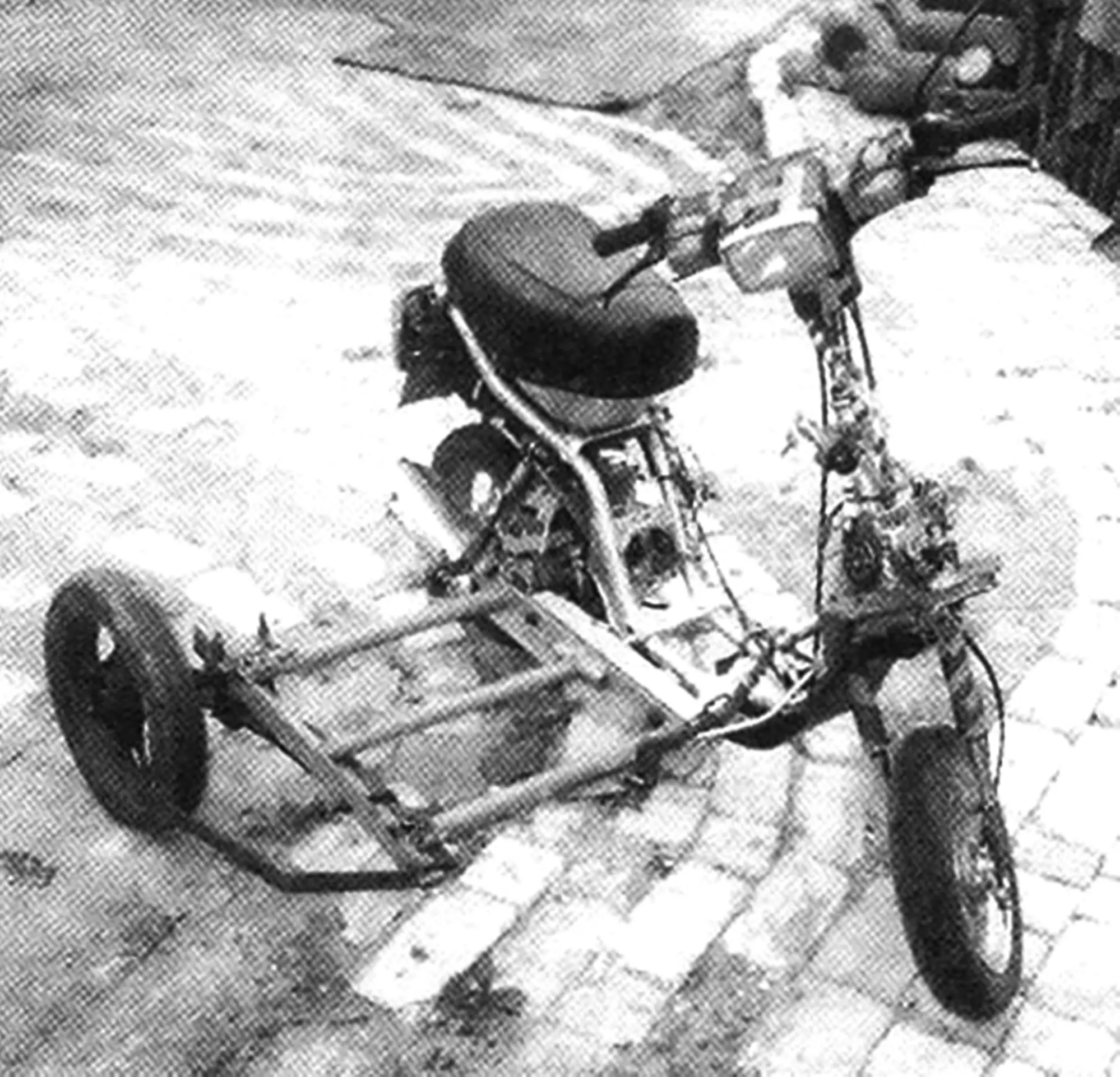
A great help on the homestead has been a YAMAHA mini-moped that I literally restored from scrap metal several years ago, which I equipped with a cargo side trailer (or sidecar, as people more often call it) of my own design.
The trailer is a frame with a wheel and a cargo platform on it, without a “cradle.” Although nothing prevents equipping the platform with a removable seat with a backrest — the mini-moped has quite enough power to carry two people (the driver and a passenger). As for cargo, I haul up to 120 kg on it, including long items (up to four meters) of timber and lumber. Looking ahead, I will note that by now I have already built four cargo mini-mopeds: one more for myself, in case the first one breaks down and needs a long repair, and two to order for acquaintances — such equipment, it turns out, is in demand and needed.
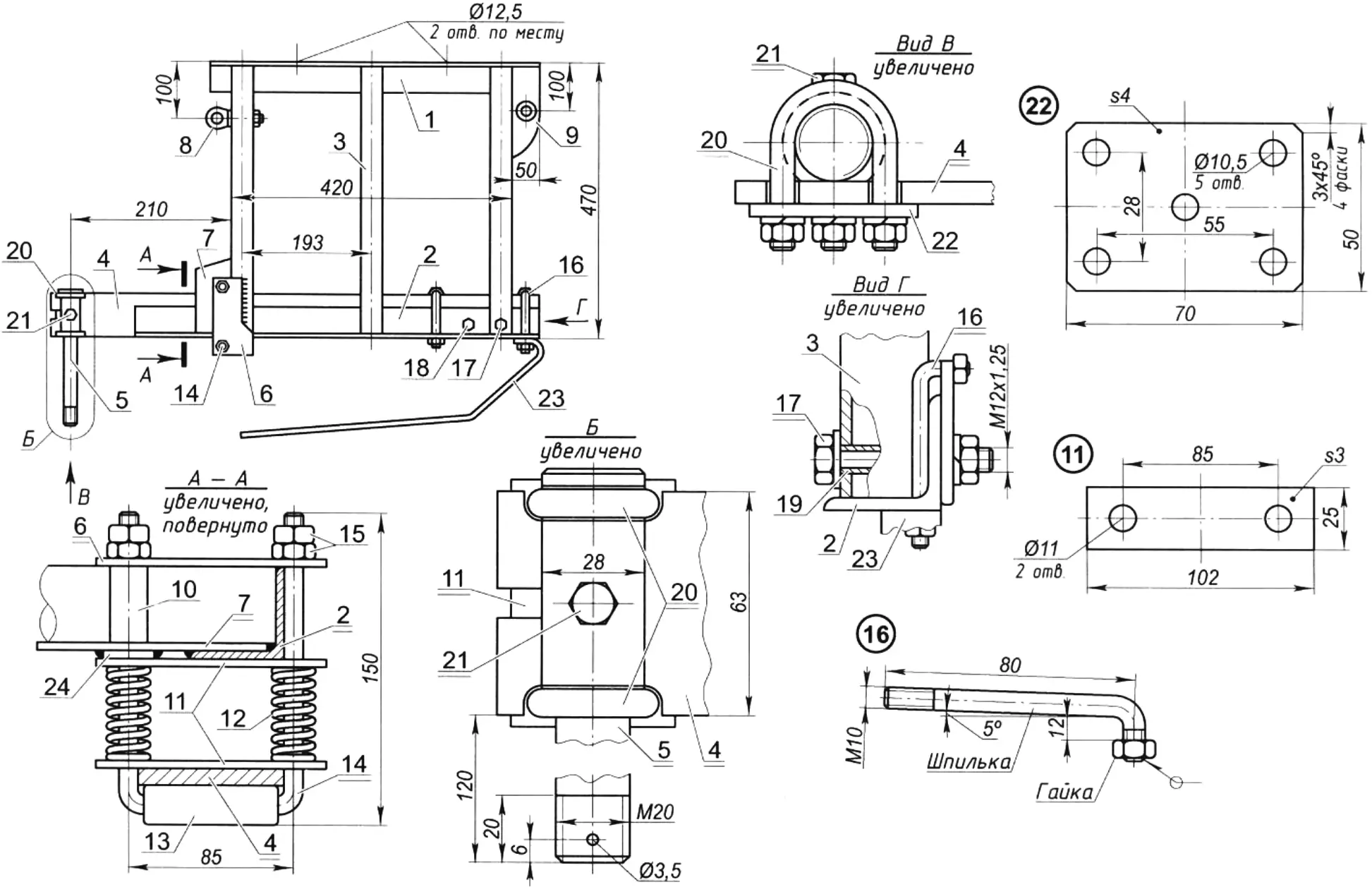
1 — left longeron (angle 45×45); 2 — right longeron (angle 45×45); 3 — cross member (tube Ø34, 3 pcs.); 4 — leaf spring (63×8, L680); 5 — wheel axle (steel, round 28); 6 — U-bolt support (steel sheet s4); 7 — insert (steel sheet s4); 8 — lug for attaching the lower end of the rear turnbuckle; 9 — gusset for attaching the lower end of the front turnbuckle; 10 — spacer bushing (tube Ø15×2); 11 — spring supports (steel sheet s4, 2 pcs.); 12 — compression spring (2 pcs.); 13 — damping bushing (rubber tube); 14 — U-bolt ring limiting leaf spring travel with M10 thread; 15 — M10 nut and lock nut (2 pairs); 16 — special M10 stud for fastening the leaf spring to the frame (2 pcs.); 17 — front M12x1.25 bolt for fastening the leaf spring to the frame; 18 — rear M8 bolt for fastening the leaf spring to the frame; 19 — safety bushing (tube Ø16×1.5); 20 — M10 U-bolt for fastening the wheel axle to the leaf spring (2 pcs.); 21 — axle retainer (M10 bolt); 22 — shim (steel sheet s4); 23 — edging of the tool box (steel strip 40×4); 24 — spacer.
In principle, side trailer designs are similar, but the materials differ — on one I even used a ready-made duralumin frame from a suspended fuel tank of some aircraft, which fit almost without modification, and motorcycle (from “Ural” and “IZH”) ball joints fit perfectly into its tubes, which I welded to the mini-moped frame tubes.
For the readers of the magazine, I provide a description and drawings of a trailer made from the most common and readily available materials, which can be attached to almost any mini-moped without modifying the latter, only by equipping the “tractor” with a trailer crossbeam and welding a pair of lugs to its frame tubes for fastening brace-turnbuckles.
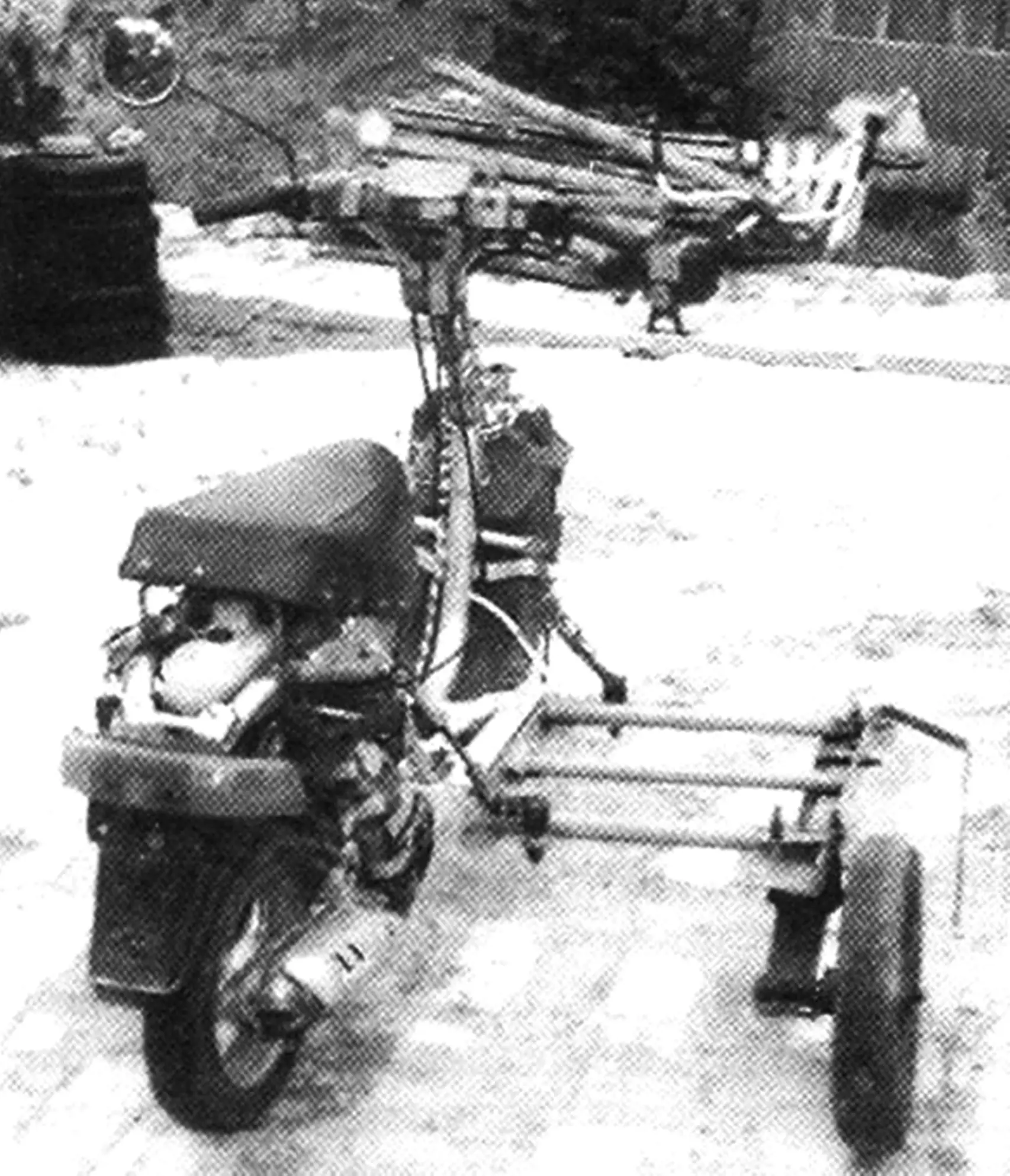
The frame of the described side trailer is welded, rectangular, and consists of two longerons (longitudinal load-bearing members) and three cross members. The longerons are made of equal-leg rolled steel angle No. 4.5, and the cross members are made of round tubes with an outside diameter of 34 mm.
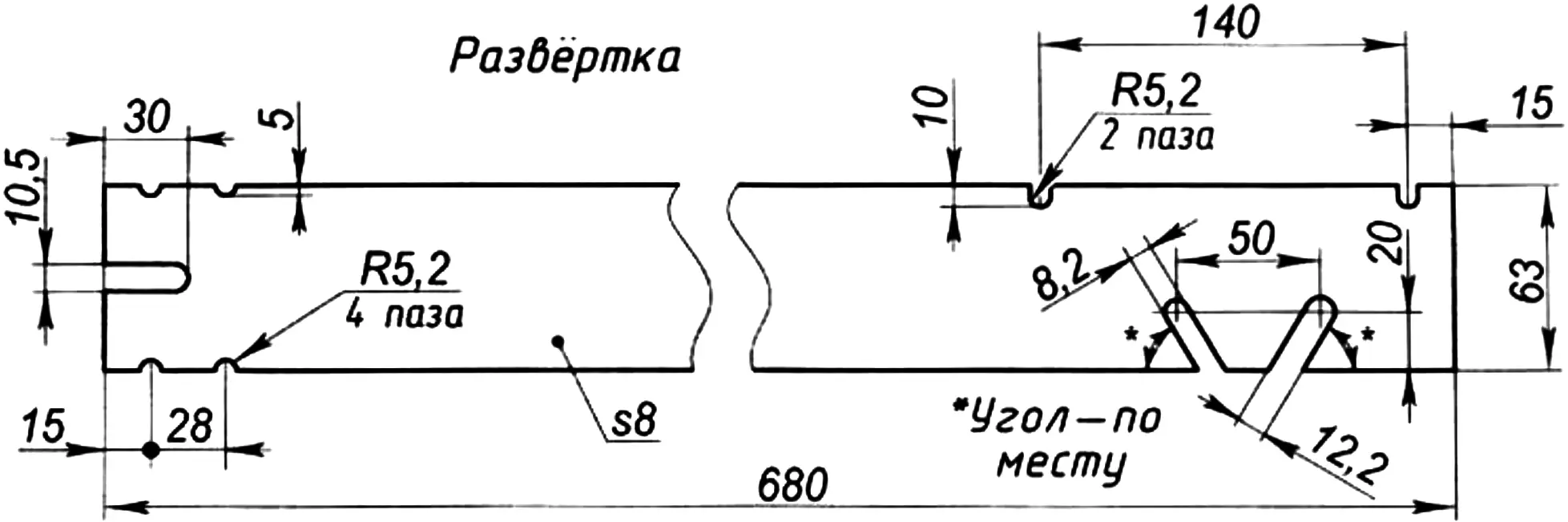
For wheel suspension I used one leaf spring with a cross section of 63×8 and a length of 680 mm from a truck, fastening one end to the frame longeron with special bolts, and mounting an axle at the other end, attaching it with two M10 U-bolts. For this I had to cut several shaped slots in the leaf spring, which I did on a bench circular saw (which home craftsmen simply call a “circular saw”), replacing its saw blade with an abrasive cutoff wheel. By the way, the “circular saw” replaced several metal-cutting machines for me at once (grinder, milling machine, and even a lathe) — I machined all metal parts on it. In order to carry heavy loads, I additionally inserted two normally stretched coil springs between the leaf spring and the frame.
For the trailer I used a 3.00×10” wheel from another mini-moped, and adapted a hub from an “Ural” motorcycle. In the wheel disc I cut a central hole 58 mm in diameter, and on the hub I cut off the flanges (with holes for spokes) and welded it into the wheel disc in place of the removed central part. I additionally reinforced the hub with three spokes made of steel strips 30×4 mm, welding their ends to the wheel rim and brake drum. I turned the axle on a lathe from a steel rod 28 mm in diameter. Wheel travel with an empty trailer is about 40 mm, and with a loaded one — about 15 mm.
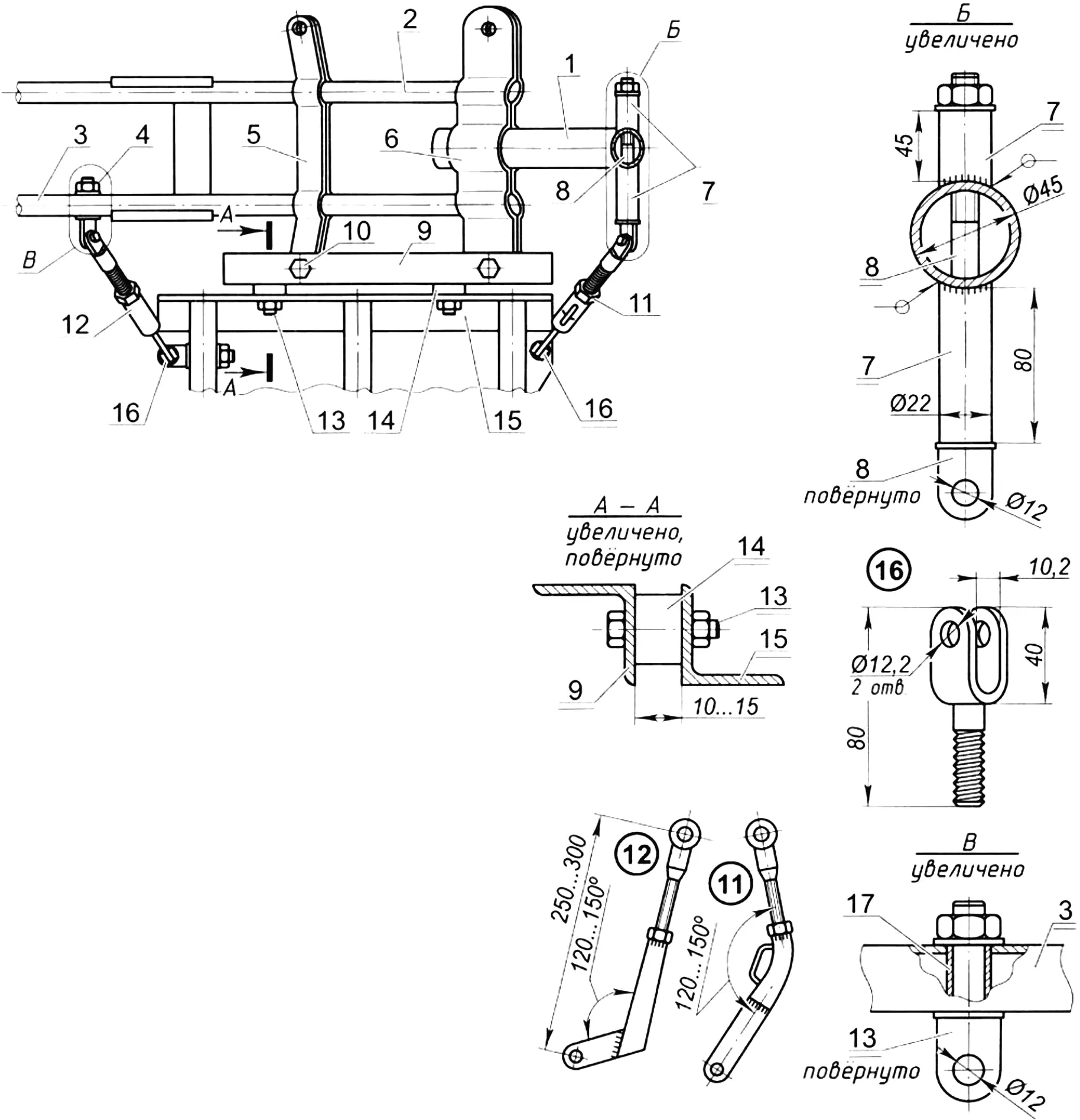
1 — mini-moped steering column; 2 — left longeron of the mini-moped frame; 3 — right longeron of the mini-moped frame; 4 — bolt-lug for fastening the upper end of the rear brace-turnbuckle to the frame; 5 — rear clamp for fastening the crossbeam (steel sheet s4); 6 — front clamp for fastening the crossbeam (steel sheet s4); 7 — spacer brackets (tube Ø22×2); 8 — M10 bolt-lug for fastening the upper end of the front brace-turnbuckle to the frame; 9 — crossbeam (angle 45×45); 10 — fastening of the trailer frame to the crossbeam (M11 bolt, 2 pcs.); 11 — front brace-turnbuckle; 12 — rear brace-turnbuckle; 13 — fastening of the side trailer frame to the crossbeam (M12 bolt, 2 pcs.); 14 — wheel toe adjustment bushing (rubber tube, 2 pcs.); 15 — side trailer frame (left longeron); 16 — fork for fastening the lower end of the rear brace-turnbuckle to the side trailer frame (2 pcs.); 17 — bushing (tube Ø14)
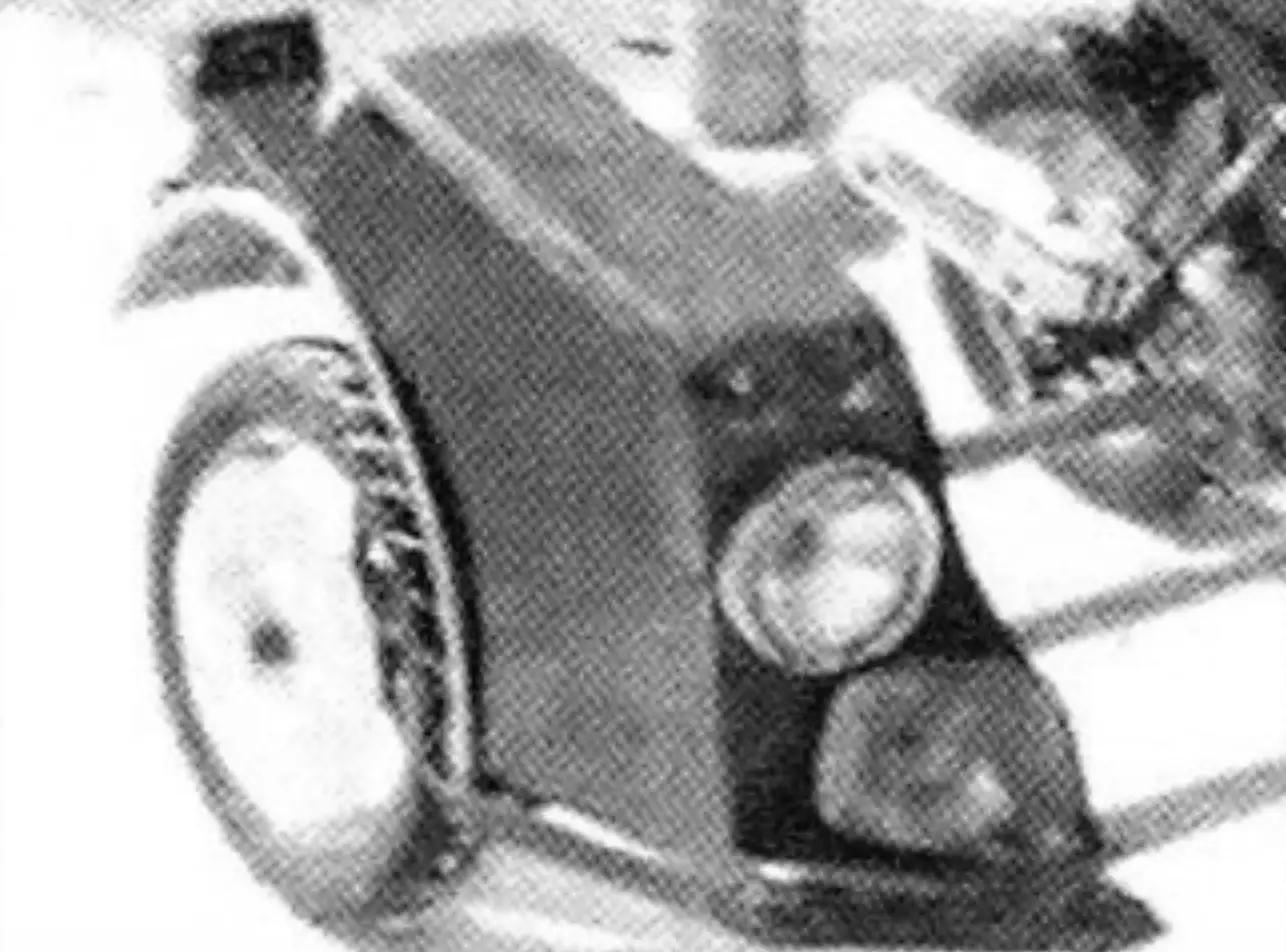
I made the fender (mudguard) for the wheel from half of the rim of that same IZH motorcycle wheel. I cut this half in half again, but now lengthwise. At the spoke holes I cut out triangular fragments. On an anvil I straightened the central part to a right angle and riveted a 0.8 mm steel strip to both parts (arcs) of the rim with 4 mm rivets. The fender is attached to the frame on brackets made of steel strips. In this case the front bracket together with the outer longeron serves as the lower binding of the tool box, and part of the fender is part of the bottom (or rear wall). The box itself is wooden, made from 25 mm boards. The box is covered on top with a lid made as an armrest: the board is lined with foam rubber and upholstered with artificial leather.
The trailer platform is also made from the same 25 mm boards. It too has two tool boxes made as recesses. They are closed on top with hinged lids flush with the platform. The lid handles are recessed. When mounting the platform, the boxes are inserted between the cross members and longerons and serve as stops, preventing the platform from shifting forward or backward (the vertical walls of the longeron angles prevent the platform from shifting left or right) without any additional fastening. This, in turn, makes it possible to quickly remove the platform from the trailer frame when necessary. Removable sideboards are provided at the front and rear of the platform, so even small piece (loose) cargo can be hauled on the trailer. For bulk cargo I place a suitable container on the platform, and I carry water in large flasks.
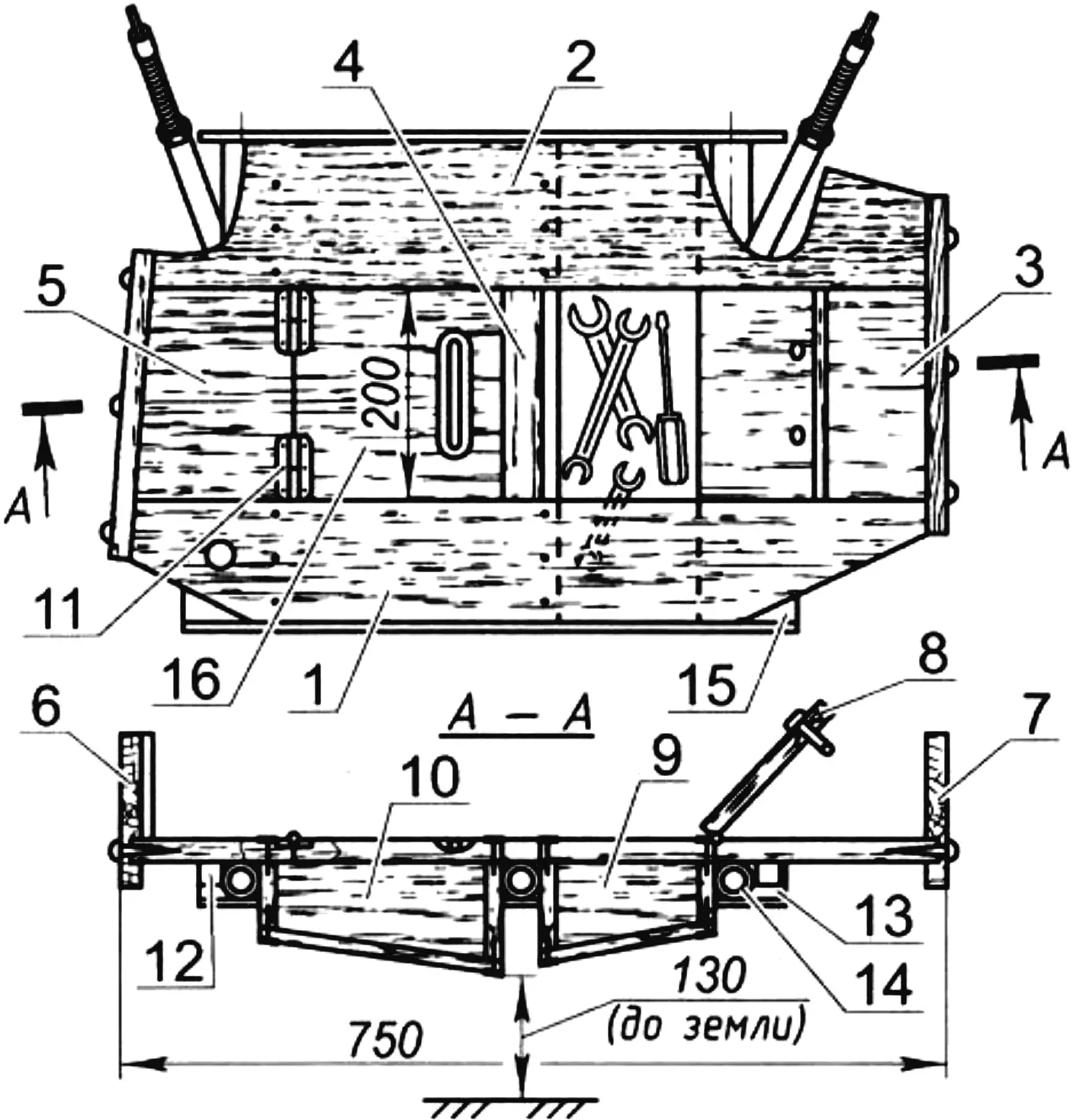
1 — outer plank; 2 — inner plank; 3 — middle front insert; 4 — middle central insert; 5 — middle rear insert; 6 — rear sideboard; 7 — front sideboard; 8 — lid of the front tool box with handle (open position); 9 — front tool box; 10 — rear tool box; 11 — lid hinges (4 pcs.); 12 — stop bar (2 pcs.); 13 — left longeron of the side trailer frame; 14 — cross member of the side trailer frame; 15 — right longeron of the side trailer frame; 16 — lid of the rear tool box (closed position)
The side trailer is attached to the mini-moped by the left longeron to a longitudinal crossbeam fastened to the right side of the tractor frame, and by brace-turnbuckles. The crossbeam is made of the same angle as the side trailer frame longeron, only installed with the shelf facing up. The crossbeam is fastened to the frame with a pair of special clamps made in the form of opposing U-shaped brackets with welded threaded studs from M12 bolts. For the turnbuckles, corresponding holes are drilled in the frame tubes or lugs with the same holes are welded on.
The turnbuckles adjust the camber angle of the side trailer wheel relative to the plane of symmetry of the mini-moped itself, which makes the mini-moped easier to handle in turns. To preserve the already small useful area of the trailer platform, I made the turnbuckles curved. The toe angle of the same wheel, which eliminates the trailer’s pull to the right, is adjusted with rubber washer-bushings inserted between the left trailer longeron and the crossbeam.
If necessary, the side trailer is quickly (it takes about five minutes) and easily detached.
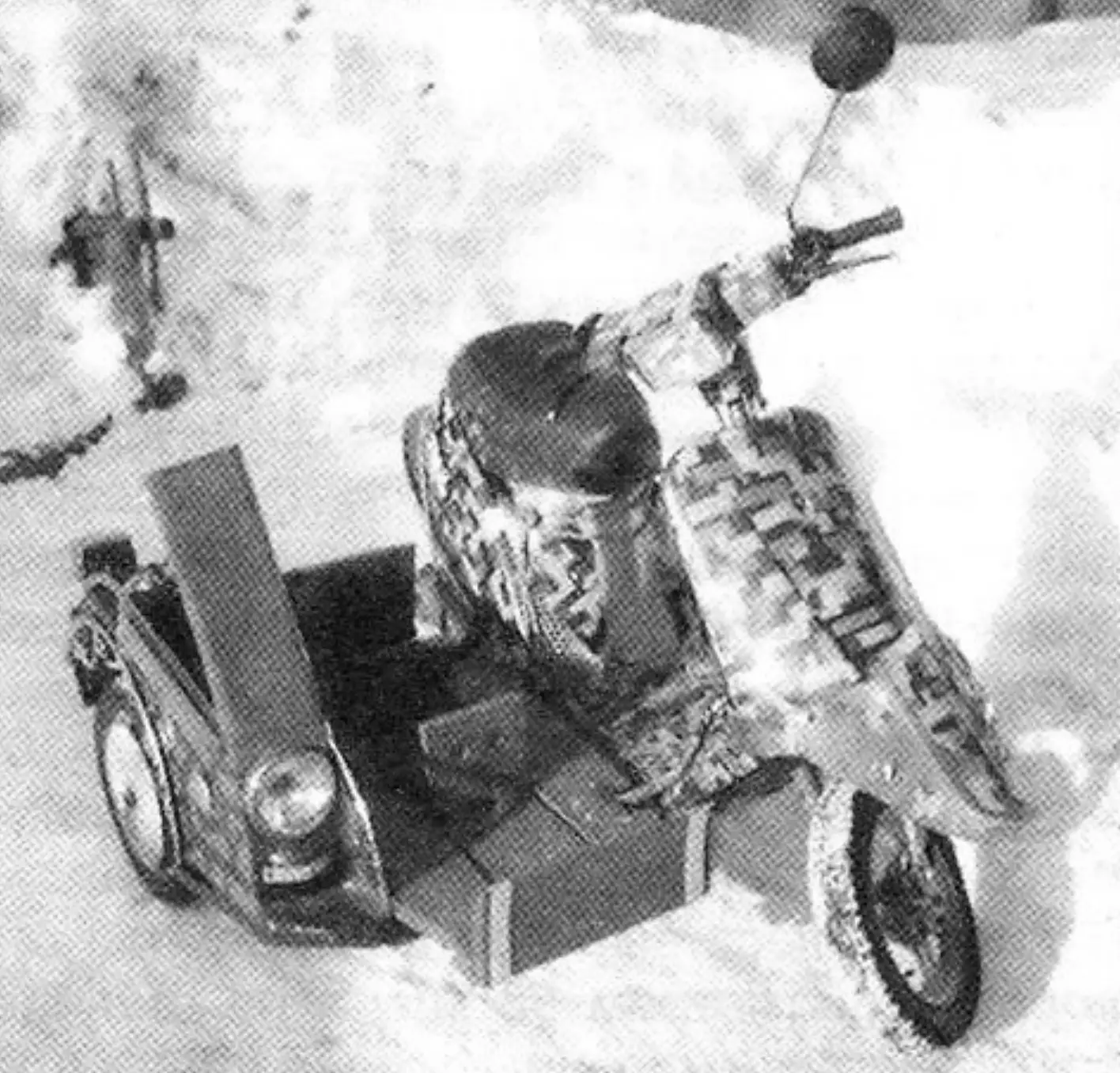
Fully manual control (all controls on the mini-moped are concentrated on the handlebars) and three support points make it possible to use it even by a person with limited lower-limb mobility.
The trailer is equipped with lighting signal devices (stop lamp, clearance and turn signals) from an “Ural” motorcycle, which makes it possible to drive the cargo mini-moped on public roads as well. And no driver’s “license” is required to operate such a vehicle (with an engine displacement of up to 50 cm3).
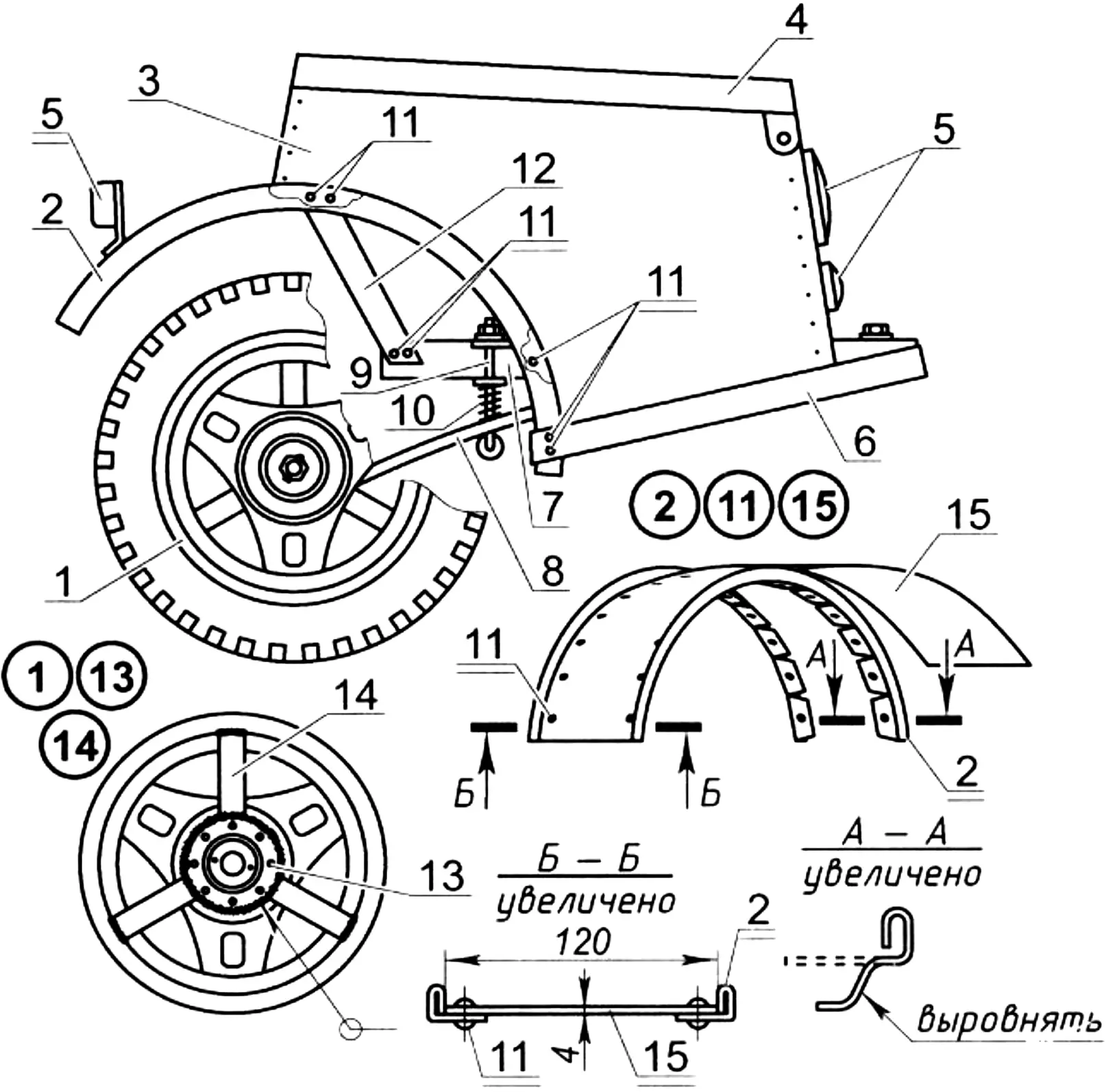
1 — wheel (from a mini-moped, 3.00×10”); 2 — fender (half of an IZH motorcycle wheel rim, modified); 3 — tool box; 4 — tool box lid; 5 — lighting; 6 — tool box edging; 7 — side trailer frame (right longeron); 8 — leaf spring; 9 — U-bolt; 10 — spring (2 pcs.); 11 — rivets; 12 — fender-to-frame bracket (steel strip 30×4); 13 — wheel hub (from an “Ural” motorcycle); 14 — additional spoke (steel strip 30×4); 15 — rim shelf
On one mini-moped, to increase ground clearance, I welded extension tubes (about 50 mm long) to the front fork legs. I did the same with the rear shock absorbers, although it would have been simpler to replace them with longer ones. But at that time I did not have any, and later I left it as it was — after all, there were no breakdowns.
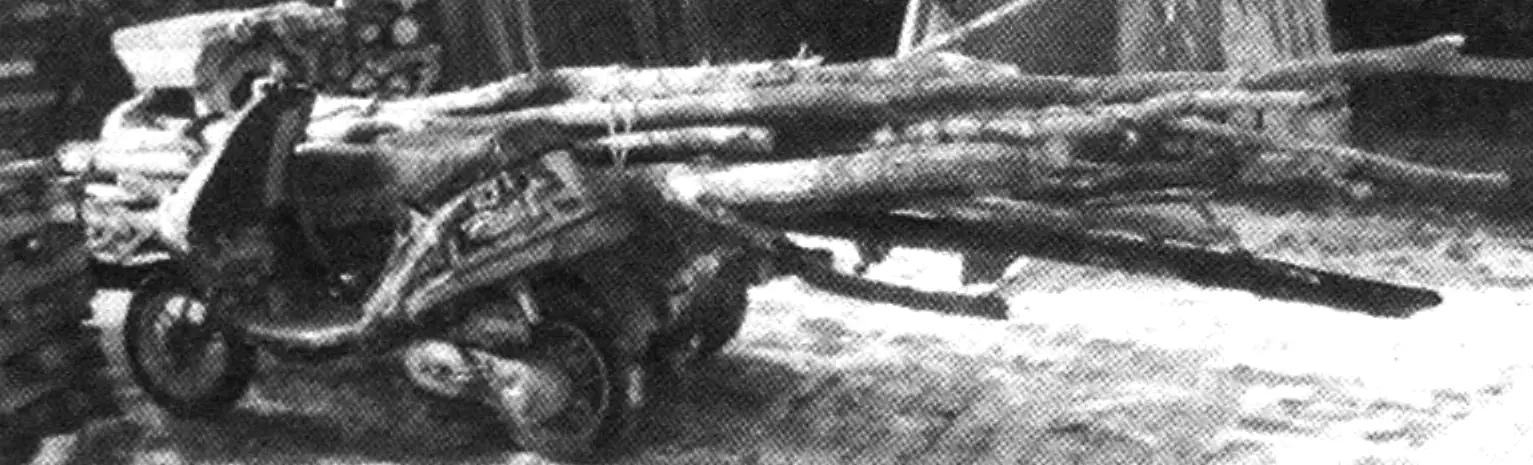
It would be unfair not to mention the shortcomings “acquired” by the mini-moped during modernization. Thus, fuel consumption increased significantly, the engine piston group has to be replaced more often, and tires wear out more intensively. But many years of operation show that these costs pay off handsomely. In a sharp right turn there is a risk of tipping over, which, however, is characteristic of all motorcycles with a side trailer.
Over four years of operation I have ridden 3800 km. Every year I prepare up to 12 m3 of firewood with the mini-moped. In one year I hauled about 12 tons of brick on it over four months from a distance of 2 km, loading from 30 to 50 pieces at a time. In general, it works like a draft horse.
“Modelist-Konstruktor” No. 10’2010, G. SARANCHIN
Recommend to read
 FLYWHEEL ELEVATOR
In the halls of the Central exhibition NTTM, dedicated to the XXVI Congress of the CPSU, it is possible to see many original designs and arrangements, created by young scientists,... OH, THE SLEIGH – RIDE THEMSELVES
Perhaps, in the memories of every adult baby winter fun be sure to contact the sled. And it's safe to say that in a rare home today will not meet them: they still serve the kids and...
