Small cozy Latvian villages, half-hidden by the curly greenery of trees, are densely scattered across fields that are as flat as a table. They are sometimes only a few kilometers apart, like the villages of Rude and Nica in the Liepaja district, and their life is closely linked by such close neighborhood. Many schoolchildren from Rude, after finishing the eight-year school there, go on to the ninth and tenth grades in Nica — there is a secondary school there. No wonder that the joint work of young technicians from Rude and Nica — the “thresher-winnower” combine — is known as RN-1: from the initial letters in the names of the villages. This unit was built in a small-scale agricultural mechanization club led by L. A. Ditke, a teacher of labor, physics, and drafting at both schools.
Why did they take on designing exactly such a machine? The point is that on the school plot in Rude the pupils grow certain agricultural crops (their seeds are then used to sow large areas in the nearby collective farm).
To process this harvest quickly and obtain high-quality planting material, a small threshing unit was needed. That is why RN-1 appeared, in which carefully selected units and parts from such dissimilar machines as a grain harvester, a moped, a vacuum cleaner, and a washing machine are used.
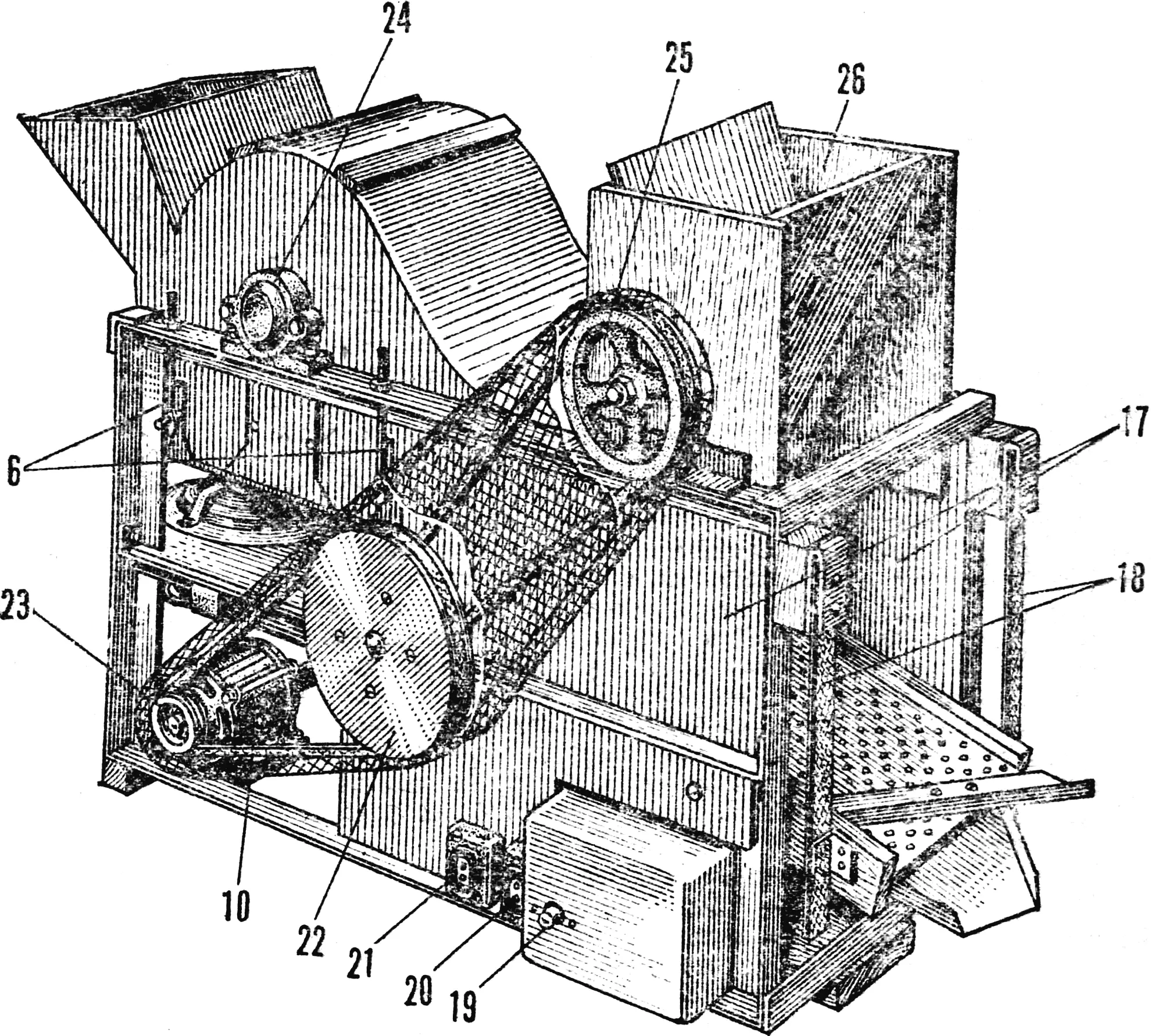
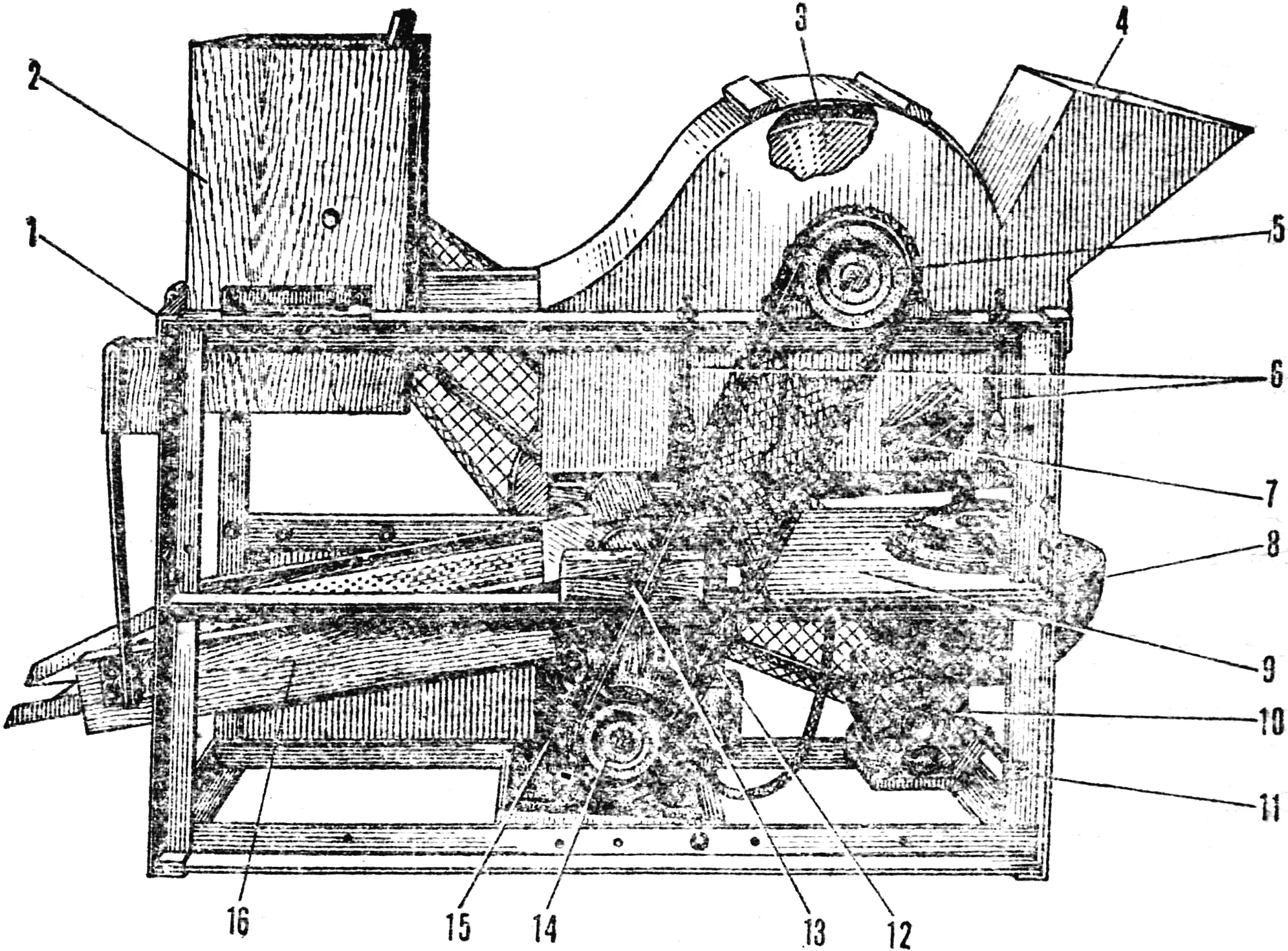
1 — frame, 2 — winnower hopper, 3 — threshing drum, 4 — loading funnel, 5 — threshing drum pulley (Ø 105 mm), 6 — adjusting rods, 7 — concave, 8 — fan, 9 — shelf, 10 — winnower drive electric motor, 11 — engine mounting pivot, 12 — belt guard, 13 — plain bearing, 14 — thresher drive pulley (Ø 70 mm), 15 — drive electric motor, 16 — sieve unit, 17 — winnower tunnel walls, 18 — sieve unit suspension, 19 — fan starter, 20 — winnower starter, 21 — thresher starter, 22 — pulley block for the crank drive (Ø 250 mm) and hopper (Ø 90 mm), 23 — winnower drive pulley (Ø 70 mm), 24 — drum bearing housing, 25 — hopper pulley (Ø 150 mm), 26 — hopper funnel.
The thresher-winnower was built by 10th-grade pupil Ivars Silenieks, his brother Andrejs, now a student at the Agricultural Academy of the Latvian SSR, as well as sixth-graders Normunds Berzins and Valdis Daugelis. RN-1 was awarded a diploma at the ceremonial opening of the All-Union Week of Science, Technology and Production in Vilnius and was shown at the republican NTTM-82 exhibition in Riga.
The design of the combine is quite distinctive. On a frame measuring 925×565×410 mm, welded from 40×40 mm angle bars, the units are arranged in three tiers: at the top — the thresher and the winnower; in the middle — the fan and the sieve unit; at the bottom — the drive electric motors and their starters.
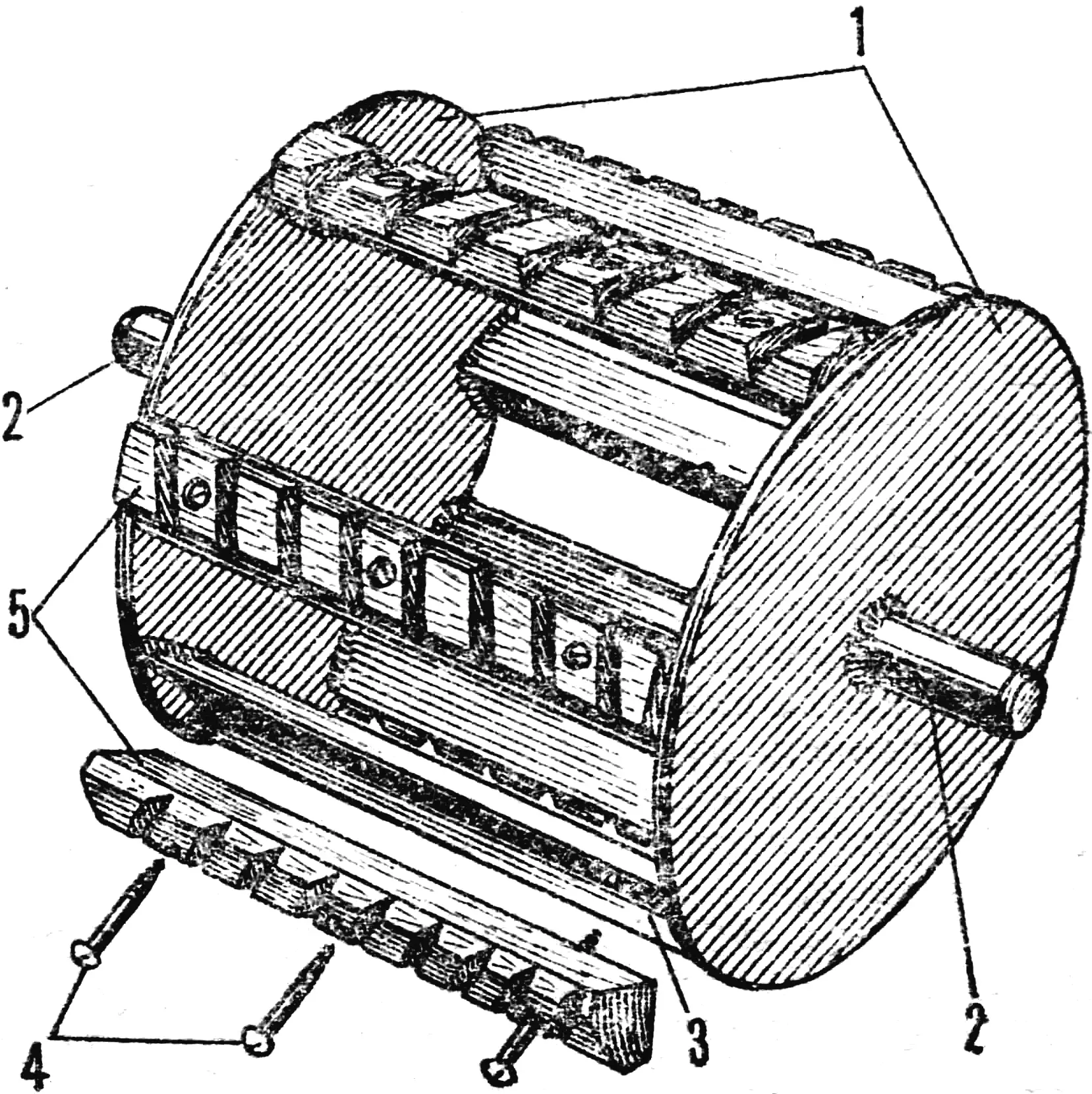
1 — discs, 2 — half-axles, 3 — beater seat, 4 — beater fastening screws, 5 — beaters.
The thresher design is traditional: a housing, a drum, a concave, and a loading funnel. The housing and the funnel are made of 10 mm plywood and thin steel sheet. The drum is made of steel discs Ø 300 mm, eight 25×25 mm angle bars, and corrugated oak beaters.
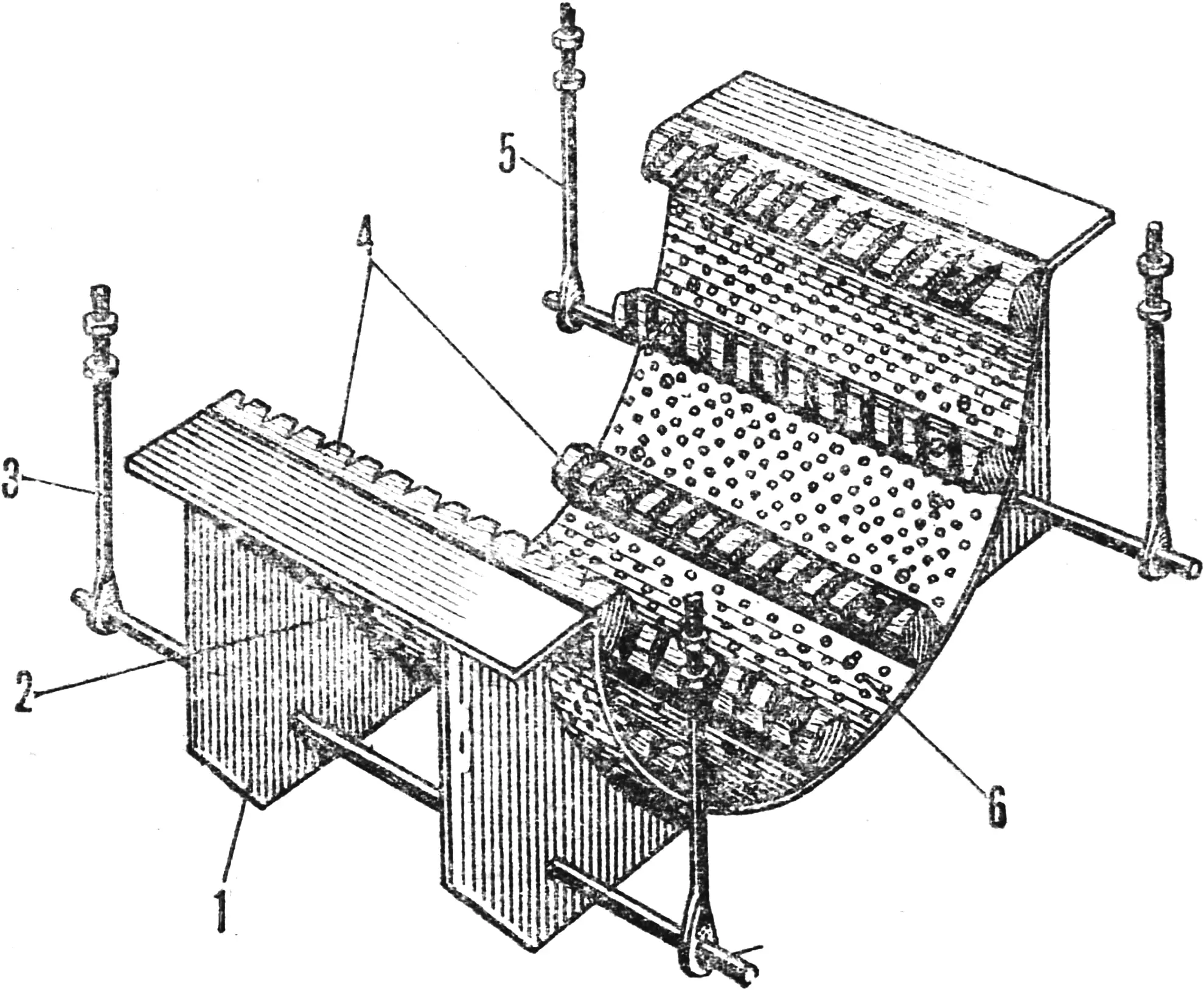
1 — housing, 2 — beater fastening bolts, 3, 5, 7 — concave suspension system, 4 — beaters, 6 — sieve.
The concave consists of a housing (two metal sheets), a fine-mesh screen bent to a radius with six beaters attached to it — the same as those on the drum — and a suspension system on the frame: steel rods with adjusting rods at their ends. By changing with the latter the gap between the beaters of the concave and the drum, the unit can be adjusted for threshing different crops, and its quality can also be varied.
The thresher is driven by two V-belts from an electric motor located on the lower tier in the middle of the frame.
The threshed grain or seeds, falling through the screen, go into a container placed on the shelf under the concave. Chaff and other waste are thrown out by the drum through the gap between the last beater of the concave and the upper covering of the thresher and fall onto the sieves, where the remaining seeds and grains are extracted from them by separation.
The sieve unit is made like the straw walker of a grain harvester. Only here there are two sieves: with holes Ø 3 mm (upper) and Ø 1 mm (lower). Beneath them is a pan.
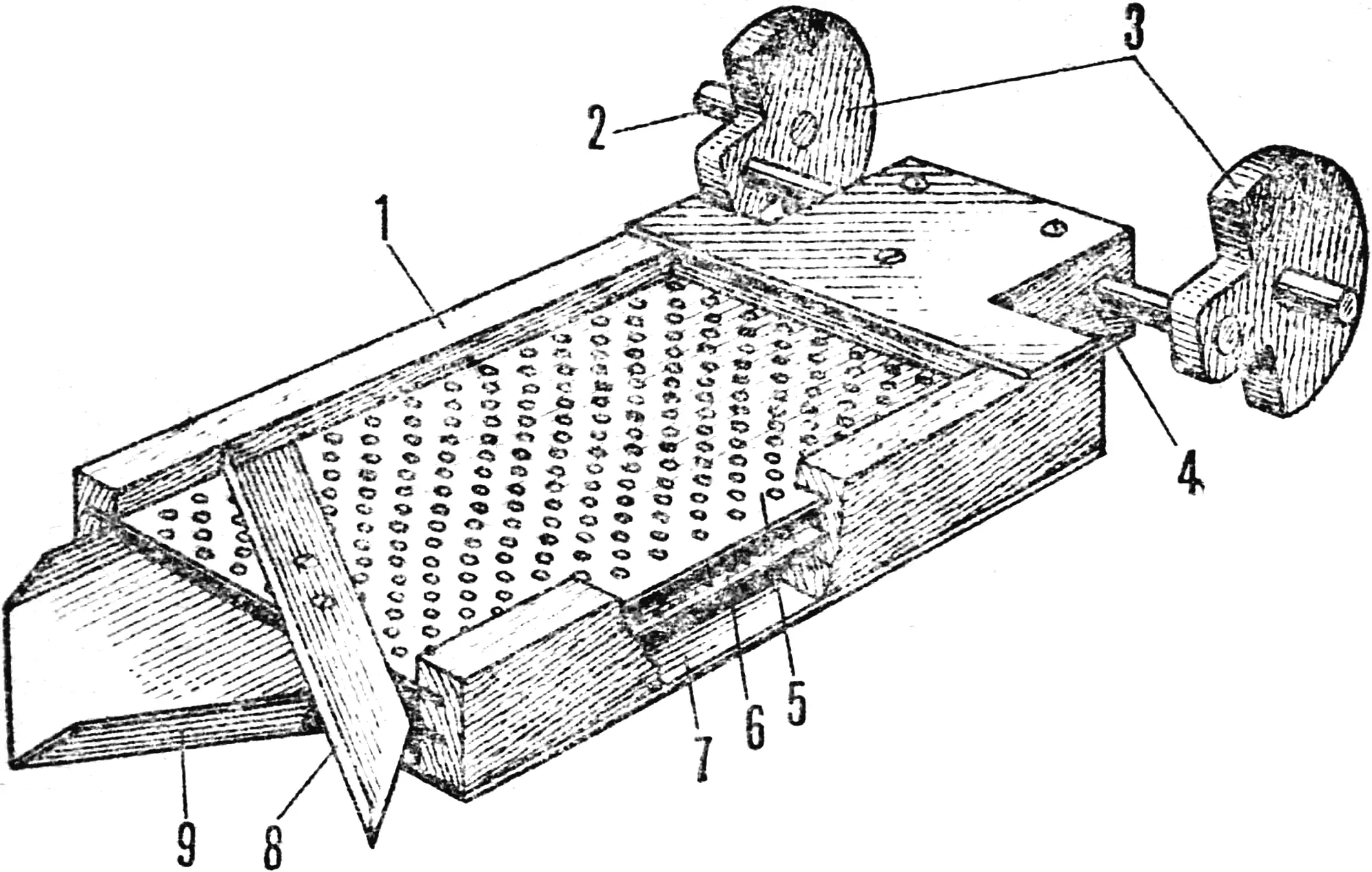
1 — housing, 2 — crankshaft, 3 — counterweights, 4 — plain bearing, 5 — upper sieve, 6 — lower sieve, 7 — pan, 8 — upper sieve chute, 9 — lower sieve chute.
A plain bearing is built into the upper part of the unit: in a section of nylon tubing a crank with counterweights from moped engines rotates. The lower part of the unit is suspended on two plywood strips that allow it to move back and forth. The separated fractions go along the corresponding chutes into containers placed underneath.
The sieves are driven by an electric motor. From it a V-belt runs to the large crank pulley. Next to this pulley there is another, smaller one, from which another belt runs farther — to the winnower hopper.
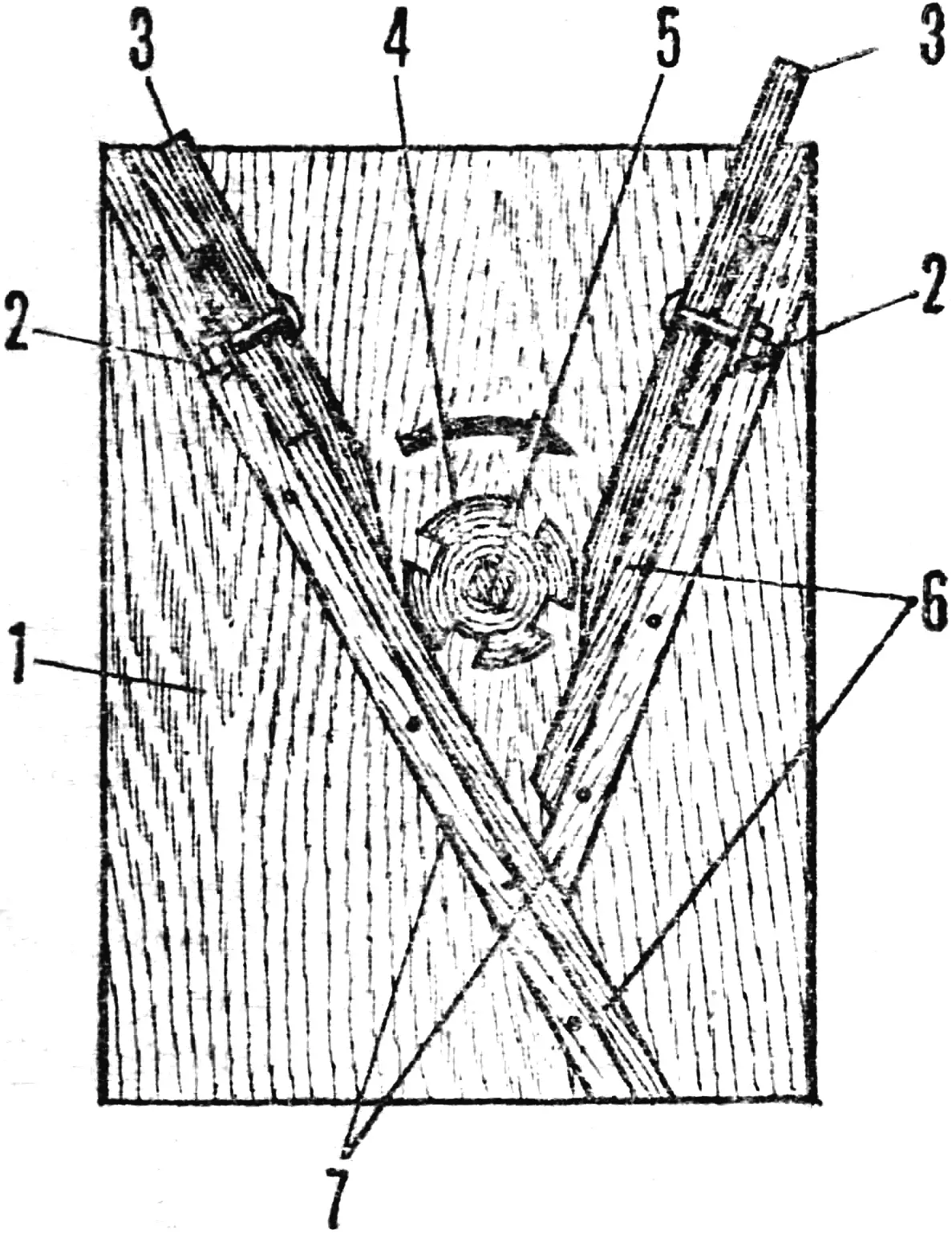
1 — housing, 2 — gate fastening bolts, 3 — gates, 4 — metering roller, 5 — metering roller shaft, 6 — funnel cheeks, 7 — cheek supports.
Now about how the hopper is arranged. It is made of 10 mm plywood. Between the two boards of the housing there is a flat funnel, in the mouth of which a square-section shaft with a metering roller rotates — a wooden cylinder Ø 50 mm with four longitudinal grooves. As it rotates, the metering roller picks up the hopper contents with its grooves and pours them in even portions into the mouth of the funnel, and thus onto the sieves, where everything is screened.
If the processed mass contains many weed particles, the fan can be switched on; it will drive a stream of air over the sieves and blow the trash away. Heavier particles will fall onto the sieves.
Tests have shown that the winnower works very reliably and with high quality; it even cleans such a “delicate” substance as bee pollen. Previously beekeepers picked trash out of it with tweezers, and that took a great deal of time. Now there is no need for such a painstaking procedure.
“M-K” 4’83, A. ALEKSANDROV
Recommend to read
 WELL, JUST VERY FLAT
Indeed, the proposed chair for the hallway is not just folding, but almost entirely flat, as folded, becomes almost equal to the thickness of the four panels, from which his legs (or... COUPE FOR TWO
When winter comes, the main individual off-road transport in much of our country be the snowmobiles. Unfortunately, they have a significant drawback in terms of comfort snowmobiles do...
