
Any garden or household plot, as a rule, yields a return and delights its owner when there is a sufficient amount of… water. If there is a natural source nearby or a central water supply, the irrigation problem becomes simpler, but in most cases one cannot even rely on a source. In a hot summer, when rains are rare, water consumption rises sharply, and wells and boreholes can no longer cope with the increased load. In such cases it becomes necessary to have a water reserve on the plot. And then the question arises: what to store it in?
If possible, one can buy a medium-sized truck tanker or something similar, but that is still not a real solution. Besides, metal rusts over time, contaminating the water. It is much more practical and affordable to make a reservoir from concrete, and to make it underground so that it does not take up space on the plot.
Where to start construction? First, it is necessary to determine the location and dimensions of the future storage. Considering that the structure is rather labor-intensive, one should not plan very large dimensions. Practice shows that the most optimal volume is 3.5…4 m3.
So, when the place has been chosen and the outlines of the excavation have been marked on the ground surface, digging begins. In doing so, it is necessary to periodically check the verticality of the walls and the correctness of the plan shape. After the earthworks are completed, the excavation is prepared for concreting. This work is not difficult; however, there are some peculiarities in setting up the formwork. It is best to use formwork made of several sections rather than installing it at once for the full height, because in that case the concrete mass may hang up and voids may form. It follows that the height of a formwork section must be chosen so that the concrete can be compacted by hand. Usually this is 500…600 mm. In a simplified way, the formwork can be made by driving stakes into the bottom of the excavation along the walls and inserting iron sheets behind them.
The thickness of the concrete walls is determined from the strength condition:
σр≤[σ],
where σр is the design stress, kgf/cm2; σ is the allowable stress, kgf/cm2;
σр=(D*ɣ*h)/(2*t),
where D is the reservoir diameter, cm; ɣ is the specific weight of water, kgf/cm3; h is the internal height of the reservoir, cm; t is the wall thickness, cm.
As an example, take a reservoir 1.6 m in diameter and 2 m in internal height (volume 4.35 m3), σр = 5 kgf/cm2; then:
t=(160*0,001*200)/(2*5)=3,2 cm.
With a threefold safety factor, the wall thickness comes out to 10 cm. We made this brief digression into theory not by chance. The point is that one often encounters tanks obtained by simply plastering the excavation walls with concrete. They last a very short time, if they do not fail at the very first filling with water. Typical failure locations are the bottom of the walls, the floor, or the joints with the cover. In the latter case the cause is incorrect design of the cover: the apron projecting beyond the reservoir outline serves as its support on the ground. When filled with water, under its weight the reservoir settles, while the upper part hangs on the apron as on a bearing slab, after which it tears away. Hence the conclusion that the apron must be made as shown in the figure — without a connection to the “cup”.
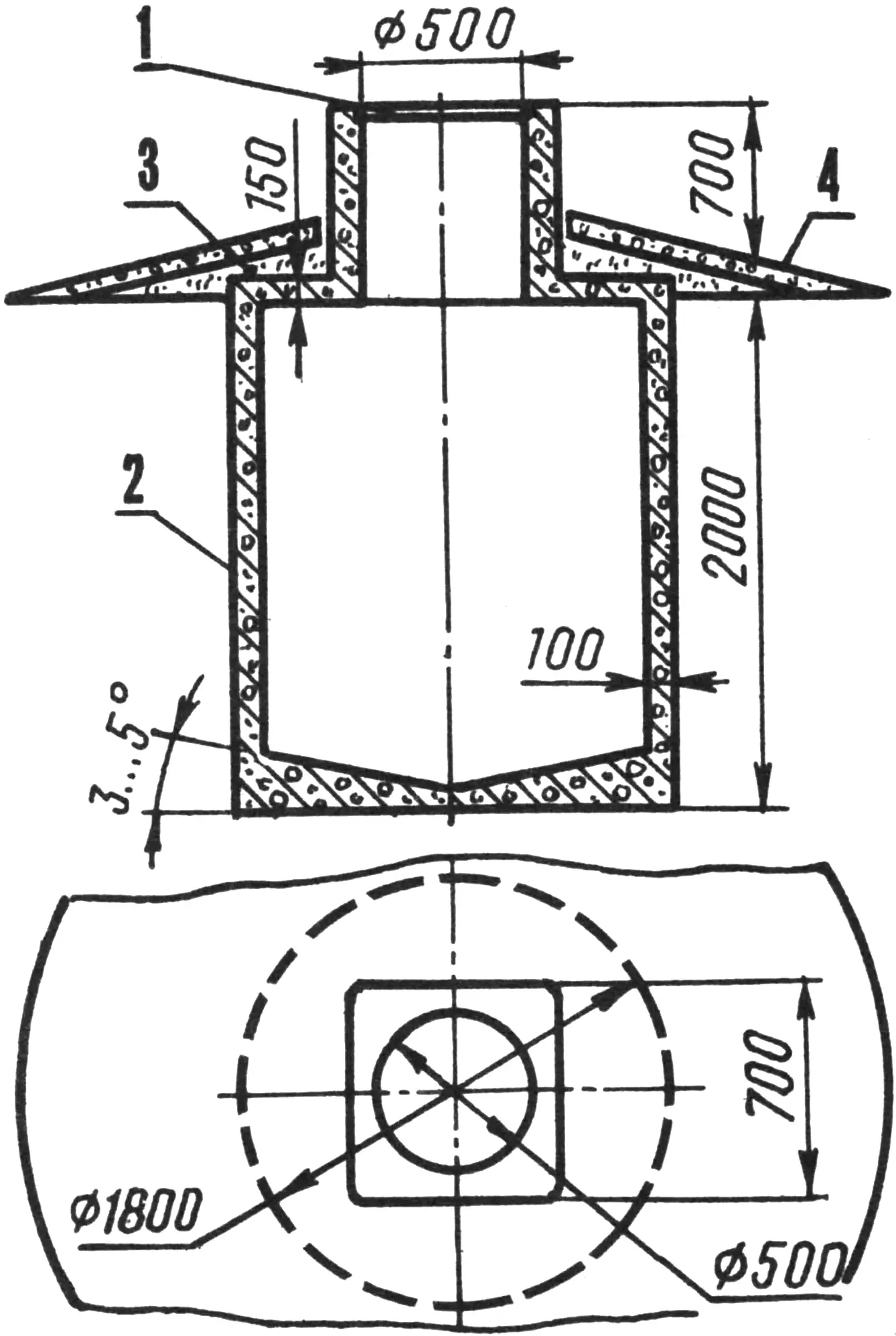
1 — ring (steel), 2 — “cup” (reinforced concrete), 3 — sand, 4 — apron (concrete).
After the formwork is installed, reinforcement is placed in the space formed between it and the earth (any scrap metal can be used) and concrete is poured.
The poured concrete mixture hardens in a day or two; then the formwork is moved.
After the walls of the “cup” have been built, the formwork is removed and the floor is poured. The final stage in treating the internal surfaces of the reservoir is so-called ironing. It consists in plastering with cement diluted with water to the consistency of sour cream. Such a mortar can be applied with a brush. A layer 2…3 mm thick will protect the tank from water seepage.
The cover is made taking into account the recommendations above. The formwork for this operation is made suspended.
The dimensions of the above-ground part of the storage are chosen within 600…700 mm in height and 500…550 mm in diameter. It can be camouflaged as a well of an appropriate style; then the whole structure will become an architectural addition and an ornament to the garden plot.
In operation, the underground tank must be periodically completely emptied of water and cleaned — otherwise, like any body of water, it will become contaminated.
“M-K” 7’91, L. KURDELYAS, Terny village, Mykolaiv region.
Recommend to read
 TWO SPECIALTY SPRINGS
Tape, knife and a stand for hot dishes can be made of conventional spring. To place the knives, the spring must be mounted on the wall,using wooden strips or metal plates. But if it roll... IT IS CALLED “BTR”
Amateur designer Oleg Aliev Old from the Moscow region village of Ostrovtsy is known by many thanks to its handsome jeep "SIMOT", built in 1996. This car can be seen in the television...
