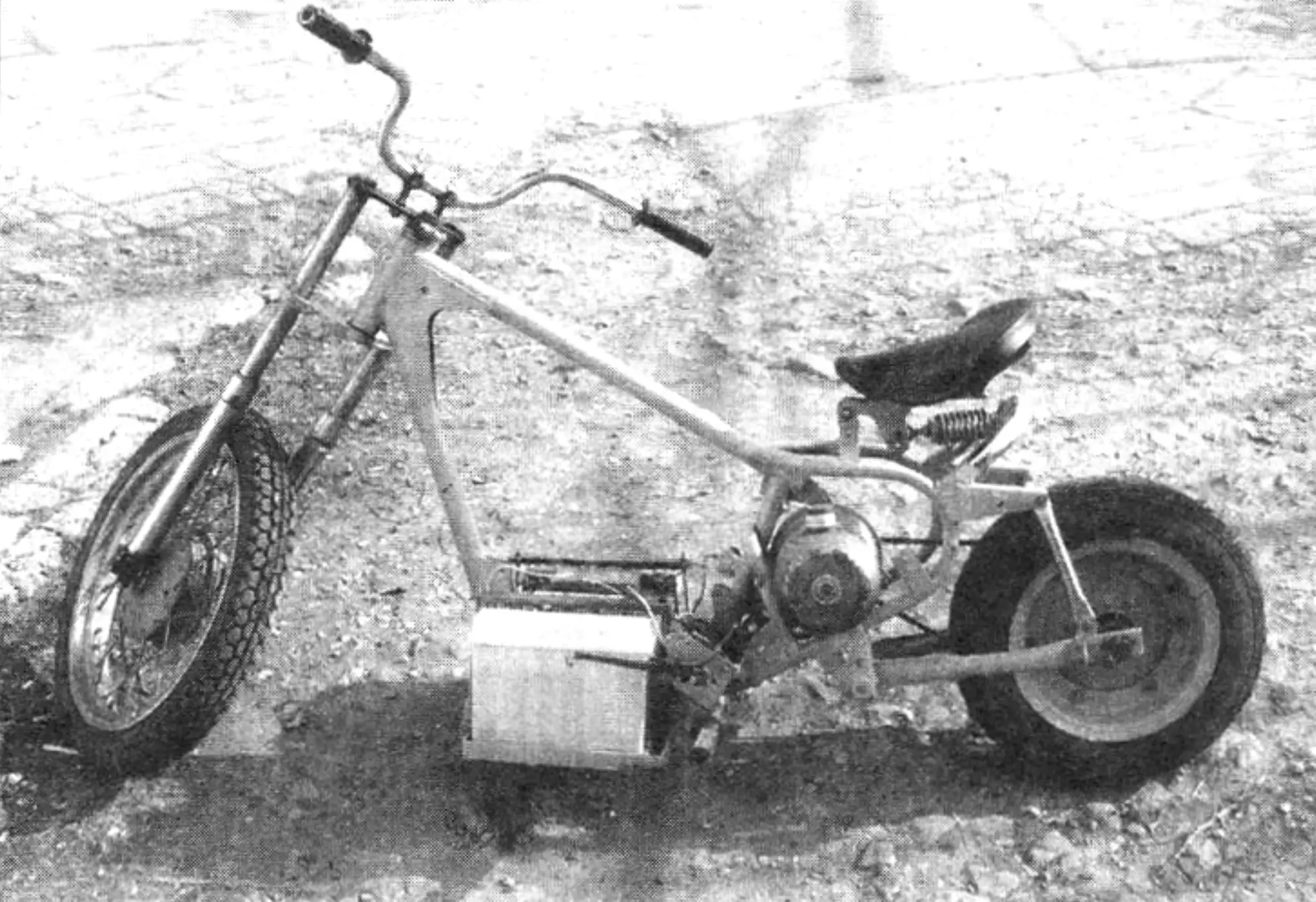
Ecology and environmental protection are becoming increasingly relevant topics worldwide. Requirements for harmful emissions from vehicles are constantly being tightened. That is why major manufacturers are developing and starting to produce electric and hybrid cars. These trends are also reaching our country.
And while the evolutionary direction of automotive development has been defined and is handled by professionals, the category of auxiliary vehicles remains an unplowed field for research, analysis, and the creation of new types of equipment for outdoor recreation, household work, initial training, and so on.
For the last of these purposes, the design association of the Center for Children’s (Youth) Technical Creativity in Beloretsk, Bashkortostan, decided to design an environmentally clean, simple, reliable, and safe vehicle. By common agreement, it was to be an electric motorcycle.
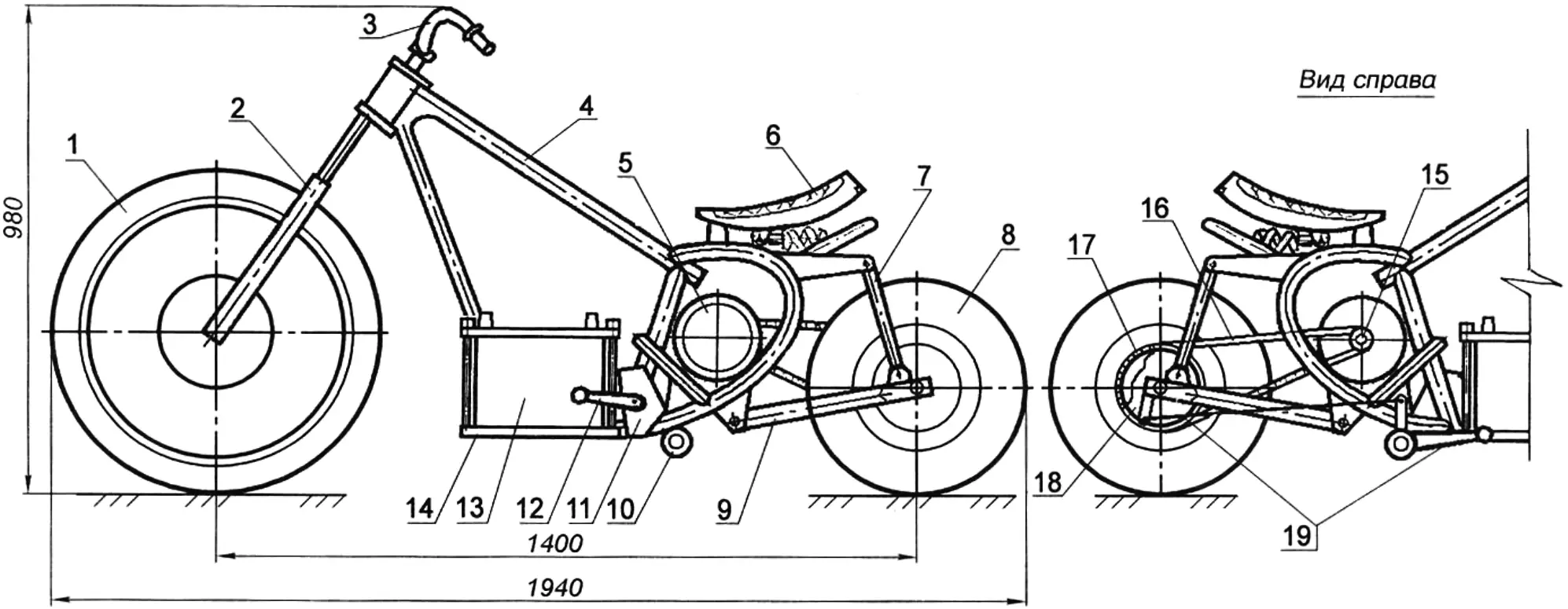
1 — front steering wheel (from MMVZ-125 motorcycle); 2 — front fork (from MMVZ-125 motorcycle); 3 — handlebar (from MMVZ-125 motorcycle); 4 — frame (from Voskhod motorcycle, modified); 5 — Electromotorenwerk Harthf electric motor (N=4 kW, n=1200 rpm, U=48 V, I=80 A); 6 — seat (from Ural motorcycle); 7 — brace (Ø22 tube); 8 — rear drive wheel (from Tulitsa scooter, modified); 9 — rear wheel fork (Voskhod motorcycle swing arm); 10 — footrest; 11 — controller (from a Bulgarian electric car); 12 — controller pedal; 13 — battery (from a passenger car, 55 Ah, 2 pcs.); 14 — battery box (25×25 angle, 2 pcs.); 15 — drive sprocket (z=11); 16 — roller chain drive (t=12.7); 17 — driven sprocket (rear-wheel drive) (z=59); 18 — protective disc (duralumin, sheet s1); 19 — braking system
As the power unit, they chose an electric motor with glued-in magnets from a decommissioned computer; it attracted our attention by its manufacturing quality and high efficiency (it barely heats up in operation).
The supply voltage for the motor was set at 24 volts — it is completely safe for humans. It was provided by two automotive batteries of 50 Ah each. Before being installed on the electric motorcycle, the batteries were packed in a polyethylene bag.
The electric motor is controlled by a controller with a neutral position into which its lever returns automatically as soon as the control action on it ceases. The braking system is from a Voskhod motorcycle.
When developing the design, we wanted to make do with a single-stage drive to the driving wheel: it is simpler to build, efficiency is highest, and the mass is small. To meet the traction and speed parameters, a sprocket with z=11 was mounted on the electric motor shaft, and a sprocket with z=59 on the driving wheel.
A small-diameter drive wheel was used — 4×10” (the tire and disc were taken from a Tulitsa scooter).
Using a tachometer, the electric motor’s no-load speed was measured, and, taking into account the specified transmission ratio and tire diameter, the electric motorcycle’s speed was calculated — 16 km/h at 24 volts. These parameters suited us well enough to decide on this transmission. Having determined the main parameters, we moved on to solving layout problems.
The basis of the electric motorcycle was a frame from a decommissioned Voskhod motorcycle, stripped of everything unnecessary. However, the units would not fit on it as desired, because we wanted to install the batteries and the electric motor so as to obtain the lowest possible center of gravity. Reworking the frame was undesirable — a jig would have been required for that (the workpiece warps during welding).
And yet a simple (one might even say elegant) way to increase the wheelbase of the electric motorcycle was found: the rear-wheel swing fork was shifted rearward and fastened in the lugs of the rear footrests. And two removable battery boxes, welded from 25×25 angle stock, were placed in front of the footrests, to the right and left of the main frame tube and even 50 mm below it.
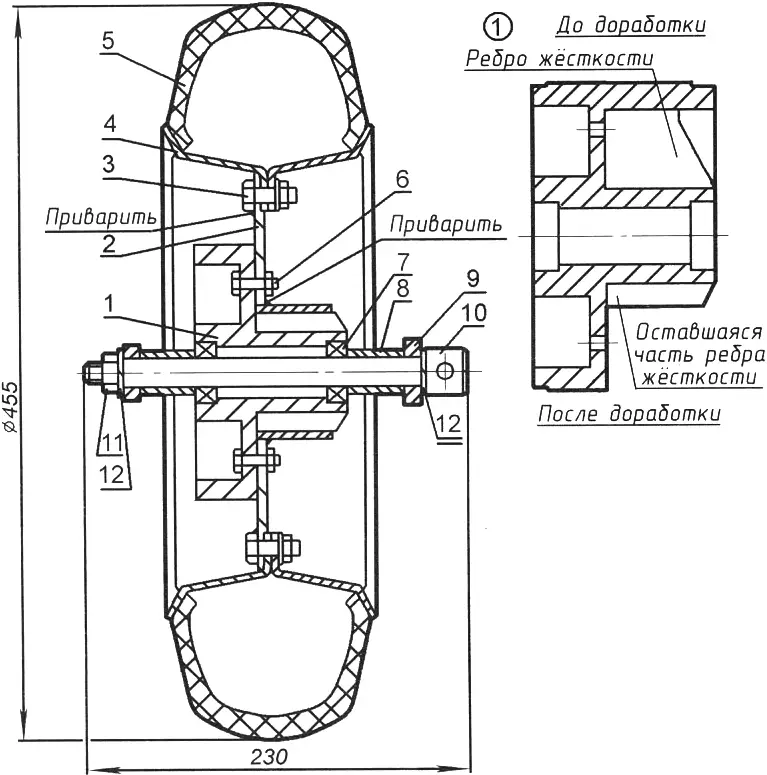
1 — hub (from Tulitsa scooter); 2 — wheel disc (from Tulitsa scooter, modified); 3 — bolt fastening the wheel rim to the disc (stock); 4 — wheel rim (composite); 5 — tire; 6 — bolt fastening the wheel disc to the hub (stock); 7 — bearing (stock, 2 pcs.); 8 — spacer sleeve (2 pcs.); 9 — rear wheel fork; 10 — axle (from MMVZ-125 motorcycle); 11 — axle nut; 12 — spring washer (2 pcs.)
The electric motor was placed in the rear of the frame, under the rider’s seat, which made it possible to use a very short drive chain, with tension adjusted by a slight movement of the rear-wheel axle in the fork slots.
The engine mounting brackets were welded in place. To do this, the rear wheel and the motor with its sprocket were temporarily fixed on the frame, and the chain was placed over the sprockets so that there was no misalignment between their axes.
The seat was taken from a Ural motorcycle; the front fork and front wheel — from a Minsk motorcycle.
Serious work was also required to rework the rear driving wheel. The hub was taken from the rear wheel of a Voskhod motorcycle. It was freed of spokes and turned on a lathe to obtain a seating surface for installing a centering bushing with a wheel disc, joined together by welding.
For the wheel rim, a centering groove is cut along the edge of the wheel disc. After the wheel is assembled, the heads of the bolts that fasten the rim are welded to the wheel disc.
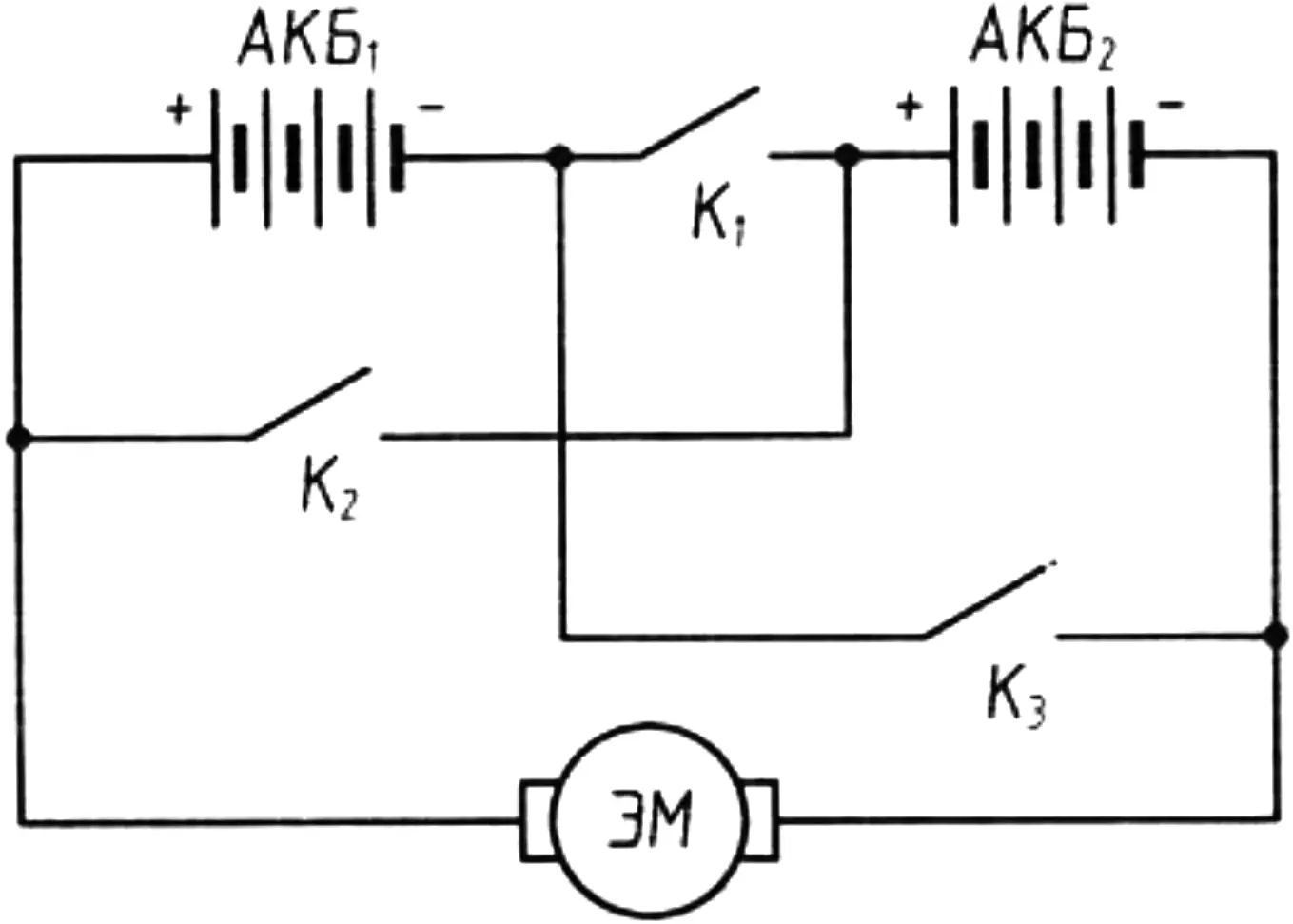
Parallel battery connection — contacts K2 and K3 closed; contact K1 open — starting from rest and accelerating the electric motorcycle.
Series battery connection — contact K1 closed — contacts K2 and K3 open — main driving mode.
The schematic electrical diagram was borrowed from a Bulgarian electric car. The difference is that instead of a diode a contact was installed that allows switching the voltage supplied to the electric motor from 24 volts to 12 or vice versa.
Starting from rest and the initial acceleration are done at reduced voltage, when contacts K2 and K3 are closed. Reduced voltage is also used for energy regeneration during braking and downhill travel. In steady motion, contacts K2 and K3 are open and contact K1 is closed — full voltage is then supplied to the electric motor.
For the first time in our design association an electric motorcycle is in operation, so it was interesting in practice to determine its current consumption parameters and the operation of its electric motor in regeneration mode. Measurements were made with an AP — 110 ammeter (GOST 1700-66) with “0” at the center of the scale.
It was found that the greatest current surge occurs when starting from rest: at 24 V — up to 30 A, and at 12 V — up to 15 A. In steady mode the current draw is 10 A at 12 V and 15 A at 24 V. However, we were puzzled by the fact that when climbing an 8% grade the current draw was 20 — 22 A at 24 V, while on the same descent in regeneration mode the battery charging current was only 20 A at 12 V. Meanwhile the electric motorcycle moved with a slight deceleration.
Such significant electric energy losses (about 50% with such an economical motor) can be explained by unaccounted large energy expenditures in the transmission, rolling resistance of the wheels, and also by inefficient motor operation at reduced speed.
It seems highly attractive to install in these same battery boxes a pair of 24 V batteries from trucks, which would be enough for 1.5 — 2 hours of riding with a sharp improvement in the machine’s running qualities, if mass, center of gravity, and therefore handling did not change… But that is our next creative task.
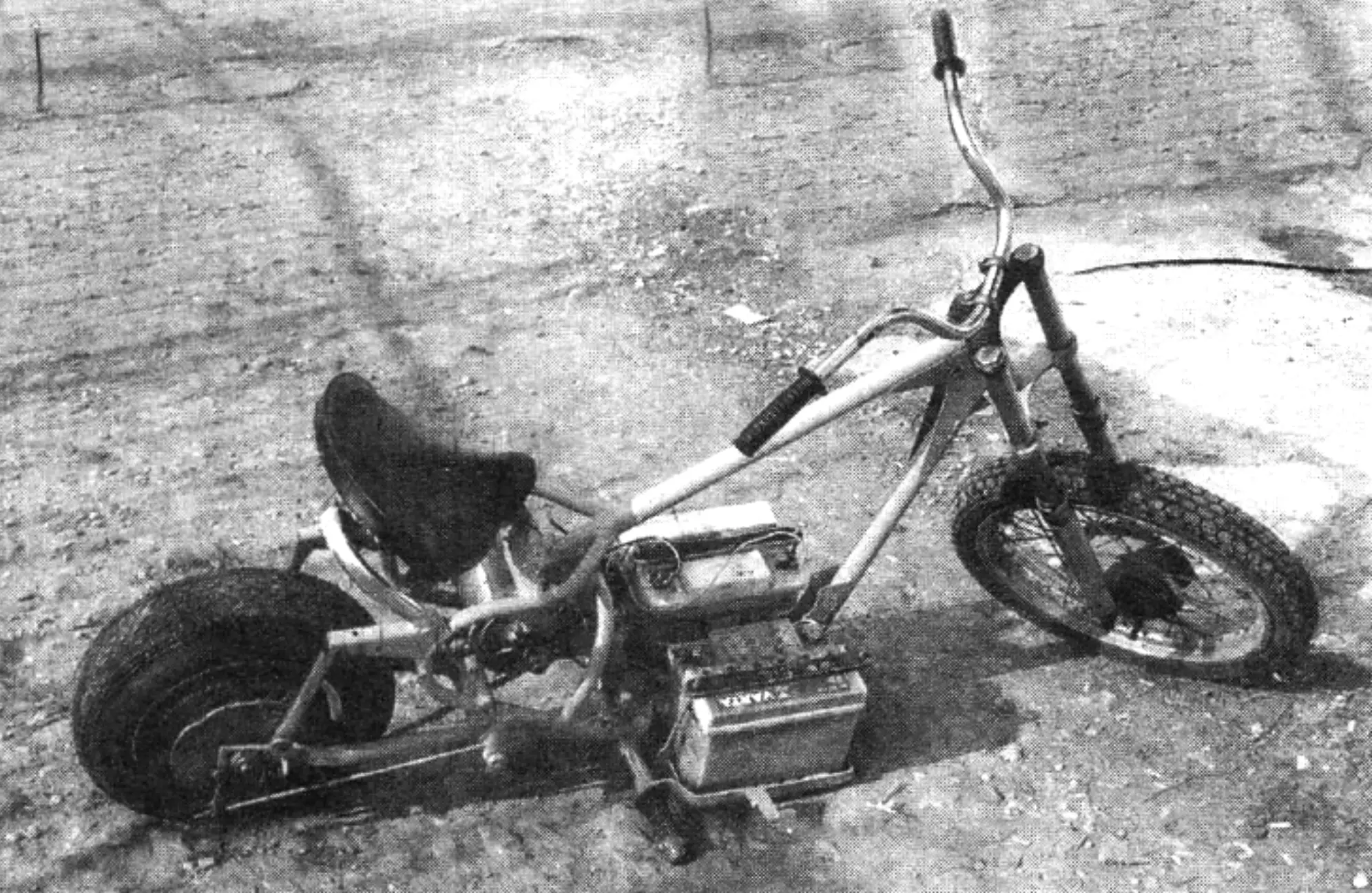
It is especially important to note that the young people acquired the basics of design and work skills, and experience in creating something new. The machine is constantly being modernized and improved. During this academic year we made the frame demountable — with flange joints — which made it possible to transport the electric motorcycle in the trunk of a passenger car. A stiffer front fork was also made.
The main advantage of electrically driven vehicles, especially for initial training, is the machine’s constant readiness for action. You sit down, press the controller lever with your left foot — and off you go. And at the same time — note — almost silently and without polluting the environment.
“Modelist-Konstruktor” No. 11’2010, A. KOPYEV
Recommend to read
 PLACE GLOVES
We all know how sometimes it is difficult among the things on the rack to find my gloves. Much easier to store them, capturing believeme clothespins mounted on a small wooden plank. FROM STANDARD ELEMENTS
It's a lot easier to accommodate storage of books, magazines, albums, drawings! Of course, wardrobe. Very often any handyman takes two vertical boards, establishes between them a...
