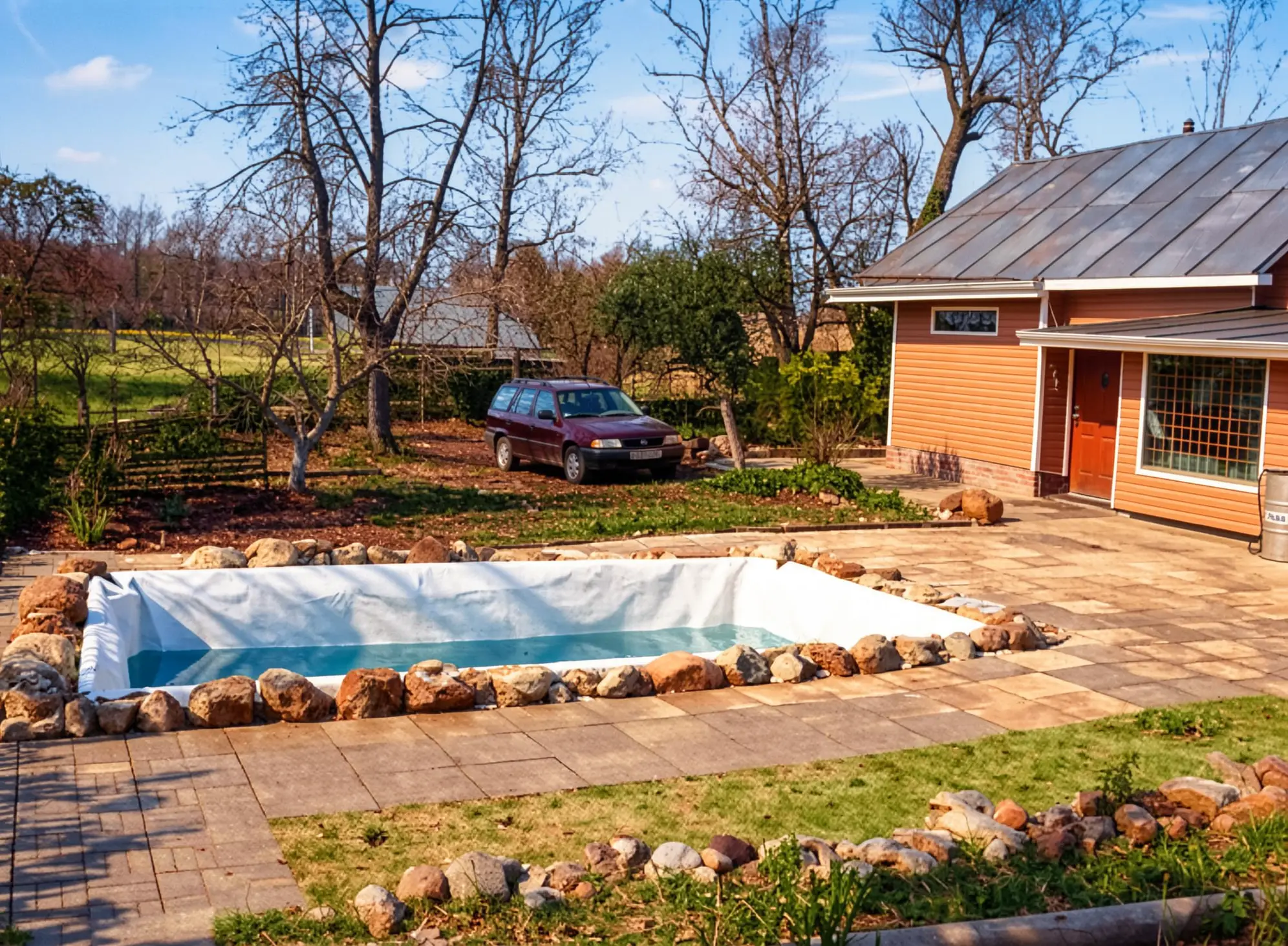
On the spot where I planned to build a swimming pool near a country house there used to be an old pond that once served both as a fire reservoir and as a place for domestic geese and ducks to roam. But time passed: for firefighting needs there is now a water supply, and the house has become a summer cottage, so we no longer keep poultry here. The pond itself also gradually silted up and overgrew.
To begin building the pool, the pond bowl had to be drained and cleaned. Pumping the water out of it was not too hard, but scooping out the bottom silt turned out to be difficult work — or rather, heavy work. Access for heavy (productive) machinery to the drained pond was impossible because it was among long-standing fruit trees that I did not want to cut down at all, and the outbuildings were right nearby.
At that time I could not invent any other method than hauling the silt (which had already become sapropel) away in a wheelbarrow with a sealed body up an inclined ramp, and I did the entire amount of work that way. For the body of the cart I adapted an ordinary stamped steel trough, and the ramp was a 6-meter length of rolled steel channel No. 50. I spread the silt around the garden and used it as fertilizer.
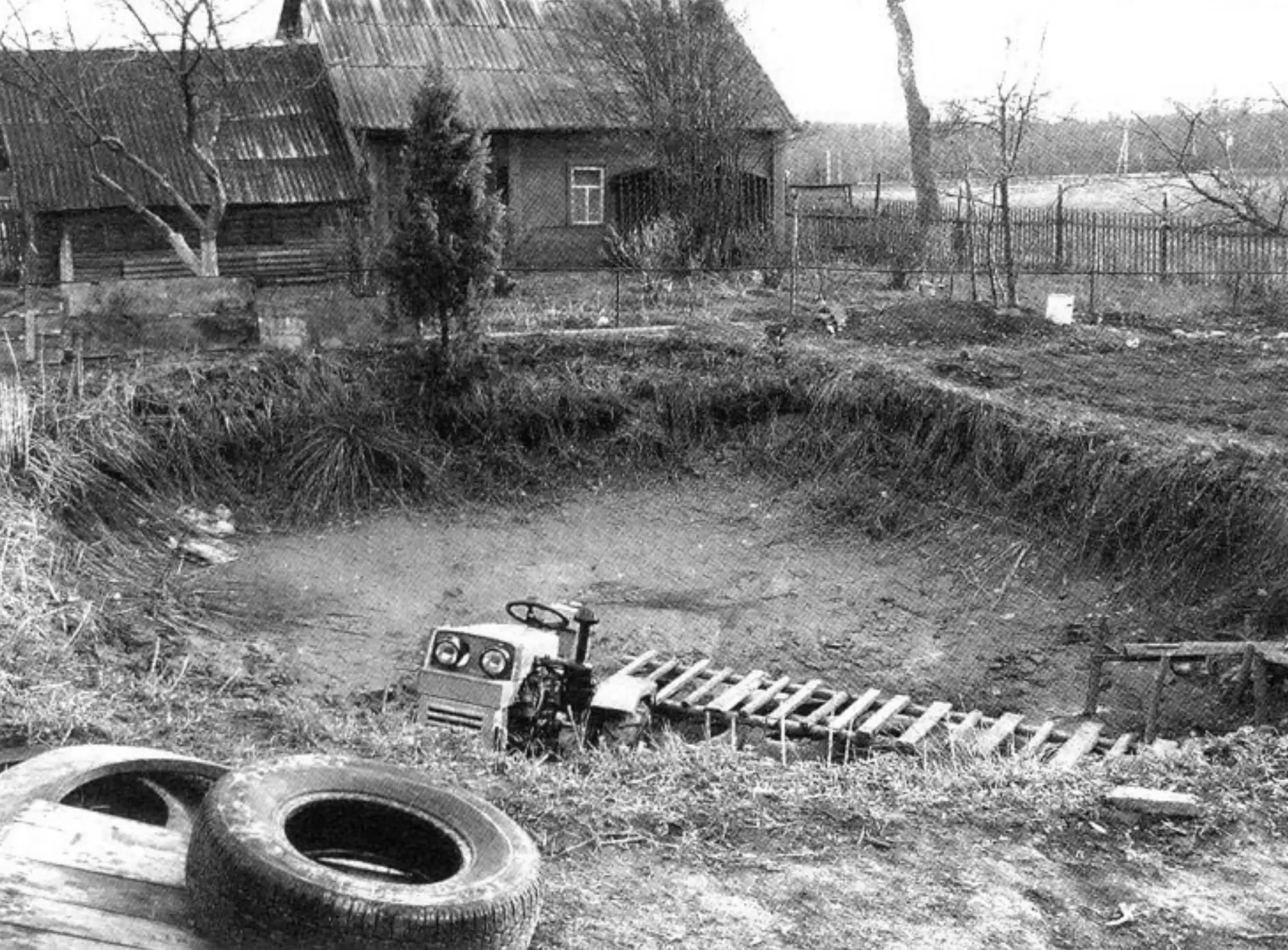
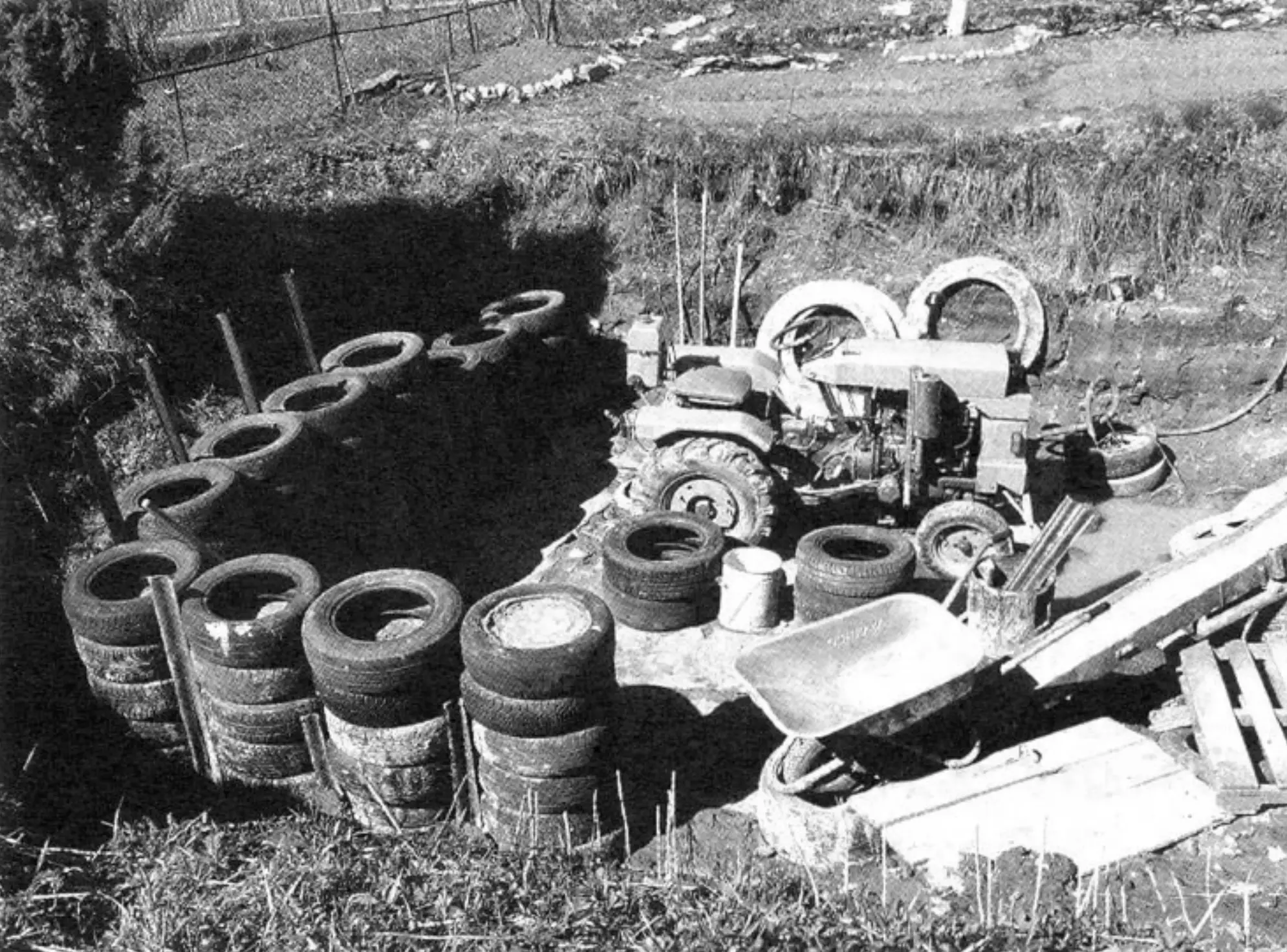
In the photograph, at the bottom of the excavation you can see a mini tractor (an article about it was published in “Modelist-Konstruktor” No. 8 for 2007). With this tractor and a trailer I prepared the main building materials: tires, stones, and sand — luckily I did not have to travel far for them. But it ended up in the excavation not as a means of mechanizing the laborious and heavy work, but by a careless accident: the tractor was on the bank of the drained pond when a heavy rain began, and on the soaked ground it slid down to the bottom (fortunately it did not tip onto its side or overturn). So in the end, the work of cleaning the pond bowl of silt was joined by the work of lifting the tractor back up, which I did with a hand winch along a ramp specially arranged for that purpose.
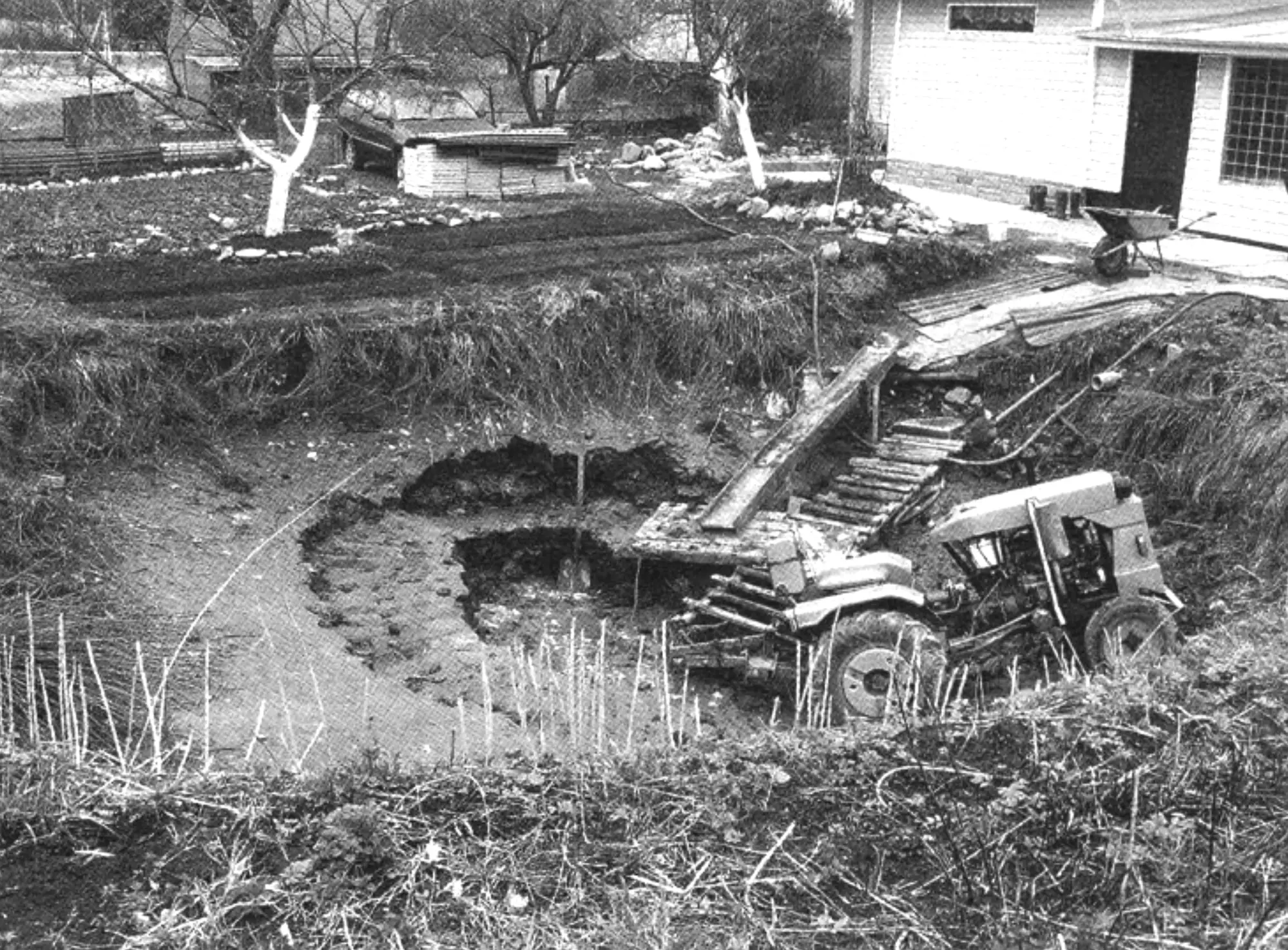
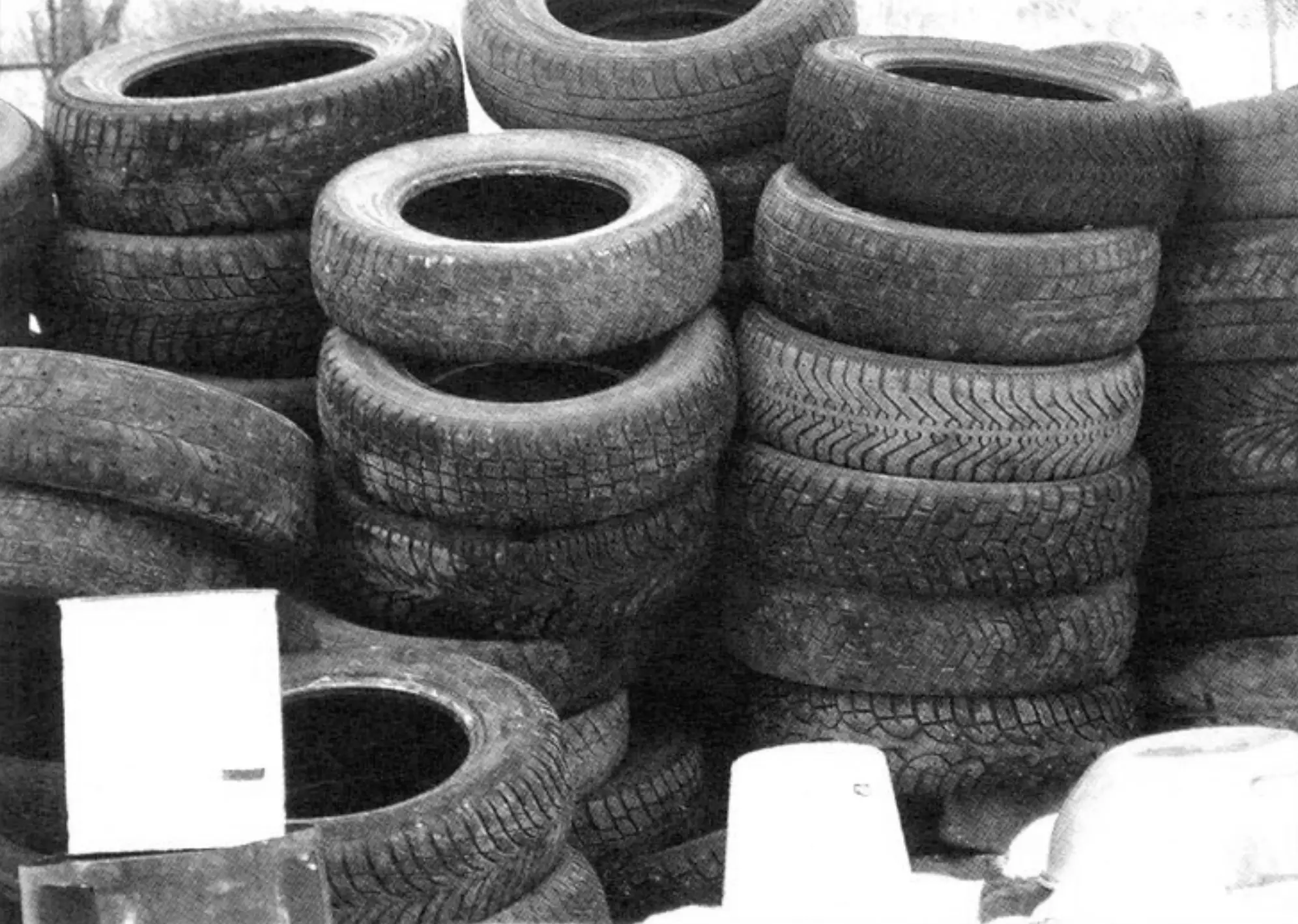
One of the key issues in building the pool was financial — funds were limited. Therefore I decided to make the retaining walls of the pool, which were to end up underground, from “free” material — worn-out tires, which are scattered around our parts (and everywhere in our country where cars drive) in countless numbers, and thereby make a modest contribution to the natural ecological process of self-cleaning. I estimated the need for tires — it turned out that about three hundred would be required. I collected tires along the edges of nearby groves and ravines in just a few days. Mostly these were tires from passenger cars, and for the most part from VAZ models. Their outer diameter was about 640 mm, and the width about 200 mm. But imported low-profile (wide) tires were best suited for this purpose: they were easier to pack with sand. And their outer diameter is almost the same as that of domestic tires.
I laid the tires one on top of another in a column, filling each with sand. When building the columns I tried to select tires of roughly the same outer diameter for each column.
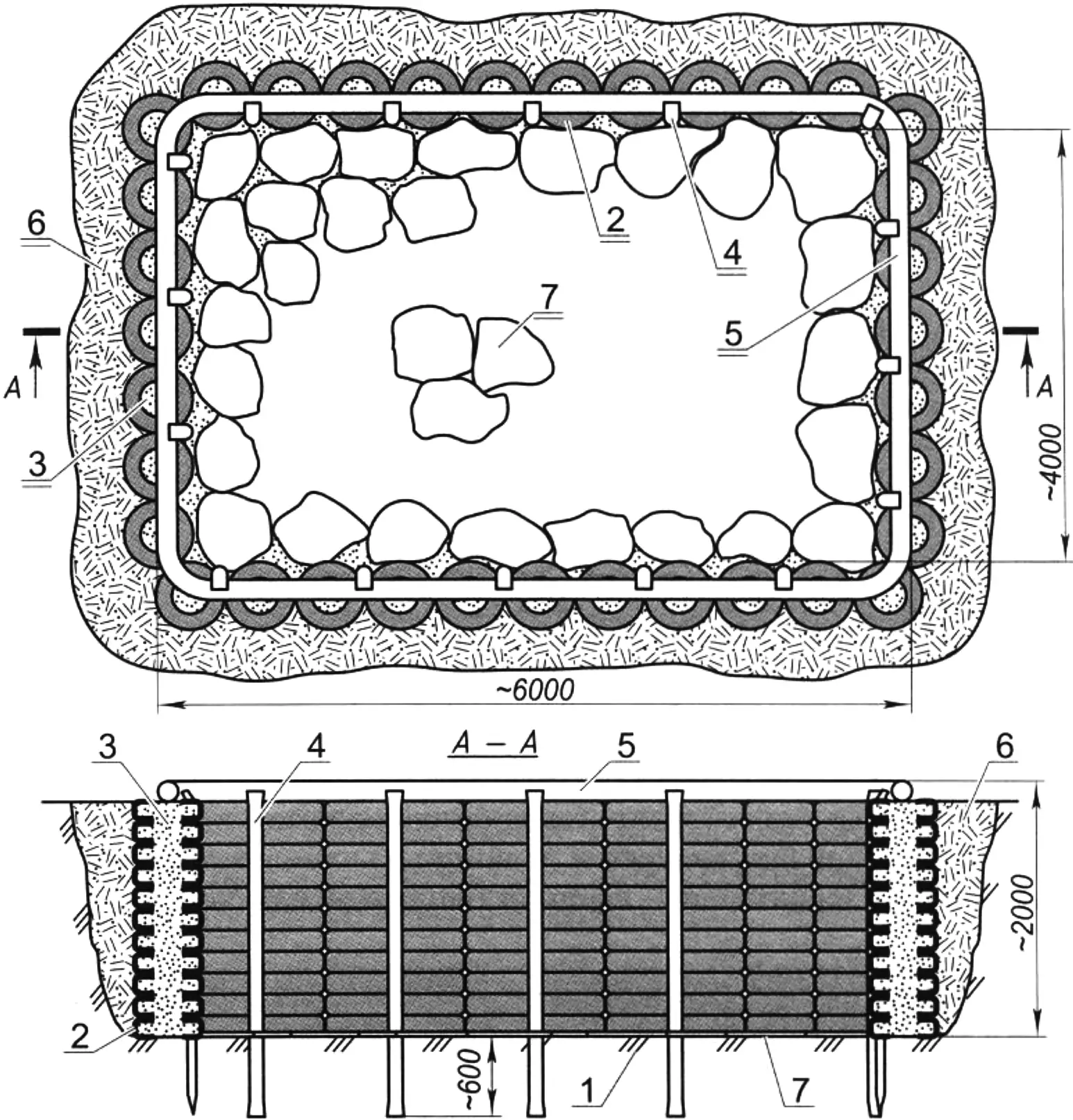
1 — native soil (clay); 2 — wall (car tires); 3 — filler (sand); 4 — support post (steel pipe Ø60, as needed); 5 — perimeter binding (steel pipe Ø100); 6 — backfill (soil, sand, stone); 7 — bottom (flagstone, asphalt concrete slabs, sand)
For reliability and stability of the columns, at the joints of some of them I drove into the bottom to a depth of 0.5 — 0.6 m steel pipes with an outer diameter of 60 mm. The height of these posts is the full height of the walls. I fastened all the posts at the top around the perimeter with a binding — a fairly thick pipe (outer diameter 100 mm). To do this I flattened the upper ends of the tubular posts and welded them to the binding pipe.
I did the backfill in the remaining spaces between the excavation walls and the tire walls with the remaining excavated soil and sand with small stones.
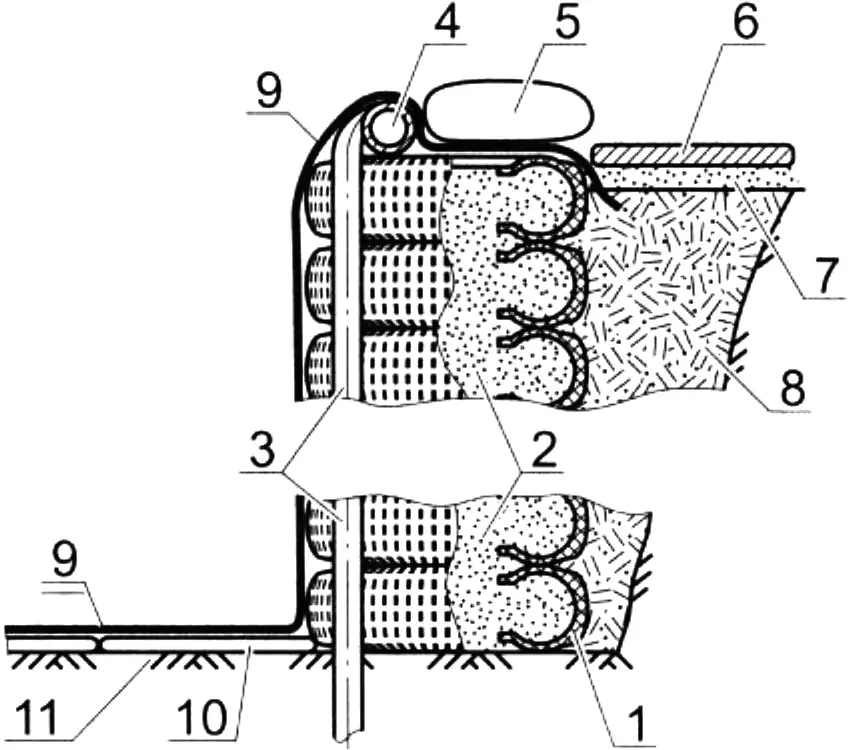
1 — wall of car tires; 2 — filler; 3 — support post; 4 — binding; 5 — ballast stone; 6 — concrete paving tile; 7 — bedding layer (sand with cement sprinkled on the surface); 8 — backfill; 9 — vinyl film sheet; 10 — bottom; 11 — native soil
Later (when the work was already finished) the thought came to me that the tires could also have been laid in a staggered bond, like running brickwork. But, as they say, the job was already done.
I first lined the pool bottom with flagstone (flat stone) and even with pieces of old asphalt concrete pavement. Then I filled and leveled it with a sand layer.
As the lining of the pool walls I used a synthetic (vinyl — PVC) nonwoven material from which advertising stretch banners are made. Although its thickness is only 0.5 mm, the material is strong (density 650 g/m2) and waterproof. The length of the sheet in a roll is 14 m with a width of 1.1 m. Different colors were available for sale, but I chose white. I glued the sheets with “Urmono” adhesive with an overlap of 20 — 30 mm.
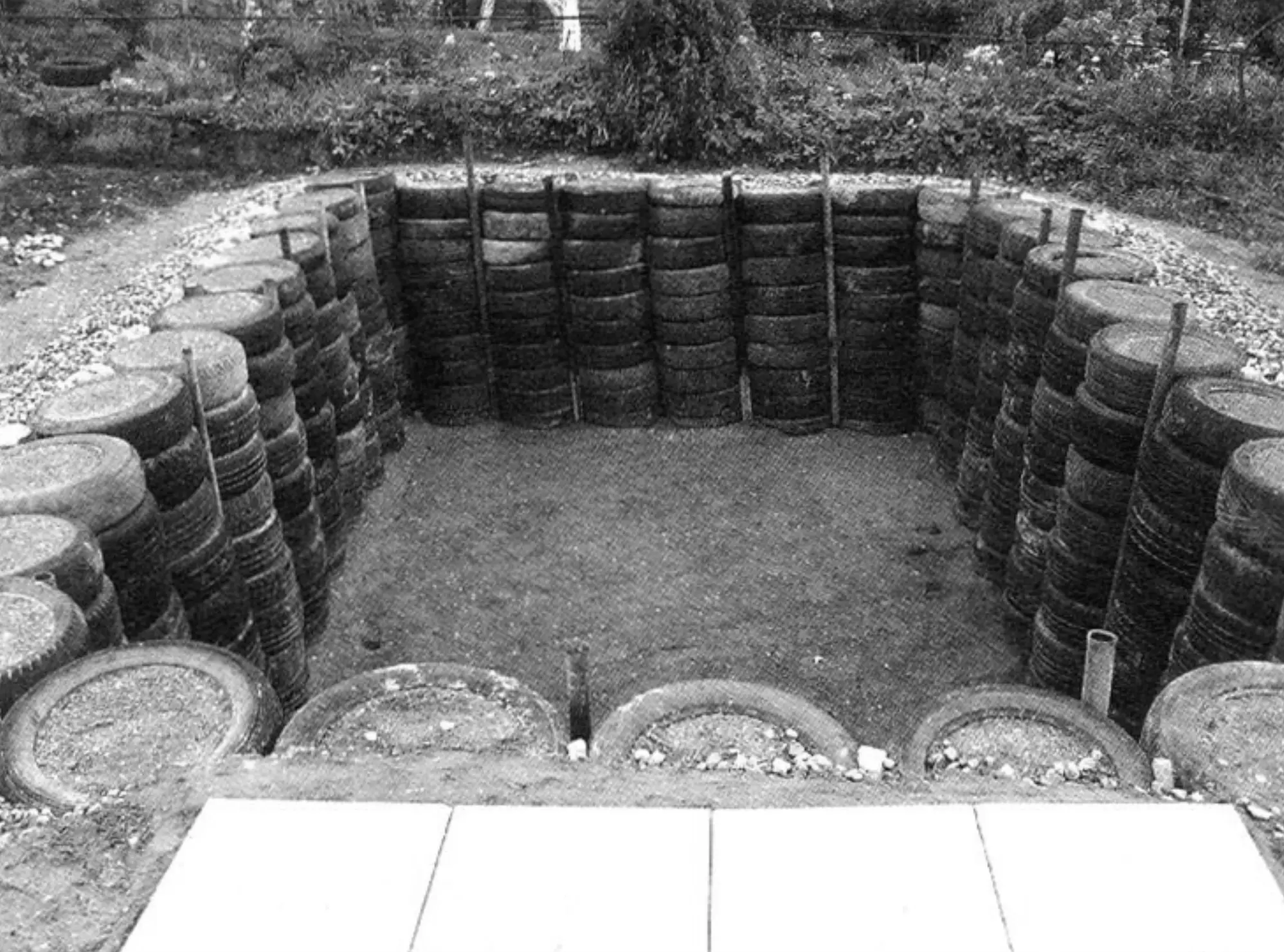
The pond (and now already the pool) was on a site with a slight slope. To protect it from dirty streams of rainwater and floodwater flowing into it (which the pond did not have), I graded the area around the pool so that its rims would be at least a little higher. For this, on the uphill side I had to build a retaining wall. I laid it from large local stone. With the same stone I also edged the rims of the pool. And the area around the pool I covered with purchased concrete tiles measuring 500x500x50 mm on a sand bedding layer with cement sprinkled on its surface and subsequent moistening before laying the tiles.
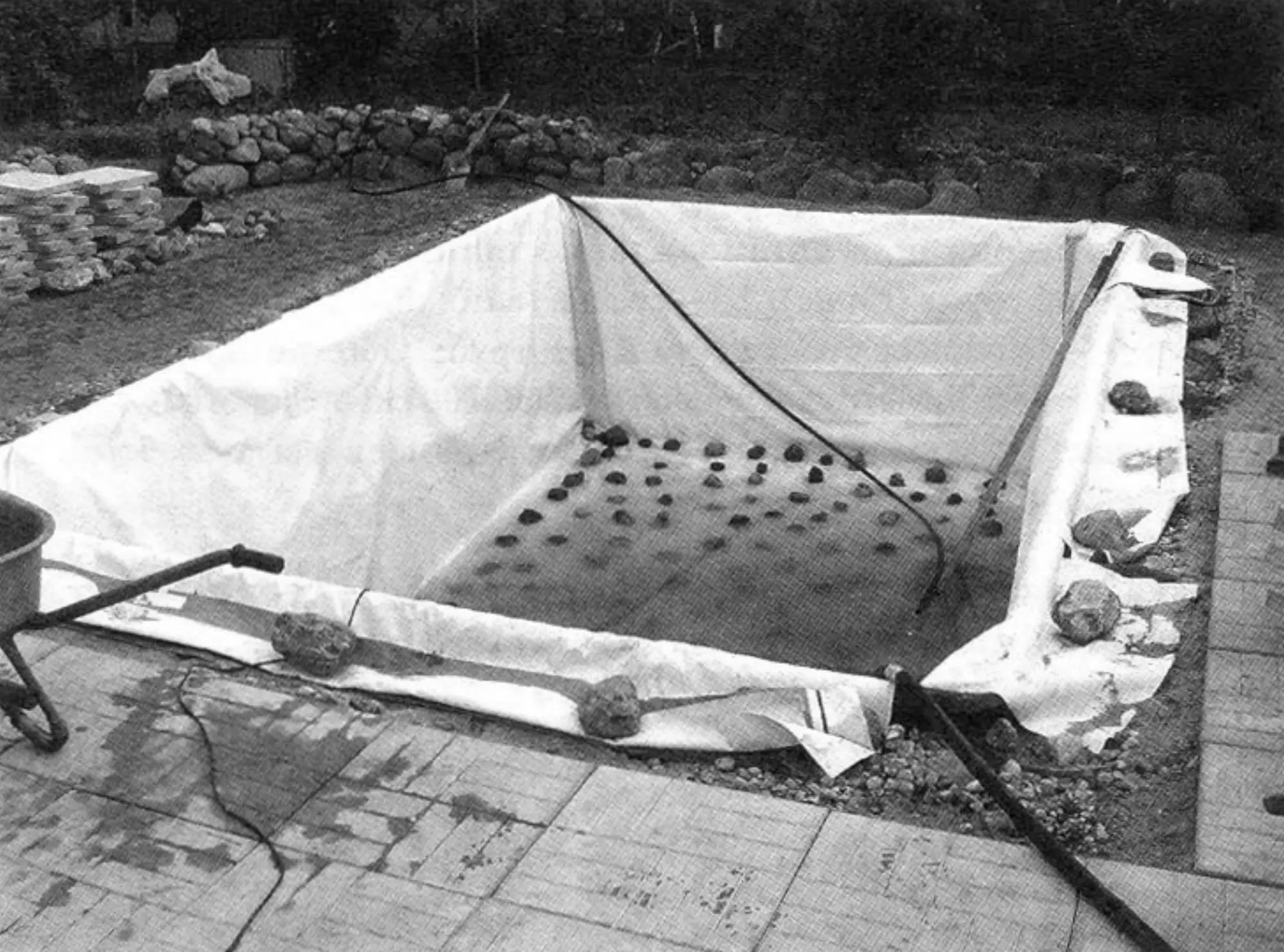
The water surface in the pool measured 6×4 m and the depth was about 2 m.
In such a pool with flexible walls it is not only safe to swim and dive, but you can also leave the water for the winter without the risk that the walls will be torn by ice.
“Modelist-Konstruktor” No. 10’2011, V. KOLYASKIN
Recommend to read
 WARM UPS
If the past winter has shown that you have carried out the insulation of the apartments (caulking Windows and gluing them to a paper tape) were insufficient, make sure that the following... THE PLASTIC “DIAPER”
Like a baby in her wrap... instrument, and in this fold it is convenient to carry and easy to store. And minimized packaging does not even need tying: itself biases, since it is obtained...
