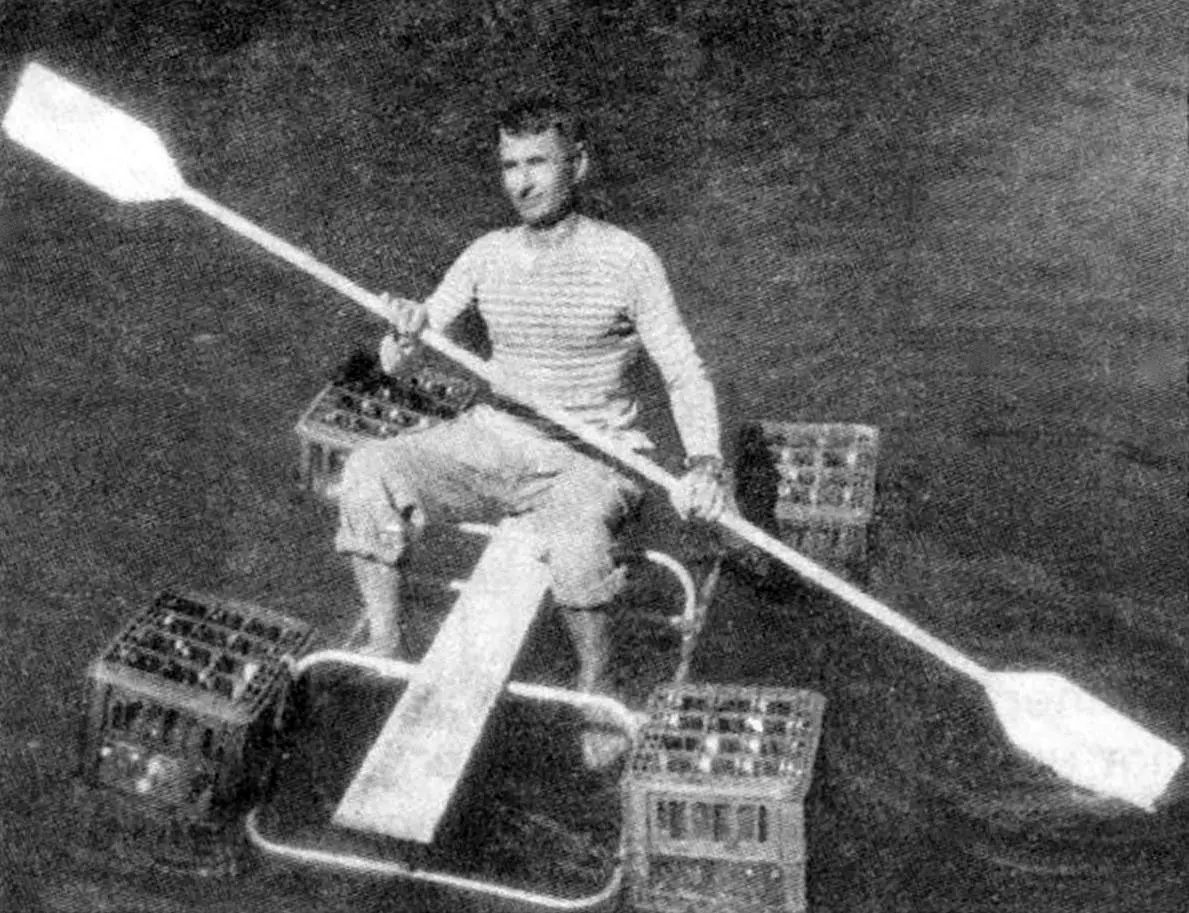
It is well known that fishing from a boat is better than from shore—usually such fishing is much more successful. But a boat, even a rubber one, is far from available to every adult fishing enthusiast. And where can one get such a watercraft, for example, for a young angler? Even finding a large inner tube from a truck tire is not easy for them. And it’s not hard to accidentally puncture it with a fishing hook.
Meanwhile, the solution to providing yourself with a reliable and cheap (if not free) watercraft, as they say, lies right under your feet. Using items that are thrown away because they cannot be repaired or are no longer needed, you can quickly build a decent raft.
To make it, you need four plastic crates from glass bottles (they can be without internal partitions), an old folding bed, and several dozen 1.5-liter plastic bottles with caps. If the crates are cracked, they should be tightened with a hoop made of annealed steel wire (so it bends easier and doesn’t break) with a diameter of 1.5—2 mm.
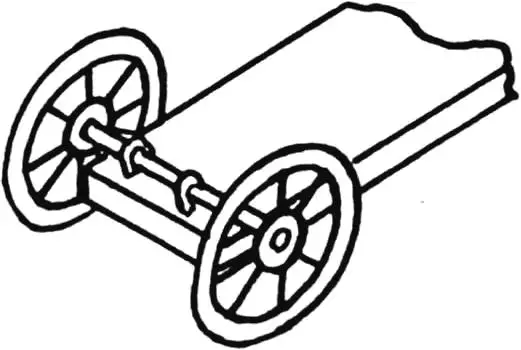
The inverted frame of a folding bed is a ready-made structural set for a raft. Usually old folding beds have torn canvas fabric. Its remnants should be removed along with the springs. Intact fabric can be left—it will serve as a soft deck. If there are broken tubes in the bed frame, their parts should be connected with a coupling or overlay straps (slightly straightened longitudinal halves of the same tubes), fastened along the length with several wire twists.
We’ll start building the raft by sawing off the hinges of the headboard arc with a hacksaw. We’ll make a crossbeam from this arc, attaching each of its “whiskers” to the frame tubes at their midpoint with at least two twists to each half (like a strap in case of a broken tube), so the frame cannot fold arbitrarily at the hinge. But it’s better to connect one half with four clamps—two on each side. The clamps will allow partial disassembly to fold the bed frame and make the raft more compact if needed, for example, for transportation.
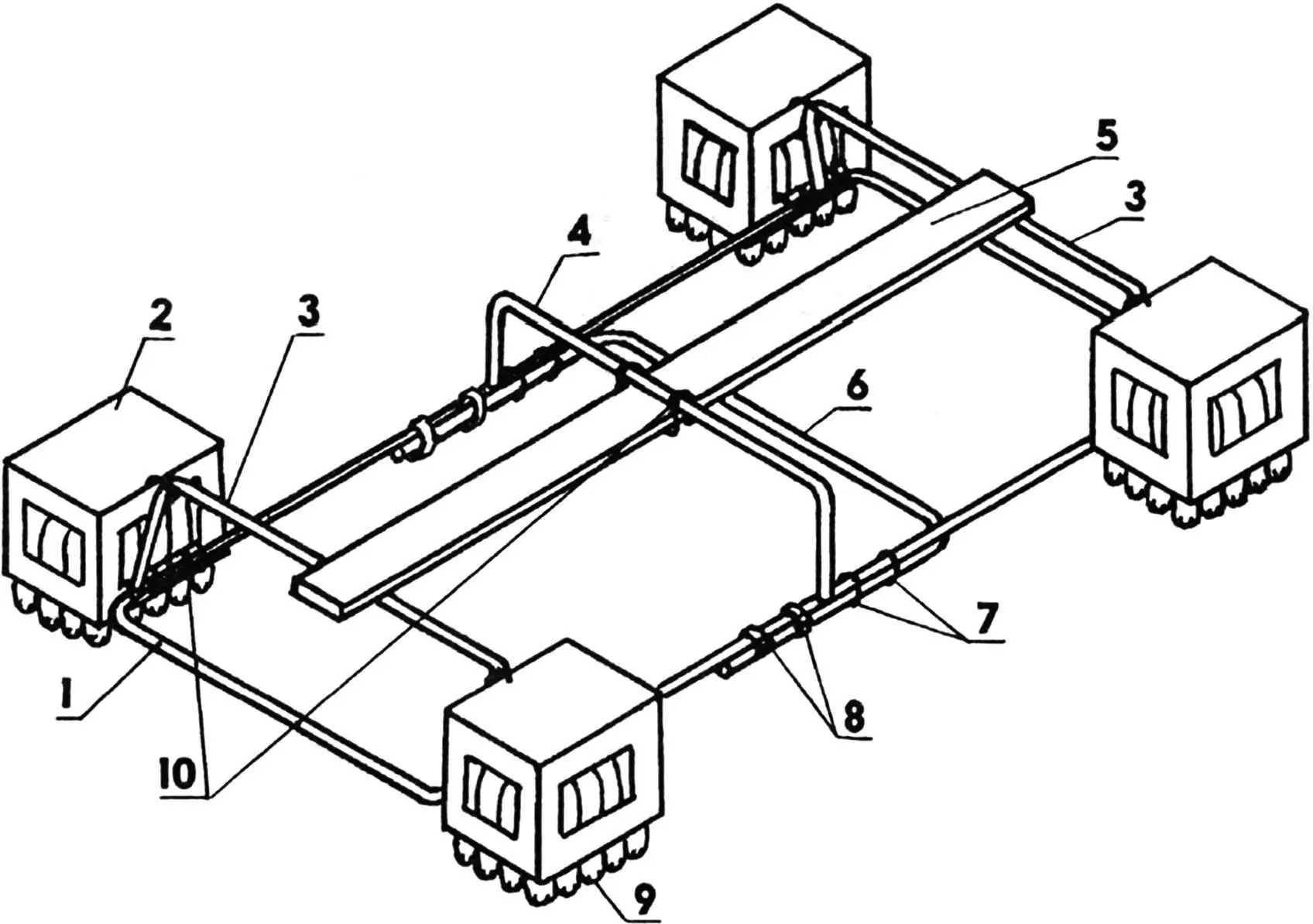
1 — frame tube; 2 — plastic crate from glass containers (4 pcs.); 3 — end posts; 4 — middle post; 5 — seat (board 200×20); 6 — crossbeam arc; 7 — twists (wire Ø1.5…2); 8 — clamps (4 pcs.); 9 — plastic bottles with capacity of 1.5 l; 10 — twists (twine)
Next, we’ll attach the crate floats to the frame, placing them at the corners of the frame bottom up. The crates can be tied with nylon cord as follows: the long side of the upper rim—to the frame tube, and the middle of the lower (bottom) rim—to one of the bed legs, which will now serve as posts. The upper rims of the crates should preferably be reinforced for reliability by tightening them with a wire hoop.
We make the seat from a board at least 20 mm thick. Its width is 150—200 mm, and its length is slightly more than the distance between the end posts. The top of the board should be planed and sanded with sandpaper or covered with leatherette or some film. We pass the board from below under the middle post, rest it on the end posts, and, having set it along the frame axis, firmly tie it to the middle post with cord or wire.
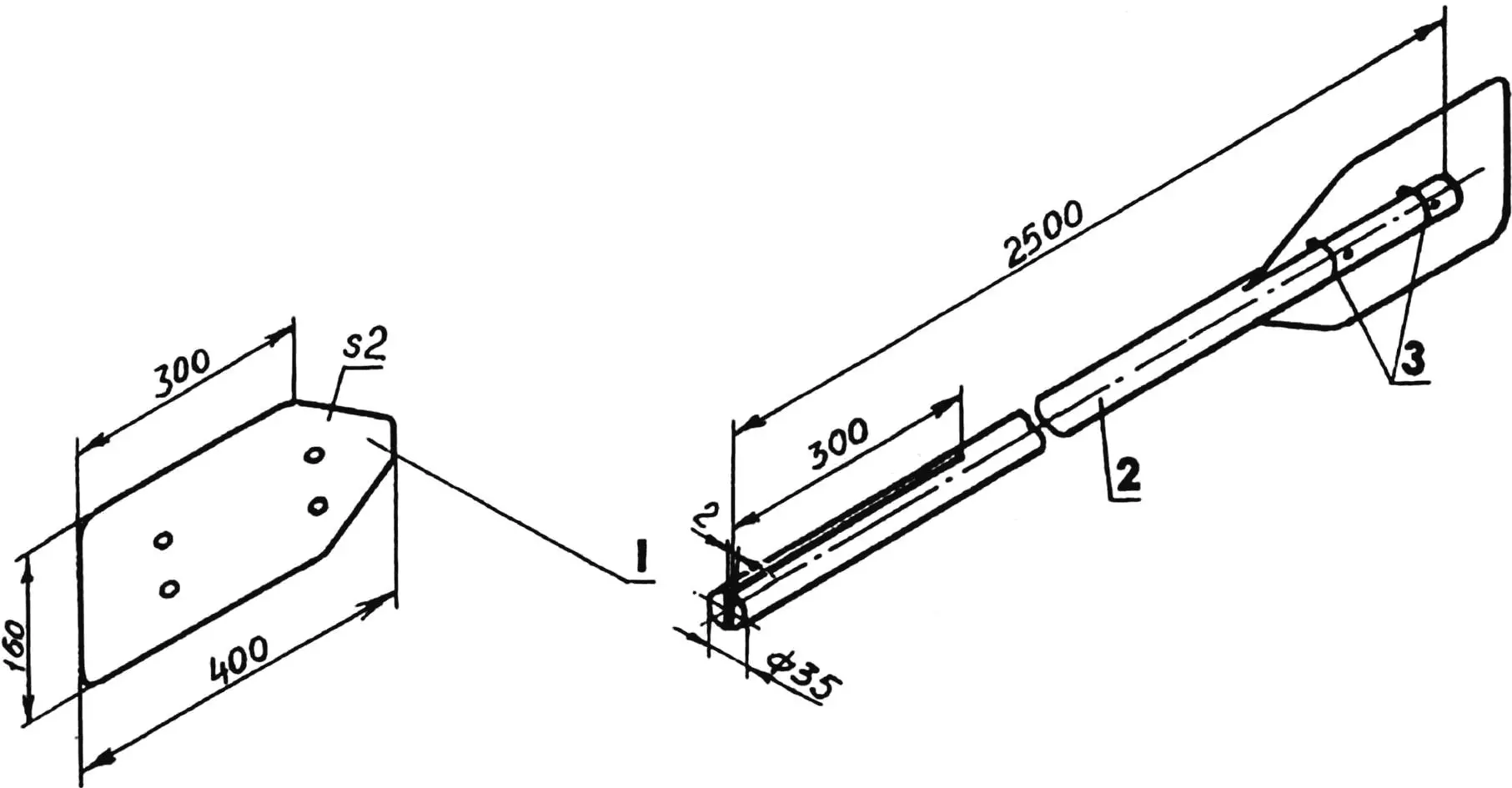
1 — blade (duralumin, getinaks, sheet s2, 2 pcs.); 2 — shaft (wooden rod); 3 — twists (wire Ø1.5…2)
Now, for convenience, placing the raft on its side or turning it over, we fill all four crates with 1.5-liter plastic bottles (20 fit in each) so that the caps press against the bottom of the crate. In this case, the bottles barely fit and may even deform slightly. Let’s estimate the displacement: 1.5 l × 20 × 4 = 120 l. So the raft, given its small own mass, can take on board more than a centner of cargo, that is, it will stay afloat even with two boy anglers. It’s okay that the legs will be ankle-deep in water; rubber boots will help in cold weather. If necessary, the displacement can be increased by one and a half times by tying two more crates with bottles in the middle of the raft, attaching them to the frame and middle posts of the frame.
With the described layout, the raft has good stability, and there’s no need to mention its survivability (ability to remain afloat with any damage) and repairability: damage to even several bottles poses no threat (compare with a puncture of a rubber boat or inner tube), and repair comes down to replacing damaged bottles with intact ones.
As a propulsion device, it’s better to use a double-bladed kayak-type paddle; on such a watercraft it’s more convenient to paddle and steer. In shallow water, you can move using a pole. Enthusiast “sailors” have the opportunity to even install a sail on the raft by attaching its mast with clamps to the middle post and crossbeam arc. If it’s necessary to move the raft on land, it can be equipped with a pair of wheels from a children’s bicycle or stroller, attaching their axle to one end of the seat board.
I. YANKIN, engineer, Baikonur, Kazakhstan
Recommend to read
 “HYDRO-N” FROM SWEDEN
The popularity of not so long ago, the class of boat Hydro n today remains very high. In some Western countries, interest in new high-speed gliders eclipsed hobby other RC models. It's... IN THE WAKE OF THE “BIG BROTHER”
After the complete defeat in 1898 in the war with the United States, Spain, once a great naval power, retreated far back and fell into a deep "hibernation". Moral decline in society the...
