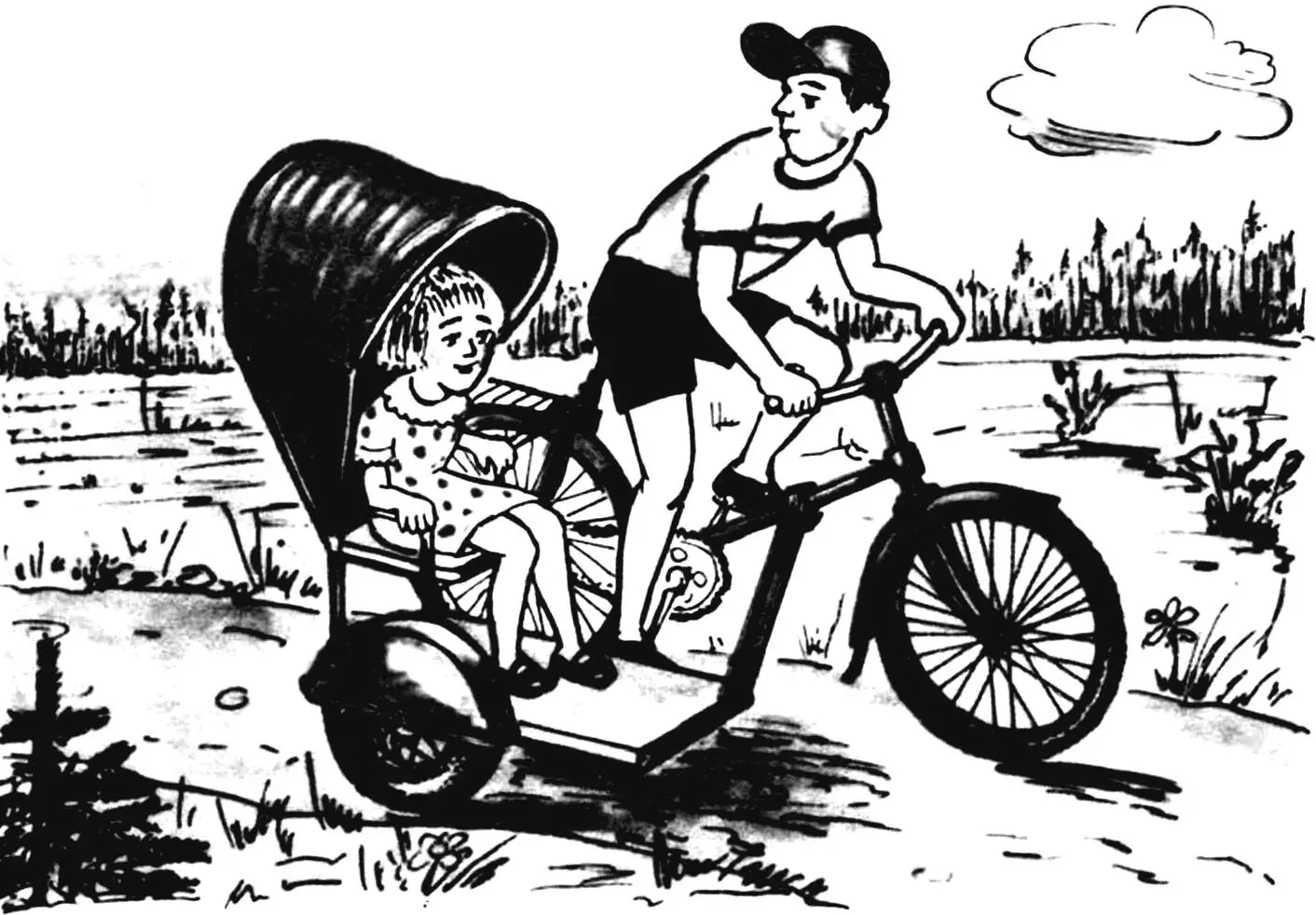
It all started when we—a young childless couple—bought two “Kama” bikes and got into cycling. When our daughter was born, we faced the question: how could we all ride together?
I made a small seat and mounted it on the rear rack. It served us faithfully for several years. But as our daughter grew, the seat became too cramped and uncomfortable.
The idea emerged to build a light, collapsible, sturdy bicycle trailer that could be attached to the bike quickly.
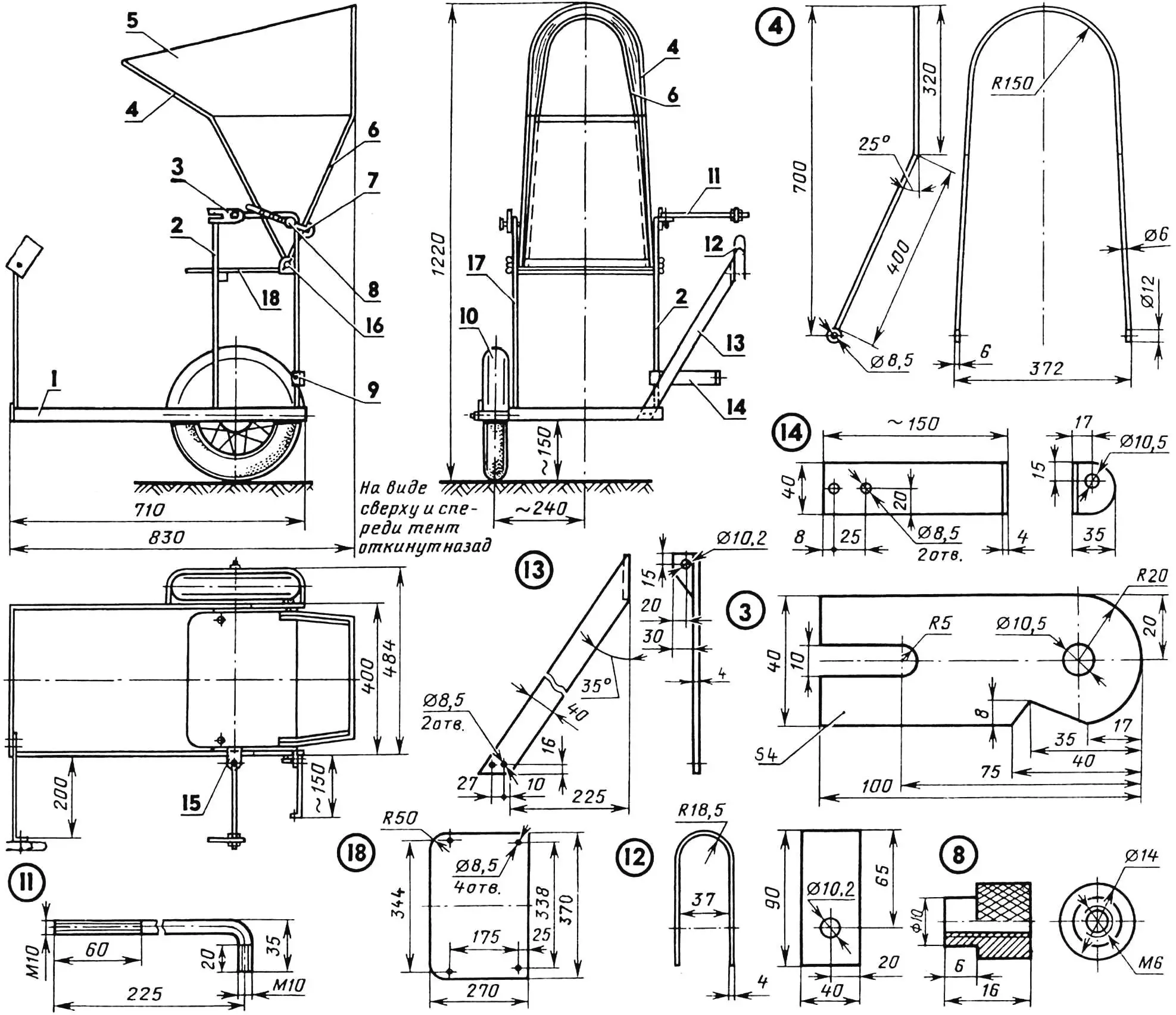
1 — frame, 2 — left stanchion, 3 — upper link mounting bar (4×40 mm strip), 4 — canopy bow, 5 — canopy, 6 — backrest, 7 — adjustment bracket, 8 — clamp, 9 — lower link clamp, 10 — fender, 11 — upper link (Ø 10 mm rod), 12 — front link clamp (4×40 mm strip), 13 — front link (4×40 mm strip), 14 — lower link (4×40 mm strip), 15 — upper link clamp, 16 — bolt, wing nut M8, lock washer, 17 — right stanchion, 18 — seat.
The “rig” I designed—with parts and assemblies made mainly from steel (St3 or equivalent)—came out fairly light, about 15 kg total. It attaches to the bicycle in a few minutes, fits in an elevator, and fully disassembles, which is very convenient for winter storage in an apartment, e.g. on a mezzanine.
The trailer consists of a frame with a floor and a seat with an adjustable backrest and canopy. It connects to the bicycle via three links.
The frame is welded from steel strip. An extra frame with a slot for the axle holds the wheel. A similar slot is made in the right side panel. The rear cross plate is shortened and reinforced with two gussets. The floor is cut from 6–8 mm plywood or textolite and fastened with bolts.
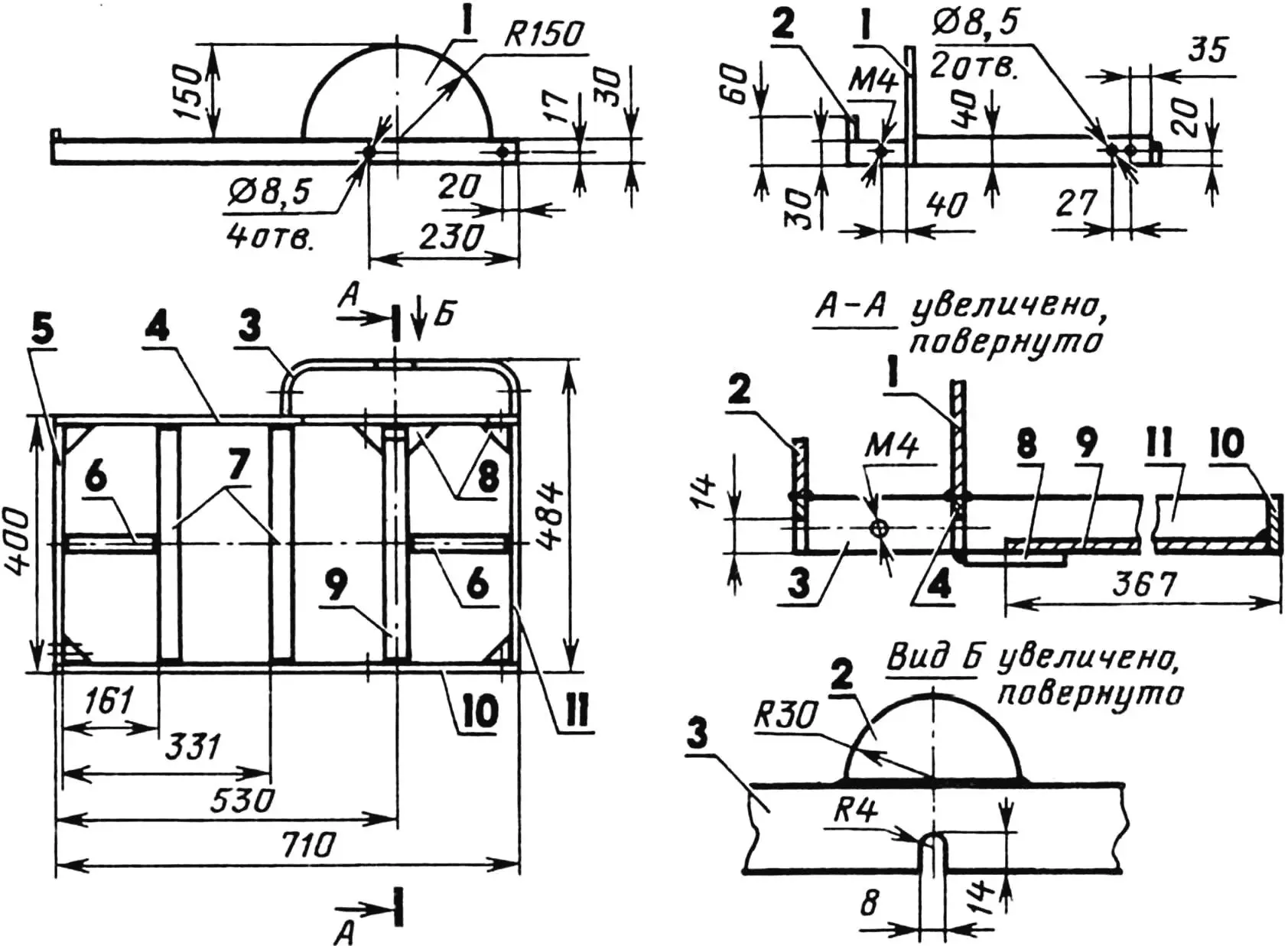
1 — shield (2 mm sheet), 2 — reinforcing plate (4 mm sheet), 3 — wheel frame (4×30 mm strip), 4 — right side (4×30×710 mm strip), 5 — front side (4×40×392 mm strip), 6 — longitudinal plates (4×20 mm strip), 7 — cross plates (4×30×392 mm strip), 8 — gussets (4×50×50 mm sheet, 6 pcs.), 9 — shortened plate (4×30×367 mm strip), 10 — left side (4×30×710 mm strip), 11 — rear side (4×30×392 mm strip).
The axle, fender, and wheel (balloon type) are from a children’s bicycle; the wheel was modified by doubling the number of spokes.
To the seat’s side stanchions, bent from steel rod, are welded bushings, seat brackets, and gussets for the adjustment-bracket clamp bolts. The seat and lower part of the backrest are made of plywood and upholstered with leatherette (or vinyl) over a soft pad. They are fixed to the brackets and frame with bolts.
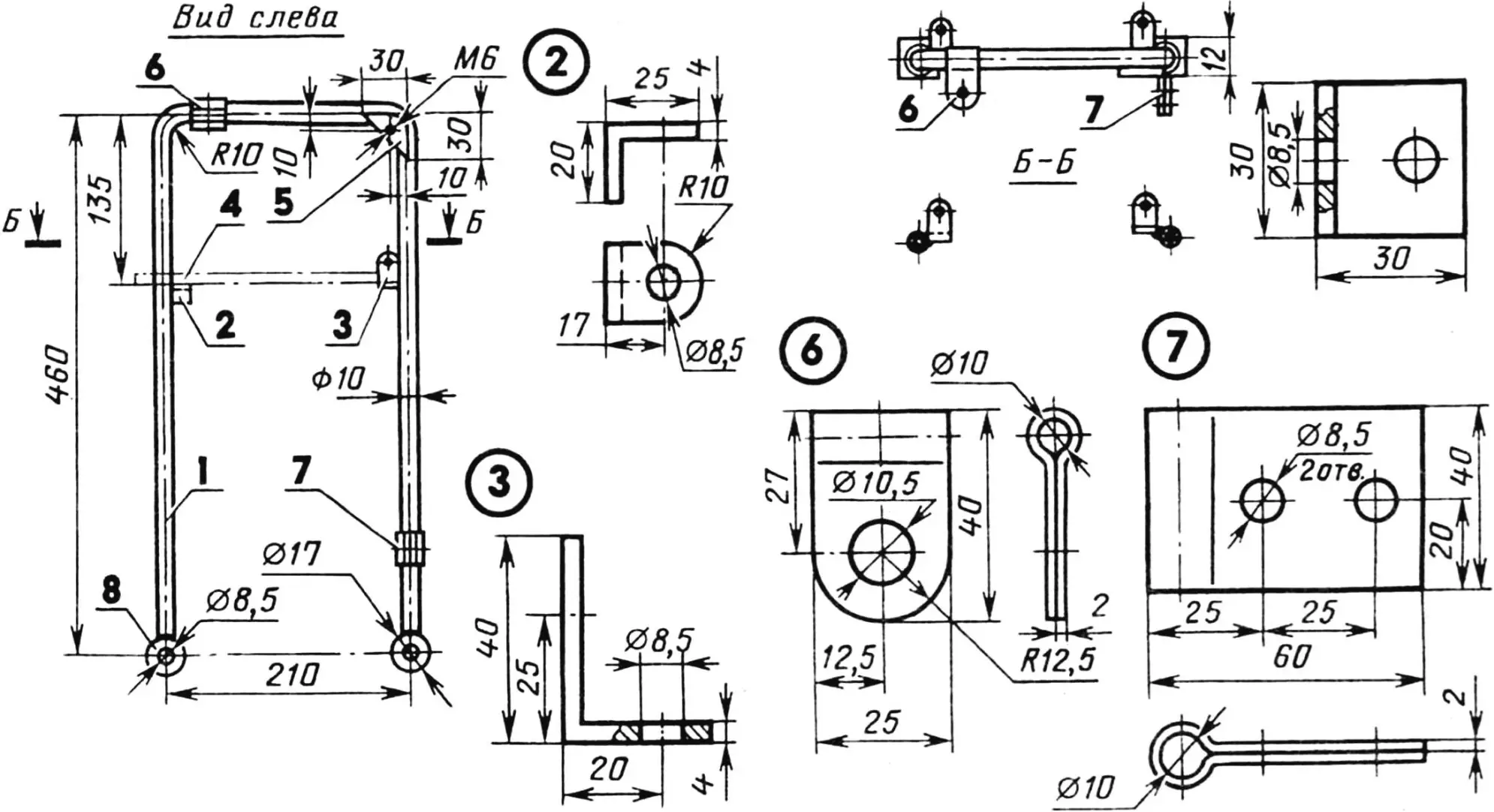
1 — stanchion (Ø 10 mm rod), 2 — front bracket, 3 — rear bracket, 4 — seat (6 mm plywood), 5 — gusset (4 mm sheet), 6 — upper link clamp (2×25 mm strip), 7 — lower link clamp (2×40 mm strip), 8 — bushing (Ø 17 mm rod).
Before attaching the trailer to the bicycle, clamps are fitted on the left seat stanchion and on the bicycle frame (above the quick-release flange); the lower link is clamped under the rear wheel nut, and the upper link bar under the seat-height adjustment bolt; the short end of the upper link with its nut pre-threaded is inserted into the upper clamp and secured from below with the other nut.
The trailer is then attached and the position of “horse” and “trailer” is adjusted using the same L-shaped link; all nuts and bolts are finally tightened.
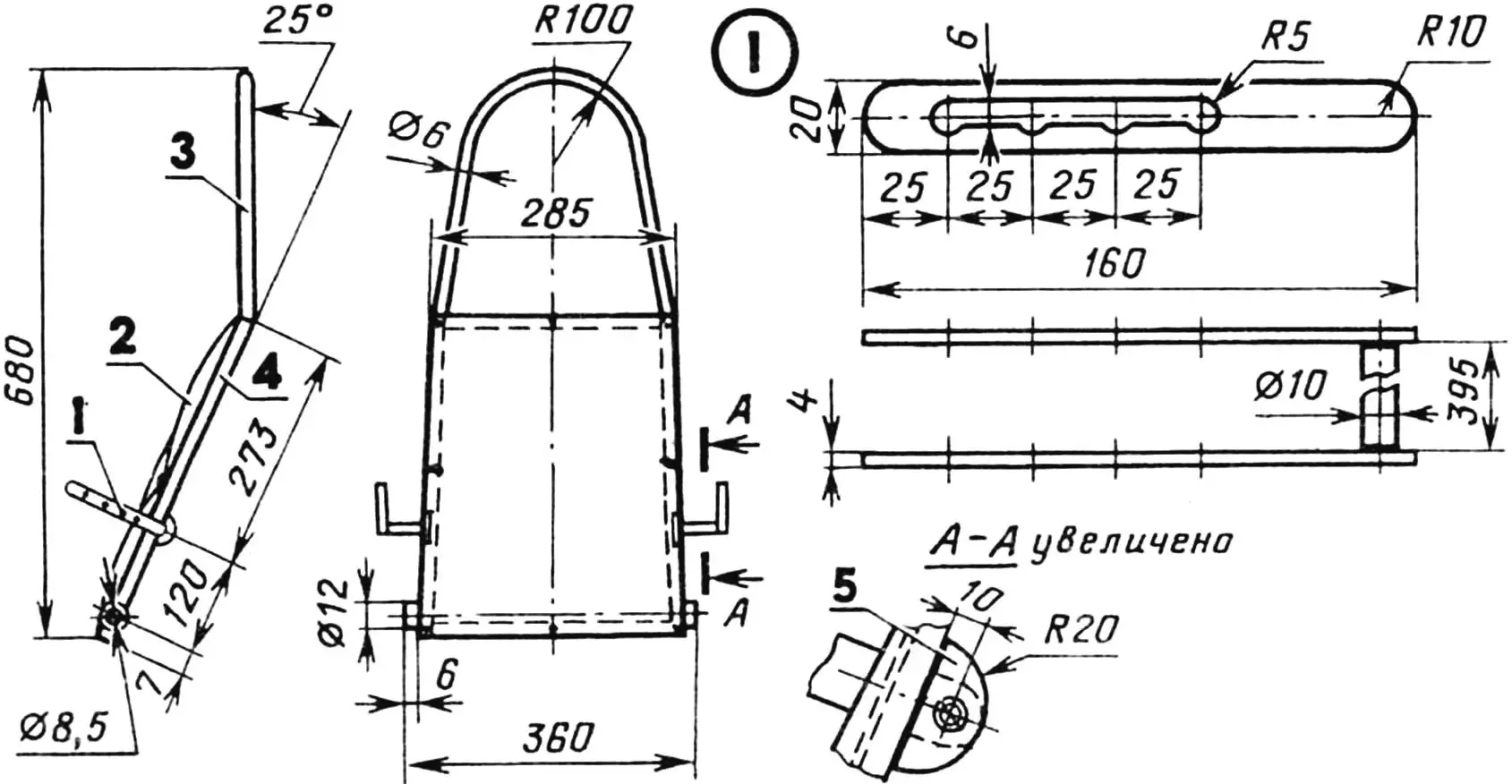
1 — adjustment bracket (4 mm sheet), 2 — backrest upholstery (foam + vinyl), 3 — bow (Ø 6 mm rod), 4 — backrest frame (2×10×10 mm angle), 5 — bracket (2 mm sheet).
To speed up assembly, I made special clamps of the type used on folding bicycles instead of ordinary nuts.
The trailer can carry over 80 kg and can be used even for adult passengers. If built from lighter materials, weight and speed can be improved significantly. With this design we lose only about 15–20% of normal speed.
«Modelist-Konstruktor» No. 11’96, B. RUDOV
Recommend to read
 There’s a machine… on the table
At first, like most beginner radio amateurs, I drilled the mounting holes in printed circuit boards with a universal tool — an electric hand drill. However, it turned out that for making... CLOUD VS CLOUD
Specially for shelling rudonosnykh clouds, bringing icy "buckshot" for planting crops, created rocket the Cloud. The task is simple — to convey and spray and mid clouds of so-called...
