At the X All-Union Week of Science, Technology and Production for Children and Youth, held in January 1983 in the capital of Uzbekistan, many interesting developments from many cities of the Soviet Union were gathered. Including from Tashkent itself. Specialists, participants and guests of the week remembered the samples of transport equipment presented by the “Autokonstruktor” laboratory of the Tashkent City Youth Technical Station. In particular, the moped “Khlopkorob-YUT-83”, designed for rural residents.
Its authors — Oleg Bylbas, Shukhrat Zaripov and Dima Novikov — were noted for the originality of the design. With their micromoped, they also participated in the All-Union Correspondence Exhibition “Create, Invent, Try!” and became its winners.
The device of “Khlopkorob” is described by the head of the “Autokonstruktor” laboratory Vladimir Aleksandrovich Ashkin, who demonstrated this machine in one of the television programs “This You Can”, where it also aroused great interest.
Once, members of the laboratory were working on cotton harvesting. Lunch time came, and the guys saw that the machine operators were driving to the field camp each on their own combine harvester. Obviously irrational use of equipment. The boys then thought about what could satisfy the combine operators: a bicycle, a moped or a motorcycle? And they decided: a moped. But what kind? Obviously, mobile, with increased cross-country ability, with a spacious luggage compartment.
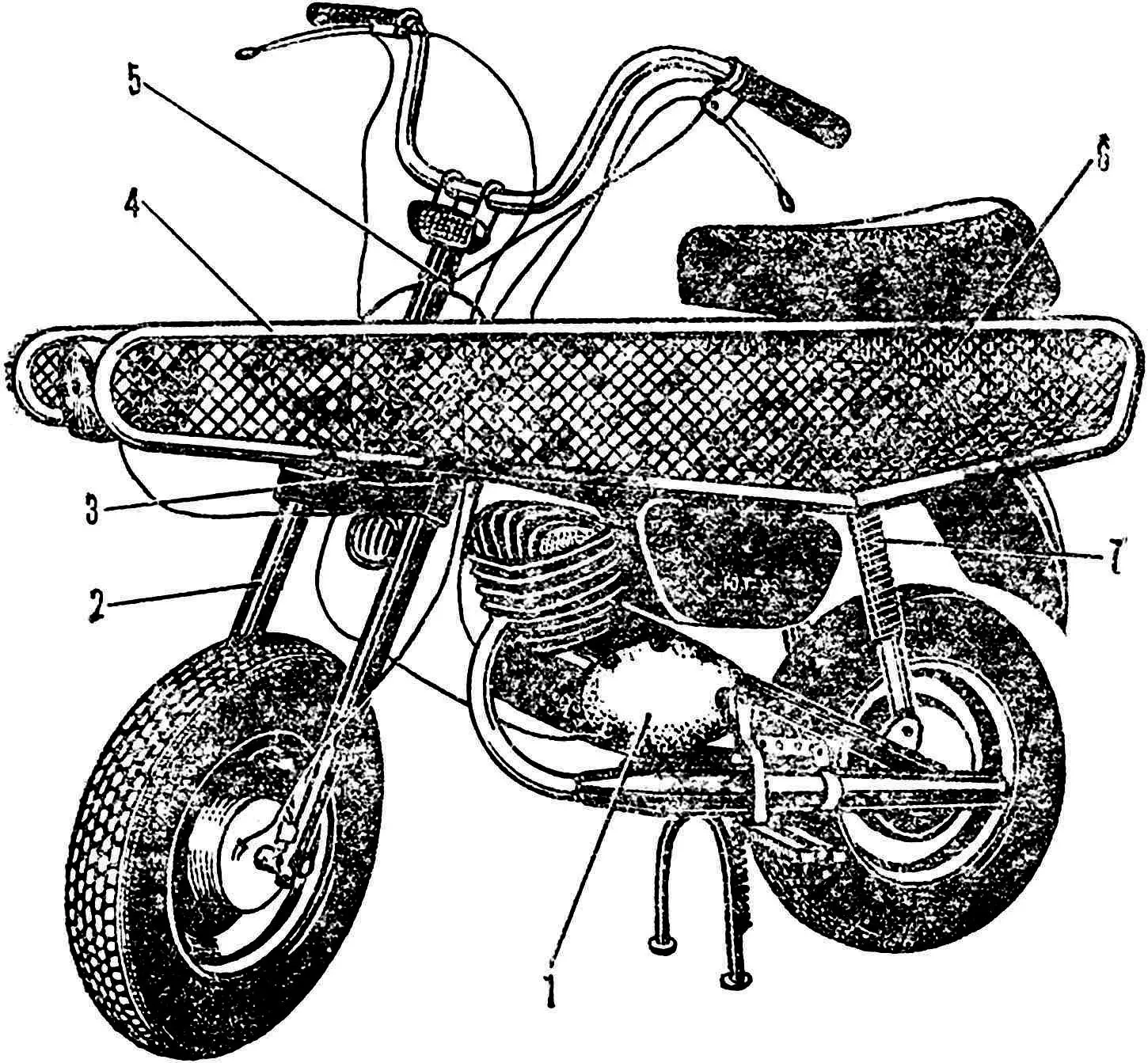
1 — engine, 2 — steering fork, 3 — steering fork bracket, 4 — frame-luggage rack, 5 — handlebar bracket, 6 — fuel tank, 7 — rear shock absorber.
The laboratory’s “portfolio of ideas” had a sketch of a similar machine. Young designers had long wanted to create a vehicle that, as an open system (bicycle, moped, etc.), would at the same time have an internal functional volume. Such a machine would be useful for rural residents, where, it happens, you have to take a lot with you, even going on a short trip. And how much will fit on a regular luggage rack? So, we need to increase its volume.
As a result of careful development of the idea, they decided to take the “Verkhovina” moped as a base model and remake it so that it would meet the developed requirements.
The main work was related to the manufacture of a new frame and the modification of the standard front fork. As a result, the frame became spatial, its internal volume is now 0.1 m3. And thanks to the shortened front fork, the driver, sitting on the seat above the luggage compartment, feels quite comfortable on the new machine. They called it “Khlopkorob-YUT-83”.
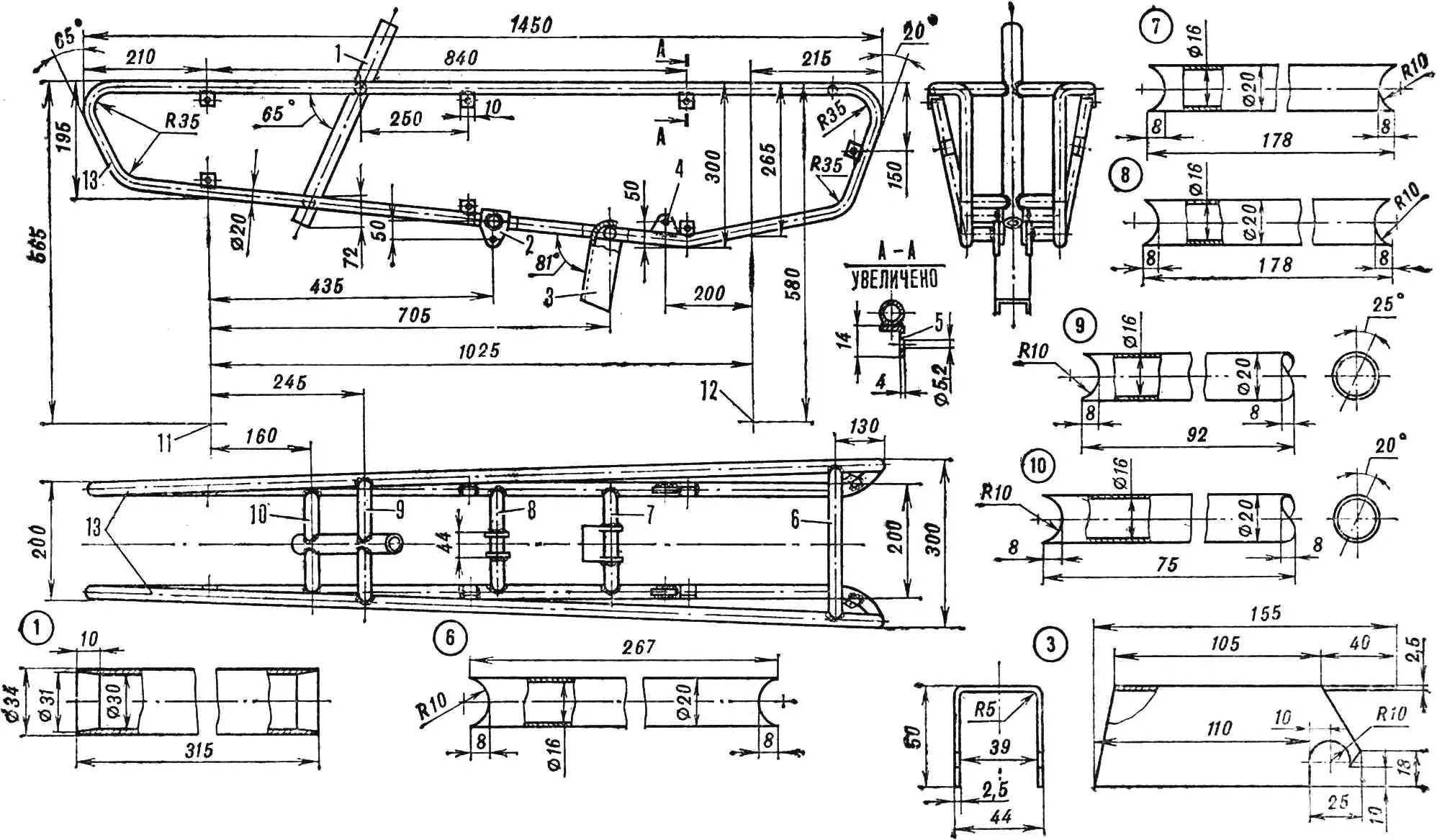
1 — steering hub, 2, 3 — engine mounting brackets, 4 — rear shock absorber mounting brackets, 5 — luggage rack mesh mounting loop (14 pcs.), 6, 7, 8, 9, 10 — crossbars, 11 — front wheel rotation axis, 12 — rear wheel rotation axis, 13 — side tubes.
So, the main homemade unit of “Khlopkorob” is the frame. It is welded from steel tubes of various diameters — 20 and 34 mm. Wall thickness 2 mm. Two closed loops are bent from the thinnest ones, in five places they are connected by segments of tubes of the same and larger diameter — crossbars. The steering hub is welded to the front crossbars, and the engine mounting brackets are welded to the middle ones.
The frame is equipped with fourteen angle loops, to which a metal mesh with cells measuring 20X20 mm is attached — the side of the luggage rack. And its bottom is formed by an aluminum sheet 1 mm thick, wrapping around the side tubes from below (corresponding slots are made in it for all protruding parts).
In the front part of the frame-luggage rack, a headlight is installed on two simple brackets, in the rear — a fuel tank and a driver’s seat.
The fuel tank is made of steel sheet 0.8 mm thick. Its bent body in shape resembles a tapering channel with a hole in the front part for the filler neck. The bottom is bent like a saddle with 15 mm wide flanges for connection to the body by roller electric welding. In the lowest place of the bottom, a stamping is provided, here a threaded bushing is welded — a drain fitting.
The fuel tank is hung on the rear crossbar with two hooks, and with brackets — on the side tubes of the frame. A driver’s seat (from “Verkhovina”) is installed above it.
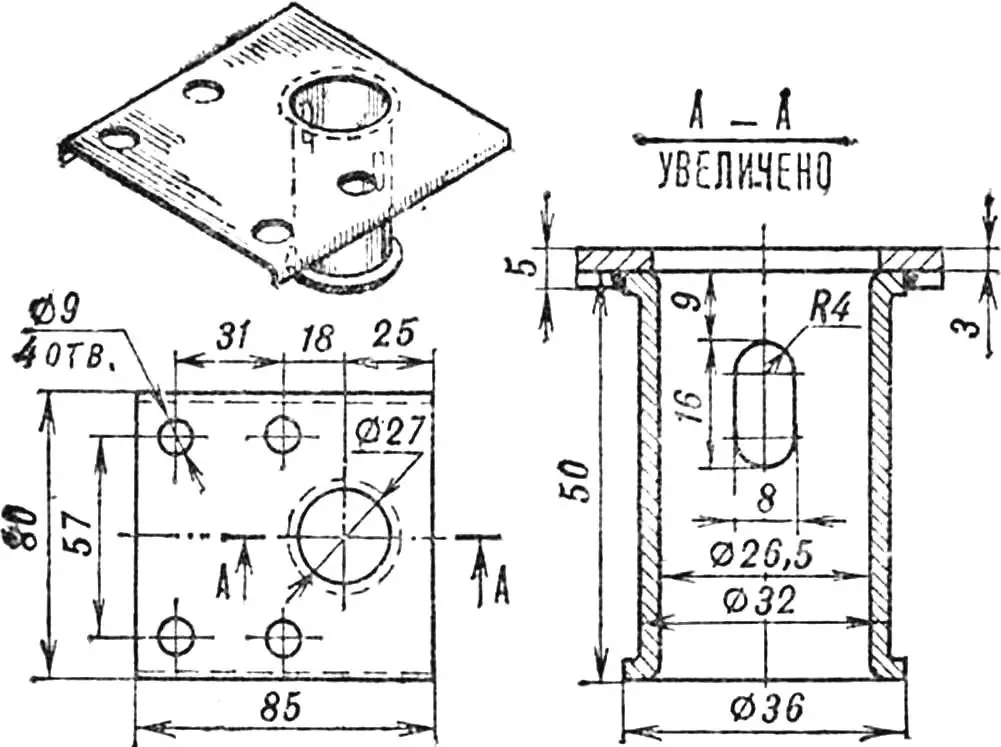
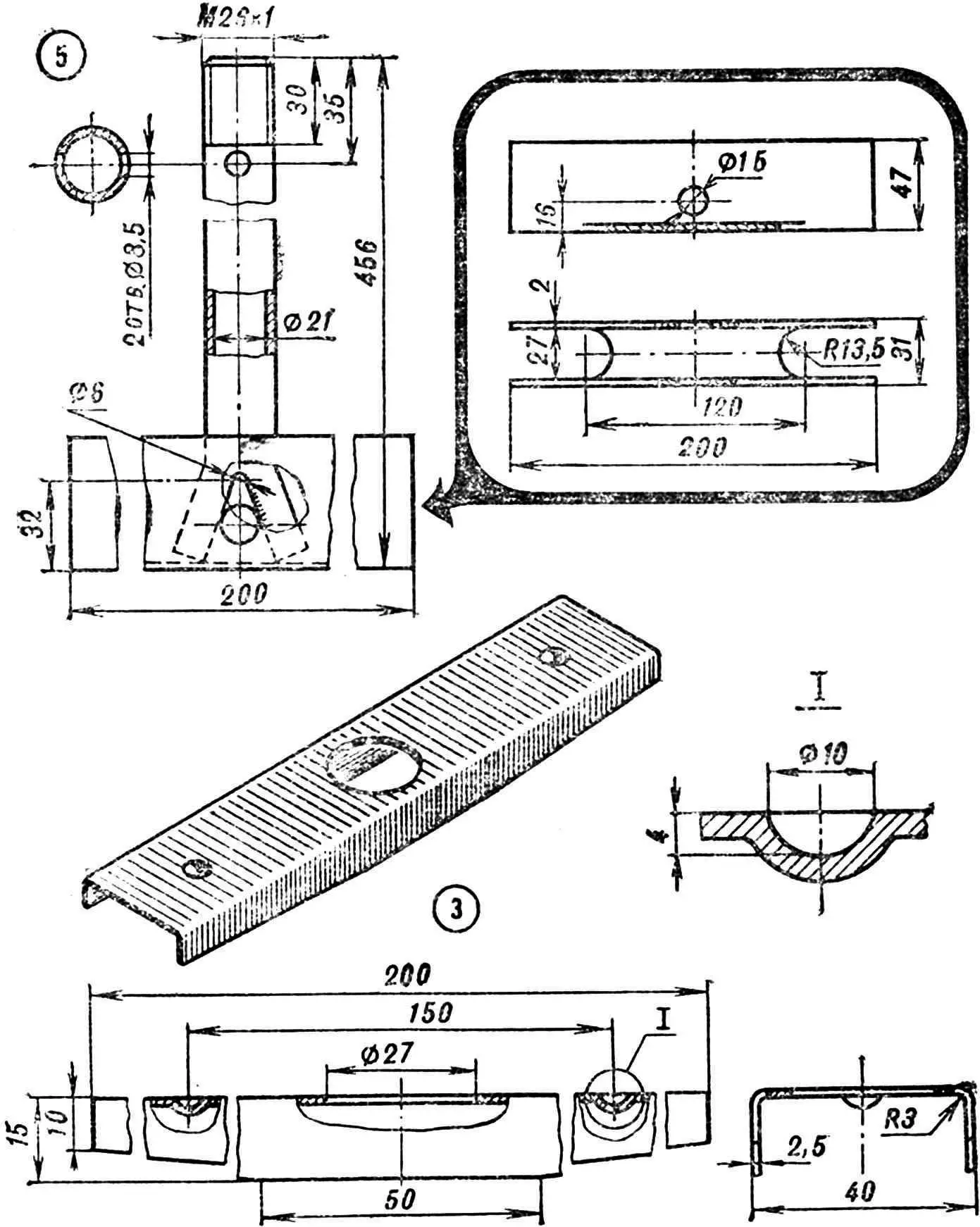
Some parts of the front fork are also from “Verkhovina”. Its shock absorbers with rods and feathers shortened by 65 mm are held in a homemade fork welded from two parts: a shaft and a channel-shaped cage. The shaft is turned from a steel tube Ø 26X2 mm. A thread M26X1 is cut on its upper end for the handlebar bracket mounting nut, and a hole Ø 8.5 mm is drilled for the bolt fixing it on the shaft from rotation. The bottom of the shaft is forked — cut along the axis to a pre-drilled hole Ø 6 mm, designed to relieve stress concentrations.
The shock absorber feathers are welded into the cage; a bracket with point rifling pressed by a ball is put on the shaft — the shock absorber springs rest against them. The bracket is held from moving upward by the cage of the lower steering bearing from “Verkhovina”.
The shaft with the fork passes through the steering hub, the upper bearing and the handlebar bracket are put on it, the handlebar is attached to the latter with four M8 bolts.
Like the front, the rear fork, wheel discs, brake drums, as well as controls and electrical equipment are taken from the “Verkhovina” moped, wheels — from the “Vyatka” motor scooter.
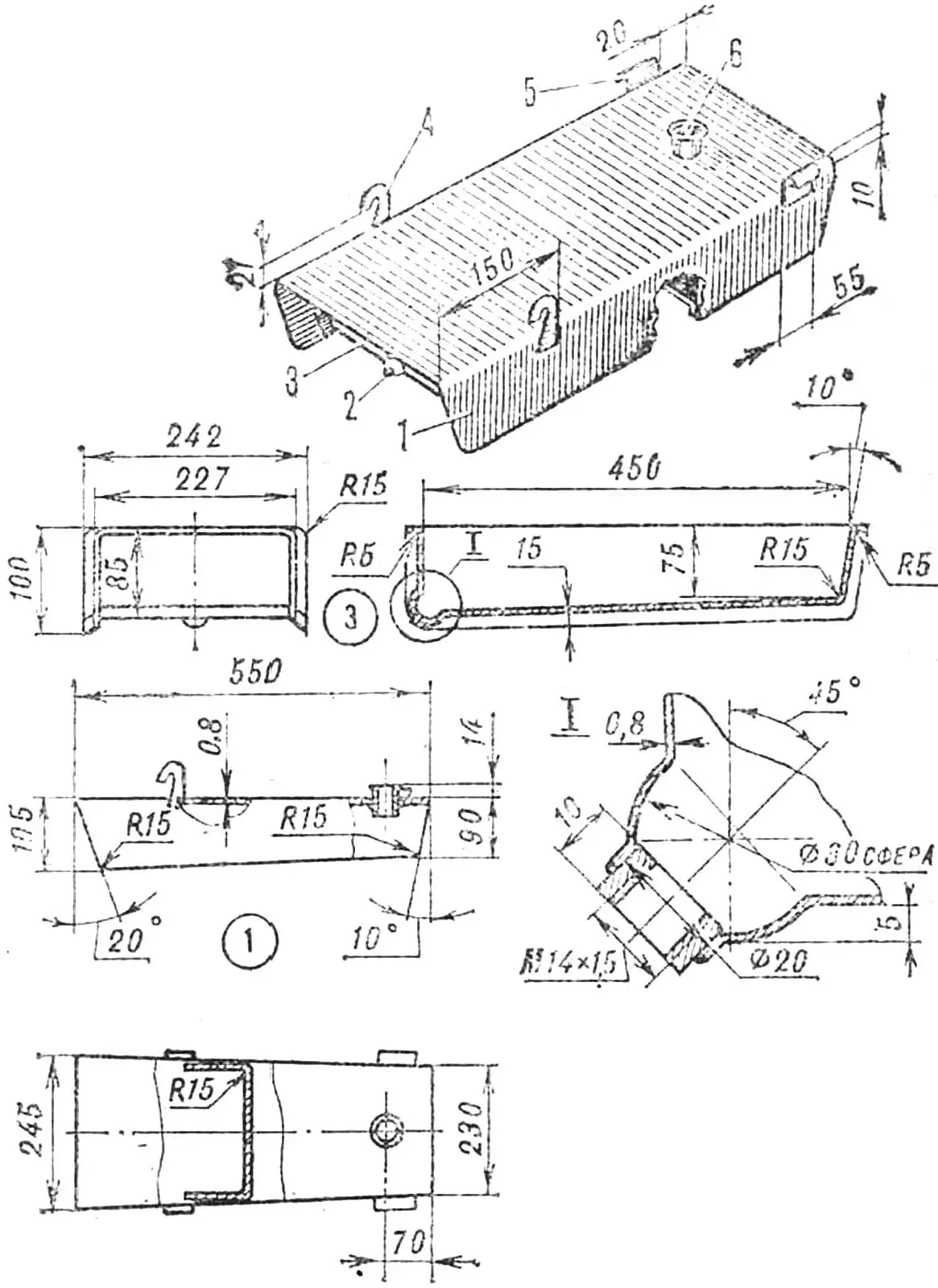
1 — body, 2 — drain fitting, 3 — bottom, 4 — suspension hook, 5 — bracket, 6 — filler neck.
The spacious luggage compartment of “Khlopkorob” allows you to take with you on the road as many things as you cannot carry on any other moped. Heavier things are placed closer to the center of gravity of the machine, lighter ones — at the corners. In its middle part, the luggage compartment is no wider than the engine, so it does not interfere with normal moped control. And thanks to the motor scooter wheels, the cross-country ability of “Khlopkorob” is higher than that of “Verkhovina”. This, in fact, makes it attractive for rural residents. Such small, convenient and mobile machines, I think, would be appreciated not only by combine operators.
Recommend to read
 IN THE “BEAK” OF THE SPRING
When the pencil lines of the drawing or drawing close to each other — the usual eraser, it is difficult to remove the erroneous one so as not to damage the adjacent correct. But this... MINI-MOKIK: SCHOOL OF DESIGN
Small cars and motorcycles always aroused great interest among Amateur designers. This is understandable: a vehicle having a small size and weight, low fuel consumption, well fit into...
