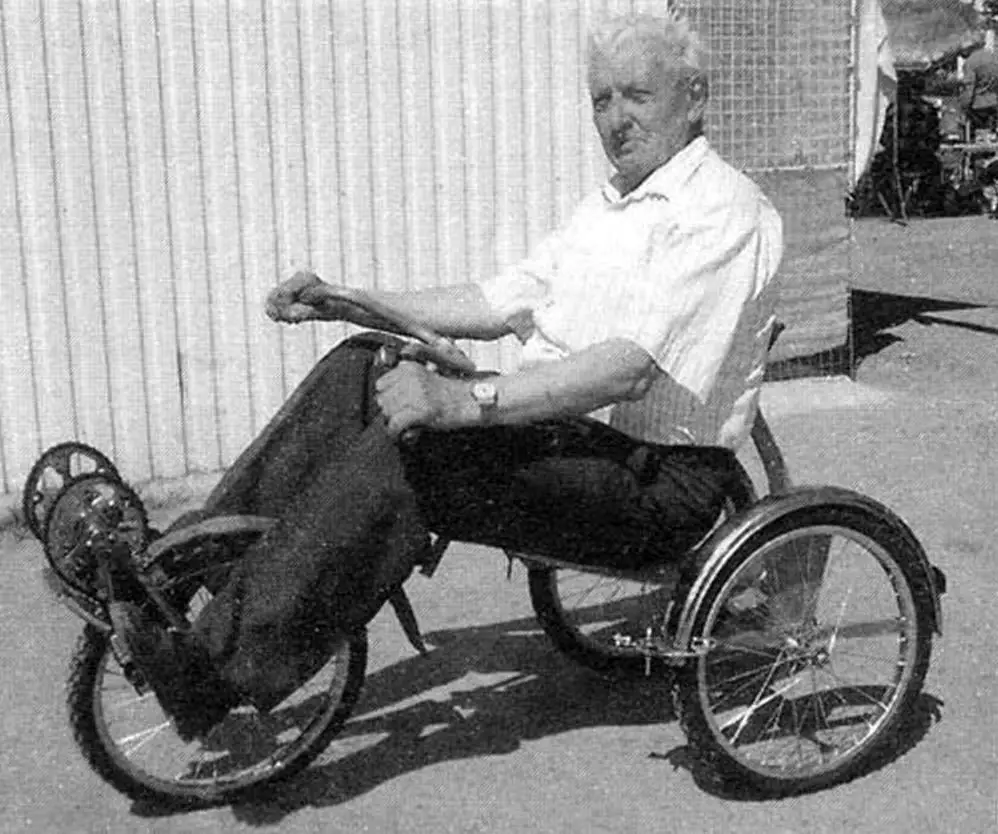
Georgy Sergeevich Khokhlachev is a military pensioner, 77 years old. Throughout his conscious life, he has been enthusiastically engaged in technical creativity: rationalization work, radio engineering, photography, and much more. In his searches, the tireless amateur regularly turns to publications in popular science publications, including the magazine “Modelist-Konstruktor”. G. S. Khokhlachev decided to present one of his latest works to the readers of our magazine:
“For the last two years, I have been fascinated by designing a velomobile. From A. S. Popolov’s book ‘Let’s Invent a Velomobile,’ I chose ‘Springmobile’ by N. Kudrin and V. Shchipachev as a prototype. The frame design and general layout did not undergo any special changes, but the drive turned out, in my opinion, to be original and, I think, may interest the readers of the magazine and velomobile enthusiasts.”
The drive structure is very simple. The drive wheel is the front one with a modernized standard hub of the rear wheel of the “Desna” bicycle. The hub has two symmetrical freewheel clutches and, accordingly, two driven sprockets, which are driven by a bicycle chain from two oval drive sprockets. During the hub modernization, the brake parts were removed. The most difficult part is manufacturing the freewheel clutch housing for the left, in the direction of the velomobile, driven sprocket: lathe work, milling work, and heat treatment will be required.
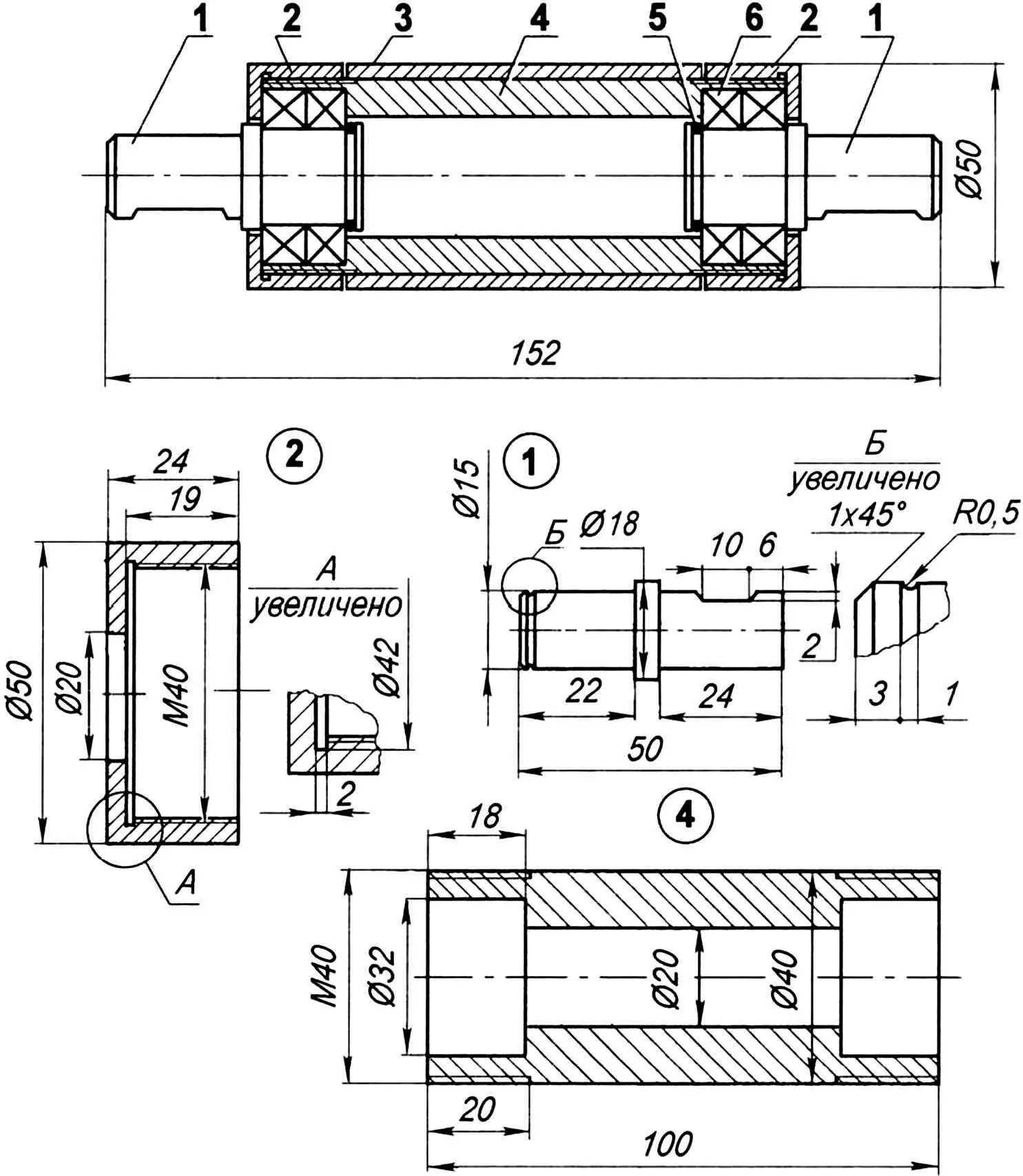
1 — pedal half-axles (2 pcs.); 2 — cover (steel, round 50, 2 pcs.); 3 — pedal hub housing (steel, round 50); 4 — bearing housing (steel, round 45); 5 — retaining ring (2 pcs.); 6 — bearing 6003RS (4 pcs.)
The clutch housing is an exact copy of the standard one, except for the working part (the location of the rollers), which must be made with a surface finish of at least grade 8 and in mirror image relative to the standard clutch. Material — steel 20Kh or 40Kh. After manufacturing, the part must be case-hardened to a depth of 1 — 1.2 mm and induction hardened to a hardness of 32-40HRC. To ensure clear operation of the clutches, the diameter of the rollers must be the same. I selected rollers using a micrometer. The lubrication of the unit must be liquid.
The device of the drive unit of the velomobile is shown in the photographs and figure 1.
The drive sprockets are coaxial but independent. Each of them — with its own pedal (from the “Tourist” bicycle) and mounted on its own axle. The working stroke is performed when pressing the pedal. In this case, the drive sprocket, through a spring-loaded chain, performs part of a revolution, and then, during the return stroke of the pedal, under the influence of the spring, returns to its original position.
The independence of the drive sprockets and pedals provides the ability to work in various modes: simultaneously with both legs forward (as when rowing), alternately with the left and right, or generally with only one leg.
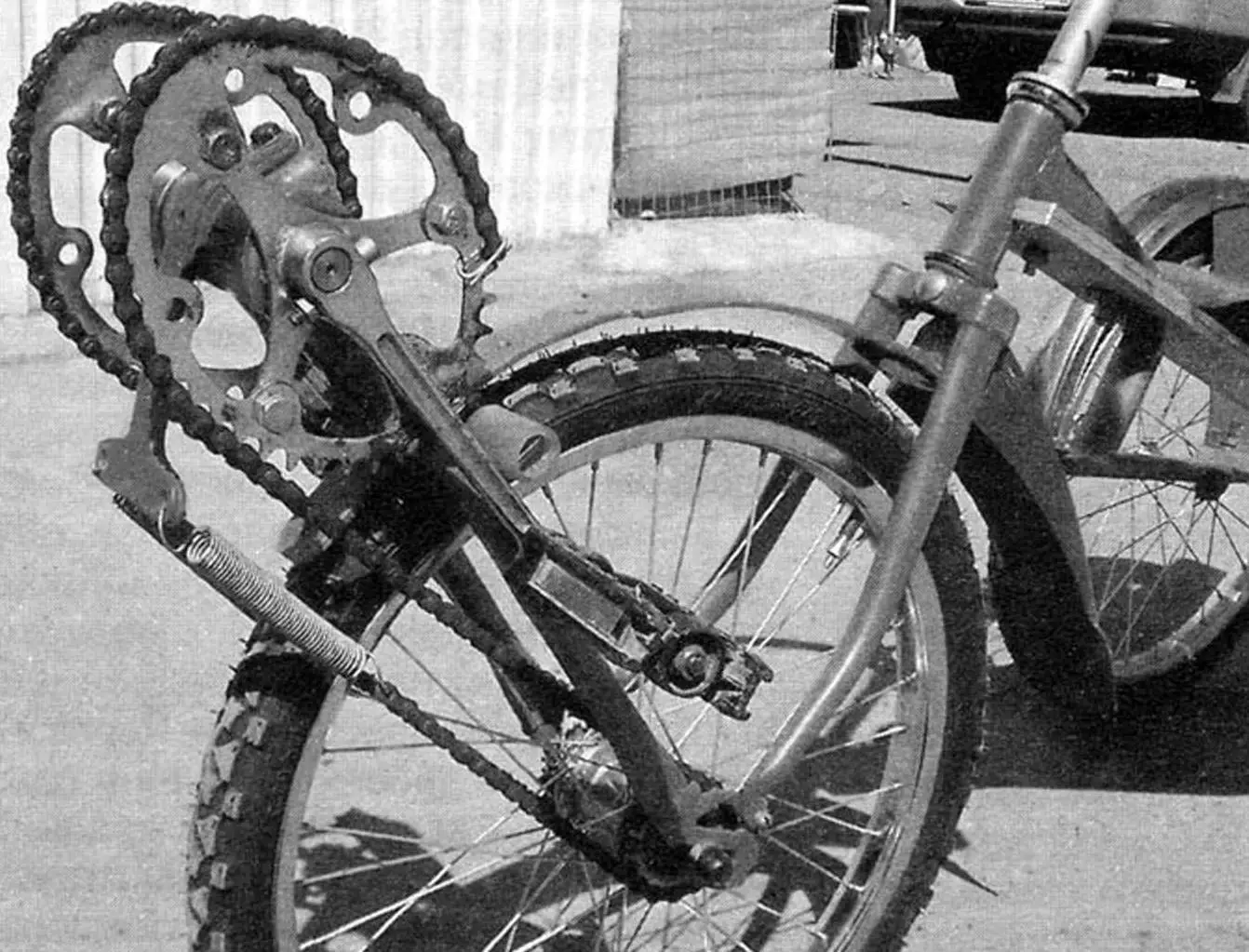
The pedal levers can be lengthened, and then the arms are included in the work, simultaneously performing steering. The implementation of this option is in my plans for further improvement of the presented velomobile design.
When using the velomobile on dirt roads, it is advisable to install elliptical drive sprockets, factory-made or homemade. On roads with asphalt pavement, drive sprockets from the “Tourist” bicycle can be used.
As can be seen from the illustrations and description provided, the drive design is quite simple, so I think an experienced amateur can reproduce it if desired.
G. KHOKHLACHEV
Recommend to read
 WITH BUILT-IN GEARBOX
I was confirmed in my decision to build a walk-behind tractor after I read the article “Vyatich” (“M-K” No. 7, 1981). However, the design proposed by the magazine, despite all its... ELECTRONIC OWL
The making of this very fun toy is easy even to schoolchildren. Decorated under stylized electronic owl, she will fit well in any interior. Location — wall mounted, connection to the...
