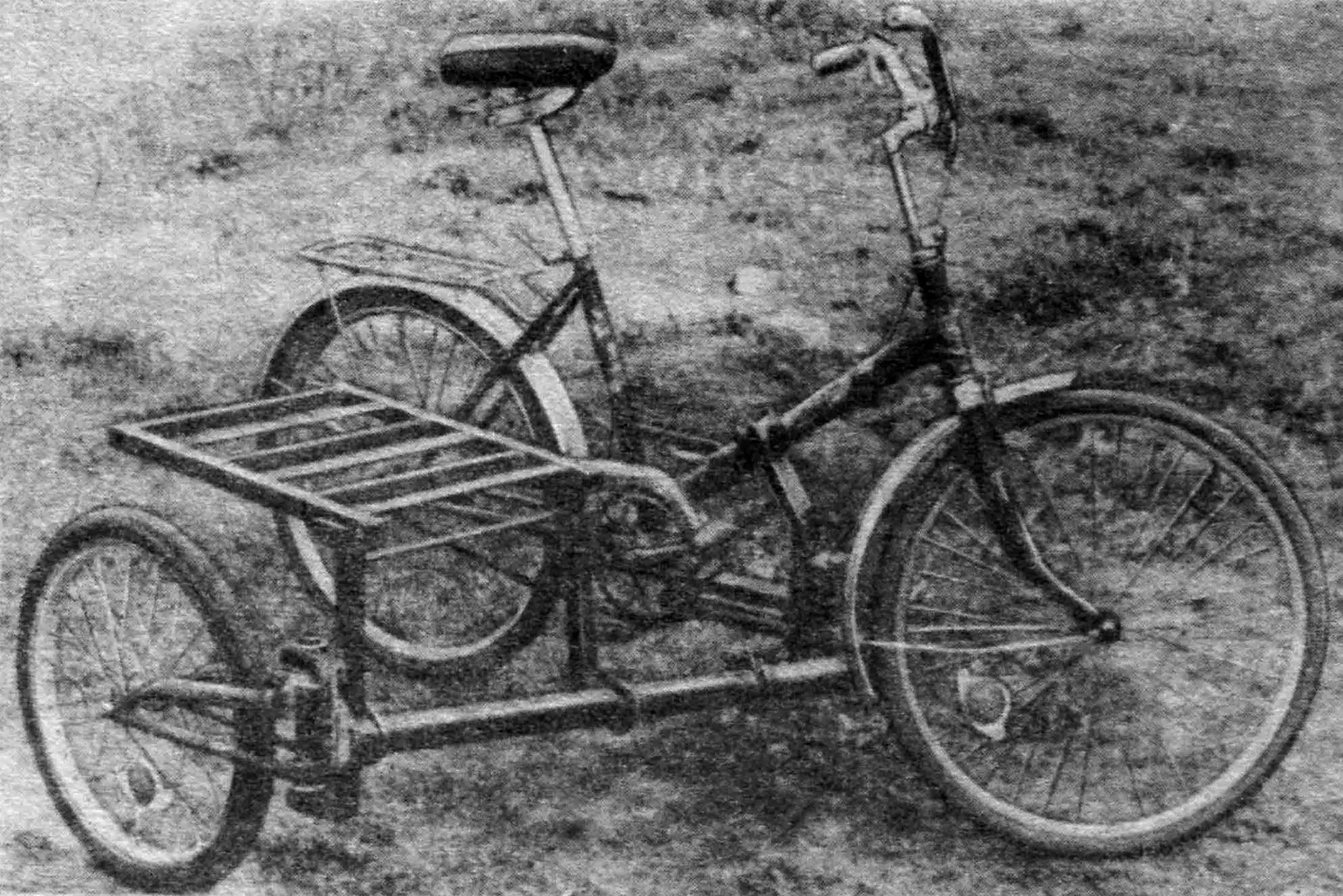
Having been engaged for a long time in the creation and operation of velomobiles (was a multiple prize winner at the All-Union bicycle festival in Šiauliai), I became convinced of their insufficient practicality. The large dimensions of a velomobile exclude the possibility of storing it in an apartment. Known folding designs are complex to manufacture and still quite bulky. The wheels used on them are usually bicycle wheels, not designed for the lateral loads experienced by velomobiles on turns.
The desire to reduce the dimensions of a velomobile in assembled form led to the idea of creating a vehicle based on a bicycle with a side trailer. Such designs are known, however they have the same disadvantages as velomobiles, since the trailer in them is rigidly attached to the bicycle. In the developed version, the side trailer is foldable; it is equipped with a horizontal hinge in the plane of symmetry of the bicycle, connected to it using a quick-release connection. Another feature is the mounting of the trailer wheel on a console with a vertical hinge (like a caster wheel).
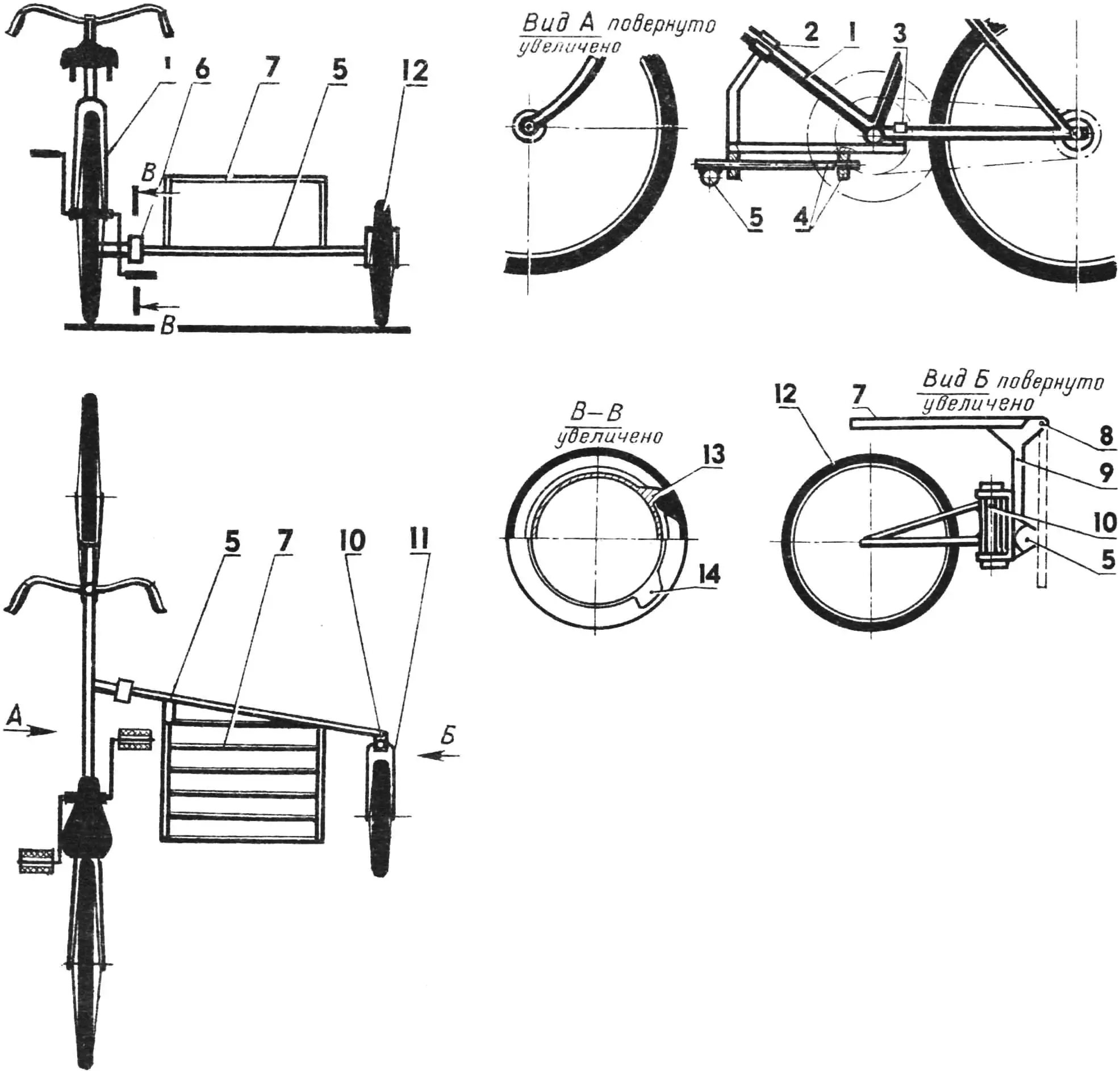
1 — bicycle frame, 2, 3 — mounting clamps, 4 — horizontal hinge, 5 — trailer frame, 6 — bayonet connector, 7 — trailer cargo platform, 8 — hinge, 9 — post, 10 — vertical hinge, 11 — console, 12 — trailer wheel, 13 — bayonet connector protrusion, 14 — bayonet connector groove.
The trailer is attached to the bicycle frame with two clamps (items 2 and 3 in the figure). The horizontal hinge in the plane of symmetry of the bicycle provides the ability to tilt on turns and “swaying” of the trailer on road irregularities. Mutual angular movements are facilitated by the rotation of the self-aligning wheel around the vertical hinge.
For folding, the cargo platform is tipped forward by 270°. The frame moves 90° around the horizontal hinge with simultaneous rotation in the quick-release bayonet connection counterclockwise. At the same time, the trailer wheel, under its own weight, tilts down. Thus, both the wheel and the cargo platform end up in the plane of the bicycle, not exceeding the width of the handlebars. In this position, the protrusions of the bayonet connection will align with the grooves, and if necessary, the trailer can be disconnected from the bicycle. This operation takes mere seconds.
In the folded state, the side trailer in dimensions practically does not exceed the size of a bicycle wheel, which ensures the possibility of storage in cramped urban conditions.
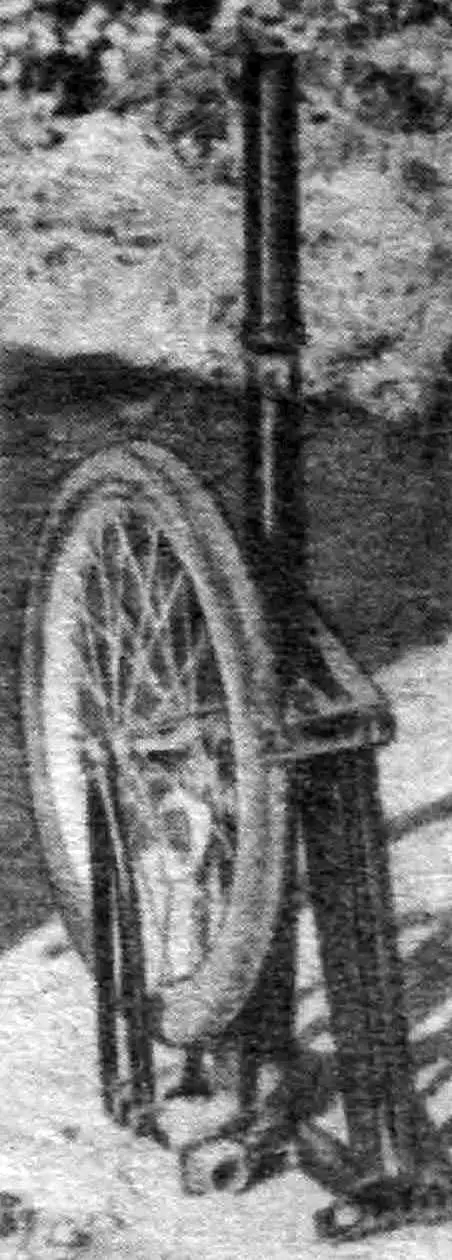
The technique of riding with a trailer does not differ from riding on a regular bicycle. The presence of hinged connections in the vehicle eliminates lateral loads on the wheels when the bicycle tilts. To increase ease of operation (when riding at low speed, when parked, when loading), a lock is provided that stops the hinge connection.
The trailer can carry various cargoes, large items (TV, refrigerator) or be used as a passenger trailer. With its own weight of 10 kg, its load capacity is over 100 kg. The trailer can be used with any production bicycle, only the mounting bracket changes. With intensive use with “Salut” for half a year, there was not a single failure. I consider this an indispensable vehicle for gardeners, rural residents, and for many city dwellers as well.
I. GRITSAYEV
Recommend to read
 GLASS TABLE
A small table, color coordinated with the seats, carpet and the lamp, will transform one of the corners of your apartment, will add to her comfort. The top — worktop — made of glass... WITH A BEAUTIFUL HEAD
Is all sorts of advice was on the use of caps and lids from unnecessary bubbles and tubes. Here's another — receiving beautiful shaped heads of bolts or nuts. Look at the picture....
