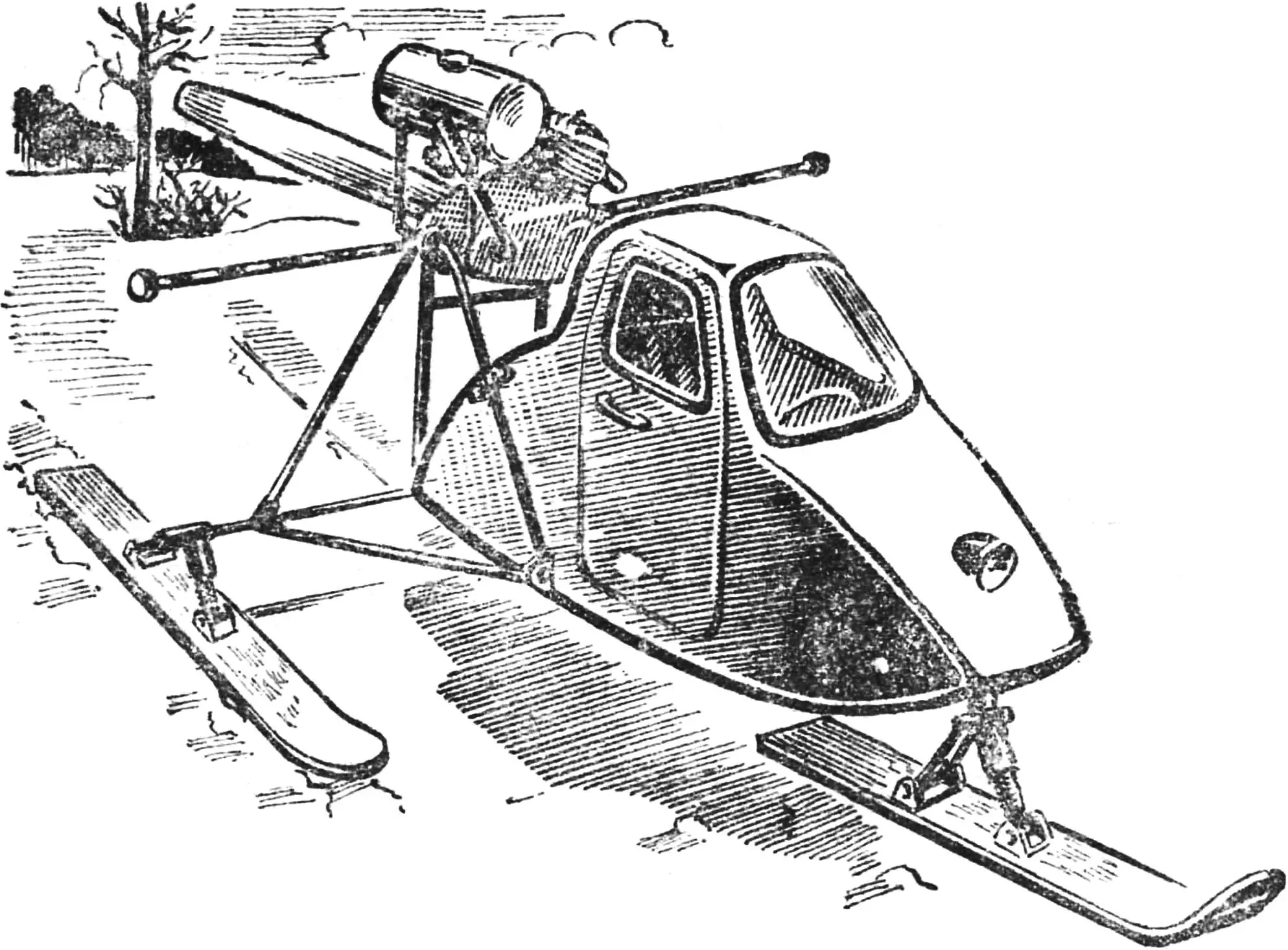
“My childhood fell on the hard postwar years,” begins M. I. Psaryov in his letter to the editorial office. “Back then, we made our own toys. Apparently, that is what planted in my soul a love for designing – all my life I have never parted with tools, metal, wood, and, of course, pencil and paper. The second half of life has already begun, yet the urge to create by hand does not fade; sometimes it flares up with such force that you forget everything in the world.”
Mikhail Ignatyevich built many remarkably interesting machines during his lifetime. And each one gave him tremendous satisfaction as the embodiment of an idea. “I have always considered designing the best kind of rest,” M. I. Psaryov continues, “so I devote almost all my free time to my favorite work.
My first successful design was a children’s motor scooter with a D-4 bicycle engine, built for my son. Then came a small car with the same engine and a plywood body.
I consider 1966 a milestone year for myself – the year Modelist-Konstruktor became a monthly publication. It was from that year that my passion for amateur designing gained a solid practical foundation: I got the opportunity to compare my own searches with the developments of like-minded people – enthusiasts just like me – and borrow the most interesting technical solutions.
I am most interested in snow-going machines. The thing is, I live in the city of Chaikovsky in Perm Region. It is located on the shore of the Votkinsk Reservoir. Many people here are fond of ice fishing, and I am no exception. As luck would have it, all the good fishing spots are far away – five to ten kilometers out. To start with, using drawings published in M-K, I built a powered sled with a D-5 engine. It turned out to be a good machine, but soon I had to abandon it: it ran briskly enough on roads, but moved with difficulty through loose snow.
After weighing my possibilities, I began building the first aerosled of my life, with a PD-10 engine. Let me say at once that I failed to fully refine this sled – the design turned out clumsy and bulky. I do not regret the labor and time lost, because without that experience I would hardly have built another sled – this time with an Izh-49 engine. The design proved quite workable and at first even satisfied me. But people are forever dissatisfied by nature: before I had properly run it in, I was already sketching the layout of a new sled – lighter, more convenient, and faster.
I designed it for a Planeta-3 motorcycle engine. To keep the sled light, I set myself the task of using metal as economically as possible, and I achieved it. Together with the engine, the aerosled weighed about 80 kg, developed a decent speed, and had quite satisfactory cross-country ability.
At that time, M-K often published descriptions of home-built motor sleds. I decided to test my own abilities as well. My snow vehicle did not resemble motor sleds in the modern sense of the word – it had two skis at the rear and a driven drum wheel at the front. I spent two years building this machine and, unfortunately, in vain. It would not run in loose snow at all, and on packed snow it crawled at a turtle’s pace. It was no match for an aerosled!
And back to work again. I decided to return to aerosleds, but not to the layout I had already grown used to; instead I turned to an amphibious snow vehicle. At first I planned to build the engine myself from two modernized PD-10 units. At home, I cast crankcases from duralumin and replaced the cylinders with others from an Izh-Yu3 engine. But unfortunately, I could not start the engine. Lack of experience and machine tools took their toll…
I designed the next aerosled for an M-72 motorcycle engine. The main problem was the gearbox, but that was solved too. By then, a small group of amateur aerosled builders had formed in our city, and many of my comrades needed such a gearbox. We made several units together. One of them works quite successfully on my aerosled with the PM-4 index. The machine turned out well, with a three-blade variable-pitch duralumin propeller and skis that can be replaced with wheels in summer.
At present, I am working on implementing a long-standing idea of mine – I want to build an amphibious aerosled.
PM – 2
Despite serial production of tracked snowmobiles, aerosleds still continue to attract amateur designers. Every winter, hundreds of new light and swift air-propeller machines set out across snowy expanses. The designs we present today in the “Series P” selection attract attention with their simplicity of construction, rational solutions, and good operating qualities.
The body of this sled is load-bearing. The frames are made of pine slats with a 25×45 mm section, and the stringers are made of thin-walled steel tubes Ø 18 mm and wooden slats with an 18×25 mm section. Outside, the body is sheathed with 3 mm plywood.
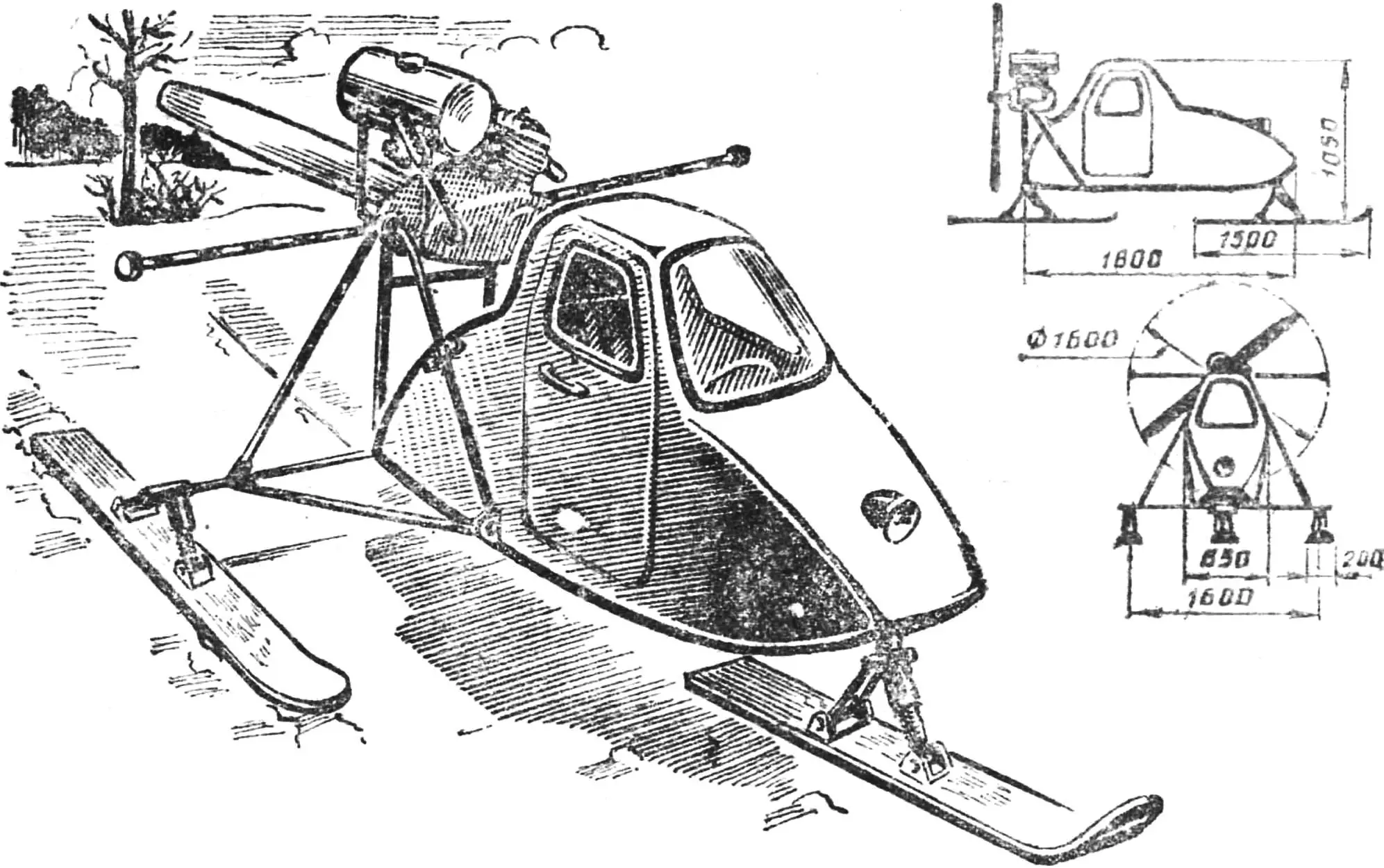
The engine mount frame is welded from water pipes Ø 20 and 25 mm. The skis are wooden, with a polyethylene sole, and suspended with shock absorbers from a Voskhod motorcycle.
The engine is from an Izh-49 motorcycle. To adapt it for aerosled use, I had to remove part of the gears from the gearbox, machine a shaft for the propeller, and make a duralumin cup. I kept the clutch and kickstarter, which is very convenient for safe engine starting.
These sleds served me for about two years; their only drawback was a relatively high center of gravity due to poorly positioned engine placement, which significantly reduced stability in turns.
PM – 3
This machine is generally similar to the previous one, but its cornering stability is higher thanks to a low center of gravity. The aerosled body is wooden, made of pine bars and plywood. The exception is the engine mount frame, made as one unit with the rear cross beam from steel tubes.
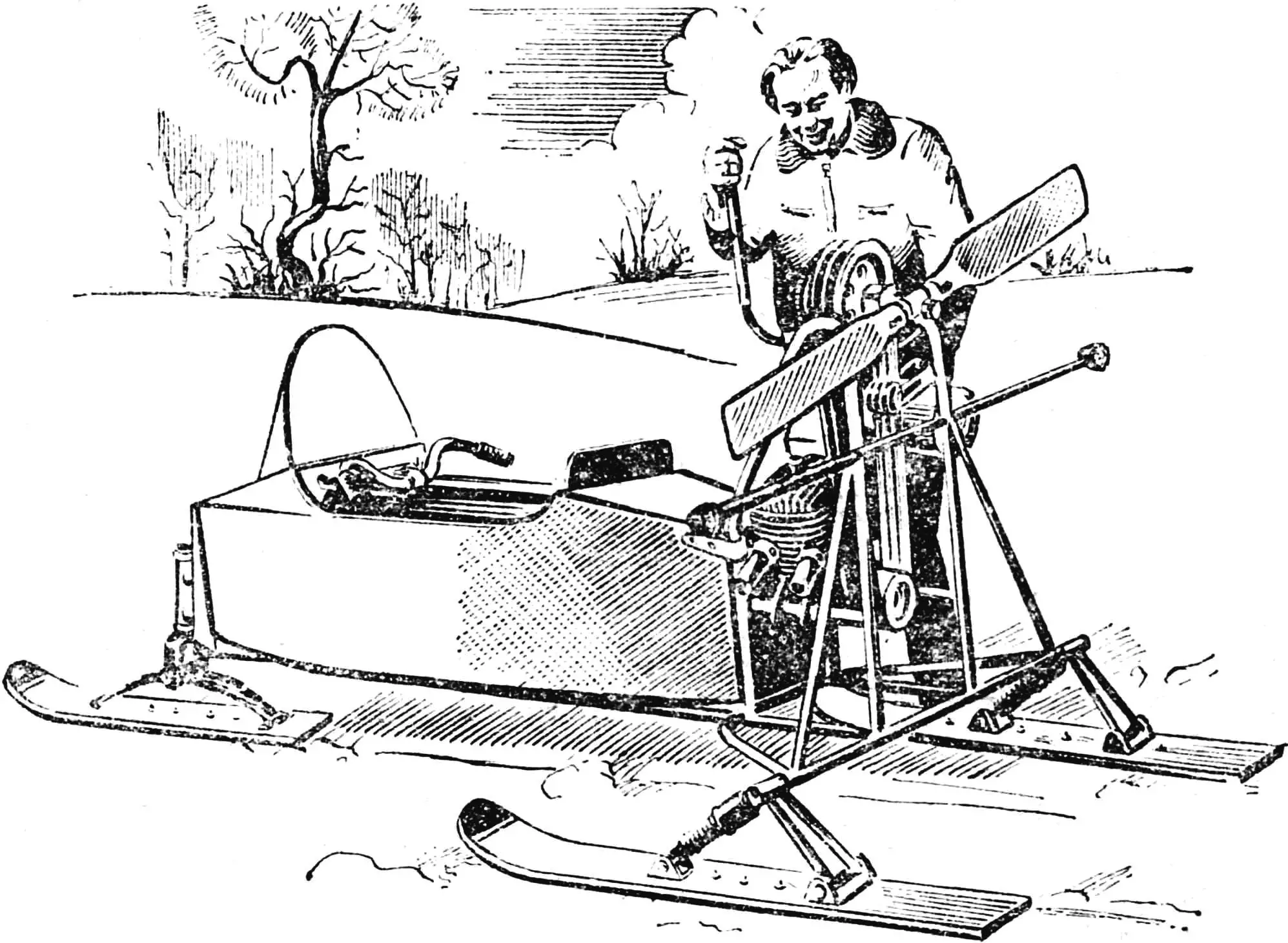
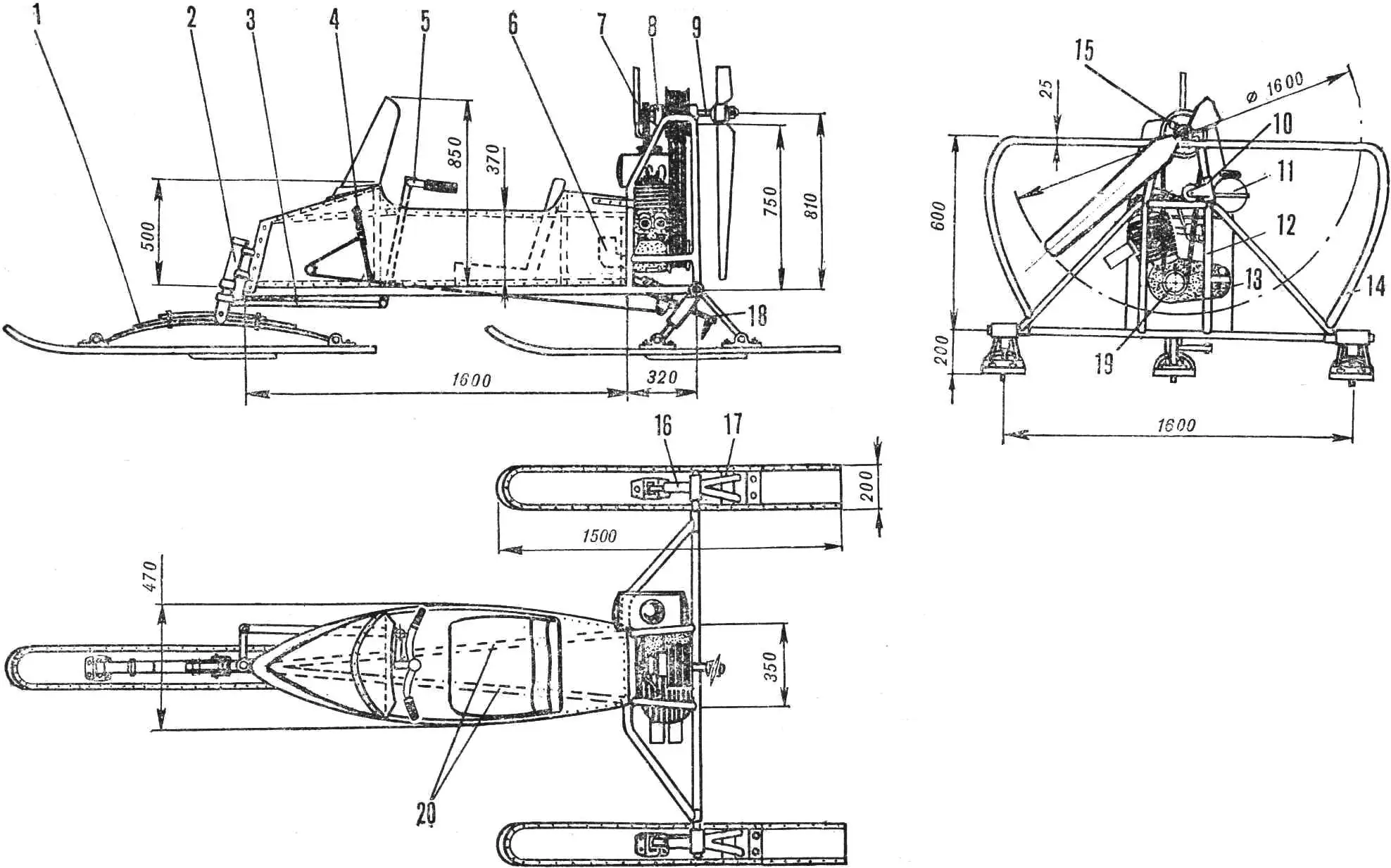
1 – spring, 2 – steering column, 3 – steering link, 4 – brake lever, 5 – handlebar, 6 – magneto, 7 – kickstarter handle, 8 – bearing housing, 9 – propeller shaft, 10 – tension roller, 11 – fuel tank, 12 – engine mount frame, 13 – engine, 14 – propeller guard, 15 – driven pulley, 16 – shock absorber (from Voskhod motorcycle), 17 – rocker arm, 18 – scraper brake, 19 – drive pulley, 20 – pine frame spars.
The propeller and the engine crankshaft are connected by a V-belt transmission with triple-groove pulleys. The gear ratio is approximately 1:2. The engine is from a Planeta-3 motorcycle. The skis are made of birch boards with a polyethylene sole. The brake is of the scraper type. Aerosled speed is up to 60 km/h.
PM – 4
This snow vehicle is my latest design, in which I tried to account for mistakes and shortcomings discovered in earlier constructions.
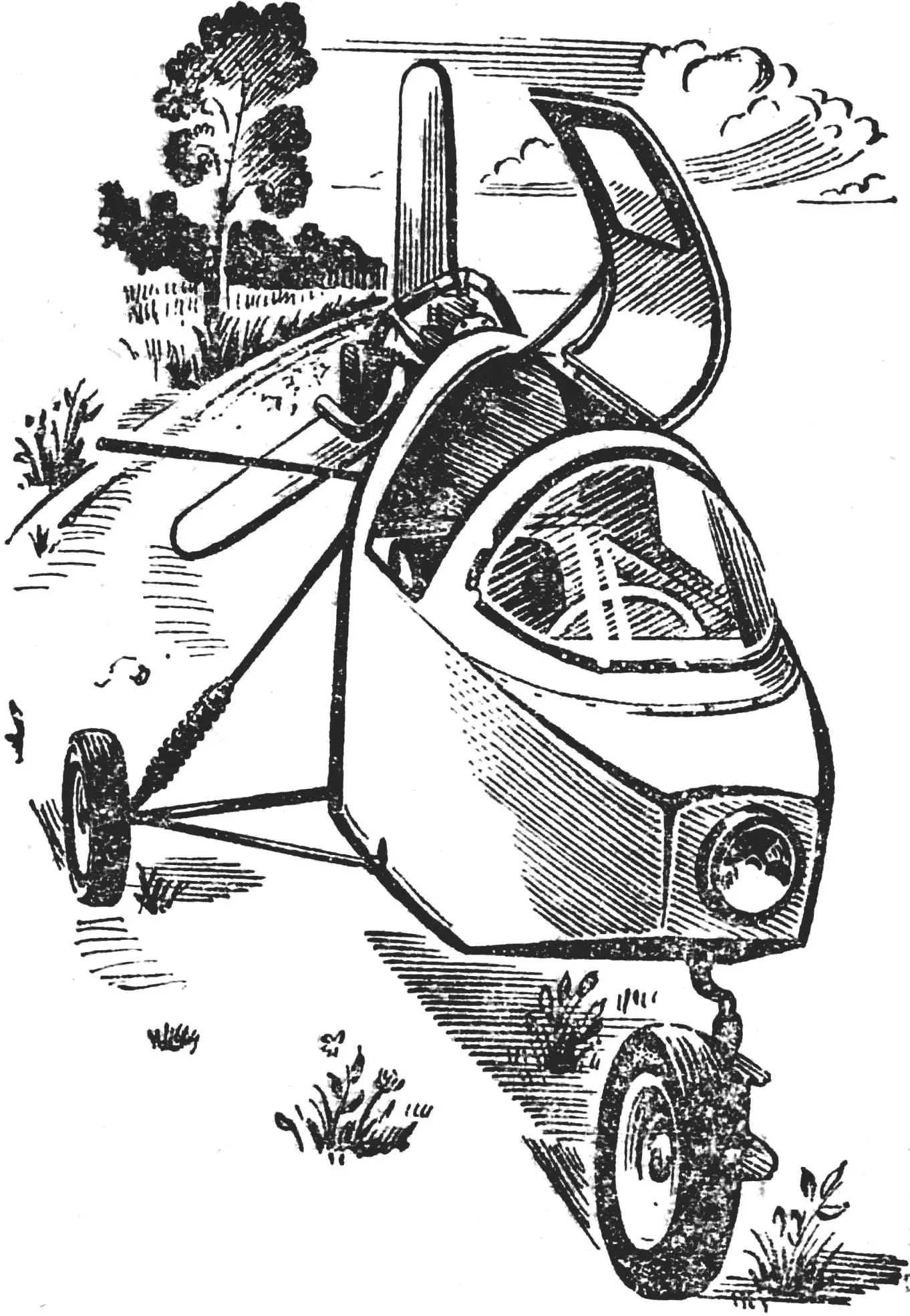
The PM-4 aerosled is two-seat, with a closed load-bearing body. The frame is wooden, with plywood sheathing. The folding canopy section is bent from 1 mm aluminum sheet. The skis are made from Ø 150 mm duralumin tubes; each ski sole is reinforced with a 2 mm duralumin sheet and covered with polyethylene.
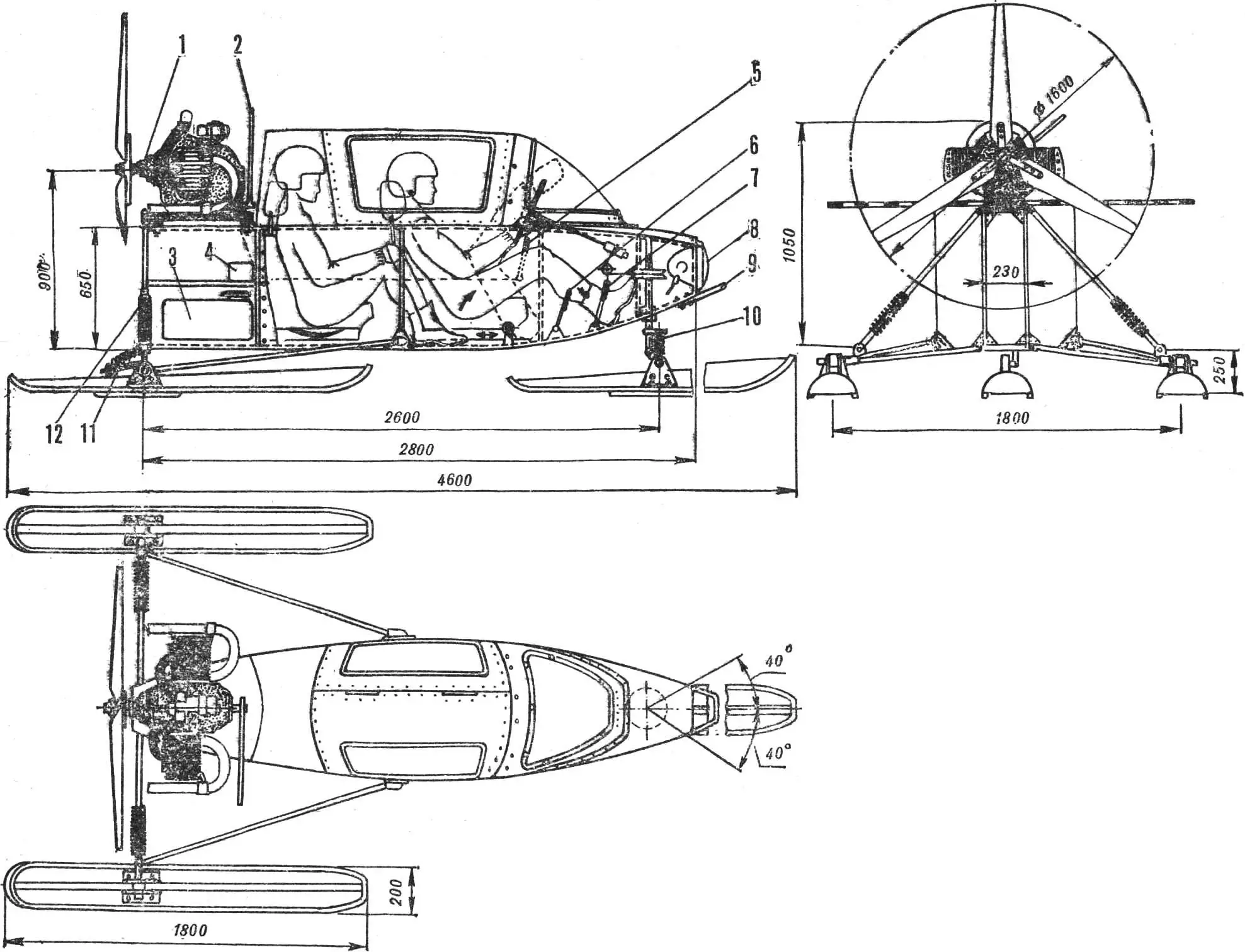
1 – fuel pump, 2 – kickstarter handle, 3 – tank, 4 – battery, 5 – clutch lever, 6 – brake lever, 7 – throttle pedal, 8 – headlight, 9 – towing bracket, 10 – front fork (from Vyatka scooter), 11 – scraper brake, 12 – shock absorber (from Vyatka scooter).
The engine is from an M-72 motorcycle. It is installed through rubber pads on a small engine mount frame. Its gearbox is removed, and instead a reducer of my own design is used, halving the rotational speed of the driven shaft. Using a fuel pump made it possible to place the fuel tank low, in the luggage compartment.
The running gear design allows wheels from a scooter to be installed instead of skis, making it possible to operate the aerosled in summer as well.
“M-K” 11’80, M. PSARYOV
Recommend to read
 The planetary Rovers
In annually conducted by our magazine national competition "Cosmos" among the many models fantasies occupy a significant place different kinds of self-propelled tools "planetary Rovers".... THE ENGINE FOR ALL OF THE ELEMENTS
OR "15 HORSES", WHICH WEIGH 12 POUNDS. In the range of domestic internal combustion engines which can be guided to create all-terrain vehicles Amateur designers, there are still no...
