It’s easiest to say: “When I grow up, I’ll get behind the wheel of a car, take a plane into the sky, build what I dreamed of…”
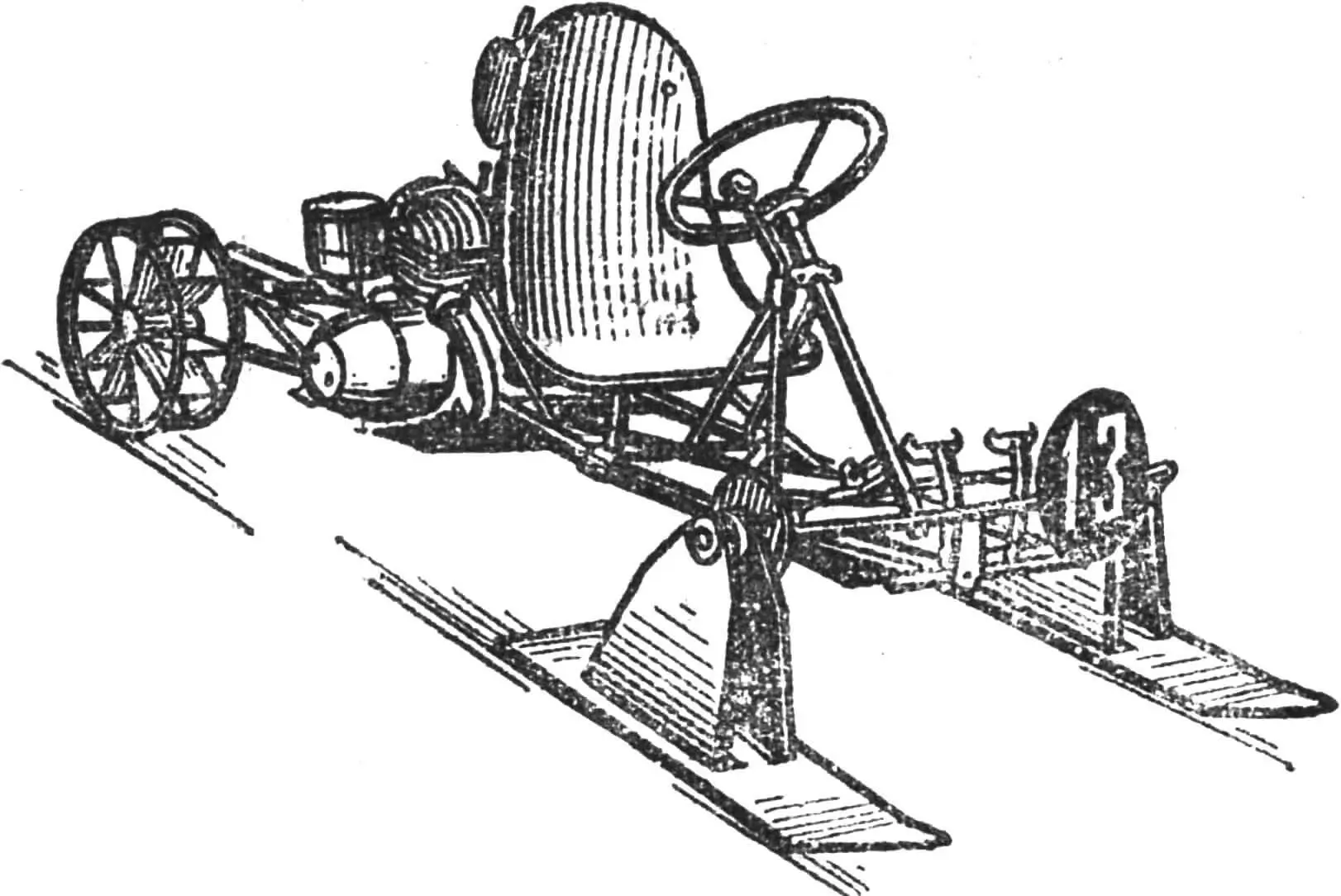
But it turns out that many dreams can come true even at the age of fifteen, if you don’t sit idle, but boldly take on their realization. We speak so confidently because we tested our strength by building an unusual machine, which we, members of the design club of the young technicians’ station in the city of Novohrad-Volynskyi, Zhytomyr region, decided to tell the readers of your magazine about. This is a kart on skis.
One winter we watched karting training, and we came up with the idea of putting a kart on skis.
This plan was implemented in our club, which is led by A. S. Haska. We took a ready-made machine as the basis. Instead of front wheels, we installed swivel skis on it, instead of rear ones — “turbines” with blades, and another wide ski was placed under the bottom. As a result, a regular kart can be converted into a winter one in just a quarter of an hour. The “summer shoes” — wheels — are removed and the winter ones — skis and “turbines” — are put on.
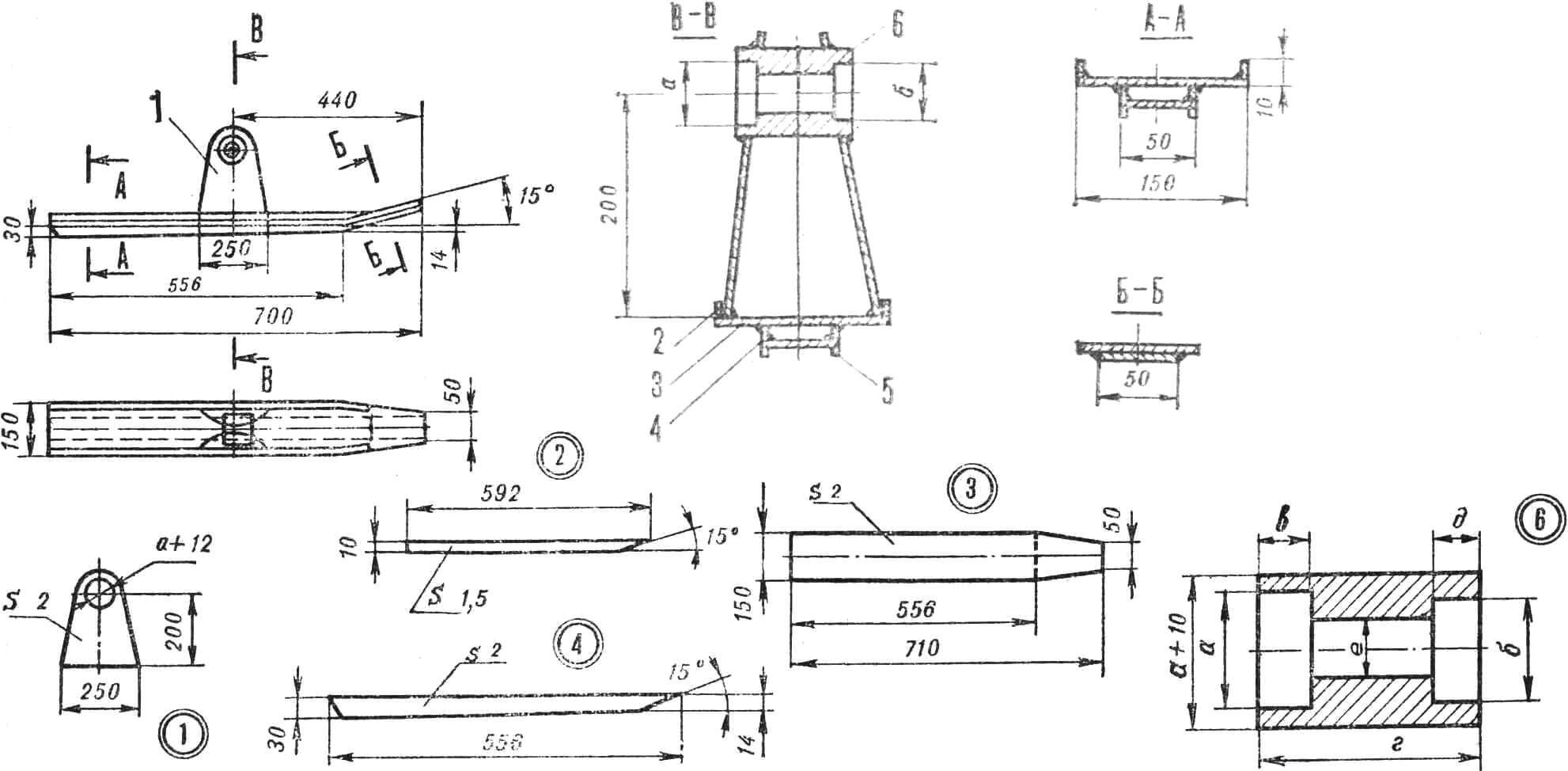
1 — stand, 2 — sides, 3 — ski, 4 — step, 5 — rod, 6 — bushing. Dimensions a—e as required.
The front ski (Fig. 1) is of a conventional design — with stands and a bushing. It is attached to the front wheel half-axle using a bushing with two pressed-in bearings and two stands welded to it and to the ski. To increase rigidity, as well as to reduce friction and improve maneuverability, a step-ridge and side-cuts were made along the ski.
On packed snow and ice, the kart moves on the step, on loose snow it fully sits on the skis. The structure is welded, with “tacks”. It is advisable to weld a metal rod along the edges of the step, as shown in Figure 1. Thus, to “re-shoe” the kart, it is enough to unscrew the nut on the wheel half-axle, remove it, put on the ski and put the nut back in place.
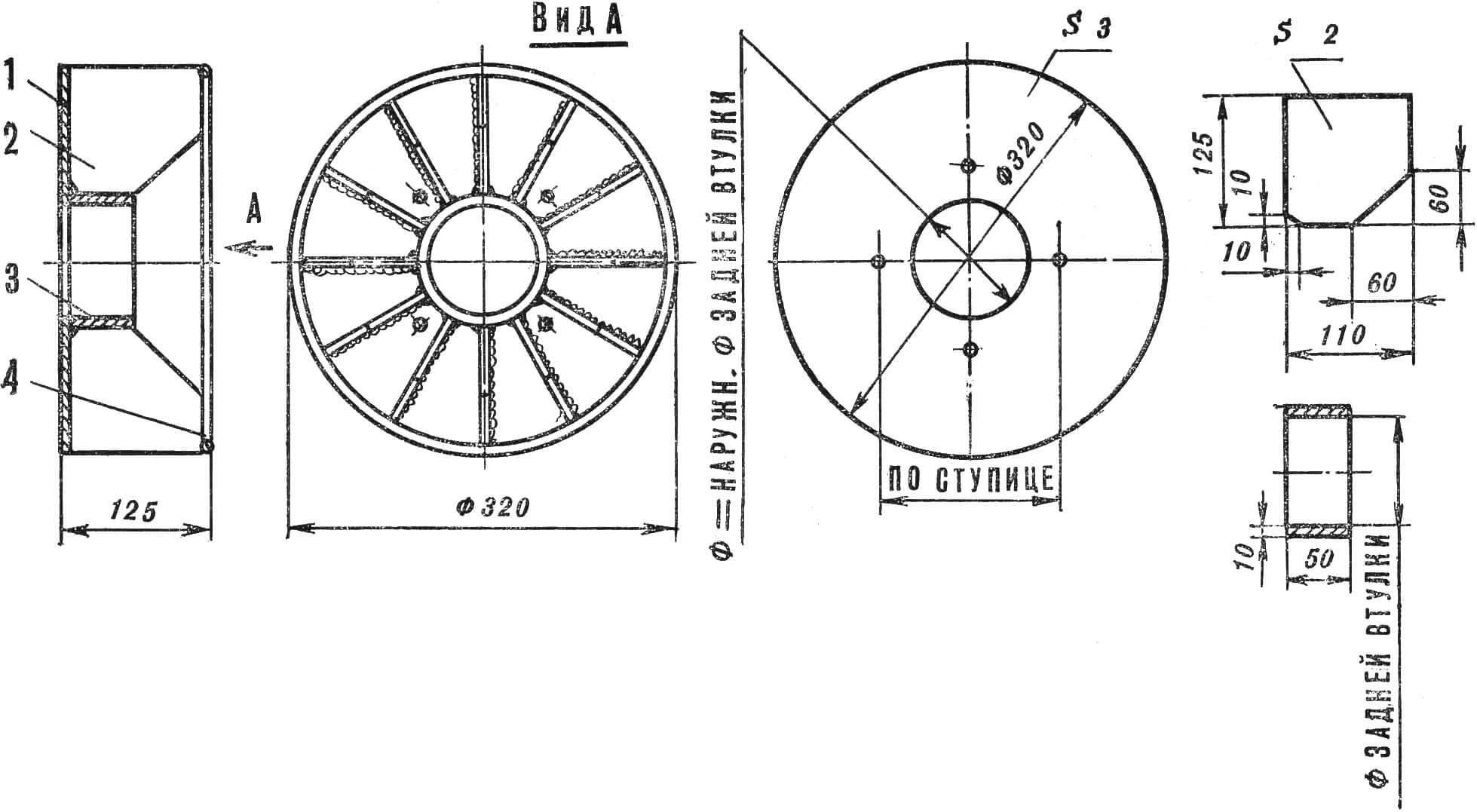
1 — disk, 2 — blades, 3 — bushing, 4 — rod.
The wheel-“turbine” (Fig. 2) is a disk to which a bushing and 12 working blades are welded. The blades cut into the snowy and even icy surface, which increases traction.
To prevent jolts during movement and to prevent the blades from bending, a ring made of a rod Ø 8 mm is welded on the outer side of the “turbine”. It is best to install the blades not perpendicular to the disk, but at an angle of 45°. In this case, you get a wheel-“turbine” in the form of a screw. To change the rear wheels, it is necessary to remove them and attach the wheel-“turbine” to the hub using four bolts and nuts.
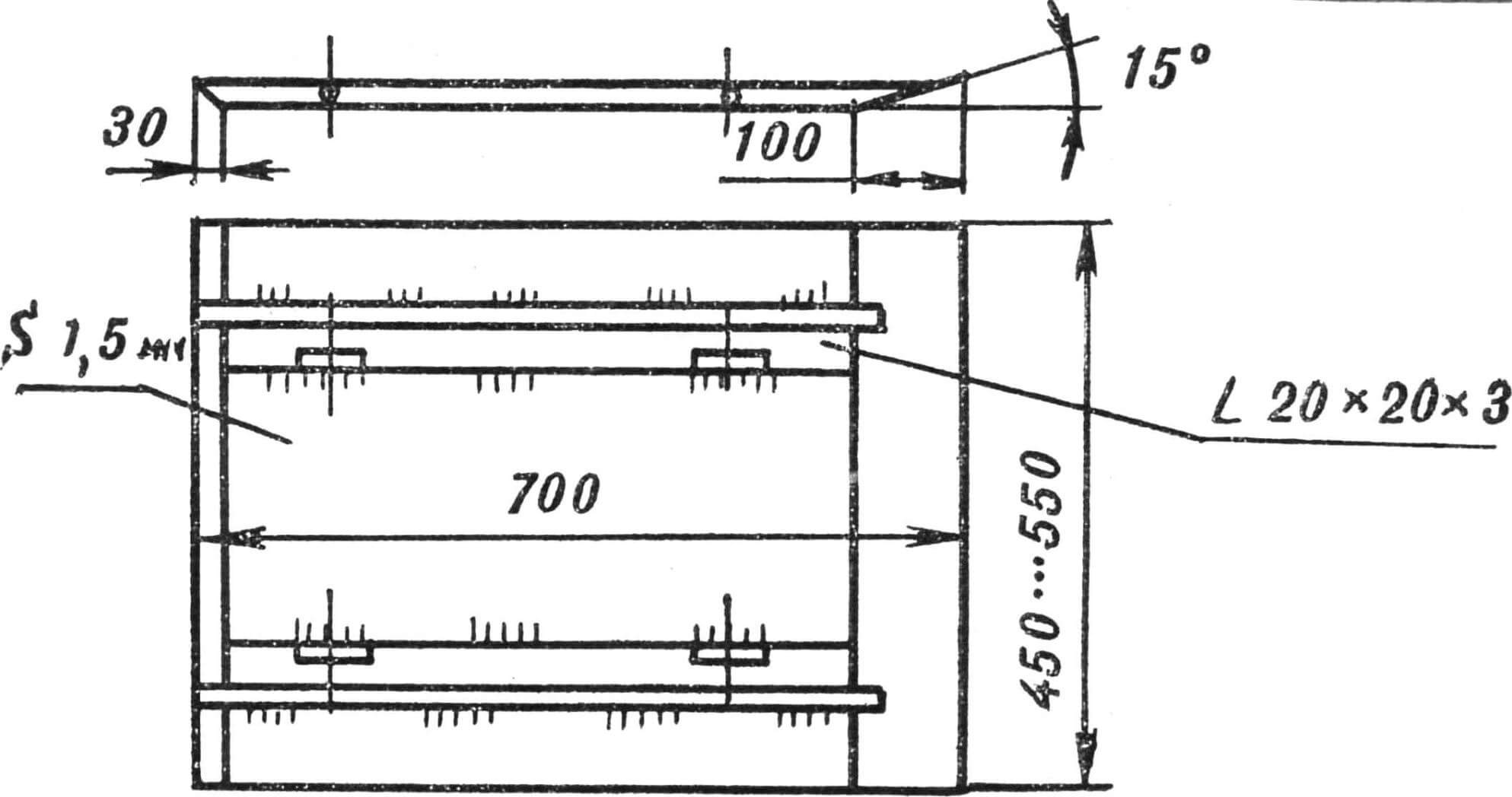
The rear ski (Fig. 3) with approximate dimensions of 700×450 (550) mm is installed in the area of the kart’s drive axle on its frame. The dimensions of the units are not given, as everything depends on the frame design. We used the mounting unit shown in Figure 4 on our machine. At the intersection points of the tubes, we welded gussets with guide bushings. Then, in accordance with the center-to-center distance, we welded brackets to the angles. We drilled holes in the angles and brackets for the bolt that will secure the rod. We made the rod, drilled a hole in it of the same diameter as for the bolt, and welded a washer for the spring. Then we assembled all this on the frame and welded the ski itself to the angles.
This unit design, in our opinion, makes it possible to adjust the skis in height, as well as provide shock absorption when moving on uneven surfaces. Springs can be used from old bicycle saddles.
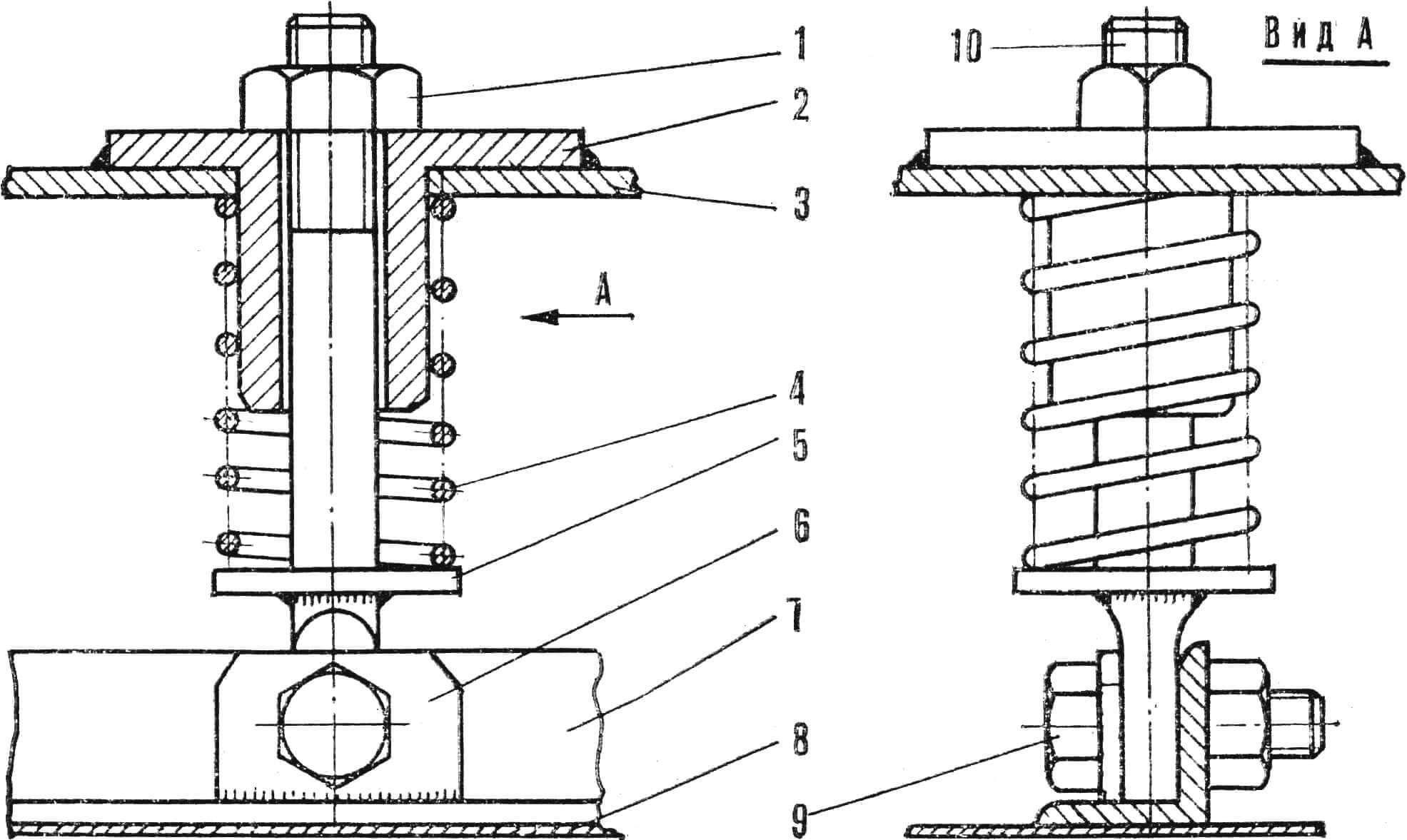
1 — nut, 2 — bushing, 3 — gusset, 4 — spring, 5 — washer, 6 — bracket, 7 — angle, 8 — ski, 9 — bolt, 10 — rod.
The rear ski is suspended so that when moving on a hard road, it is 40—50 mm above the ground. This distance is adjusted by a nut, which must be locked.
In terms of driving qualities, the kart on skis is almost as good as a regular one. Its speed is somewhat reduced due to the increased weight, but the cross-country ability and maneuverability increase, and the machine does not skid on the winter track. The kart immediately, without wheelspin, gains speed, and snowdrifts are not an obstacle for it. Such a machine can be used for training in the winter season on uncleared paths and even as a cross-country kart-snowmobile, a new type of sports equipment for the snowy season.
P. Denysiuk, P. Kovalchuk, N. Shvytsov, B. Yankovyi, B. Horiunov.
Recommend to read
 A WHITE SAIL…
A white sail gleams In the mist of the blue sea... These lines from a beautiful poem by the great Russian poet always evoke a dreamy sadness and a burning desire to go into the... THE BTR-T FROM THE TANK
Heavy APC based on the T-55 was first shown at the 2nd exhibition VTTV-97 in Omsk Developing a machine tailored to heavy urban fighting of the first Chechen campaign, Omsk KB transport...
