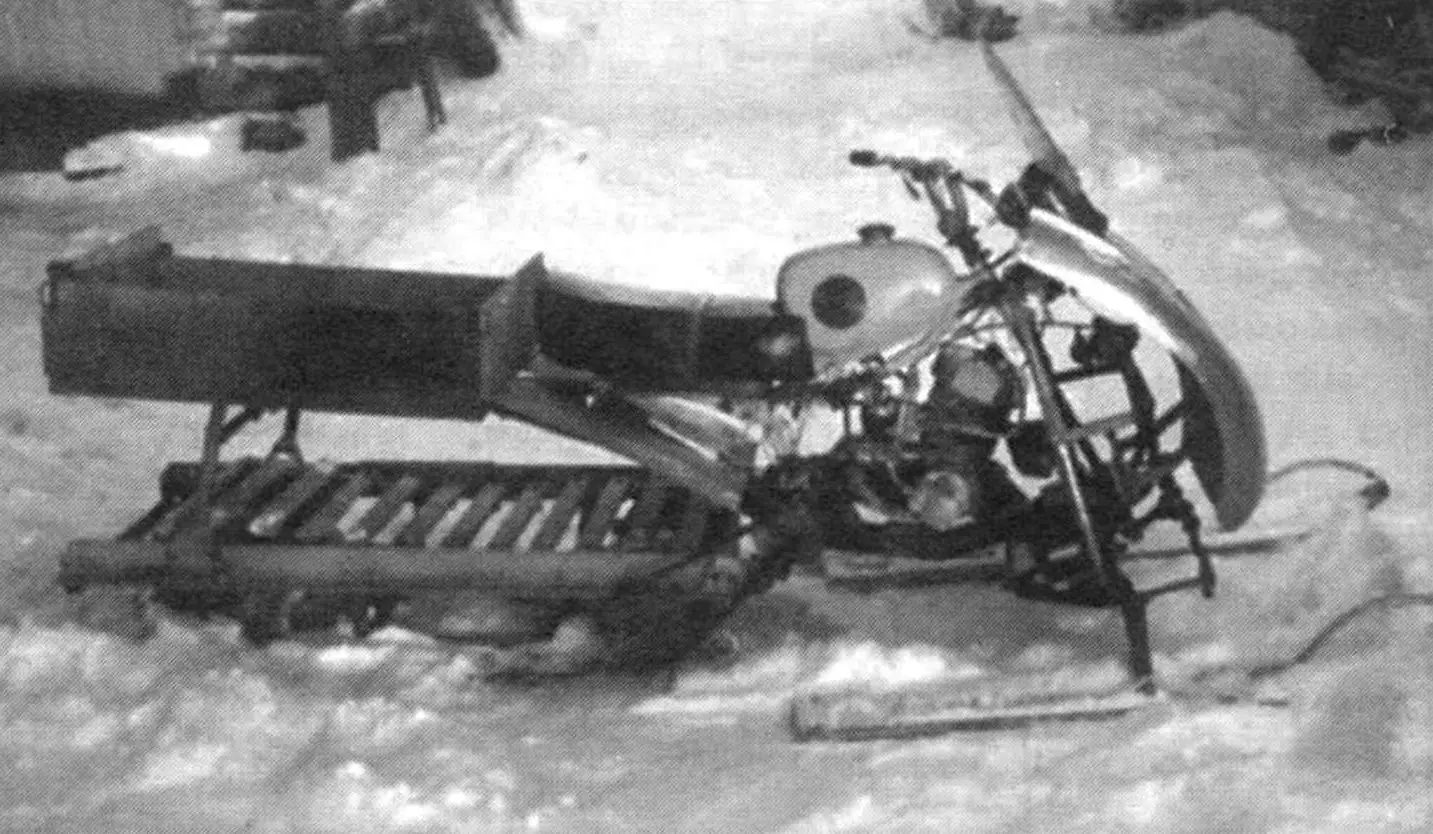
In “Modelist-Konstruktor” magazine No. 11’1991 I came across a description of motonarty — a tracked snowmobile built by the Matveychuk brothers from Zavodoukovsk, Tyumen Oblast, and named by them “Mysl-2” (“Thought-2”). I liked the machine. For me, a rural resident, it looked like an indispensable means of transport in winter, and as a home builder — quite feasible even with my modest home workshop equipment. What I have: a welding set, a sharpening grinder, an electric drill, and ordinary hand tools.
By then I already had experience building all-terrain vehicles — I had previously built wheeled (on pneumatic tires) and wheeled-ski motor ATV designs. A photograph of one of them was published in “Modelist-Konstruktor” No. 1 for 1991 in the “Photo panorama from readers’ letters” section.
Nevertheless building the motonarty stretched over years — sometimes more important matters came up, sometimes times were such that I could not even buy electrodes. For a long time I also tried to improve the design so the machine would be universal — for any season: simply change the running gear and the motonarty would become a pneumatic vehicle or a quad. But that greatly complicated the design, and building it at home no longer seemed possible. In the end I decided to make two machines: motonarty and a quad, moving only the engine from one to the other.
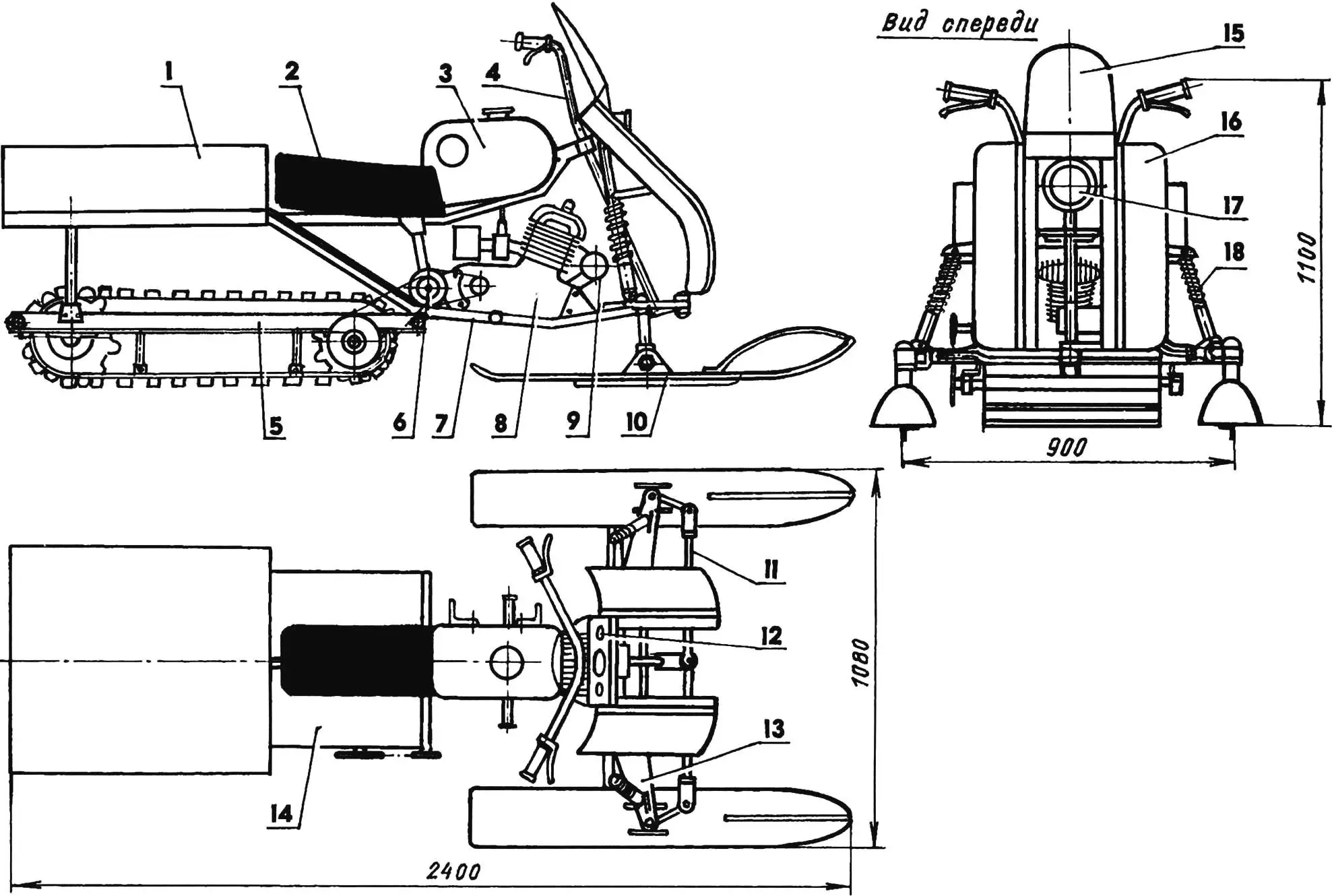
1 — body (St3 steel, sheet s0.8, edging — 25×25 angle); 2 — seat (from a Voskhod-3M motorcycle); 3 — 6 L fuel tank (from a Karpaty moped); 4 — handlebars (from a Voskhod-3M motorcycle); 5 — track unit (propulsion); 6 — intermediate shaft; 7 — frame; 8 — power unit (from a Voskhod-3M motorcycle); 9 — muffler; 10 — steering ski (2 pcs.); 11 — steering tie rod (from an S3D motor wheelchair); 12 — instrument panel (from a Voskhod-3M motorcycle); 13 — suspension lever (from an S3D motor wheelchair); 14 — snow deflector (duralumin, sheet s1); 15 — windshield (plexiglass); 16 — wind deflector (duralumin, sheet s1, 2 pcs.); 17 — headlight (from a Voskhod-3M motorcycle);
18 — shock absorber (from a Karpaty moped)
I used the same snowmobile layout as on the Matveychuk brothers’ machine: three-point with two front steering skis and one driven track at the rear. Such a layout promised good traction and stability, which matters when riding cross-country without roads. Only the rider’s seating on “Mysl-2”, like on a motor scooter, did not suit me. I found it more familiar and comfortable to ride the snowmobile sitting on it like a motorcycle — astride. Therefore I arranged the power unit with gearbox on the snowmobile the same as on a motorcycle, and did not even have to rework the control levers.
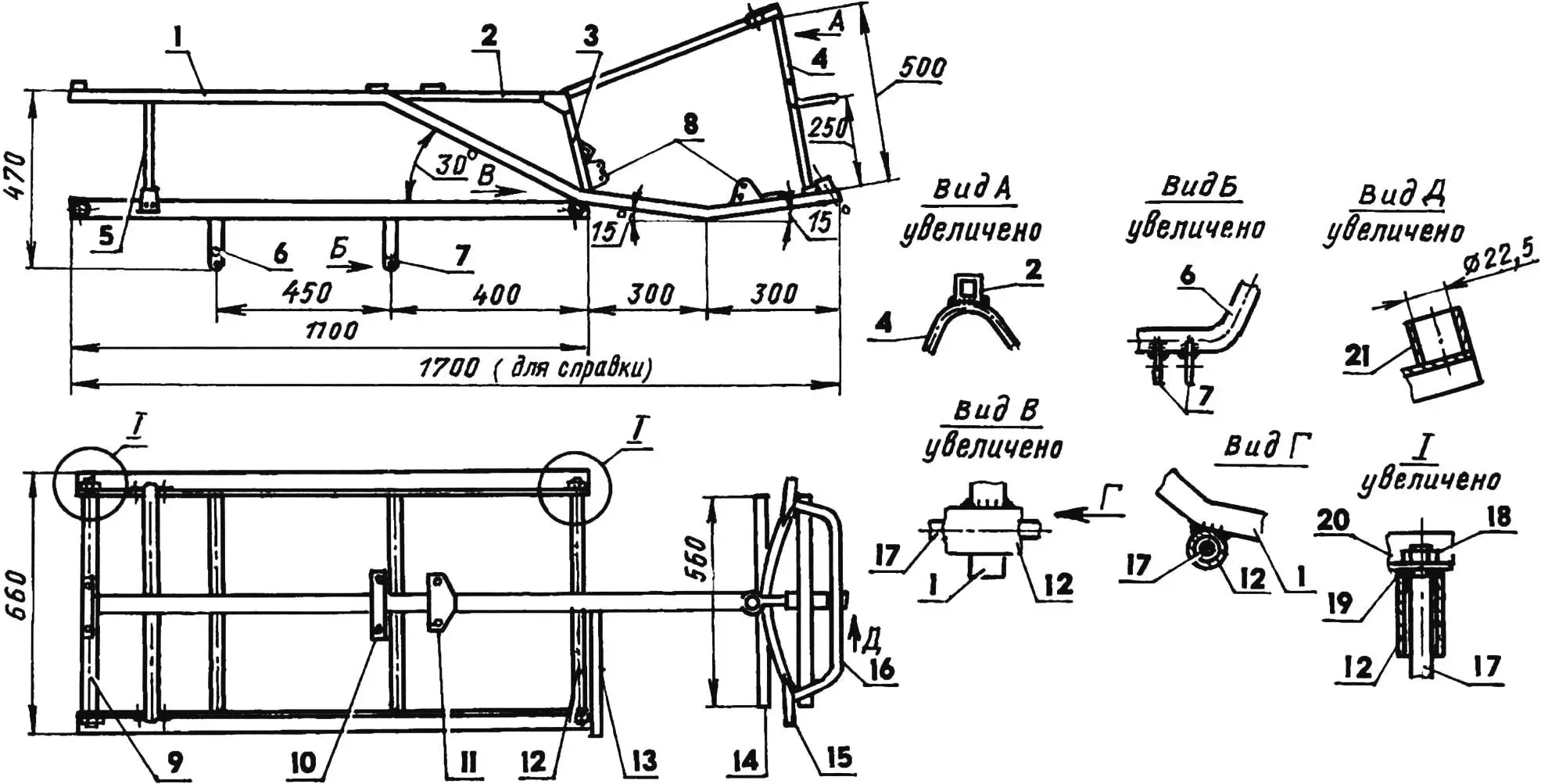
1 — main longitudinal member (40x40x4 channel); 2 — upper cross brace (from a Verkhovina moped); 3 — seat tube (30×30 pipe); 4 — front strut (Ø28 pipe); 5 — underbody support strut (1/2″ pipe); 6 — support ski strut (1/2″ pipe, 2 pcs.); 7 — lug for support ski bracket (St3 sheet s5, 8 pcs.); 8 — power unit mounting brackets; 9, 12 — rear and front cross tubes (1″ pipe); 10 — body mounting bracket (St3 sheet s4, 2 pcs.); 11 — seat mounting bracket (St3 sheet s4); 13 — intermediate shaft mounting cantilever (60×60 angle); 14 — front beams (from a passenger car, 2 pcs.); 15 — shock absorber mounting bracket (from a passenger car, 2 pcs.); 16 — arch (1/2″ pipe); 17 — tie rod (Ø18 stud, 2 pcs.); 18 — M22 nut (4 pcs.); 19 — nylon bushing (4 pcs.); 20 — track-unit subframe longitudinal member (60×60 angle, 2 pcs.); 21 — steering shaft housing (pipe Øint. 22.5)
Unlike the brothers’ spatial-frame snowmobile, my machine’s frame is simpler — a motorcycle (backbone) type with cantilever beam cross-members. The main longitudinal member is steel channel 40x40x4 mm. The upper part (cross brace) is a ready-made part (from a Karpaty moped). It is of a fairly complex shape. But that is not driven by necessity. Therefore on the drawings its shape is simplified.
The front strut is made from 28 mm steel pipe in fork form; its lower ends rest on the front beam taken together with suspension arms from a passenger car (the beam is shortened, and only the lower arms are used). The track-unit subframe cross tubes are steel pipe. Tie rods are inserted through nylon bushings. The cantilever for the intermediate shaft is made from 60×60 mm angle. Brackets for the seat and body are from 4 mm steel strip.
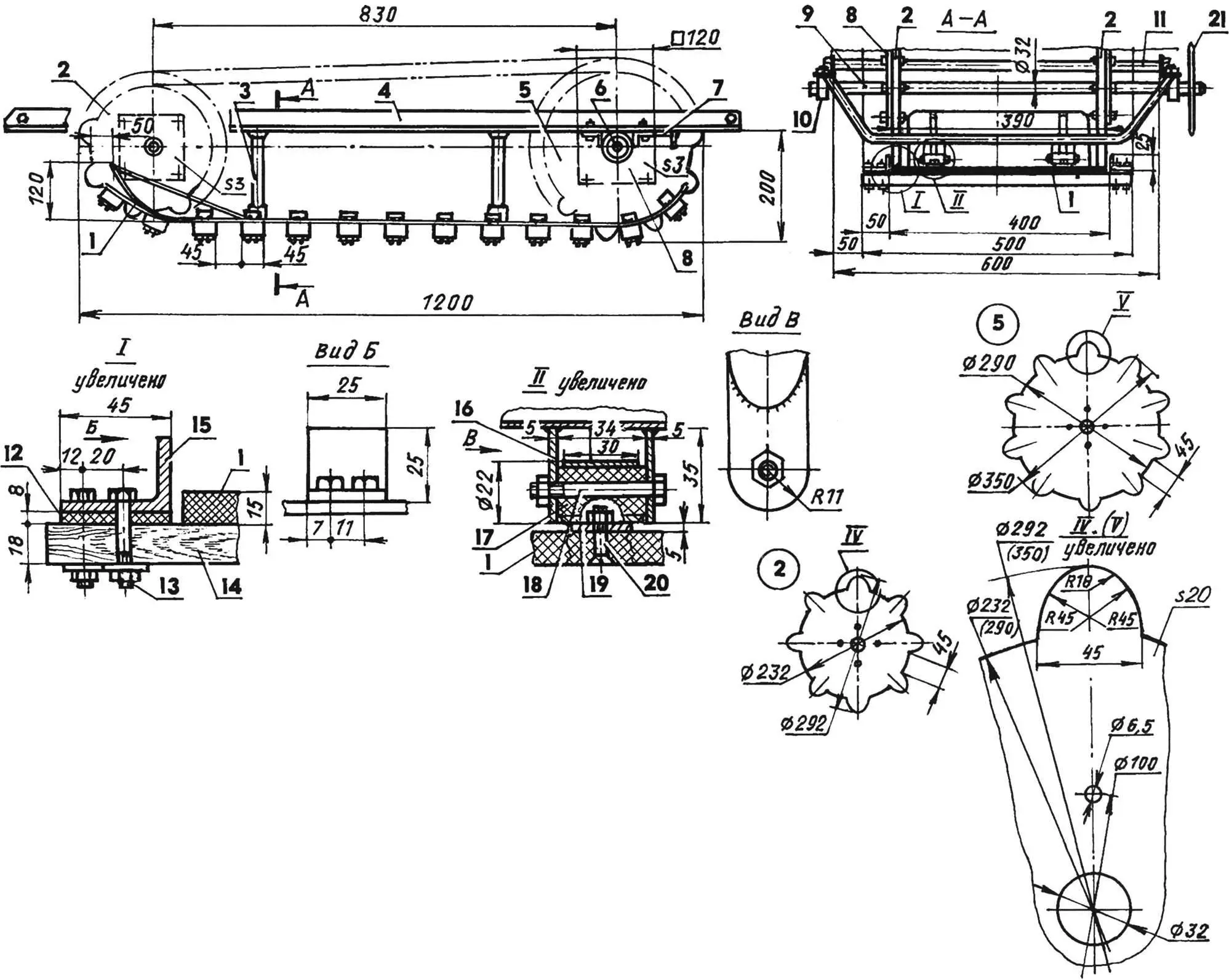
1 — support ski (nylon, sheet s15); 2 — drive sprocket for the track; 3 — support ski strut; 4 — track-unit subframe longitudinal member; 5 — driven (idler) sprocket (nylon s20, z = 10, 2 pcs.); 6 — idler sprocket shaft (Ø32 pipe); 7 — track tensioner; 8 — sprocket flange (St3 sheet s3, 4 pcs.); 9 — track drive shaft (Ø32 pipe); 10 — 80204 bearing in housing (4 pcs.); 11 — front subframe cross tube and track-unit axle; 12 — connecting belt (rubber-fabric conveyor belt 45×8, 2 pcs.); 13 — M6x40 bolt with washer (112 pcs.); 14 — snow cleat (birch strip 45×18, L500, 28 pcs.); 15 — guide angle (duralumin, 45×25 angle, 56 pcs.); 16 — support ski bracket lug (St3 sheet s5, 8 pcs.); 17 — rubber bushing (4 pcs.); 18 — axle (M8x50 bolt, 4 pcs.); 19 — support ski bracket (4 pcs.); 20 — M6x35 countersunk bolt (8 pcs.); 21 — chain sprocket (z = 32, motorcycle type)
The track-unit subframe is also of simple construction. Its basis is two longitudinal members made from 60×60 mm steel angle. The longitudinal members are tied with cross tubes; the front one is welded to the snowmobile frame. Two arched support ski struts for the track unit are also welded to the longitudinal members from below, and an arched luggage rack strut is attached on top with M8 bolts. All struts are made from half-inch steel water pipe.
According to initial estimates, the snowmobile was to use a Tula high-mobility motorcycle engine with 200 cm³ displacement and 13 hp power with forced air cooling.
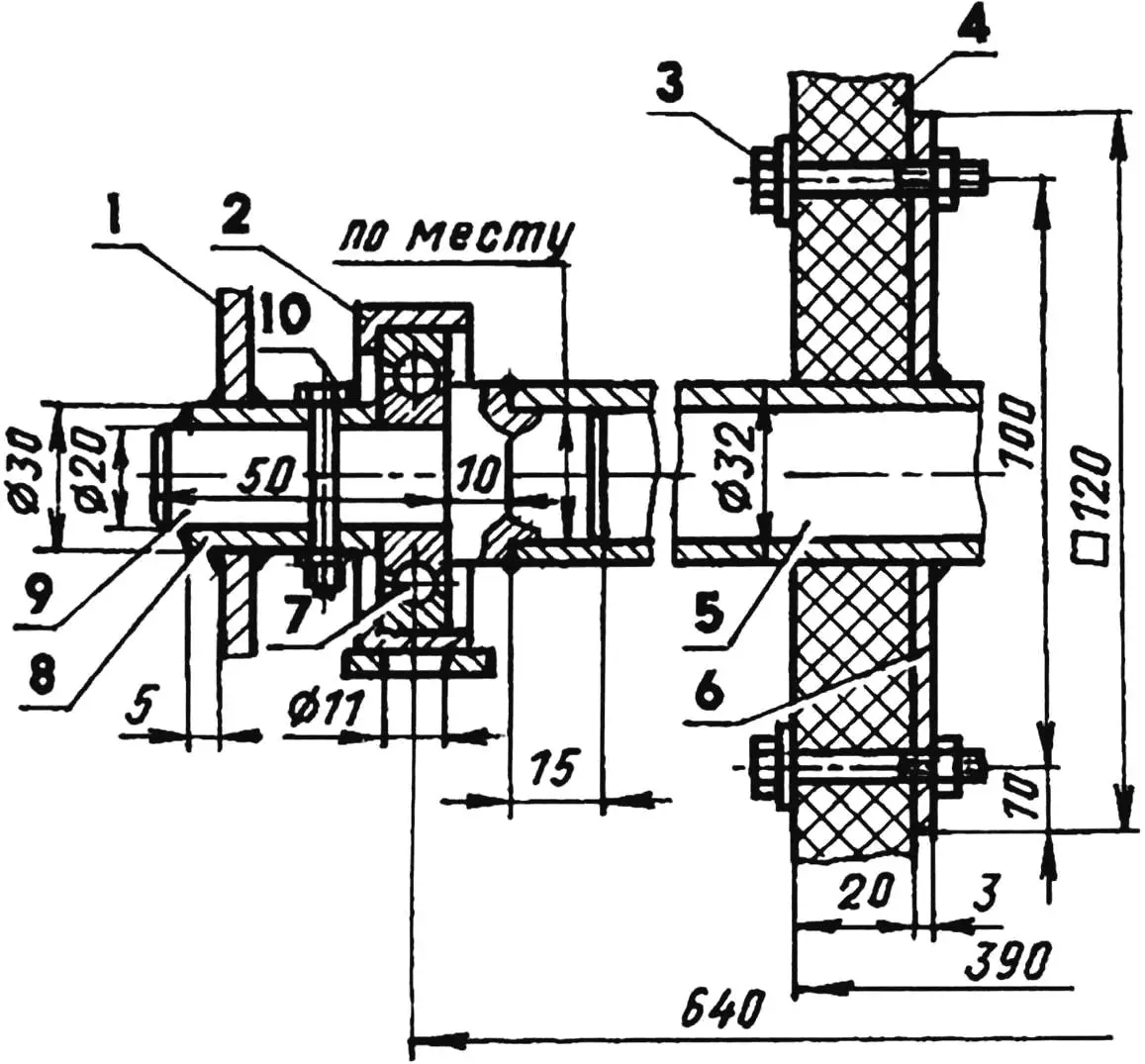
1 — chain sprocket (z = 32, motorcycle type); 2 — bearing housing; 3 — M6 bolt for track sprocket to flange (4 pcs.); 4 — drive track sprocket (z = 8, 2 pcs.); 5 — tubular drive axle shaft; 6 — track sprocket flange; 7 — bearing No. 80204; 8 — chain sprocket hub (St3 pipe Ø30×5); 9 — insert (St3 round Ø32); 10 — pin (M8 bolt)
In that case the front of the snowmobile could be covered with a traditional fairing hood typical for such machines, which greatly improved riding comfort, especially in frost and in a headwind.
However I could not purchase a “Tula” engine at an acceptable price, and the machine had to be fitted with an old, overhauled power unit (engine with gearbox) from a Voskhod-3M motorcycle. Its power is even slightly higher (14 hp), although displacement is smaller (175 cm³). But it has no forced cooling. Therefore I had to abandon the hood and instead install two wind deflectors (like mud guards) with a gap between them through which air flows to cool the engine.
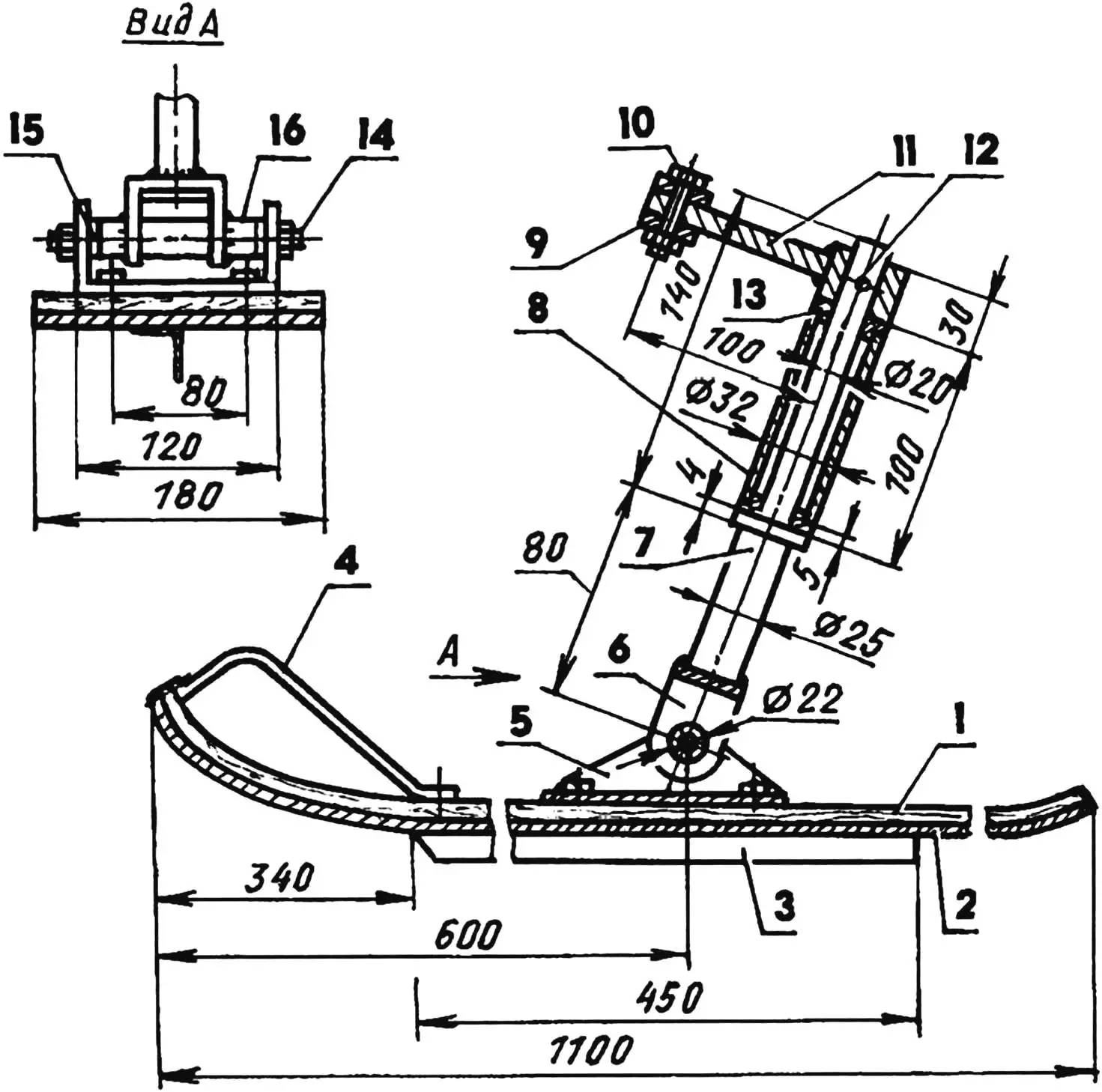
1 — ski (aspen board 180×15); 2 — sole (aluminum, sheet s1); 3 — guide (duralumin 25×25 angle); 4 — clamp (steel Ø10 pipe); 5 — support bracket (St3 sheet s3); 6 — strut fork (from a universal joint); 7 — strut (St3 round Ø32); 8 — steering knuckle housing (St3 Ø32 pipe); 9 — cross steering tie fork (from a universal joint); 10 — joint (M8 bolt); 11 — steering knuckle lever with bushing; 12 — pin (M8 bolt); 13 — bushing (bronze, 2 pcs.); 14 — axle (M12 stud with two nuts); 15 — bushing (nylon, 2 pcs.); 16 — joint housing (1/2″ pipe)
The transmission on my motonarty is somewhat more complex than on “Mysl-2” — it has an intermediate shaft. But the shaft is not redundant: with sprockets of different tooth counts (22 and 12) it acts as a reducer (or, as local builders call it, a “speed reducer”). Rotation from the power unit gearbox to the intermediate shaft and from it to the track-unit drive shaft is by chain drives. Chain tension is adjusted with shims under the intermediate and drive shaft bearing housings.
The track unit is the most complex of the homemade assemblies. I had no experience building it, so I relied on the construction and part dimensions given in the magazine. Because the article is old and young reader-builders may not have that issue, I think it is worth showing the drawings of the unit and its main assemblies and parts again.
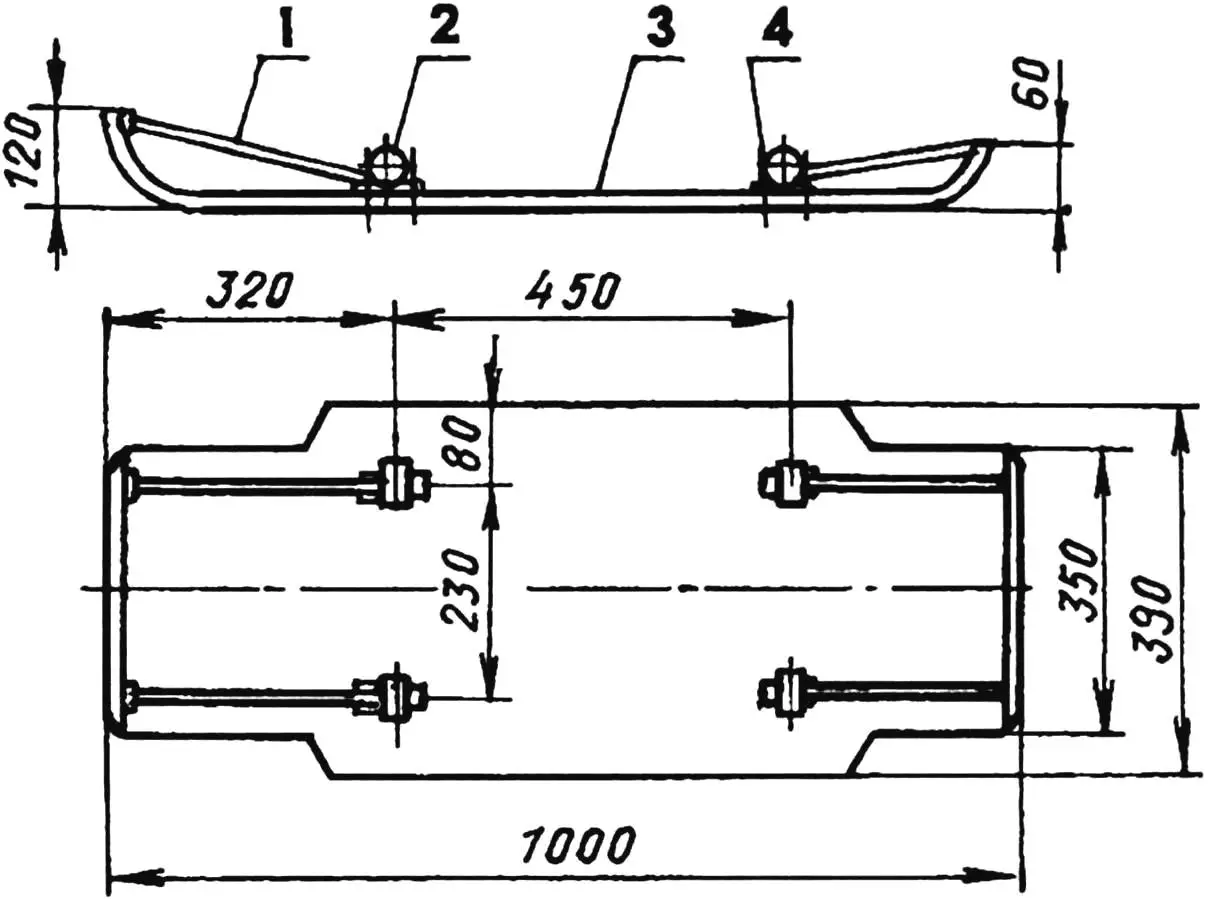
1 — tie rod (duralumin tube Ø10, 4 pcs.); 2 — bracket (4 pcs.); 3 — ski (nylon, s15); 4 — M6 countersunk bolts for bracket mounting (8 pcs.)
Of course there are some differences in the construction and materials of my track unit; although they are not fundamental, I think they are worth highlighting.
Thus, the shaft and axle bearings on my track unit are not 203 but 80204 — they are larger and have protective washers on both sides of the cage. The support ski is all nylon. I did not provide side brass guides — with correct (parallel) alignment of the axle relative to the drive shaft and good track tension the track does not wander sideways. Operation showed that rollers work better than rear sprockets; they can be made from the same sprockets by cutting off the teeth, which I later did. Bolts for cleat strips to the belt are installed with protruding ends and nuts outward: they now act like ice-speedway motorcycle tire studs — they give good grip on packed snow on roads, firm crust in fields, and ice on rivers or lakes.
I made the front steering skis from 15 mm thick aspen board 180 mm wide. I steamed the ski tips in boiling water and bent them on a template until dry. Then I oiled them and covered the underside with aluminum sheet. In the middle of the sole I attached guide rails from 25×25 mm duralumin angle.
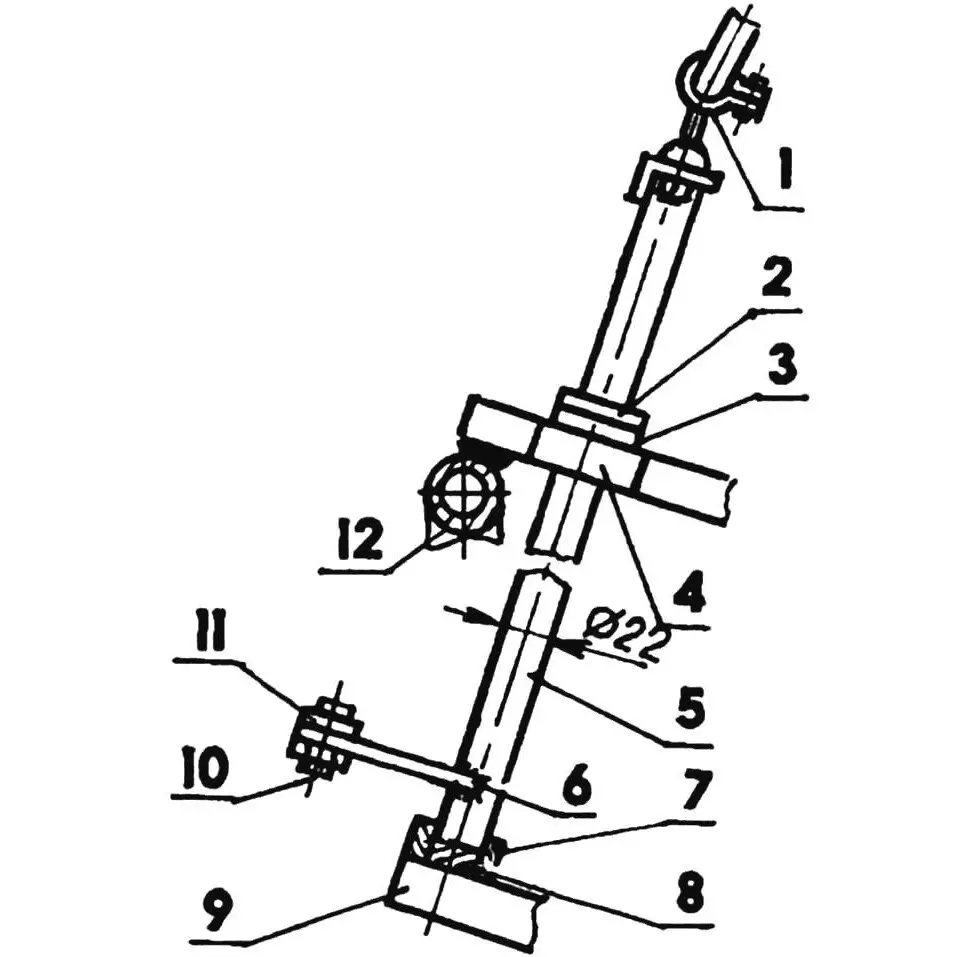
1 — handlebars with bracket (from a Voskhod-3M motorcycle); 2 — steering shaft collar; 3 — washer (bronze); 4 — bushing; 5 — steering shaft (Ø22 pipe); 6 — steering arm (St3 sheet s10); 7 — housing (pipe Øint. 22.5); 8 — thrust washer (bronze); 9 — main frame longitudinal member; 10 — joint (M10 bolt); 11 — cross steering tie rod (2 pcs.); 12 — front frame support strut
The steering ski struts are mounted in sleeve housings fixed at the ends of steering knuckle arms taken from a passenger car. The arms are sprung with shock absorbers with springs from an old moped. Ski steering is via modified steering tie rods from a motor wheelchair (stock tie-rod ends replaced with universal-joint forks), connected to an arm fixed on the end of the steering shaft.
All snowmobile equipment — seat, handlebars, headlight, horn, electrical instruments — like the power unit, is from an old Voskhod-3M motorcycle.
The luggage rack is welded from 1 mm steel sheet; for stiffness the bottom is edged with 25×25 angle. The 6 L fuel tank is from a moped. A toolbox is mounted under the seat. The track under the seat is covered with a duralumin sheet so less snow falls on the rider’s feet. To protect the torso and face from oncoming air, in addition to the front deflectors I mounted a windshield above them.
The transmission and propulsion layout allows the machine to do without brakes — there is practically no freewheel.
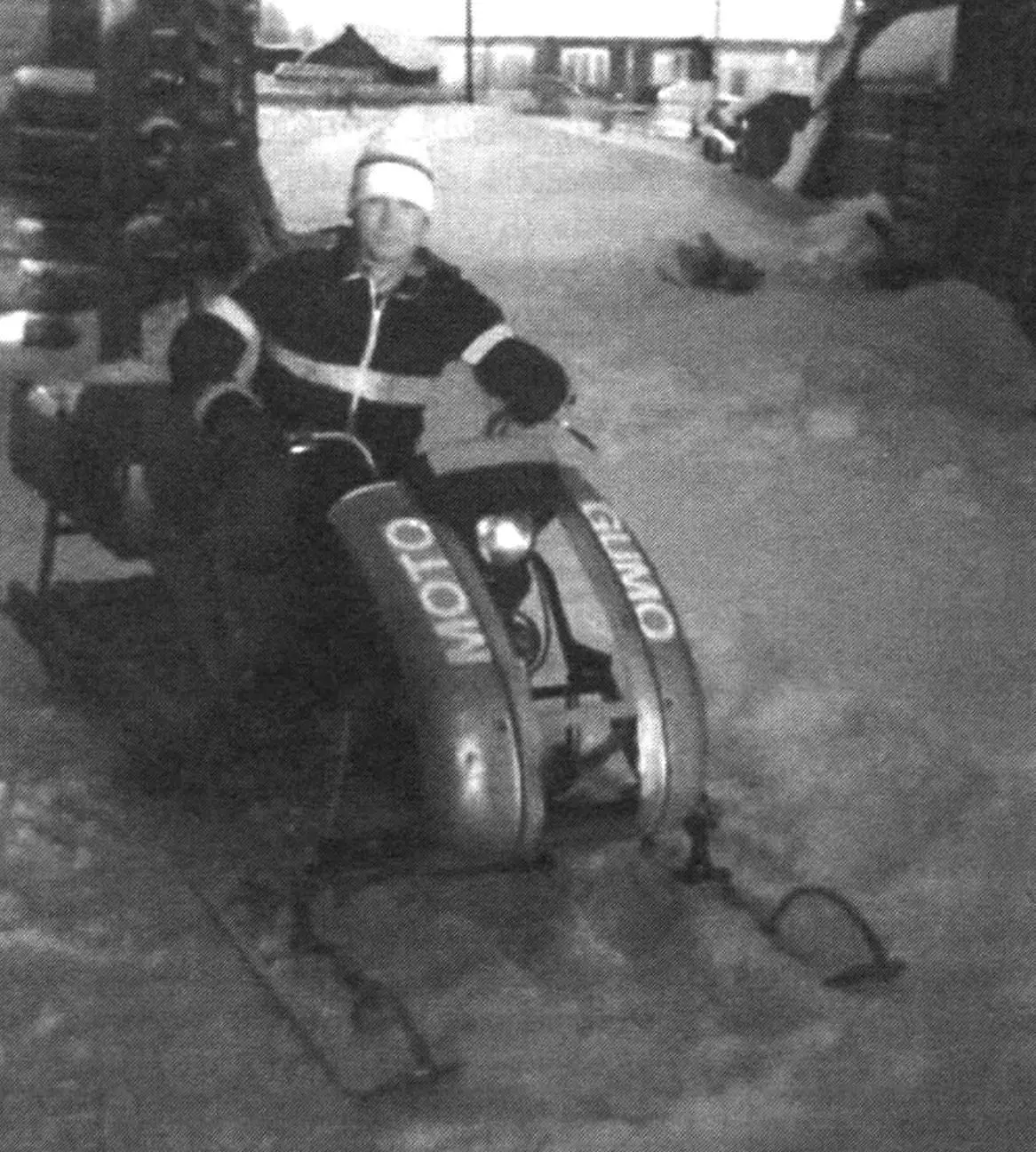
I did not keep a cost tally for building the snowmobile — that would have to be done quite scrupulously, since I did not spend much because I mainly used assemblies, parts, and mechanisms someone had once thrown away (and I had picked up), waiting their turn in the yard “arsenal.”
I do not consider the time wasted, because besides design experience, extra metalworking skills, and the satisfaction of a machine built with my own hands, I end up with a vehicle very useful around the farm for hauling various loads and for quickly covering long distances even through deep snow in our northern region over a long winter.
“Modelist-Konstruktor” No. 11’2004, A. STARTSEV
Recommend to read
 NOT SHAVING, AND SANDING
If you Unscrew an ordinary safety razor, you can use separately as the loom and the blade. Fix machine cut abrasive sandpaper is my best and you will get a convenient tool for grinding... RESCUE CLIP
How to be if urgently need to carry out drafting work using ink, a special ruler with a raised above the paper edge among the tools was not there! A way out of this situation is shown in...
