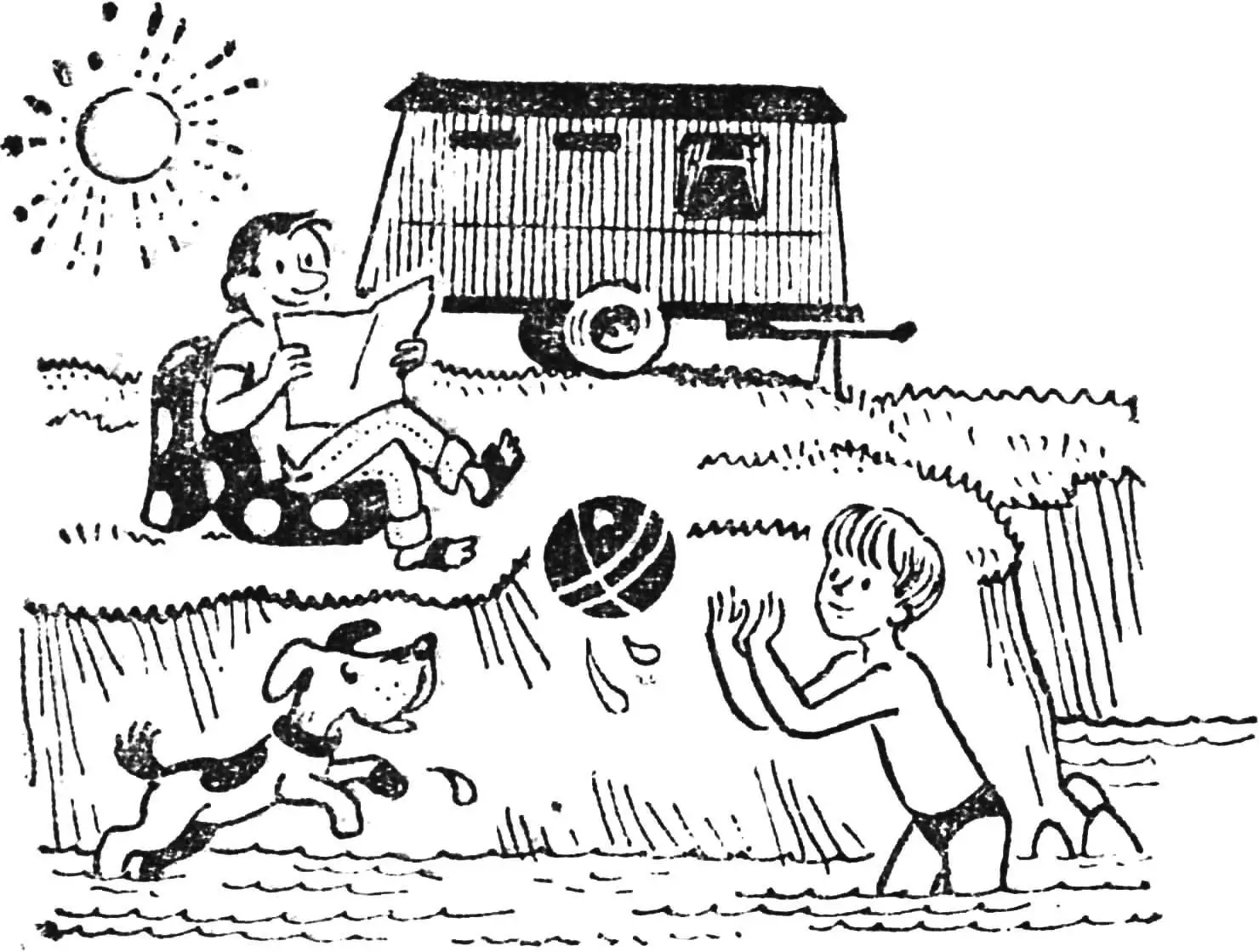
As the vacation period approaches, many auto tourists (especially families) begin to think about where and how they will rest on the road: living in a campground or on wheels, equipping the car with devices for overnight stays, or simply in a tent. There are other, so to speak, accompanying problems. For example, supplies of drinking water on the road and at stops, bathroom equipment, lighting system, galley arrangement, etc.
The best solution today is building an individual trailer-dacha with a universal coupling device that allows it to be towed both by your own car and by passing transport.
Our magazine has repeatedly published descriptions of similar designs: “Teremok” (author — R. Chernets, Elektrostal), “Alenushka” (V. Gribovsky, Moscow), “House on Wheels” (P. Zak and G. Stepanov, Moscow).
The editorial office receives many drawings of already built trailer-dachas, as well as various projects and proposals. Today the word goes to a very young designer, Yura Galkin, a 10th-grade student at school No. 28 in the city of Kirov.
For several years now, I have been a subscriber and regular reader of your magazine. I am especially interested in materials about motor transport.
Many auto trailers have already been created, both homemade and factory-made. They are especially popular abroad. And our enthusiasts have repeatedly appeared on the pages of the magazine with descriptions of their trailers. But, in my opinion, an optimal design specifically for a tourist trailer-dacha has not yet been created. In the article by P. Zak and G. Stepanov (“M-K”, 1977, No. 7), possible options for the arrangement and layout of houses on wheels were analyzed. The path they proposed opens up great prospects for enthusiast-builders. However, not everything in these proposals works out in the best way. Here, comfort and capacity are proportional to the nominal dimensions of the trailer. So, the length of a trailer for 4-6 people for a Zhiguli car exceeds 6 m. The difficulty of towing such a “house” needs no comment. And reducing the length of the trailer with the same layout principle will cause a corresponding reduction in capacity and comfort level provided to its occupants. So, a different path is needed, but what?
What can industry offer us? The folding trailer “Skif”. Small dimensions, convenient storage. Put it in the garage “upright” — and no worries. But not always maximum compactness, simplicity and originality of design can satisfy people. Especially now, when everyone wants to relax in nature with comfort!
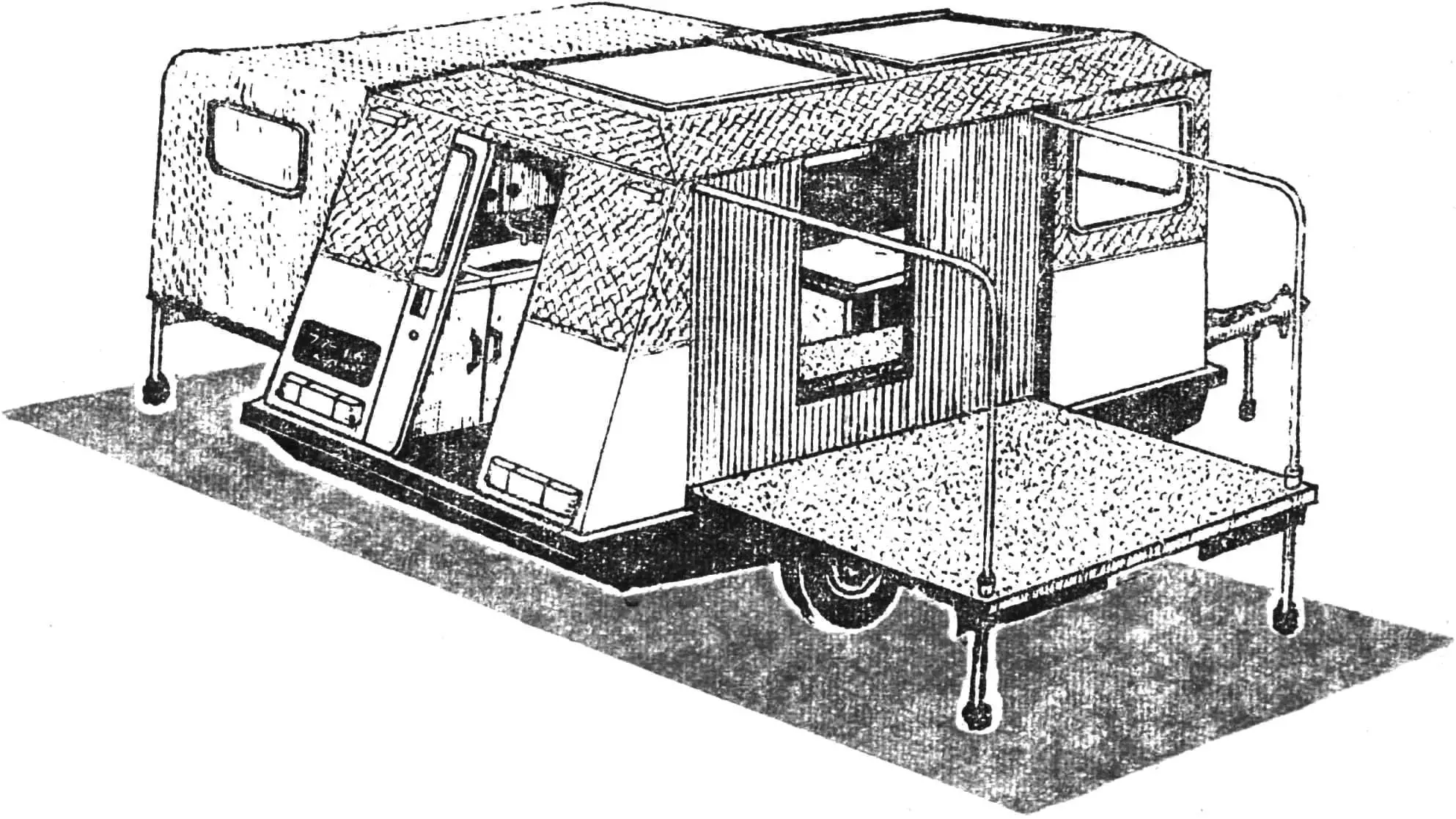
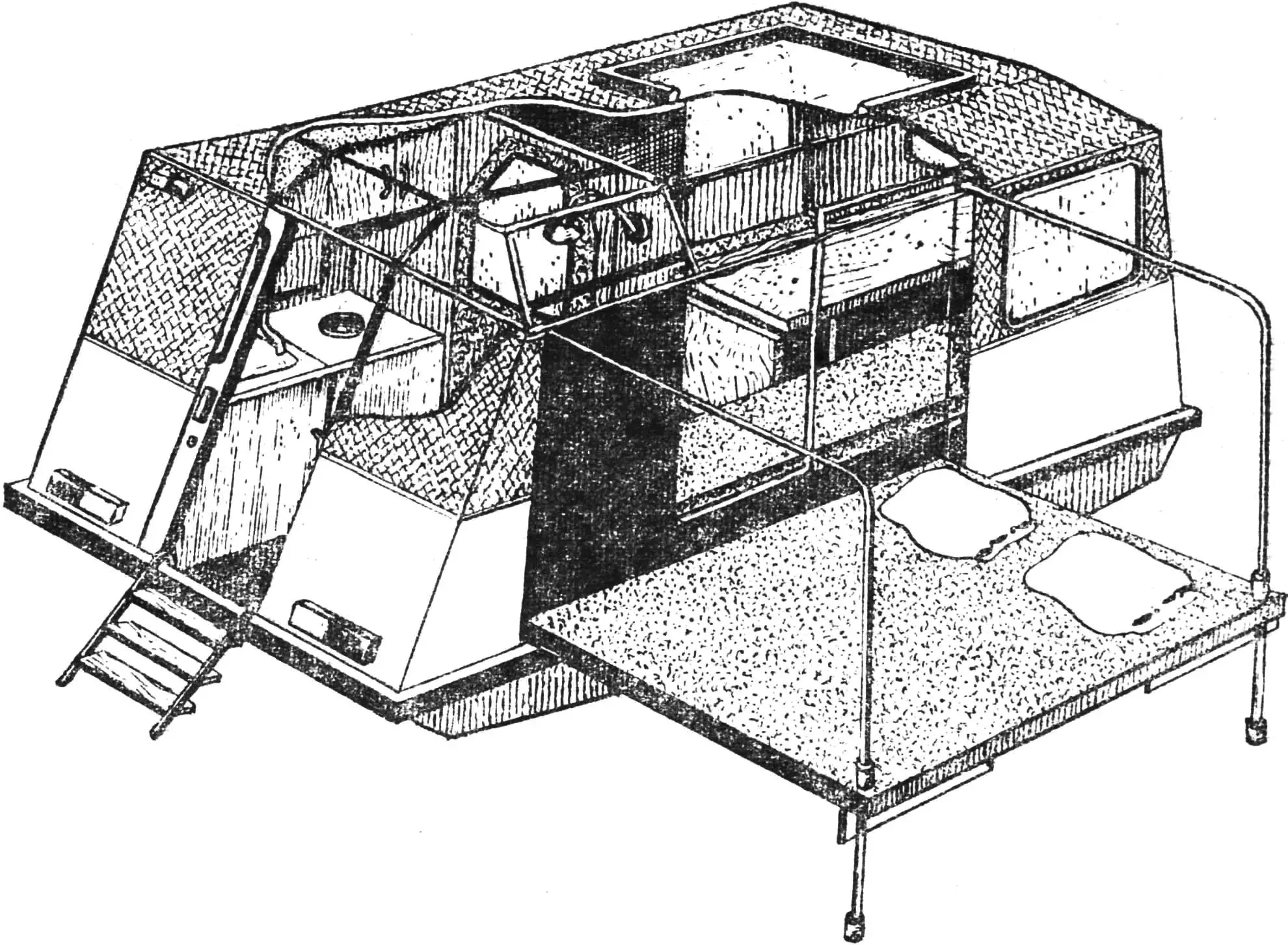
My proposed option represents a kind of compromise between a rigid, non-collapsible and folding trailer-autodacha. That’s why I called it “Kompromiss” (Compromise). The advantage of the trailer, in my opinion, is its relatively small dimensions in transport position. At the same time, maximum amenities for vacationers: kitchen with gas, shower, cabin with dining table, comfortable sofas and sleeping places. The number of sleeping places can be changed from 2 to 6 using folding walls, which is very convenient and doesn’t take much time. A folding dining table design can be provided: it will serve as the seventh sleeping place. When using screens, three separate isolated two-person cabins are obtained.
Since such trailers are usually used only in summer, the canvas tents of the folding walls provide sufficiently reliable protection from cold and bad weather. In extreme cases, they can be insulated from the inside. The high position of the trailer floor from the ground facilitates protection from crawling insects. Other details of the “Kompromiss” device are visible in the drawings.
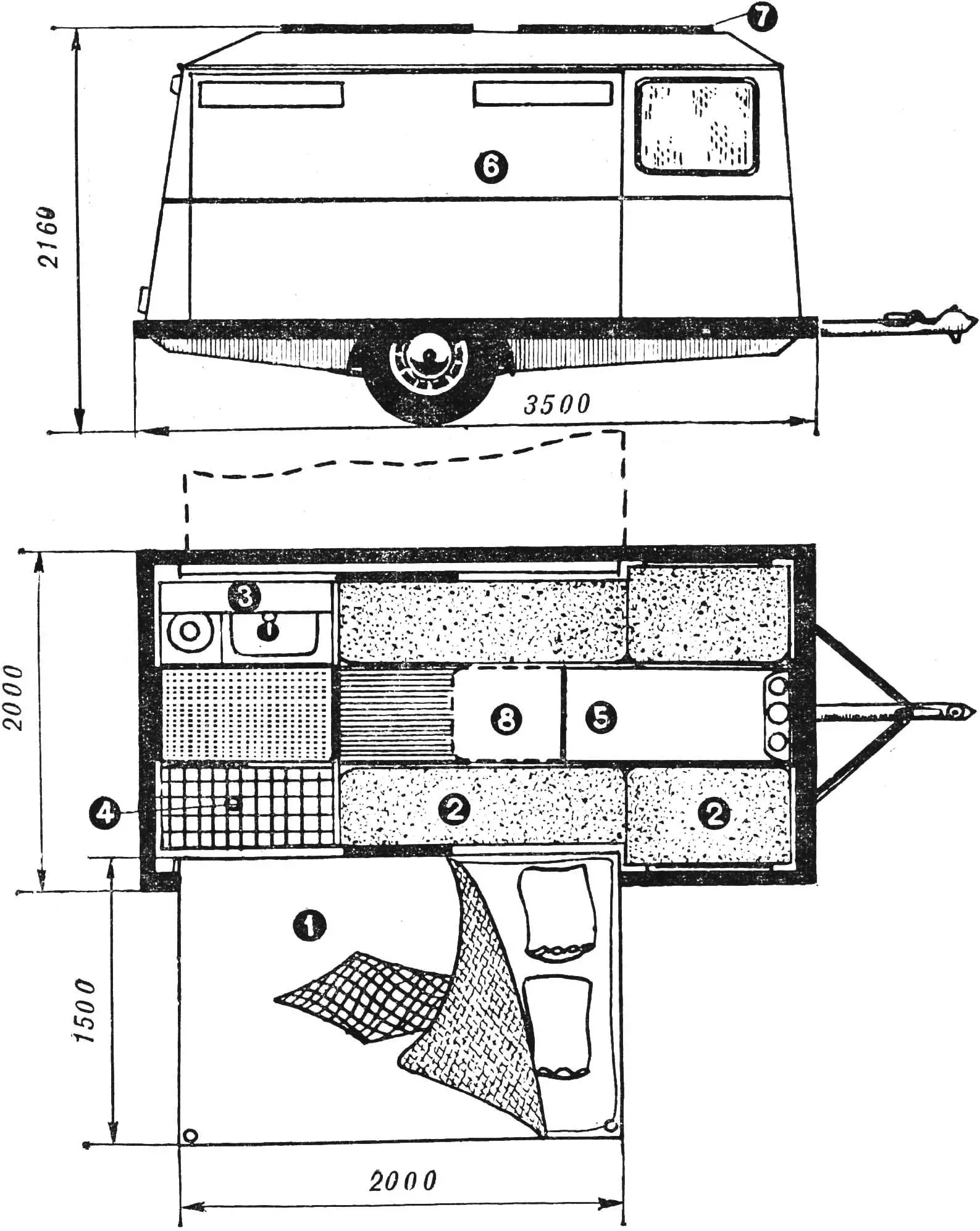
1 — sleeping places, 2 — soft sofas, 3 — kitchen, 4 — shower, 5 — table, 6 — folding wall-platform, 7 — roof windows, 8 — folding table.
I do not provide a description of the traction-coupling device and suspensions: this has been written about many times. In addition, the coupling is currently an industry standard, and there is no need to invent something yourself here.
The frame must be very rigid. To reduce the thickness of the folding walls, the mattresses should be made removable and stored under the seats of the sofas in the cabin. There remains quite enough space for storing tourist equipment, tools, etc. The tent arches should be made collapsible or foldable. Finally, it can be made so that the tent of the folding walls will unfold when the walls are folded down, as on children’s strollers, but in this case, the depth of the recess for the folding wall will have to be increased.
I think that everyone who is interested in my proposal will refine the details themselves without much difficulty.
The disadvantage of the trailer is that to bring it into a stationary position, a relatively level area is required (otherwise there will be distortions of the folding walls). But this disadvantage can be eliminated by installing telescopic or threaded supports under these walls or by using supports of different lengths, made on site from available materials.
Y. GALKIN
Recommend to read
 THE FIRST SWALLOW
Guided missile "air — air" RS-1-U. In the late 1940-ies the main Soviet fighter-interceptor was an aircraft cannon. They can be used effectively to strike aircraft at distances not... AND TAKE OFF YOUR SHOES AND PUMP UP
Remove the boots helps convenient device, which is a plate under the heel of the Shoe. To protect the heel from damage, sharp edges of the recesses should be rounded, sanded, and even...
