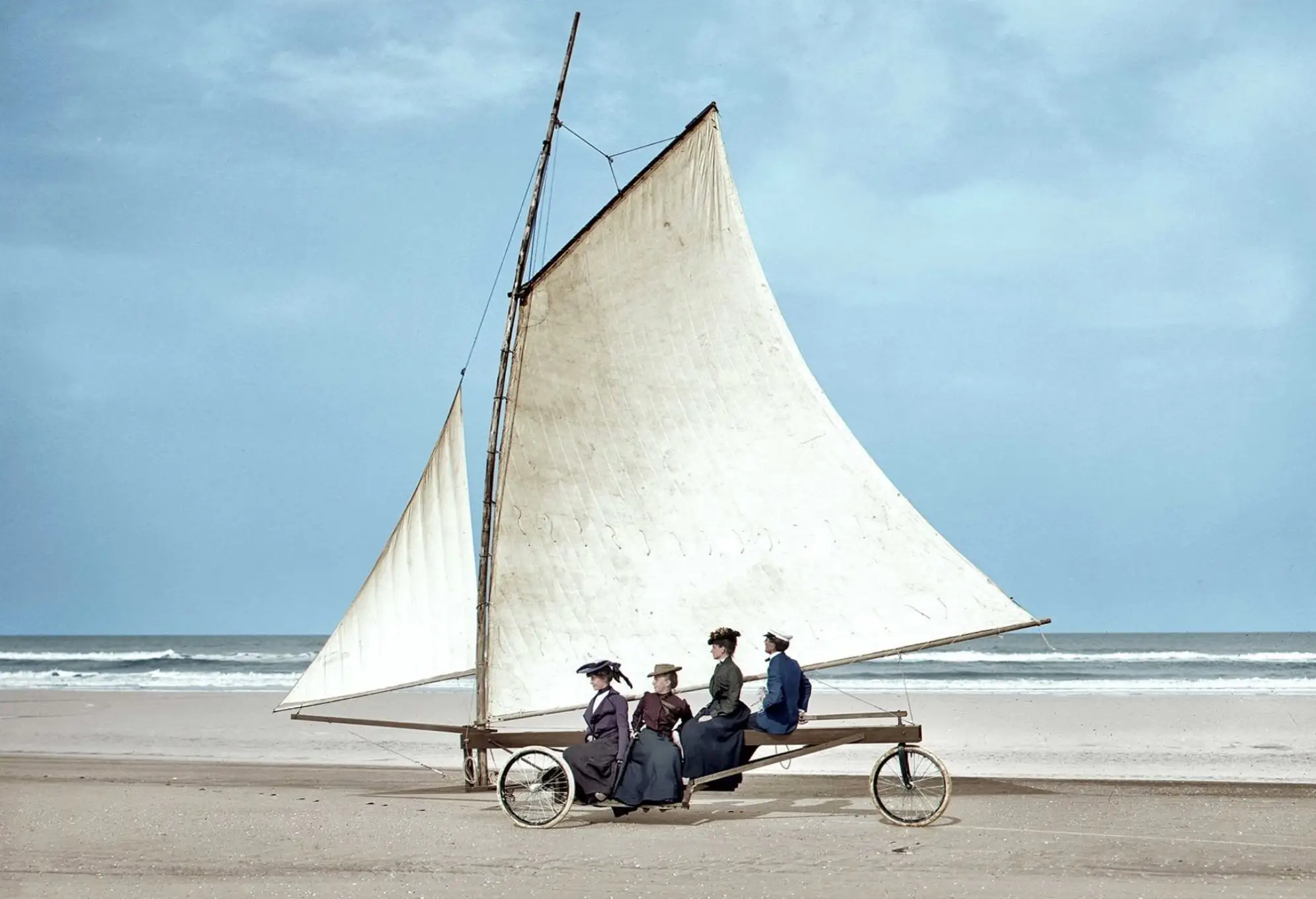
Historians claim that the sail appeared on land about four millennia ago! Fantasy? No — there is documentary evidence for it.
In 1953, an Italian archaeological expedition excavating the temple of Ptolemy near the town of Medinet Madi discovered the remains of an ancient land sailer. It was designed and built under the direction of the Egyptian pharaoh Amenemhet III (1849–1801 BC). It was a boat that first sailed on the Nile and was later mounted on four wooden wheels. Colored sails were stretched on two four-meter masts. An inscription on a polished basalt slab found in the desert read: “Pharaoh Amenemhet III traveled from here across the desert to Medinet in a sailing boat driven by the wind.”
In ancient Russian chronicles there is a description of the campaign of the Kievan prince Oleg and his retinue against Byzantium in 907. The Greeks closed the entrance to the harbor of Constantinople with a chain, blocking the path of the Russian ships. “And Oleg ordered his warriors to make and set the ships on wheels… and he went toward the city.” With a fair wind, the ships on wheels raced toward the city over land, striking the enemy with horror and confusion.
The flat sea coasts of Holland and the constant strong winds blowing from the sea led the Dutch mathematician Simon Stevin (1548–1620) to the idea of using a sail on land. Having secured financial support and the patronage of the Prince of Orange, Stevin in 1600 built land sailers nicknamed the “Hague wonder.” Despite opposition from the church, which considered the invention “the work of the devil,” Stevin managed to organize regular service along the Dutch coast between the towns of Scheveningen and Petten, 60 km apart. The carriages held up to 20 passengers and reached a speed of about 30 km/h.
In the days of the first railways, in coastal areas of Canada, cars equipped with masts and sails and steered by sailors ran on rails at speeds of up to 50 km/h.
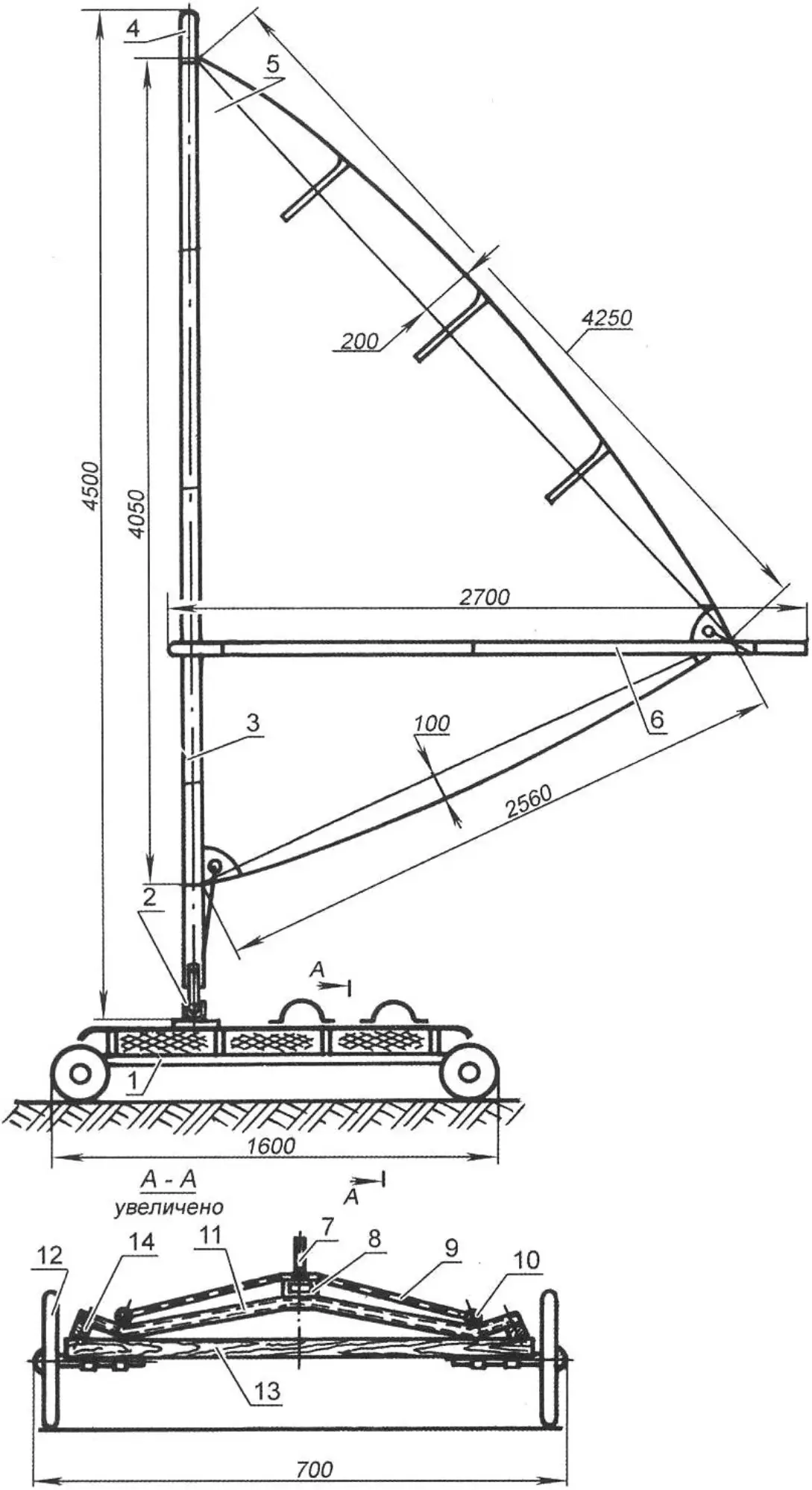
1 — cart frame; 2 — mast hinge; 3 — sectional mast (duralumin tube Ø40×1.5, 4 sections); 4 — truck (wood); 5 — sail; 6 — demountable boom; 7 — foot strap; 8 — base; 9 — metal mesh; 10 — mesh stop (tube Ø16×1); 11 — crosspiece (tube Ø20×1.5); 12 — wheel; 13 — cross beam; 14 — longitudinal beam
In our country, K. G. Paustovsky advocated sailing transport on land. “Do not take me for a dreamer,” he wrote, “but the winds of the desert must also be used for transport. I have not yet found the exact embodiment of this idea, but I picture sailing travel in the sands, where there is neither vegetation, nor settlements, nor mountains, and nothing can hinder movement.”
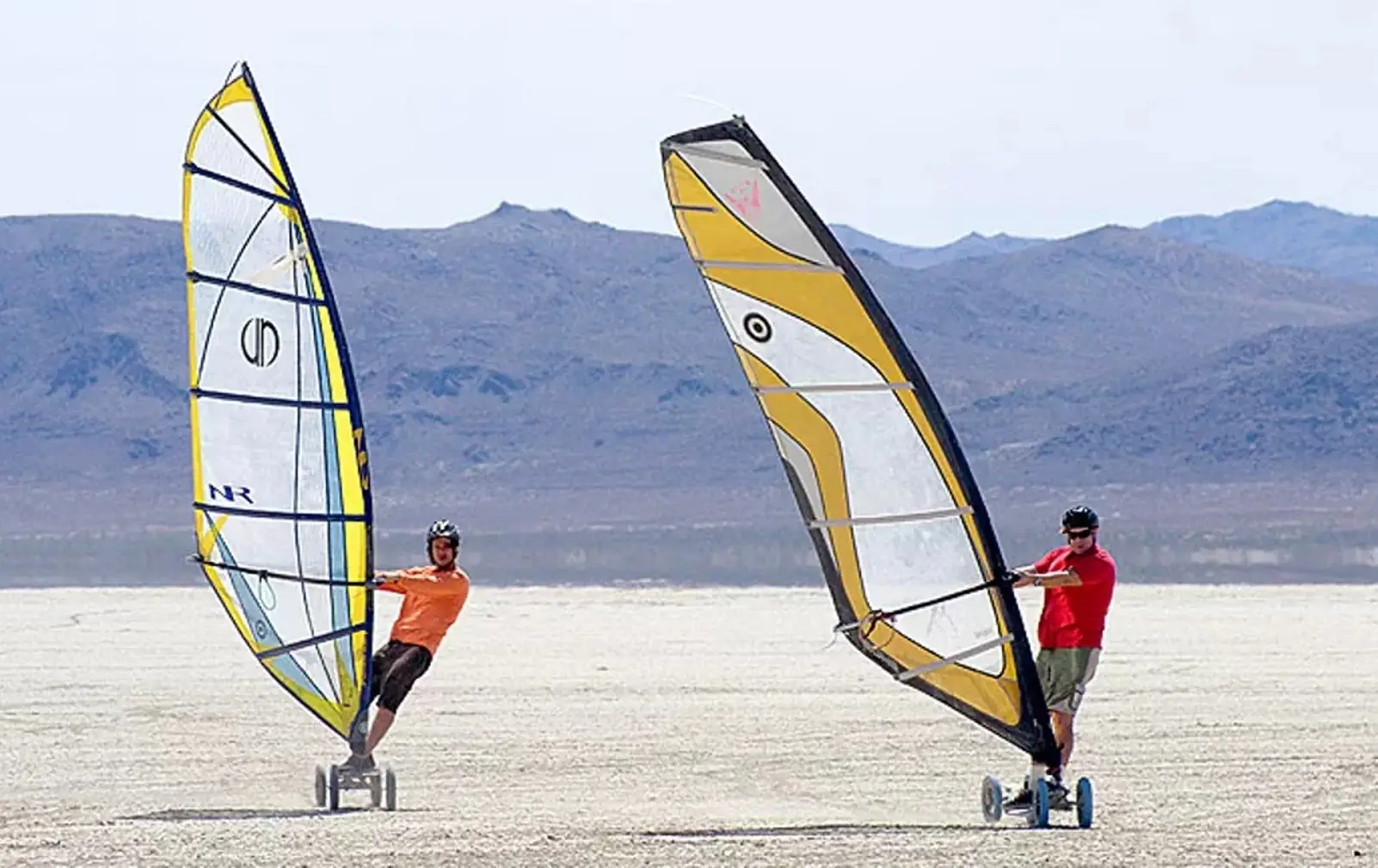
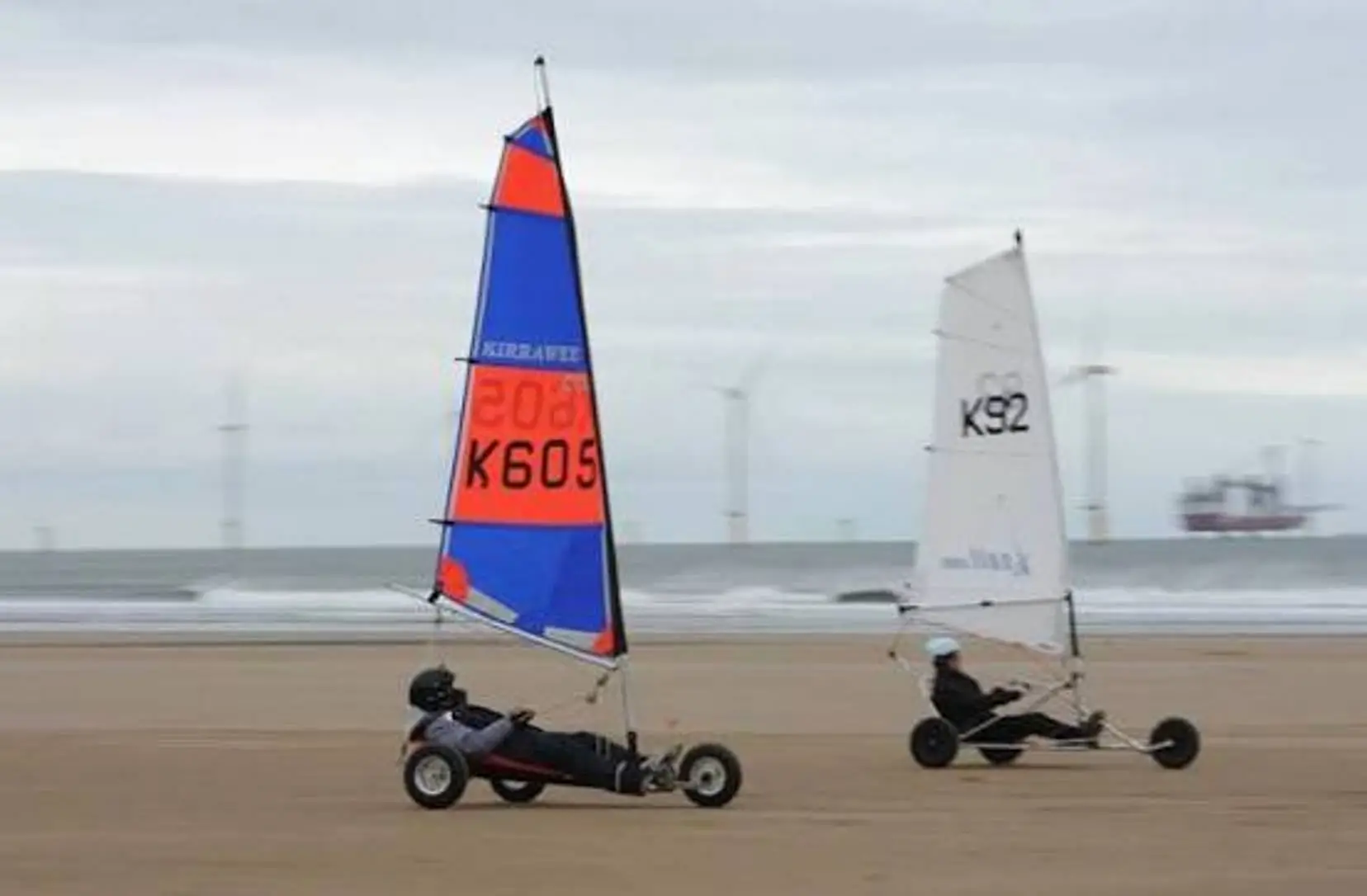
“Sand sailers,” or “beach yachts” — that is what the new sports craft were called: light single-seat wheeled yachts. Their plastic hull, shaped like a small boat, is fitted with three wheels from light aircraft or motorcycles. A tall triangular sail is controlled by a boom sheet. Stopping is done with a special lever that digs into the ground when braking.
Perhaps the land sail has a great future ahead, but today such designs are used mainly for sporting purposes only.
Recall that in 1960 the International Federation of Wheeled Yachts was founded. Since then, open European championships have been held regularly: for speed, time, slalom exercises, and acrobatic riding at speeds of up to 50 km/h. On wheeled yachts, speeds of up to 200 km/h are reached. Competition starts and training take place on sandy beaches, airfields, and even in deserts.
Another field of application for wheeled yachts is long, thousand-kilometer runs across steppe expanses and deserts. Moreover, sand yachts withstand enormous loads, significantly greater than those of their waterborne relatives. The first long-distance expedition organized by Jean de Boucher on wheeled yachts took place in 1967. The athletes covered 3,000 km across the sands of the Sahara — from Algeria to Mauritania.
In our country, multi-kilometer crossings on land yachts were often improved across the sands of the Aral Sea region, the Karakum, the Ustyurt Plateau, the northern Caspian region, and Kazakhstan.
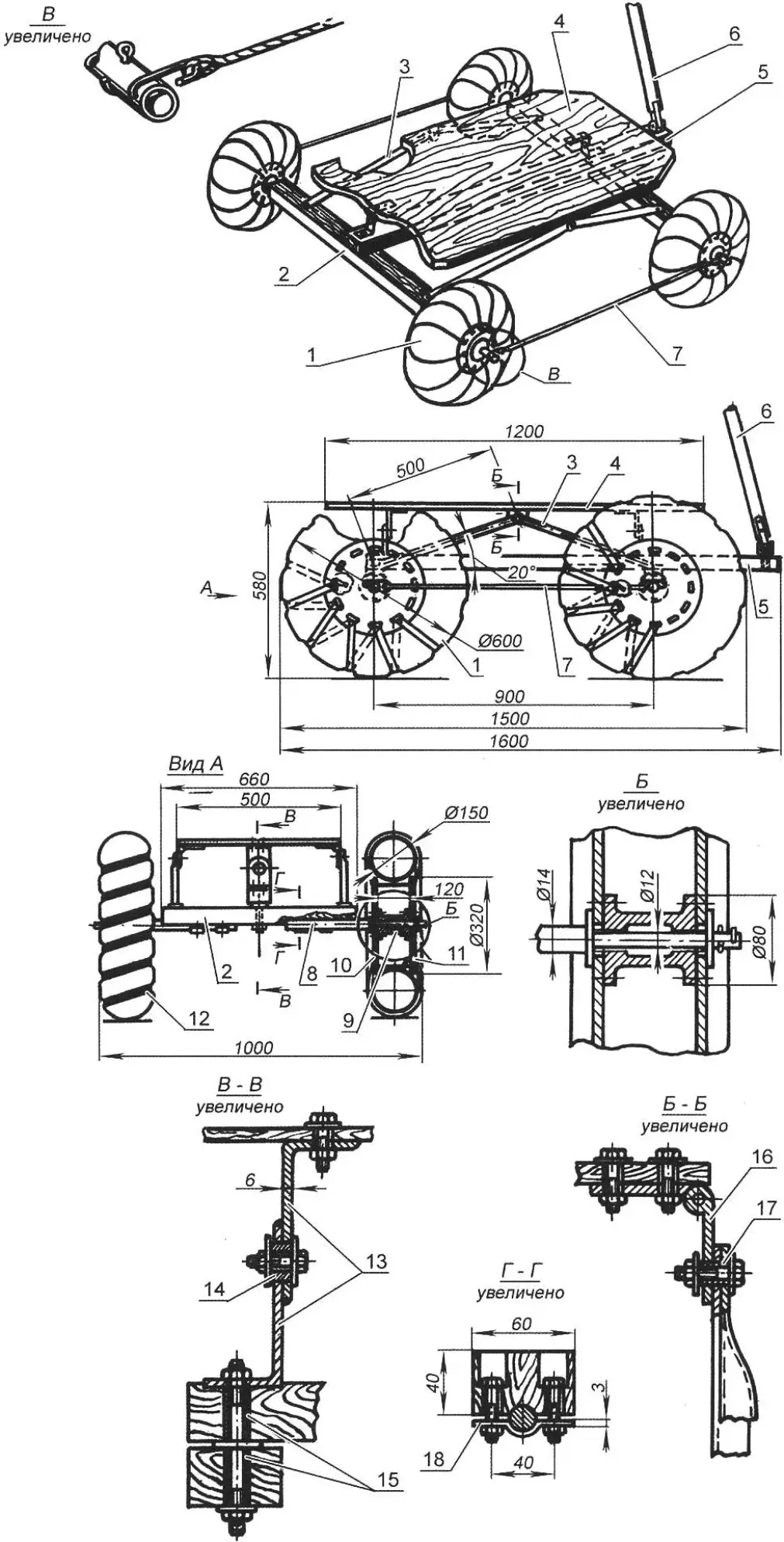
1 — wheel; 2 — steering beam; 3 — inclined link; 4 — platform; 5 — base; 6 — mast; 7 — rubber shock absorber; 8 — wheel axle; 9 — bronze (brass) bushing; 10 — inner wheel disc; 11 — outer wheel disc; 12 — nylon tape; 13 — angles 50×100; 14, 15, 17 — spacer bushings; 16 — piano hinge; 18 — clamp
Hardly had a new form of sailing sport — windsurfing — appeared and gained strength when enthusiasts put it on wheels. Eight years ago, the Frenchman Arnaud de Rosnay covered 1,300 km across the sands of the Sahara Desert in 12 sailing days on a cart under a windsurfer sail. World championships in land windsurfing are already held on dried salt lakes in Tunisia.
The new sporting craze — riding a wheeled cart under a sail on land — is not hard to master not only for those who can already ride a sailboard, but even for those who are only planning to take up windsurfing.
The simplest land windsurfer can be built at little cost. When making the windsurfer hull, wooden bars of 40×60 mm cross-section and 1,200 mm length are mounted along the sides. Two more cross bars of the same section, 600 mm long, are needed for mounting the wheel axles. For the running gear it is preferable to use inflatable wheels from a child’s bicycle or scooter; wheels from a baby carriage are also acceptable, but in that case the sailer’s ride will be stiffer. The rig of the sailing cart may be demountable or taken from an ordinary sailboard.
The design of the axles and the mounting of the wheels to the hull depend on the features of the wheels used. Doing both in each specific case presents no difficulty. When dismantled, the packed dimensions of the windsurfer do not exceed 1,500x300x200 mm, which, at a total mass of 14…16 kg, allows one person to carry it.
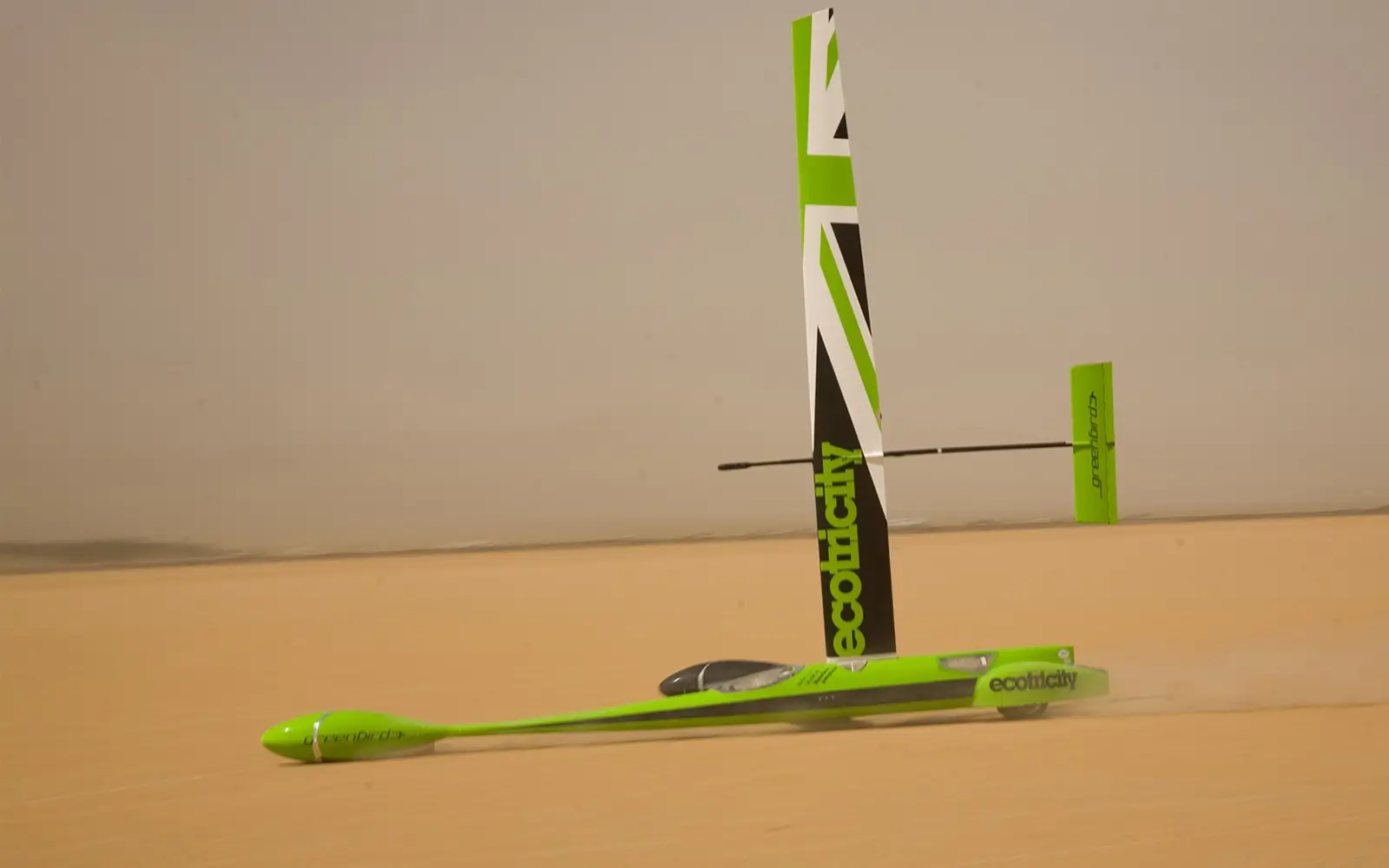
A wheeled windsurfer is good for riding on asphalt roads closed to traffic, sandy beaches with packed sand, and of course steppe and desert plains. Rubber tires provide enough grip on soil and asphalt to move the cart at a fairly sharp angle to the wind. Turns on such a simplified cart can be made only after stopping, by repositioning it in the desired direction. To brake, it is enough to ease the sail off into the wind and press a foot on the nearest rear wheel. This is convenient when the rear wheels protrude slightly above the platform. The front wheels may be the same size or larger.
When learning to ride a sailing cart and when traveling at high speeds, knee pads, elbow pads, and a motorcycle or hockey helmet will not be superfluous. Experienced surfers master land riding in about half an hour, and conversely, those who have learned to handle a sailing cart then quickly “tame” a sailboard.
For using a sailing cart on land in more difficult flat-country conditions, its design is meant to allow turns on the move and to go around various obstacles.
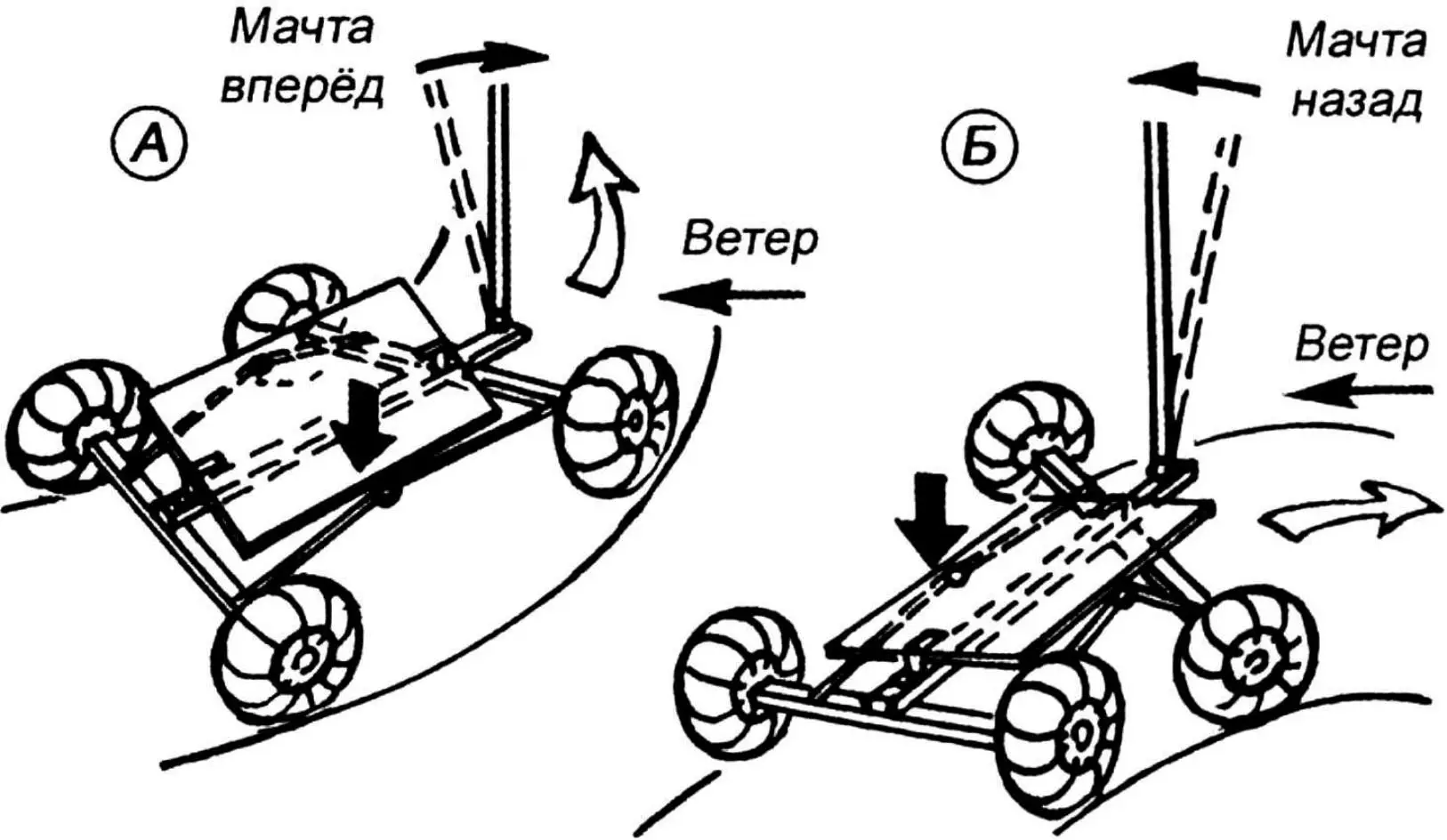
A — “bearing away” turn; B — “luffing” turn
For a windsurfer of increased cross-country ability and maneuverability, tubes from children’s scooter “inflatables,” karts, mopeds, and light cars may be used, mounted on drums made of 8–10 mm plywood. The wheel discs are fastened with M6 bolts to bronze or brass bushings that also serve as plain bearings. Thick grease is packed into the bushings when they are fitted on the axles. The axles are steel, hardened. The wheels are secured on the axles with washers and cotter pins. Nylon tape of 3×25 mm cross-section, or cord, that cinches the tubes is passed through holes in the discs so that the tube surface contacting the road deflects under the tape by 15–20 mm.
For inflating the tubes, holes 40 mm in diameter are provided in the outer discs: the valve stems are passed through them and connected to the pump hose. Air pressure in the tubes is kept within 0.3–0.4 kgf/cm2.
Such wheels are excellent shock absorbers that protect the cart from hard jolts. In addition, lightly inflated tubes provide good stability not only when riding straight, but also on turns and slopes.
Unprotected low-pressure tubes seem so vulnerable that one hesitates to use them on a land windsurfer–all-terrain vehicle meant for rough country, and at high speed at that. Yet operating experience confirms their reliability. All-terrain vehicles fitted with such wheels have made long journeys even in the Far North (“M-K” No. 5, 1984). Soft tires with a deep tread can also be selected for the wheels and fitted over the tubes.
A platform is mounted on hinges on the cart base and can tilt to either side of the cart’s longitudinal axis. At the ends of the base, steering beams with wheels are mounted on vertical axles. The mast hinge is fixed at the forward end of the base.
The cart platform is hinged on both sides by inclined links to the steering beams so that when the platform tilts, the wheels on one side of the cart spread apart and those on the other draw together. For example, when sailing close-hauled on starboard tack (Fig. A), the athlete presses a foot on the right edge of the platform and tilts the mast slightly forward, so the wheels on the right spread and those on the opposite side draw together — the wheeled windsurfer begins a turn to the left (“bearing away”). Pressing the opposite edge of the platform and tilting the mast slightly aft produces a turn to the right (“luffing”), (Fig. B).
To turn left when sailing on a run, the platform must be tilted to the right, and vice versa. In an emergency turn one need not maneuver the sail, but only press the edge of the platform opposite the turn. That is how turns and obstacle avoidance are made when riding a land windsurfer.
To brake on a run, it is enough to depower the sail by suddenly setting it into the wind (luffing); on close courses — ease the pull with the sheet hand and suddenly set the sail against the wind; the light cart has little inertia and stops almost at once.
To increase platform stability, rubber shock absorbers are attached to the ends of the wheel axles. Their stiffness is selected by experiment: the higher it is, the greater the force that must be applied to the platform edges to turn the cart.
All cart hinges — the connections of the inclined links to the platform and to the steering beams, and of the platform to the base — are made with M6 and M8 bolts fitted with spacer bushings that prevent these joints from being tightened “dead.”
The hinges connecting the base and the steering beams consist of an M8 stud, spacer bushings, and an intermediate washer; the latter prevents the beams from “biting” each other. All nuts are secured on the bolts with cotter pins. The inclined links are made from a duralumin tube 22×1 mm in diameter, flattened and drilled at the ends.
With a sufficient volume of the cart’s wheel tubes, a pivoting daggerboard and a lifting skeg can be fitted, turning the land windsurfer into an amphibian. With a favorable wind and a gentle shore it can run into the water and cross large bodies of water under sail in windsurfing mode.
The wheeled windsurfer has a low own weight, and its mast, which can tilt in all directions — a “free-sail system” — lets the athlete set the sail in the optimal position relative to the wind and obtain maximum drive, enabling the windsurfer in a fresh breeze to travel over rough country more successfully than wheeled yachts of traditional design.
“Modelist-Konstruktor” No. 7’2015, N. SHERSHAKOV
Recommend to read
 MAZ-525
Model MAZ-525, as well as any car-truck, fun to do with the current mechanism of tipping. This obliges to elaborate the details of all devices under the bottom and found when the body is... SHELF MODULE
Settlers, developing in our time a new apartment is not to be envied. To start, they have sometimes from scratch, as purchase anything today of furniture is almost impossible. The only...
