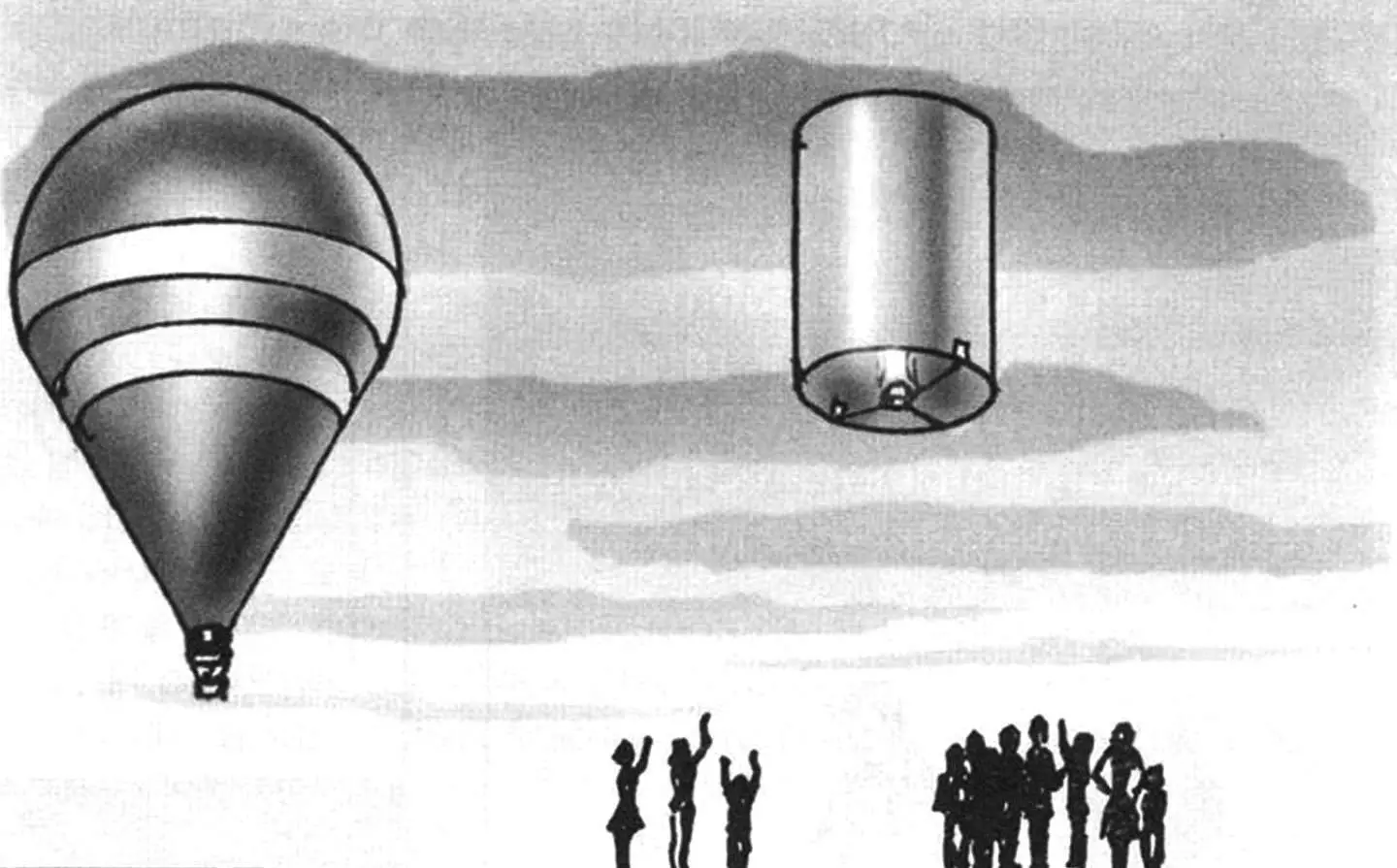
Many teenagers in summer camps and model aviation clubs enjoy making and launching thermal aerostats or, as they are also called, Montgolfier balloons filled with hot air.
Everyone who has dealt with this knows how much work and time it takes to build such an aircraft in a spherical shape.
We suggest gluing together a very simple balloon that has a cylindrical shape resembling an upside-down bucket (Fig. 1). Equipped with the simplest heater, this unusual Montgolfier quickly gains altitude and flies so high that it often disappears from sight entirely.
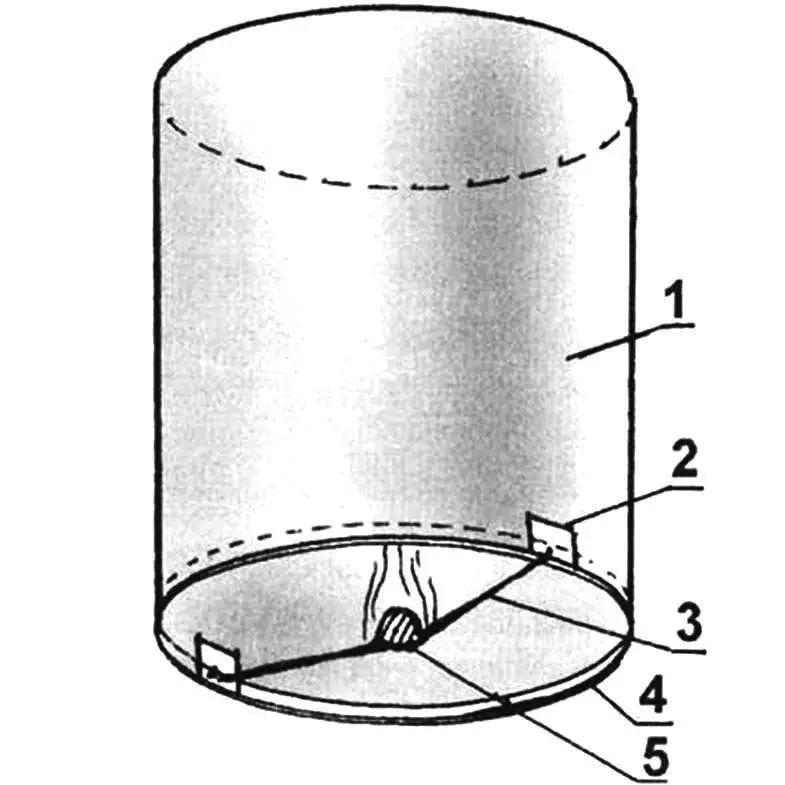
1 — tissue-paper envelope; 2 — drawing-paper patches; 3 — spoke (burner bracket made of steel wire); 4 — stiffening hoop made from a blind slat; 5 — burner (cotton wool wrapped with copper wire)
With tissue paper, 4 mm thick veneer strips, and a 2 mm diameter steel wire segment at hand, such a hot-air balloon can easily be made in half an hour.
Start by preparing glue. Pour half a glass of cold water into a tin can, mix in half a teaspoon of wheat flour, place it over heat, and warm it while stirring continuously until the paste thickens.
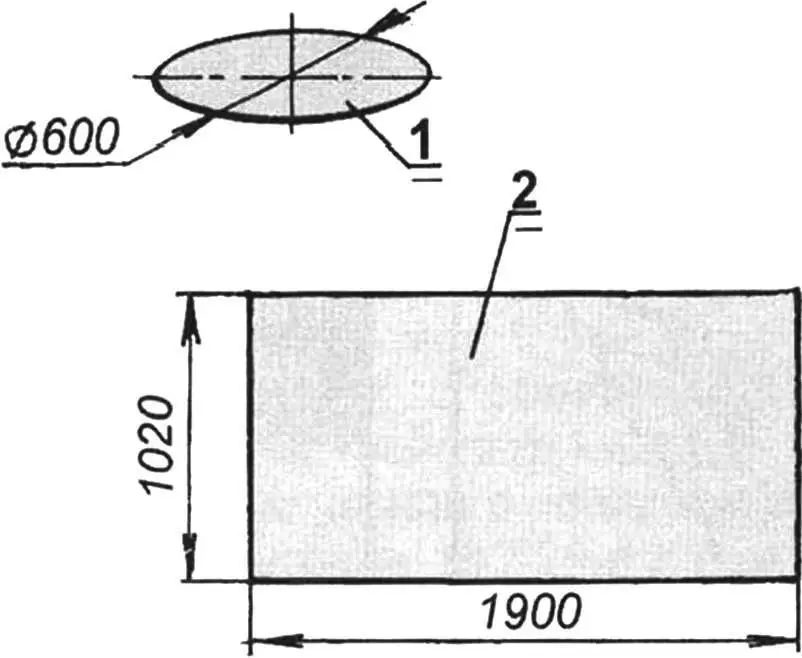
1 — top cover; 2 — cylinder layout
For the cylindrical part of the balloon, cut and glue a tissue-paper sheet (Fig. 2) 1020 mm wide and 1900 mm long. If you then glue the short sides of the sheet together, you will get a cylindrical Montgolfier envelope, and you can hang it up to dry.
The round top cover of the balloon is cut from the same paper (Fig. 2). Its diameter is about 605 mm. To properly glue the cylindrical part of the balloon to the cover, it is recommended to use the auxiliary jig 3 (Fig. 4). Its horizontal part is made from a piece of plywood and cardboard, while the stand is made from a 120 mm wooden strip, which for convenience is attached to a chair or clamped in a bench vise.
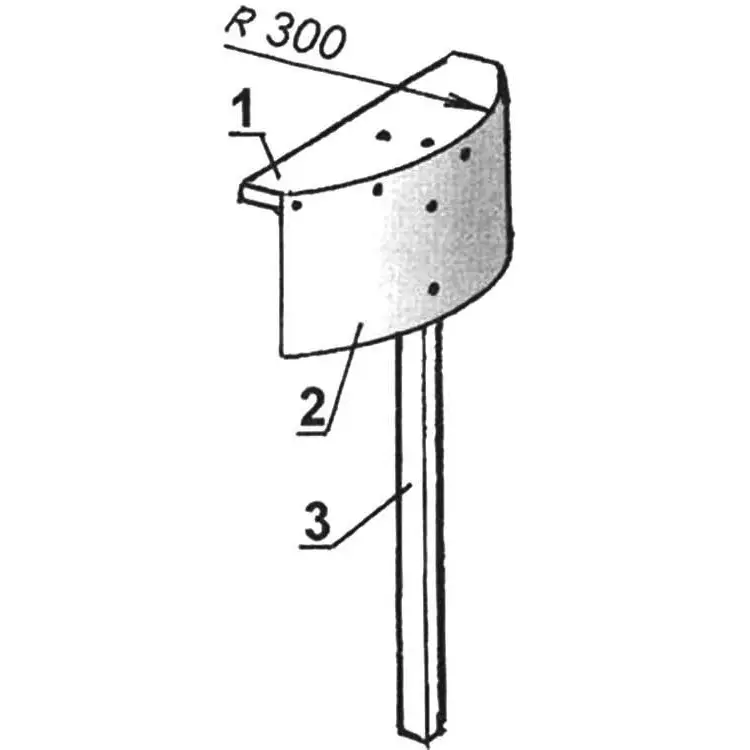
1 — template (made of plywood or board); 2 — cardboard side panel; 3 — stand
The edge of the cover is coated with glue, and the paper from the cylindrical section is laid over it (Fig. 4). Then, to give the structure stiffness, glue a light hoop made from a 10-15 mm wide veneer strip along the inner lower edge of the cylinder. The hoop diameter should also be 600 mm.
On the outside of the cylinder at hoop level (Fig. 1), in two diametrically opposite places, glue two 50×50 mm squares of drawing paper and pierce holes in them for the burner holder – a 2 mm diameter steel wire spoke. The burner used to heat the air inside the balloon is a 50-60 mm cotton pad soaked in kerosene or alcohol, attached in the middle with thin 0.3 mm copper wire. If the cotton is not secured, it may come off the spoke, fall down, and cause a fire.
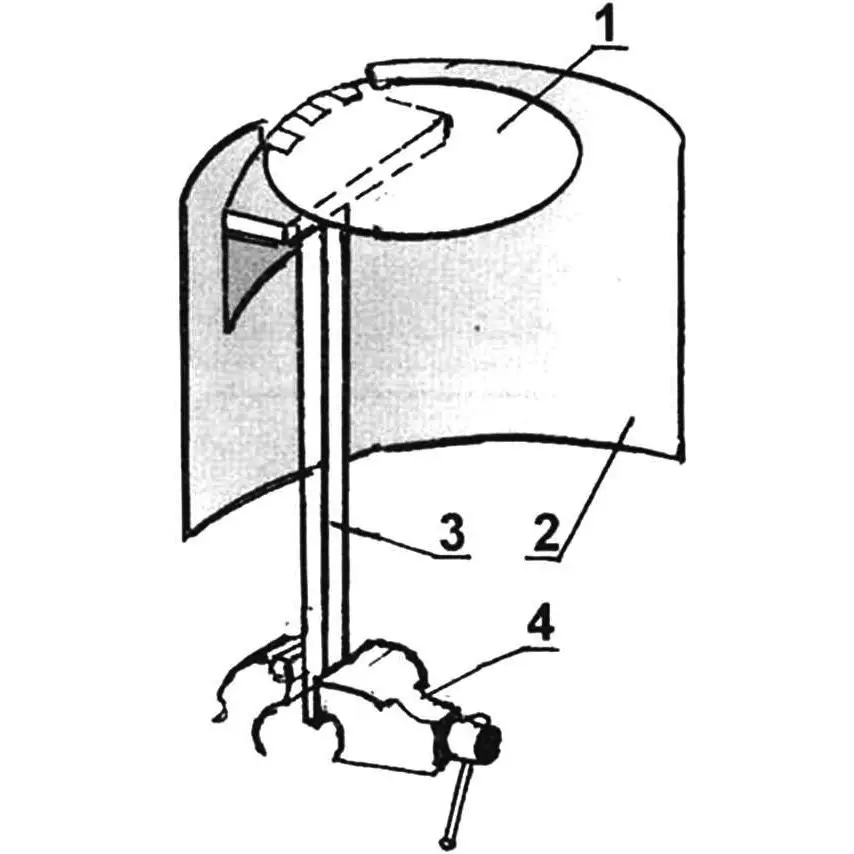
1 — cover; 2 — cylinder blank; 3 — stand; 4 — vise
The balloon may be launched only in calm, windless weather, far from forests, power lines, and residential buildings.
Such a Montgolfier is launched by two people. One holds it by the upper part with outstretched arms, while the second carefully soaks the cotton with kerosene and ignites it. At the same time, make sure kerosene does not get on clothing or on the cylinder envelope.
After a few seconds, the air in the balloon will heat up, it will become lighter than the surrounding air, and it will rise smoothly upward, leaving a dark smoke trail behind.
As long as the kerosene burns, the balloon will keep climbing. Only after the flame goes out and the air inside the envelope cools down will the Montgolfier begin to descend slowly. For this very reason, it is considered safe from a fire-hazard standpoint.
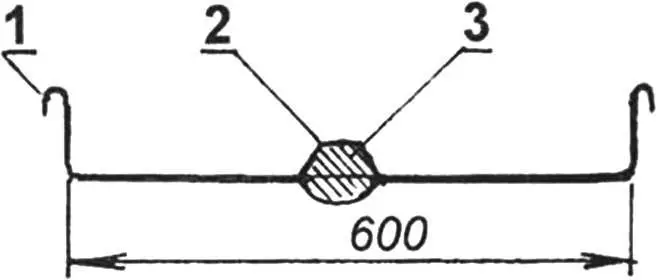
1 — steel wire bracket; 2 — cotton wool soaked with kerosene or alcohol; 3 — copper-wire winding
Such balloons are often used in some countries during major holidays, and to entertain the public they are sometimes given whimsical shapes, even in the form of human figures.
A heated balloon launched to great altitude during flight often causes random spectators, due to its unusual appearance, to make the most incredible guesses and assumptions: what strange object is silently floating in the sky? Could it be a UFO?
“Modelist-Konstruktor” No. 6’2011, B. SERGEYEV
Recommend to read
 ELECTRIC CAR BATTERIES
You can make a simple model of the electric vehicle that will run on batteries. This will require: microelectrochemical PD-12A, flat battery, 4.5 V, two coils of No. 10 without thread,... Perpetual wind fan
Many rural outbuildings need ventilation. Without it, houses and sheds become damp, cellars and basements get wet, and using an outdoor privy without a fan is, to put it mildly,...
