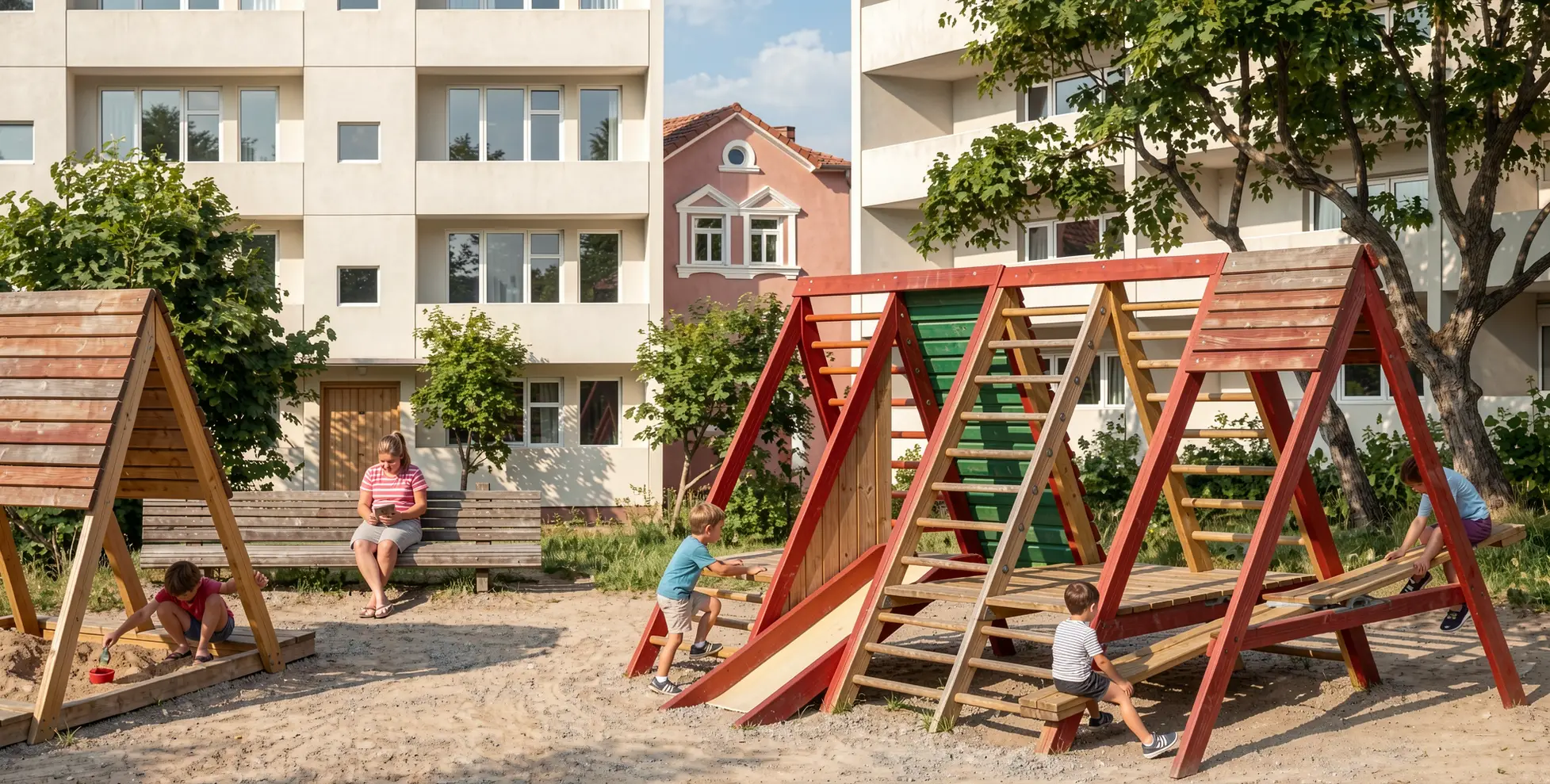
How can you equip a children’s playground in the yard? You can simply install a sandbox, a slide, or carve figures of fairy-tale and cartoon characters from logs. But that is not the best solution.
We offer craftsmen another option: to turn it into a play and physical-activity area with their own hands. Building such a children’s mini-town requires neither scarce materials nor special equipment.
Several simple standard board elements, in different combinations, create a “family” of play structures that, depending on the yard layout, can be used either as separate installations or combined into full complexes.
This is a familiar and typical picture for most residential courtyard areas: instead of equipped children’s playgrounds, there is a traditional sandbox with an equally traditional “mushroom” canopy, and at best two or three tubular climbing “spiders.” That is why children look for other places to play: entry halls, covered kindergarten areas, and shaded gazebos.
True, in some courtyards and parks you can see so-called “fairy-tale towns”: huts on chicken legs, fantastic wooden figures. But in these landscaping elements, despite their visual appeal, the main thing is usually missing – functionality.
Very rarely do we find playgrounds where the architecture of small forms is not only decoration but life itself, and its name is PLAY. However, the large amount of design and construction work required for such facilities, along with their high cost, is the main factor slowing the development of integrated courtyard solutions.
Still, there is a way out: residents themselves, with assistance from housing maintenance services, can build interesting play structures for children from available materials.
Architect N. Pomytkin explains how to do this.
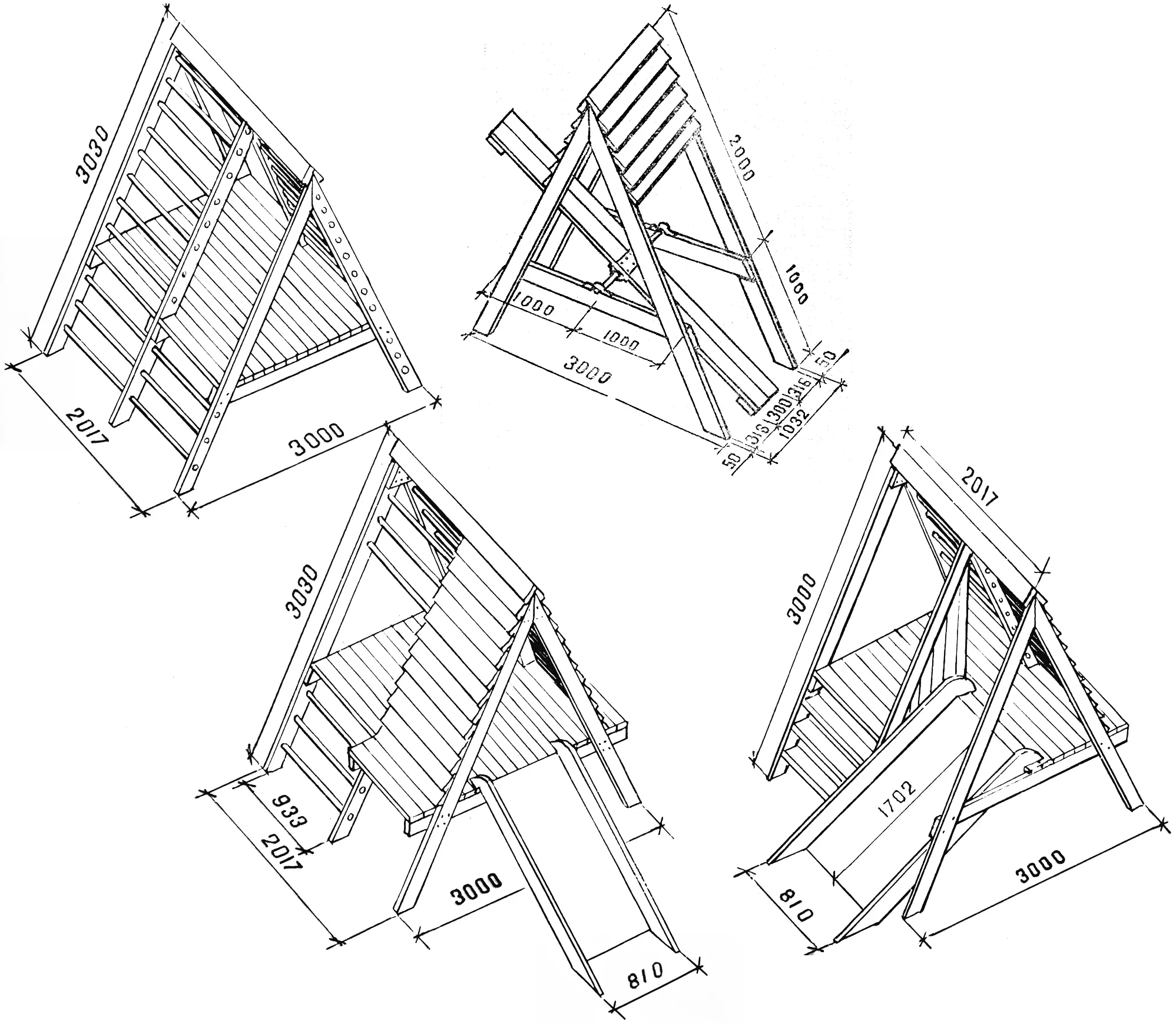
The proposed structures are assembled from standard elements which, in different combinations, create multifunctional play objects designed in a unified architectural style.
The main building material is boards with sections of 50×150 mm and 30×150 mm. The thicker boards are used for the primary load-bearing parts, while the thinner ones serve as additional ties and decorative finishing.
The main structural elements here are vertical triangular frames consisting of two inclined posts tied at the lower part by joists. All joints are made with M10 bolts. The finished frames are set parallel to each other and temporarily fixed in this position. Then the deck is mounted over the joists. In places where a ladder is planned, the joists are shortened to the outer side of the inclined posts. Transverse rigidity is provided by wall bars or roof boards.
Roof construction should start from the bottom, since each upper board partially overlaps the previous one, ensuring water runoff. The covering is completed with two ridge boards.
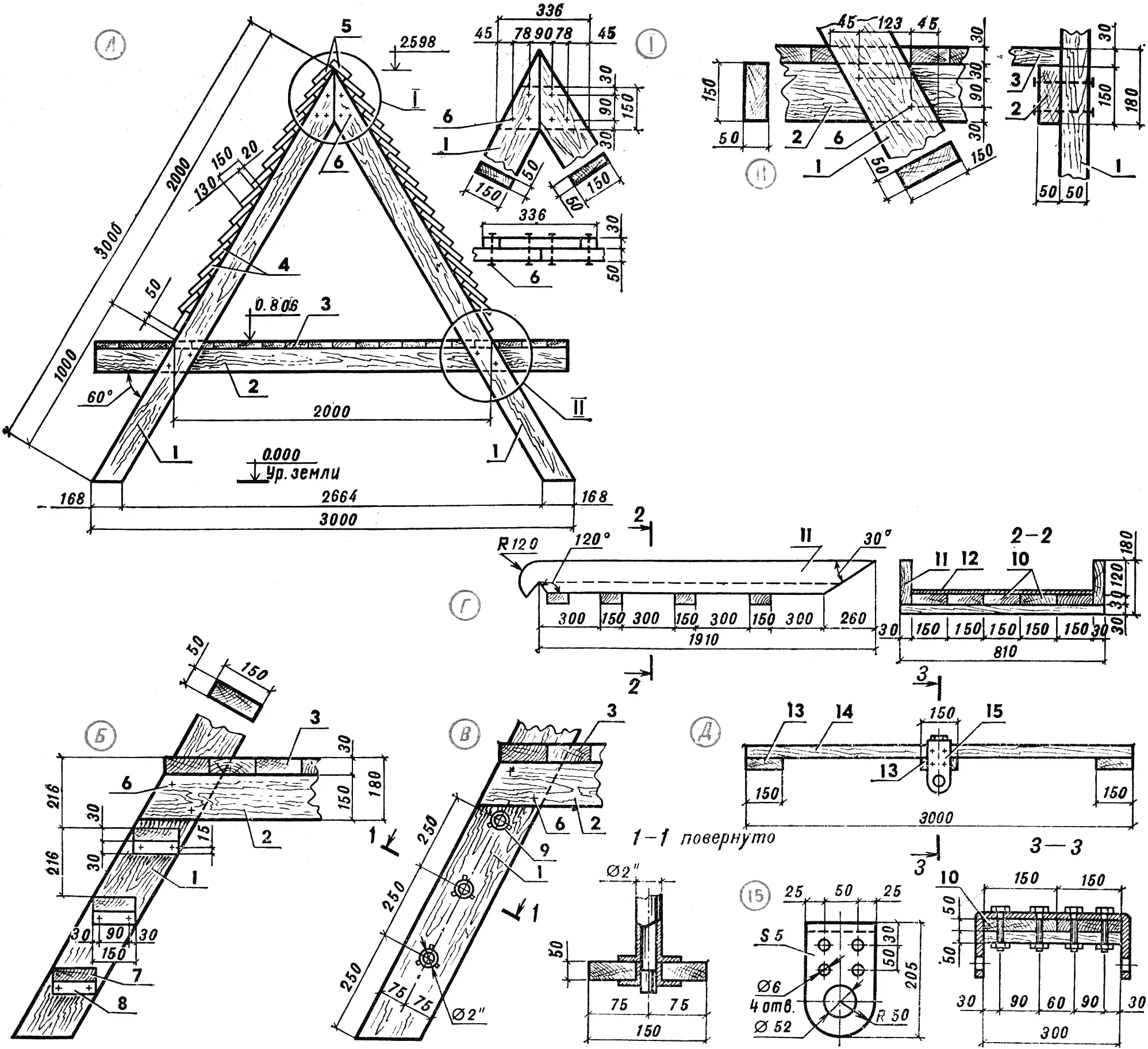
1 – inclined posts, 2 – joists, 3 – deck boards, 4 – roof boards, 5 – ridge boards, 6 – M10 bolts, 7 – steps, 8 – support strip, 9 – steel two-inch pipe, 10 – slide slope boards, 11 – guard boards, 12 – sheet covering, 13 – tension strip, 14 – seesaw board, 15 – U-shaped fastening strip; A – side view of the playhouse, B – ladder, C – wall bars, D – slide, E – seesaw.
The wall-bar rungs are made from steel two-inch pipes, inserted into the inclined post boards without additional flanges or fasteners. For this purpose, six 150 mm-deep cuts are made along the pipe axis, splitting the end into six petals. Before installing the pipe into the hole, three petals arranged at 120 degrees are bent outward, while the other three are passed through the hole and bent from the outside. For reliable fixation, a wooden plug is driven into the pipe.
The slide slope is assembled from 30×150 mm boards nailed into a panel. Side guard boards are attached to provide longitudinal rigidity. For better sliding, it is advisable to cover the slide plane with linoleum or another sheet material.
Seesaws are made from two 50×150 mm boards connected by strips. A U-shaped strip is fixed in the middle part. An axle – a steel pipe fixed on the joists – passes through its holes.
This set of parts is enough to build various small architectural forms for children’s playgrounds. Here are some of them.
Wall-bar complex is assembled from three vertical frames with shortened joists and a deck. Below the deck, inclined posts are connected by rungs in all three frames, while above only paired frames are connected. Unconnected posts form the entrance to the platform.
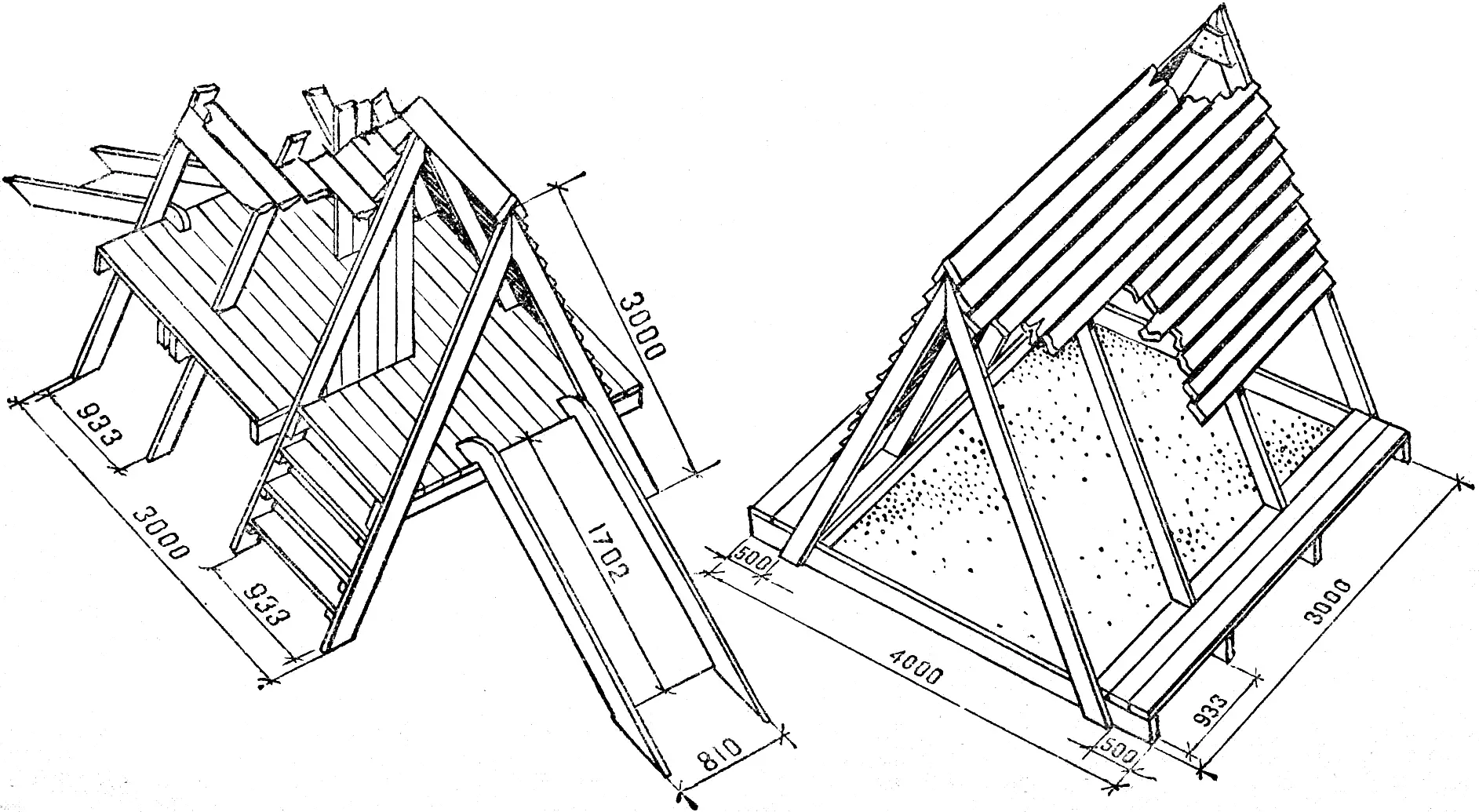
Playhouse with slide and wall bars is assembled from three frames, two of which are covered with boards, while the remaining one is connected to the middle frame by ridge boards and short wall-bar rungs. A slide slope is installed on the playhouse side.
Single-sided slide with canopy and wall bars consists of three framed sections with a deck into which the slide slope is built. A ladder is placed nearby. The opposite wall is boarded and equipped with wall bars.
Slide labyrinth is a four-frame structure, centrally symmetrical in plan. It is equipped with two slides, a roof, and ladders. Internal partitions form a kind of labyrinth.
Seesaw is the smallest play element, consisting of two frames, a small roof, and a balancing beam with an axle.
Sandbox with canopy differs somewhat from the other designs in frame construction. These frames have no joists or deck. Instead, the outer frames are tied longitudinally with four-meter boards serving as fencing, and transversely with benches installed on special supports.
All proposed structures, except the sandbox, can be combined into one play complex or grouped play elements. In this case, it is also advisable to do some ground work: lay paths or create artificial hills using available materials (sand or gravel).
Finished structures should be coated with waterproof varnish or, preferably, enamel paints in a spectral color range. At the same time, large surfaces are better painted in yellow-red colors so they stand out against soil, greenery, and surrounding buildings, while post-and-beam elements should be painted in blue-green shades. In addition, supergraphics can be used in the overall design, that is, artificial segmentation of surfaces using color.
«M-K» 5’88, N. POMYTKIN, architect
Recommend to read
 ELECTRONIC METRONOME
It is used in teaching music in rhythmic gymnastics, in experiments in physics etc. a Metronome, a scheme which offers Bulgarian journal "Radio Television Electronics" (see Fig.), gives... NAILED SKIRTING
After nastilki a floor you have to beat a plinth, mount which in such remote bridges, such as, for example, a radiator always causes trouble. Rescue a simple device consisting of a metal...
