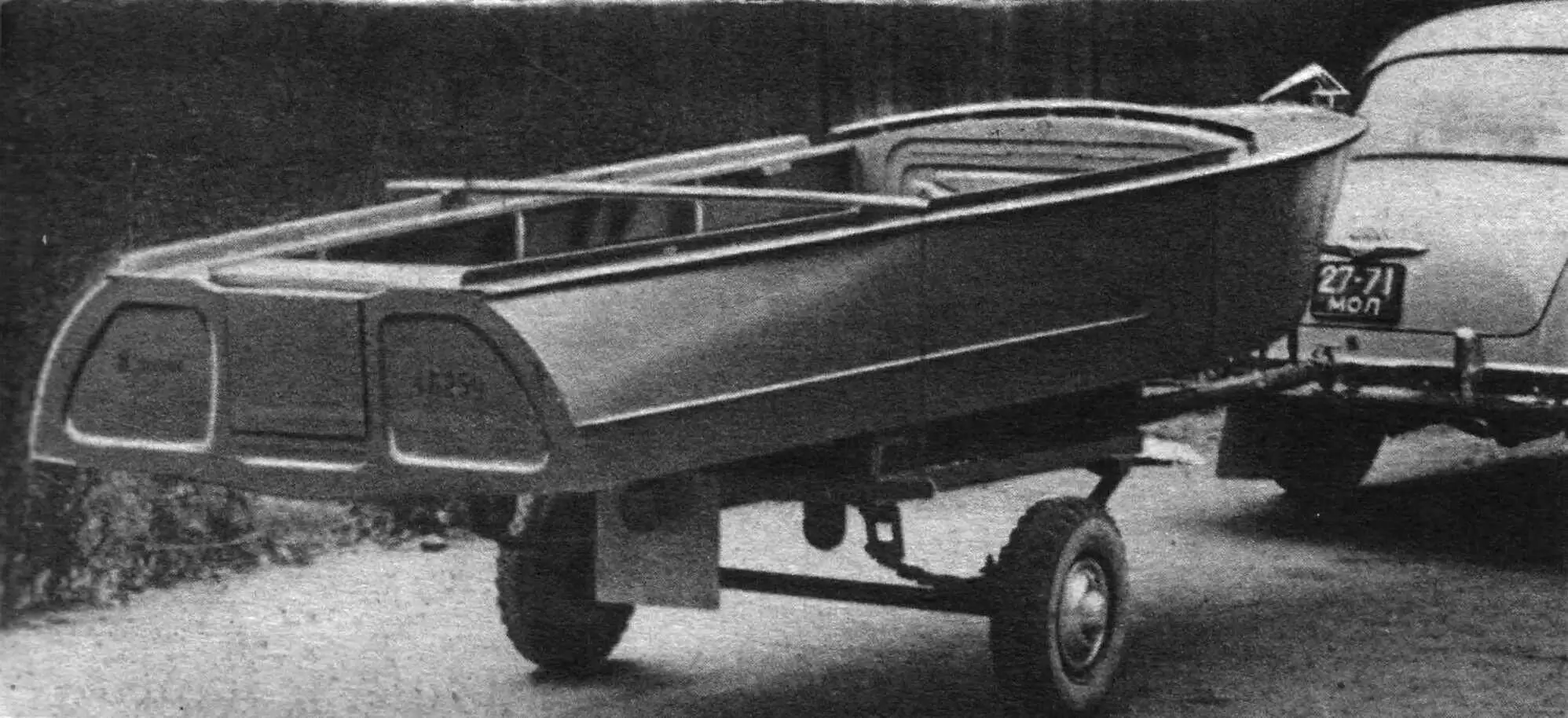
Quite recently, trailers for passenger cars appeared on the roads of our country. This new vehicle very quickly gained the widest popularity, and during vacation periods on highways one could observe lines of cars with trailers in tow. What designs are there? Trailer-dachas, “folding beds”, motor boats and yachts on trailers, self-propelled trailers — ground and floating — too many to list!
The demand for trailers for passenger cars is very high. There is nothing surprising in this: having a trailer, you can free the car’s interior from everything unnecessary on the road, but absolutely necessary at the campsite. In addition, it allows you to transport oversized cargo, thus expanding the possibilities of economic use of the car.
Now, on the eve of the mass motorization of our country, the issue of trailers is becoming especially acute. Even if we take only one indicator — the increase in carrying capacity achieved through the use of a trailer, on average by 50—60% (which is quite realistic), we get hundreds of thousands of tons transported with the same consumption of engine resources and fuel and lubricants. In the country’s budget, this is equivalent to thousands of freed railway cars and a huge amount of savings due to reduced labor intensity of transportation.
But where did the trailers we see on the roads come from? For the most part, they are created in a makeshift way or in small series at enterprises of related profile. An enormous amount of time and labor is spent completely unproductively on their construction, since there are no proven standard projects, and amateurs copy imported trailers by sight or borrow individual successful samples from each other. As a result, ugly, heavy, inconvenient and unsafe structures are obtained everywhere.
Going to meet amateurs, the USSR State Traffic Inspectorate developed new “Technical Requirements” for the construction of homemade trailers, and now they have come into force throughout the USSR. The “Technical Requirements” are mandatory both for the State Traffic Inspectorate bodies that carry out registration and technical inspection of homemade trailers, and for the owners of these trailers. We publish the text of the new “Technical Requirements” in full — for the correct orientation of our readers on this issue.
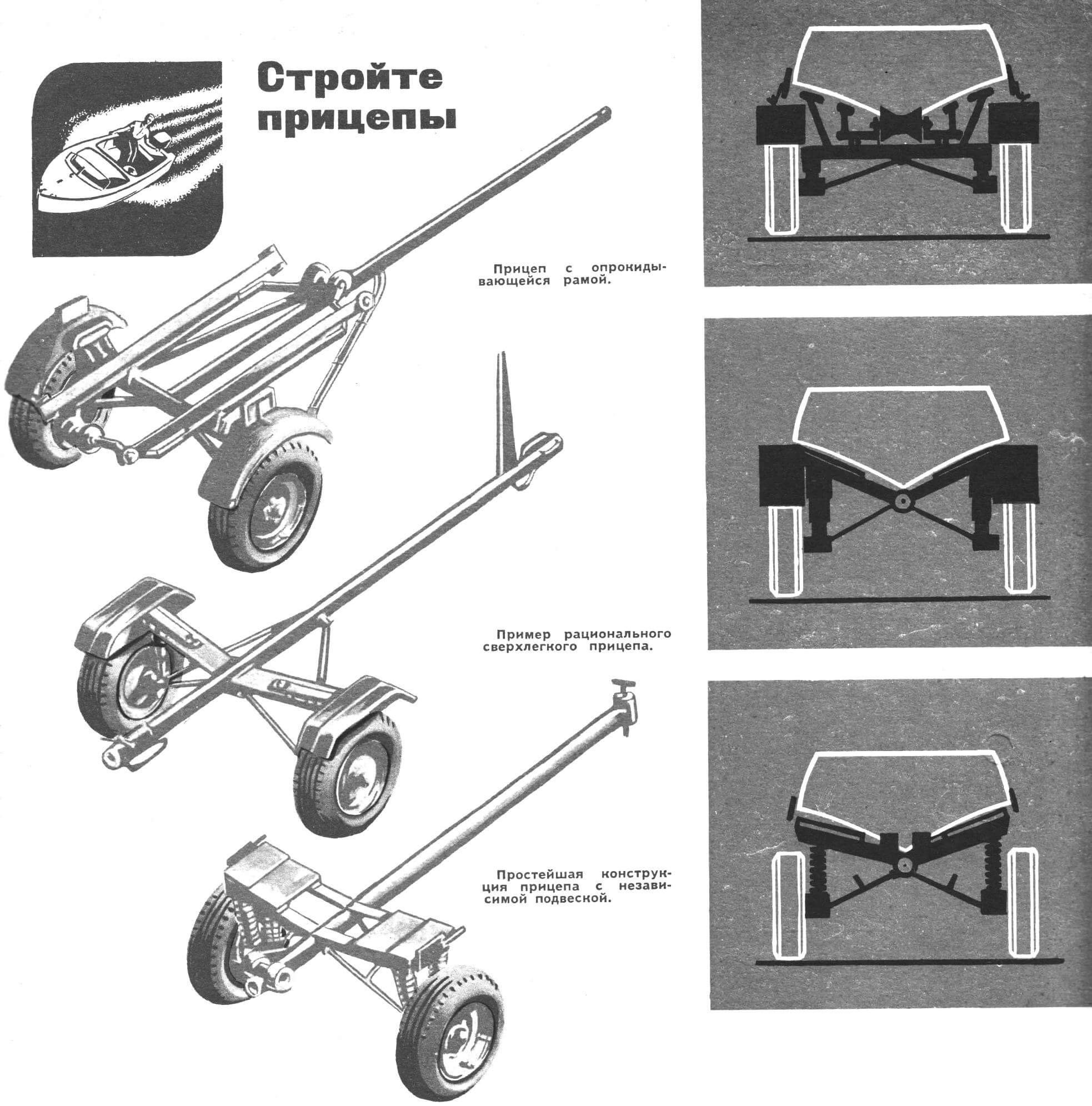
TECHNICAL REQUIREMENTS FOR TRAILERS FOR PASSENGER CARS
These technical requirements apply to trailers intended for towing by passenger cars on public roads.
1. Trailers must comply with these technical requirements, and industrially manufactured trailers, in addition, with approved drawings and technical specifications.
2. When manufacturing trailers, it is allowed to use units, assemblies, mechanisms, parts and tires of passenger cars and motorized wheelchairs.
Units and assemblies of trailers for which there are state standards or industry standards must be made in accordance with the standard sizes, design and technical requirements provided for by these standards or norms.
3. Trailers must be manufactured only as single-axle.
4. The maximum gross weight of the trailer (with load) must not exceed 60% of the curb weight of the towing vehicle. 5. The maximum gross weight of a trailer (with load) that does not have brakes must not exceed 30% of the curb weight of the towing vehicle.
6. Trailers with a gross weight of more than 750 kg must be equipped with service and parking brakes.
7. The parking brake must hold the trailer (with load) in a braked state on a dry road with a hard surface on a slope of at least 20%.
The force on the parking brake drive handle must not exceed 30 kg.
8. Trailers that do not have parking brakes must be equipped with two anti-roll stops (“shoes”) for placing under the wheels when parked without the towing vehicle. 9. The braking distance of a road train, which includes a trailer equipped with brakes, must not exceed the braking distance of a single towing vehicle by more than 10%.
10. To ensure traffic safety, it is mandatory to install a safety (emergency) cable or chain between the vehicle’s coupling device and the trailer’s drawbar; in case of emergency separation from the towing vehicle, the trailer’s drawbar must not touch the road surface.
11. The overall dimensions of trailers must be:
a) length — up to 1.5 times the length of the towing vehicle, but not more than 8 m.
b) height — up to 1.5 times the track width of the trailer, but not more than 2.5 m.
c) width may exceed the width of the towing vehicle by no more than 200 mm on each side, but must not be more than 2.5 m.
12. The track of trailers must be at least the track of the main towing vehicle.
13. The ground clearance of trailers must be at least that of the main towing vehicle.
14. A trailer as part of a road train with a towing vehicle when moving in a straight line must not “sway” in each direction by more than 3% of its overall width.
15. The trailer must have a towing coupling device in accordance with industry standard ON 025 320-68. “Towing coupling device of ball type. Coupling ball. Dimensions”.
16. The design of fastening the ball of the towing coupling device to the vehicle must be carried out through the power elements of the frame or body and ensure reliable operation when operating the road train.
17. The vertical (static) pressure from the trailer’s towing coupling device with load, transmitted to the coupling ball, must be within 25—50 kg, depending on the ratio of the towing vehicle’s weight and the trailer’s gross weight.
18. Trailers must be equipped with external lighting devices according to GOST 8769-69 and a plug according to GOST 9200-59.
If the overall width of the trailer exceeds the width of the towing vehicle, the location of the front reflectors must determine the trailer’s overall width by its width.
On trailers for transporting boats and similar products, it is allowed to mount external rear lighting devices on an extension bracket.
19. Trailers must have support stands that ensure the stability of the trailer in an uncoupled state.
20. Support stands of trailers in transport position must not impair the road train’s cross-country ability.
21. Trailers must have brackets (or place) for mounting the license plate according to GOST 3207-65.
22. Trailers intended for transporting boats and other cargo must be equipped with devices for their fastening.
23. On all external surfaces of the trailer there must be no sharp edges and corners, and on the side surfaces — protruding parts that may cause injury.
24. The external shape of the trailer, as well as design details, must meet modern aesthetic requirements.
25. The painting of trailers must be even, without cracks, delamination, bubbles and drips.
26. When operating a trailer whose overall height exceeds the height of the lower edge of the vehicle’s rear window, the latter must be equipped with two extension rearview mirrors.
Note:
In accordance with the rules for registration and accounting of motor vehicle rolling stock, trailers for passenger cars are subject to registration with the State Traffic Inspectorate.
BOAT ON LAND
Our magazine has already published detailed materials about homemade trailers for cars (see No. 8, 1969). Over the relatively short period that has passed since then, much has changed in this field of design. And first of all, new technical requirements have been approved. Here we give a description and drawings of a simple to manufacture, but very reliable in operation trailer for towing a boat.
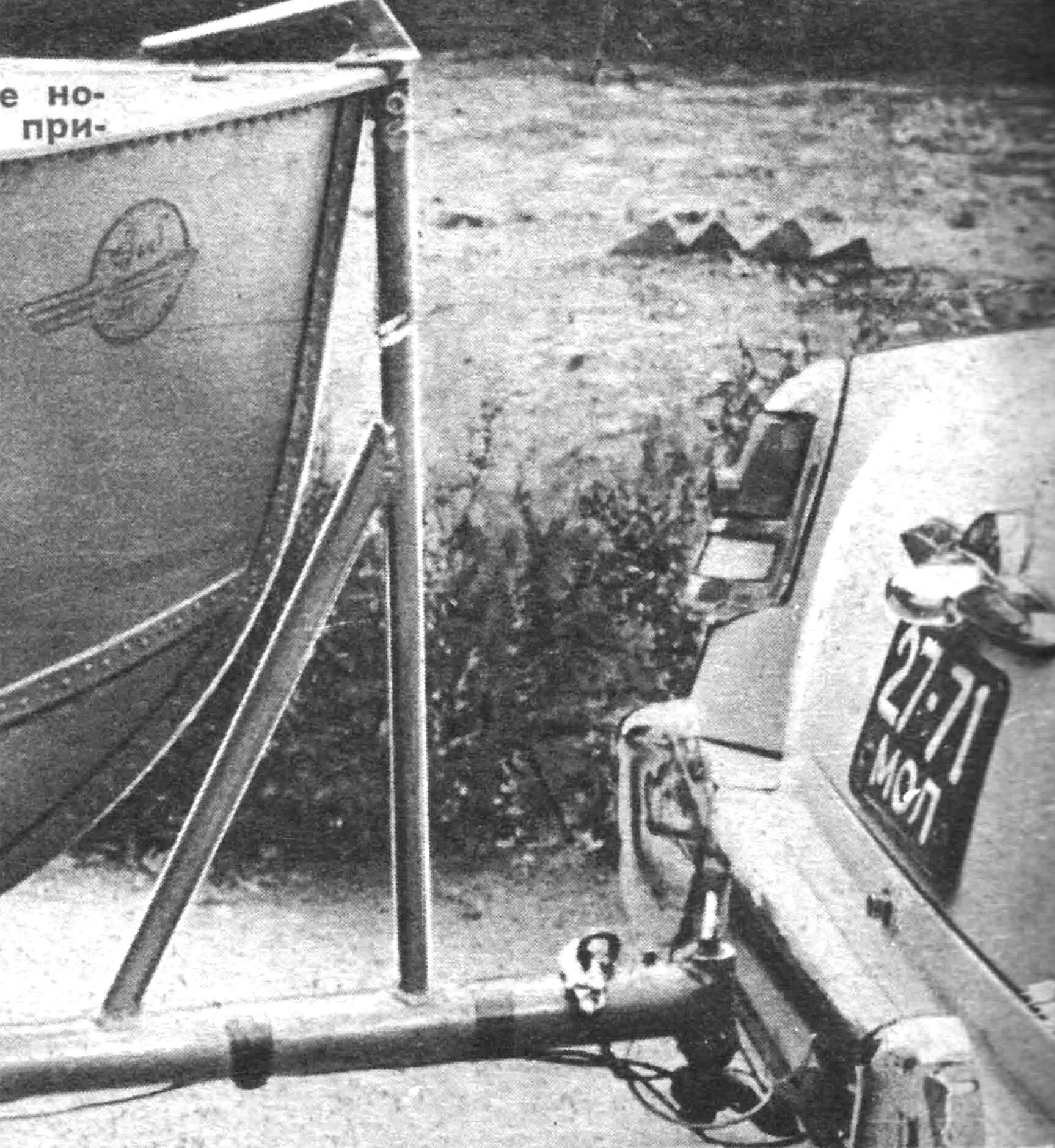
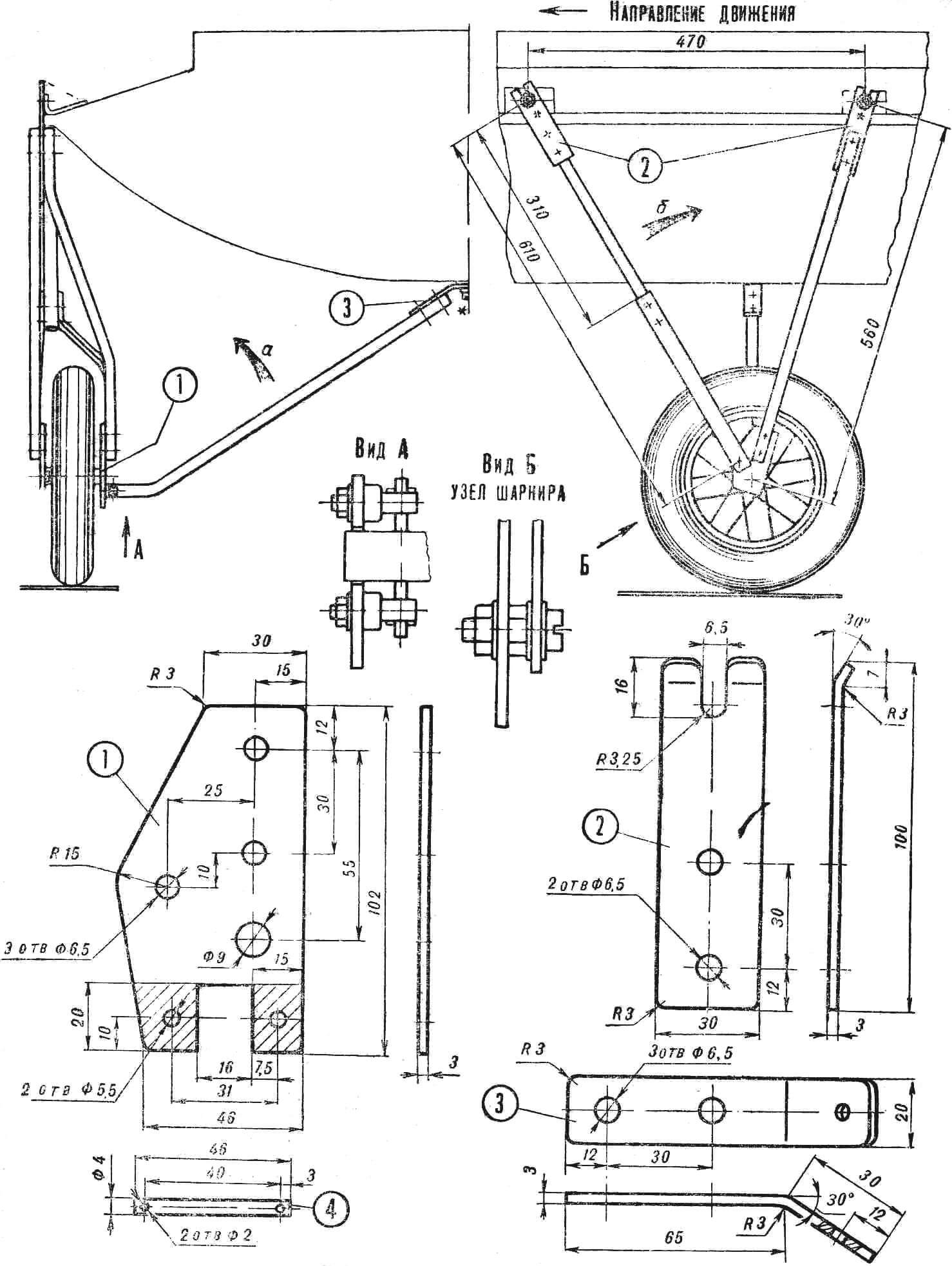
A fishing boat is most conveniently transported on land by placing it on small wheels, for example from a children’s scooter or bicycle with inflatable tires 205 X 56 (12 1/2 X 1 1/4) model L-155. Main materials for making the trailer: sheet duralumin 3 mm thick, duralumin pipes Ø 25—30 mm with wall thickness 1.5 ÷ 2.0 mm (you can use ski poles), fastening screws M6. Approximate dimensions of the finished structure are shown on the assembly drawing (see figure). If the boat length reaches 3—3.5 m, then the wheels are installed under the center of gravity. A longer boat must have larger holders, otherwise the rear part will drag on the ground.
Of course, such a boat should not be towed behind a car.
When the boat is launched into the water, the wheel holders fold in the direction of arrows A and B, like aircraft landing gear.
Yu. UNIATSIS, Riga
Recommend to read
 A LITTLE INTELLIGENCE…
...and then you don't have to throw away empty plastic bottles of detergents. The tip of the bottle into a convenient funnel, the lower part will put on the table is a glass for... SWEET ROAD TRAIN
Not so long ago, after retiring, I seriously took up beekeeping. However, our region is not rich in honey-bearing plants, so during the season, I have to move the entire apiary from one...
