The first impression when you look at this unusual furniture is that it probably isn’t very stable and is perhaps too fragile—not meant for the loads we usually expect from such pieces.
Indeed, can a table be reliable if each leg, bent as it is, rests on the floor not where it traditionally should, but where the next leg belongs—which in turn “moves” to the following one, that one also to someone else’s spot, and the last one to the first leg’s place? How could it be stable if at the front you end up with one front leg and… a back one, and at the back—one back leg and… a front one?
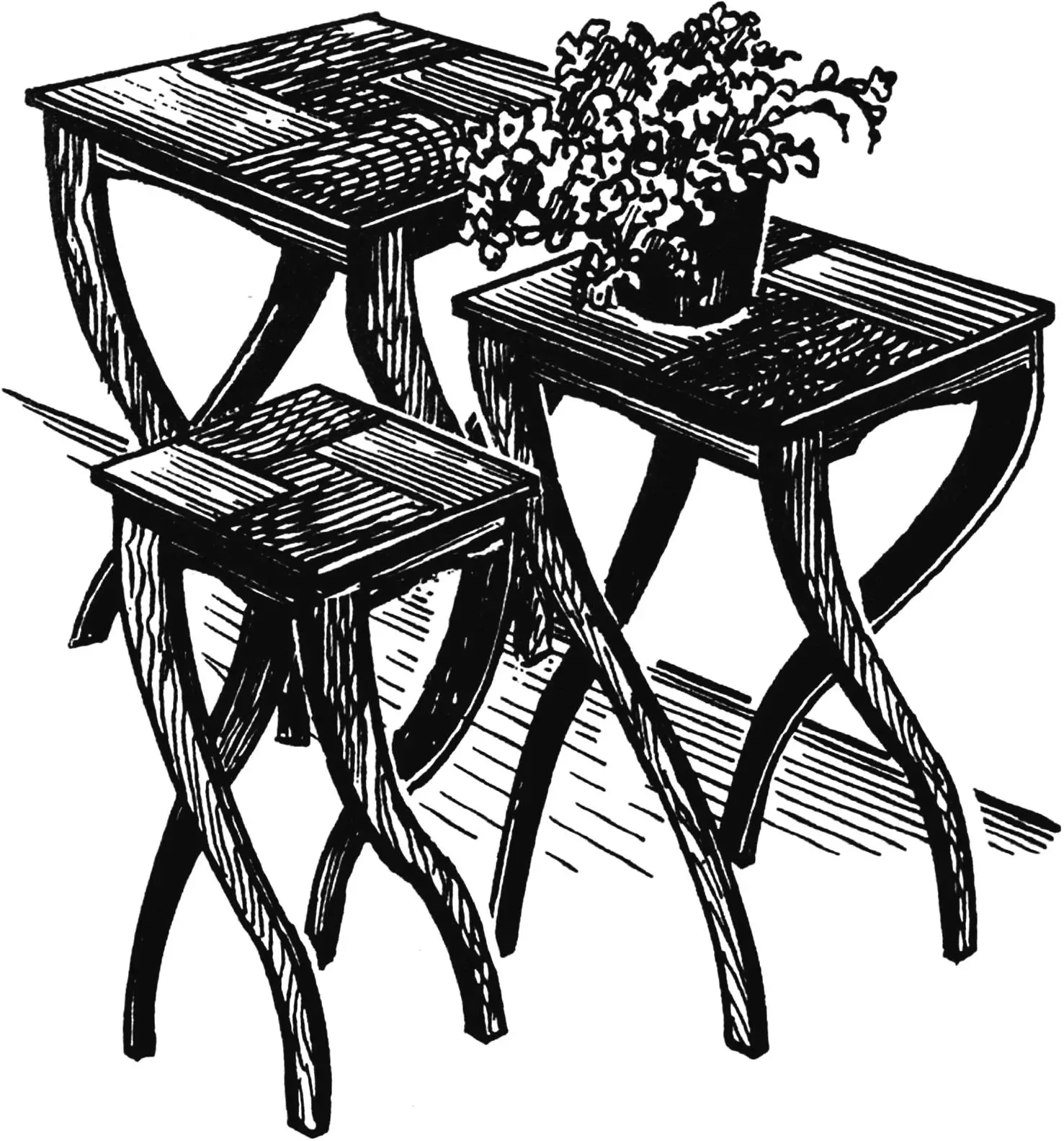
Yet the original “dancing” furniture is no prank or joke design—it is quite real, and according to the Hungarian magazine Ezermester, not hard to build yourself. If you look closely, the fear of instability is only apparent. See for yourself. The fact that each leg rests on the floor away from its “own” spot is offset by another leg taking that spot, and the rest, as if in a circle, replace one another, forming a conventional four-legged base.
Despite the unusual look, this furniture is no more difficult to make than traditional versions of similar items. The only tricky part is choosing material for the legs: it depends on the piece’s purpose, because loads on a stool, for example, are potentially greater than on a small table. That must be taken into account when making the legs. So we will consider each construction separately.
Side table
This is not a large dining table but a light one—for chess, cosmetics, or as a coffee table. For the top in any of these three cases, a 12 mm plywood sheet will do. Choose top dimensions so the edges overhang the underframe on all sides by about 50 mm.
As already noted, defining the leg material is harder. Ideally you would saw them from solid oak or beech boards 20—25 mm thick, then join them to the underframe rails with mortise-and-tenon joints, forming a kind of strong frame under the top. But finding boards at least 600×400 mm can be difficult.
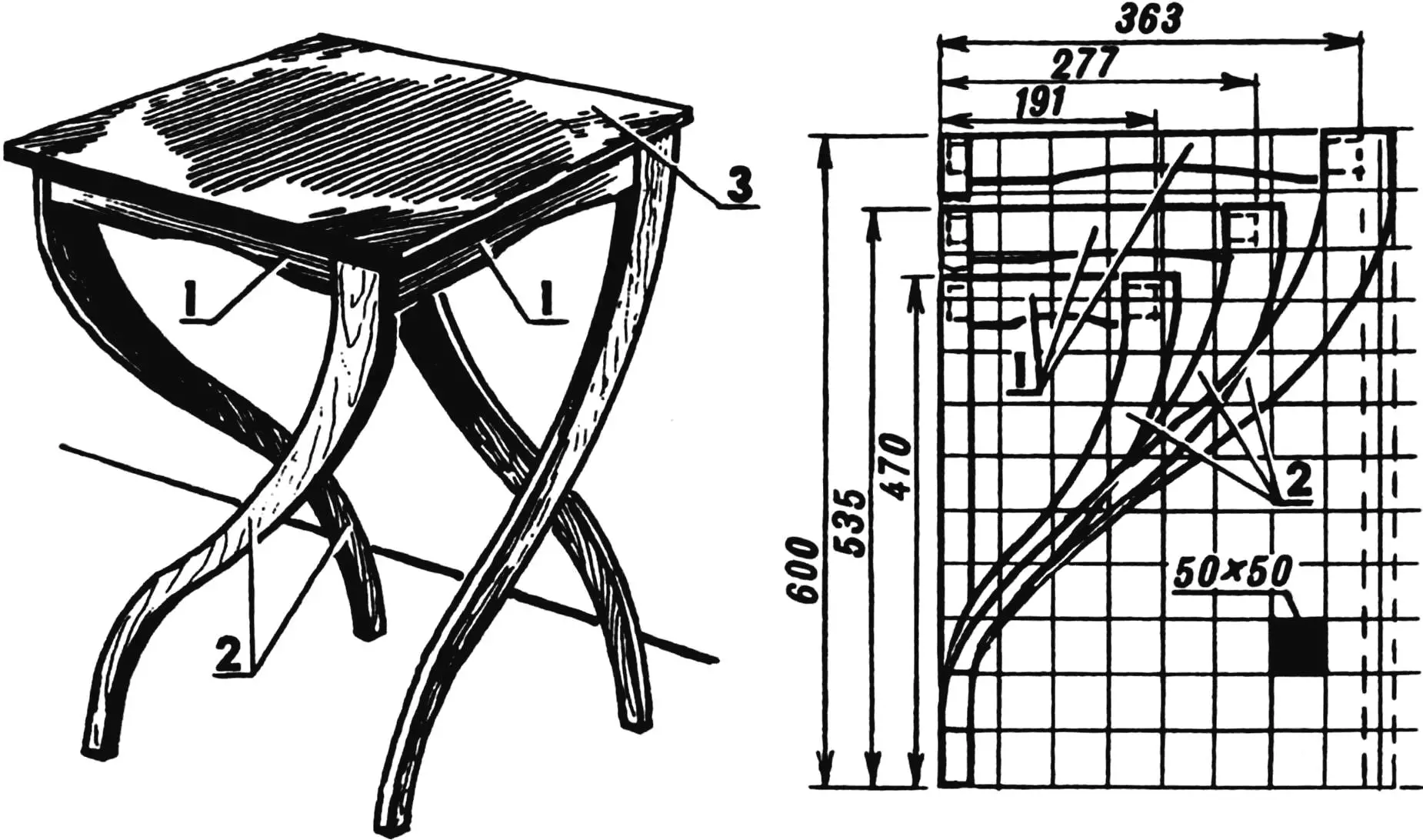
1 — rails forming the underframe; 2 — legs; 3 — tabletop.
So let us look at a simplified version using 19 mm plywood or particleboard. In that case it is better not to set the sawn legs into the underframe but to make them overlay a frame built separately from 60×20 mm battens. The battens are joined with round dowels and glue (joinery or PVA), reinforcing the inside corners with metal brackets on screws or triangular glue blocks on glue and screws.
On the overlay legs, on the side facing the frame, cut a step equal to the frame height. Attach the legs to the frame with glue and screws. For particleboard legs, given the material’s relative brittleness, you can glue on plywood strips matching the leg outline before assembly for reinforcement.
Stool
Technologically all its parts and joints mirror the table’s, except how the legs meet the underframe. Because loads on the legs are much higher than on the table, two legs are fixed differently—not staggered but facing each other, forming crossings at the bottom. Both pairs of legs are mounted from opposite sides of the corresponding underframe rail. Batten and leg thickness must match, and the steps at the top of the legs should be half-lap depth so at the crossing the legs meet and can be clamped together for strength by screwing a brace between the leg crossings. That assembly gives the stool the strength it needs.
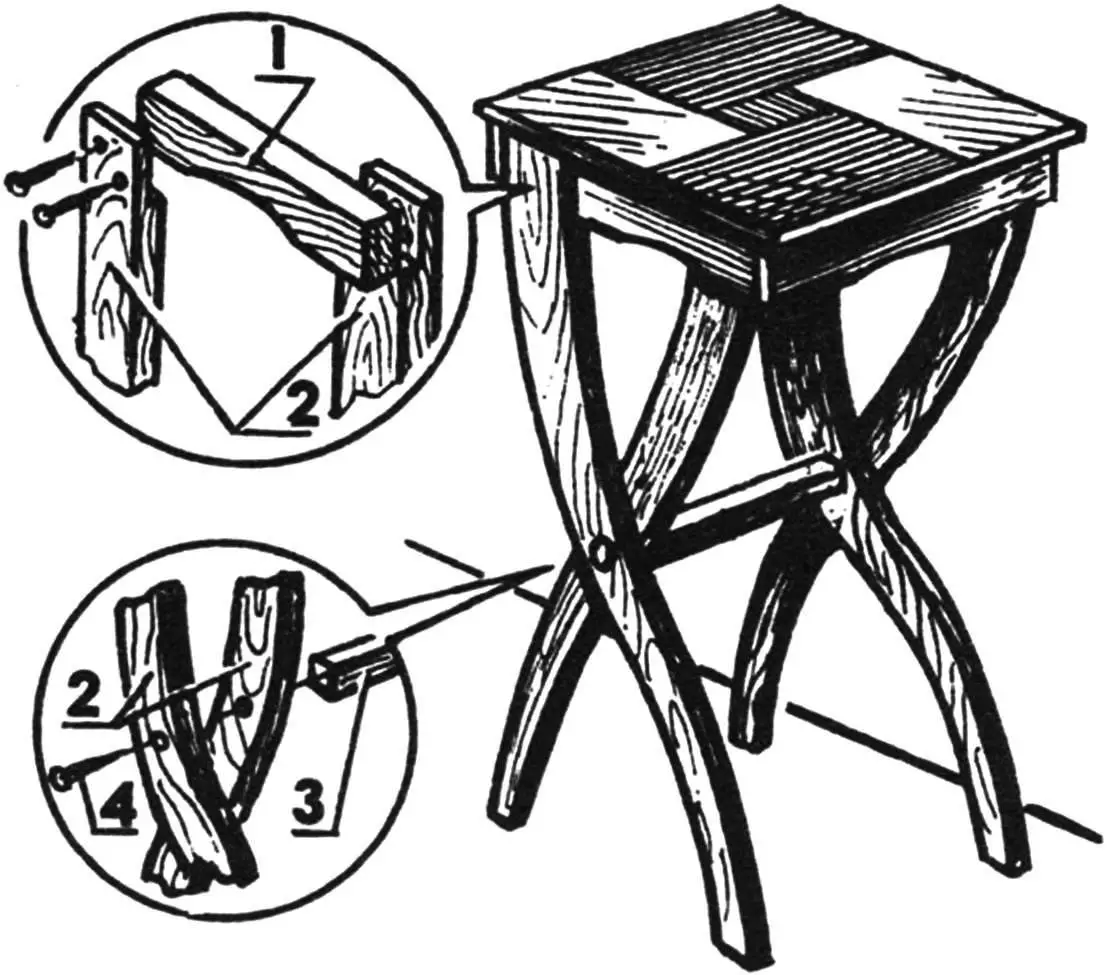
1 — rail; 2 — half-lap legs; 3 — brace; 4 — furniture screw.
Finishing the table and stool legs can be the same: careful sanding; stain followed by varnish, or enamel, nitrocellulose, or oil paint (same for underframe or seat-frame members).
Tops and seats can be treated the same way in principle. Upgraded options are possible too. If the wood figure on the top is attractive, after sanding it is better to apply several coats of furniture or parquet lacquer with drying between coats to bring out the natural grain.
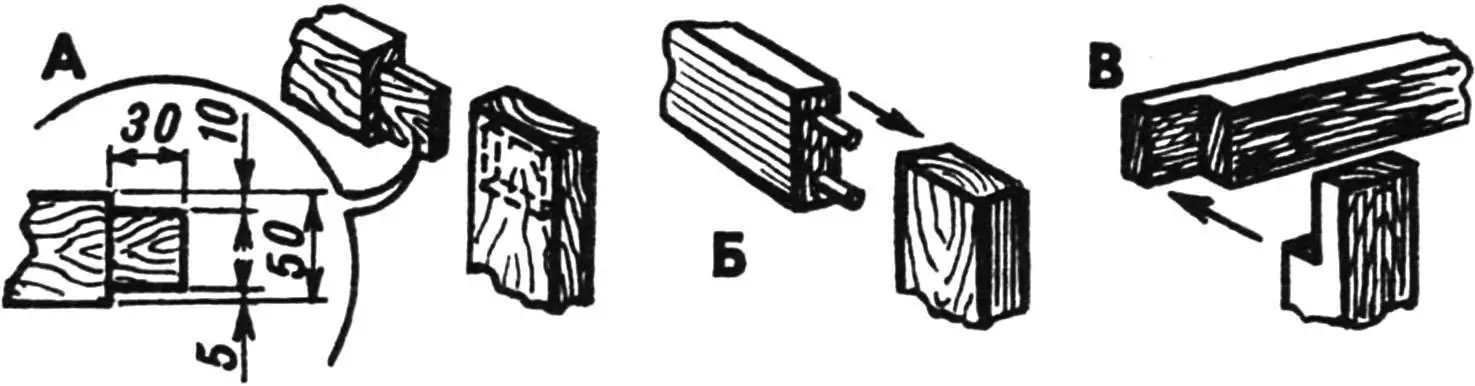
A — blind tenon; B — round dowels; C — half lap.
If the table is for houseplants, it is better to glue a plastic sheet to the surface.
Plain plywood is easy to dress up by gluing on a sheet of solid-color veneer or squares in different tones for a “chessboard” look.
Modelist-Konstruktor No. 6, 2000
Recommend to read
 DRILL THE HOLE UNDER THE
The idea is to make readers Boer came to me in the following everyday situations: having descended into the manor house, did not have time before winter to conduct water from the well.... WITHOUT BURSTS
Carrying water-filled bucket at a great distance, it is difficult to ensure that it is not spilled. The problem will remove a simple technique, often used by rural Housewives is...
