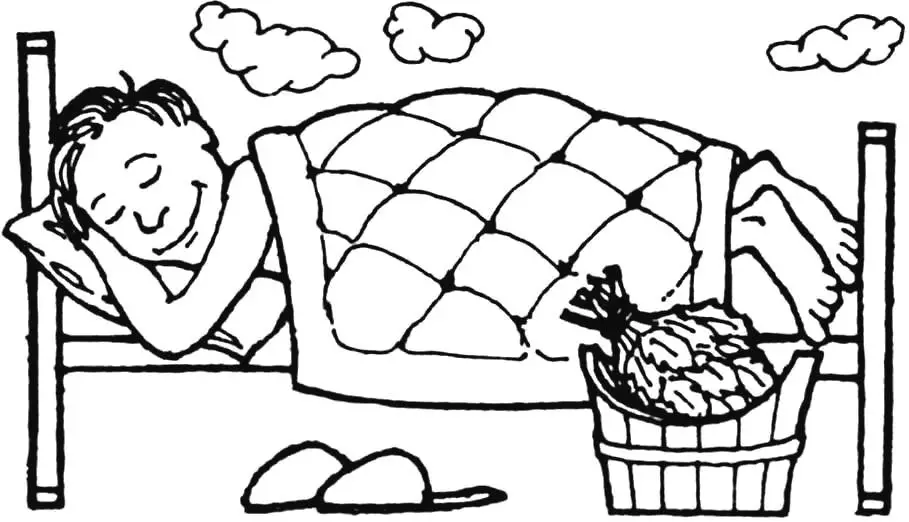
Everyone knows the wonderful properties of a steam bath. It helps healthy people maintain vitality, harden themselves, avoid illness, and excellently restore the body after nervous and physical stress. During the bath procedure, a person, along with sweat, is freed from toxins and salts, which is why doctors recommend sweating daily—from physical exertion or from thermal procedures.
The steam room is no less valuable for sick people. The world has accumulated extensive experience in the prevention and treatment of a whole range of diseases through heating. Thus, the steam room excellently helps kidney patients, people suffering from obesity, diabetes, sciatica, gout…
Finally, the bath improves sleep and appetite, giving a feeling of lightness.
In short, “the bath steams, the bath rules, the bath will fix everything…”.
Unfortunately, in modern household conditions, it is difficult to provide each person with easily accessible and comfortable steam room. Moreover, many are simply not satisfied with the very principle of a public bath.
Actually, this problem was solved long ago: portable home mini-baths exist. However, in my opinion, known designs do not combine ease of use and compactness with low cost.
I propose my project of a portable mini-sauna—simple and inexpensive. It differs from known ones also in that its design does not form a closed volume: it is an enclosure 30…40 cm high, having the shape of an elongated letter P. The enclosure is installed on any flat surface (for example, a couch, bed, sofa), covered with a sheet, and covered from above with a warm blanket. A person lies in the resulting space, like in a large pencil case, covering the neck and shoulders with the free edge of the blanket so that the body is in the steam space, and the head is outside. The horizontal position of the body eliminates excessive stress on the cardiovascular system during the thermal procedure, and the position of the head outside increases comfort and eliminates breathing difficulties usually associated with the small volume of the sauna.
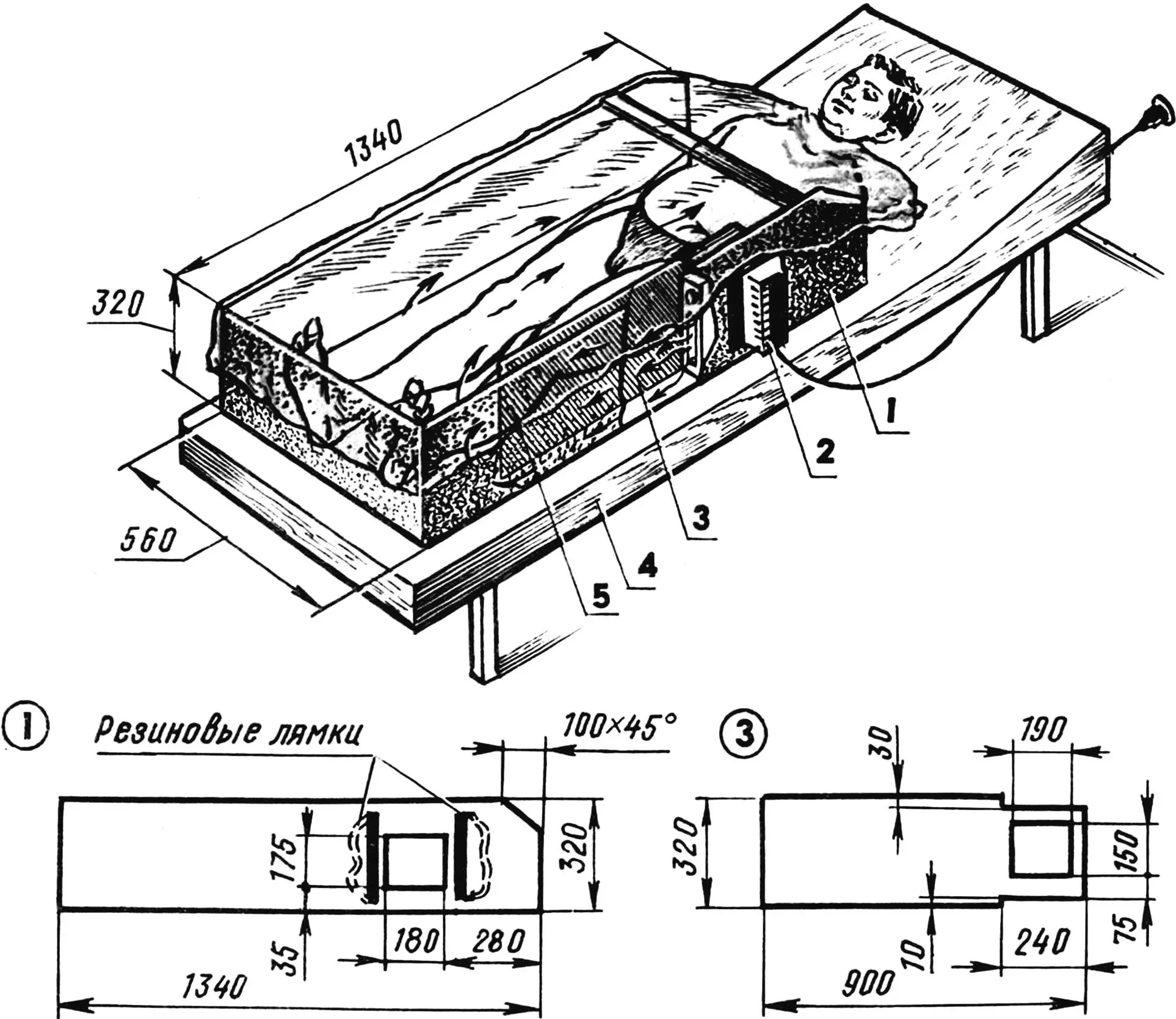
1 — side enclosure wall, 2 — electric heat fan, 3 — screen, 4 — couch, 5 — blanket.
The air temperature inside the mini-sauna rises to 70… 100° C with the help of a household electric heat fan “Veterok-2” (hereinafter — EHF). It is installed on the side wall of the enclosure, in its rectangular opening, so that the body and power cord are outside. The EHF is separated from the steam space by a screen, which prevents human contact with the EHF and directs hot air to the back wall, to the feet (in this regard, it is recommended to take the procedure in socks). The screen together with the EHF is attached to the side wall with two rubber straps.
At any time, the sauna can be ventilated by slightly opening the edge of the blanket from behind and (or) from the front: this creates a contrasting temperature effect on the body.
Experience has shown that the “heating-1” mode of the EHF (600 W power) is sufficient to warm up well and sweat within 15…25 minutes. After the procedure, the person takes a shower or wipes down, and the underlying sheet and the edge of the blanket are completely disinfected and dried during the subsequent 5…10 minutes of the sauna’s operation in the “heating+ventilation” mode. After the procedure, the enclosure folds “accordion-style” at the fold points and becomes compact.
The construction of such a mini-sauna can be made at home from available materials. For example, a prototype was glued from packaging corrugated cardboard in literally an hour, but has already withstood half a year of almost daily use. This revealed such qualities as safety (both fire safety and in terms of impact on humans), economy (the cost of one procedure does not exceed a few rubles), efficiency (the time for placement and heating does not exceed 5…10 minutes), compactness (in the folded state, the sauna has dimensions of 190x32x1.5 cm and can be stored in any gap between furniture, against a wall, etc.), low cost and reliability.
When using the mini-sauna, it is necessary to observe the necessary safety measures. And first of all—do not install it on surfaces that conduct electric current (in a bathtub, on bare ground, etc.), and the electric heat fan body must be grounded. The sauna should also not be used without a screen.
It must be remembered that steam bath procedures are contraindicated for some people, so it is wise to consult a doctor beforehand.
In conclusion, I wish readers many pleasant minutes in the mini-sauna.
A. KROTKOV, engineer
Recommend to read
 PLOWMAN SLOPING FIELDS
Now, as strengthening the material-technical base of agriculture, in all growth, the challenge to improve its efficiency, to improve all quality indicators. This requires... care about... MIXER FOR A MINUTE
From the thoroughness of mixing epoxy resin with hardener and plasticizer depends largely on the quality of veclachi. If mix components in the traditional way with a wooden stick — then...
