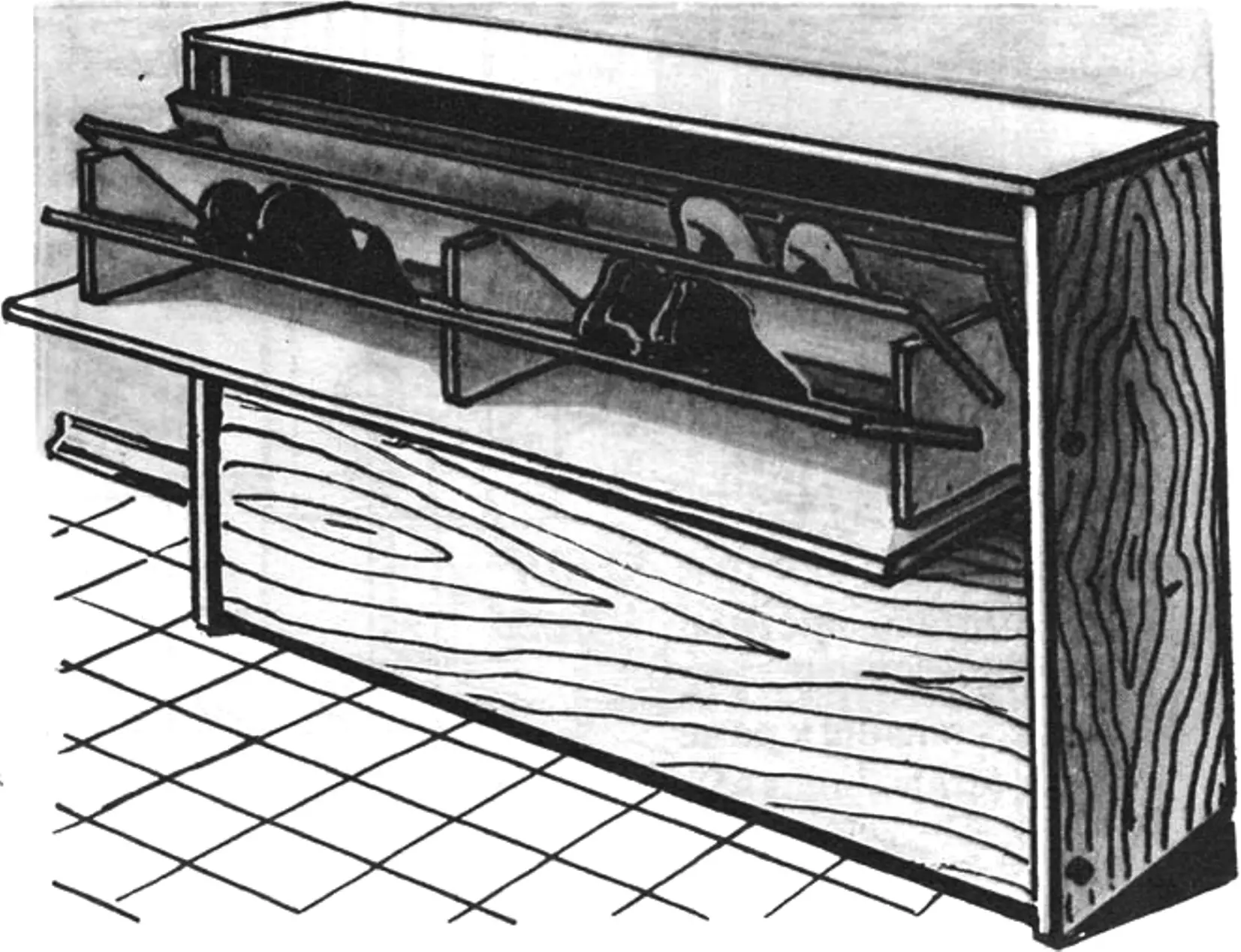
A shoe storage solution is always a challenge. Shoe cabinets usually sold in stores are, structurally, ordinary box units with shelves that are not very well suited for storing shoes. This is exactly what prompted the design of a custom version different from store-bought models.
The main advantages of the proposed design are compact dimensions with high capacity, immediate access to all shoes at once, and the ability to adapt it to specific conditions (room dimensions) during manufacturing.
The cabinet consists of two tiered compartments, whose fold-down lids serve as distinctive multi-section shelves intended for shoes. In this version, both compartments can be the same size or different: for example, a larger lower one for winter shoes and a smaller upper one for children’s shoes.
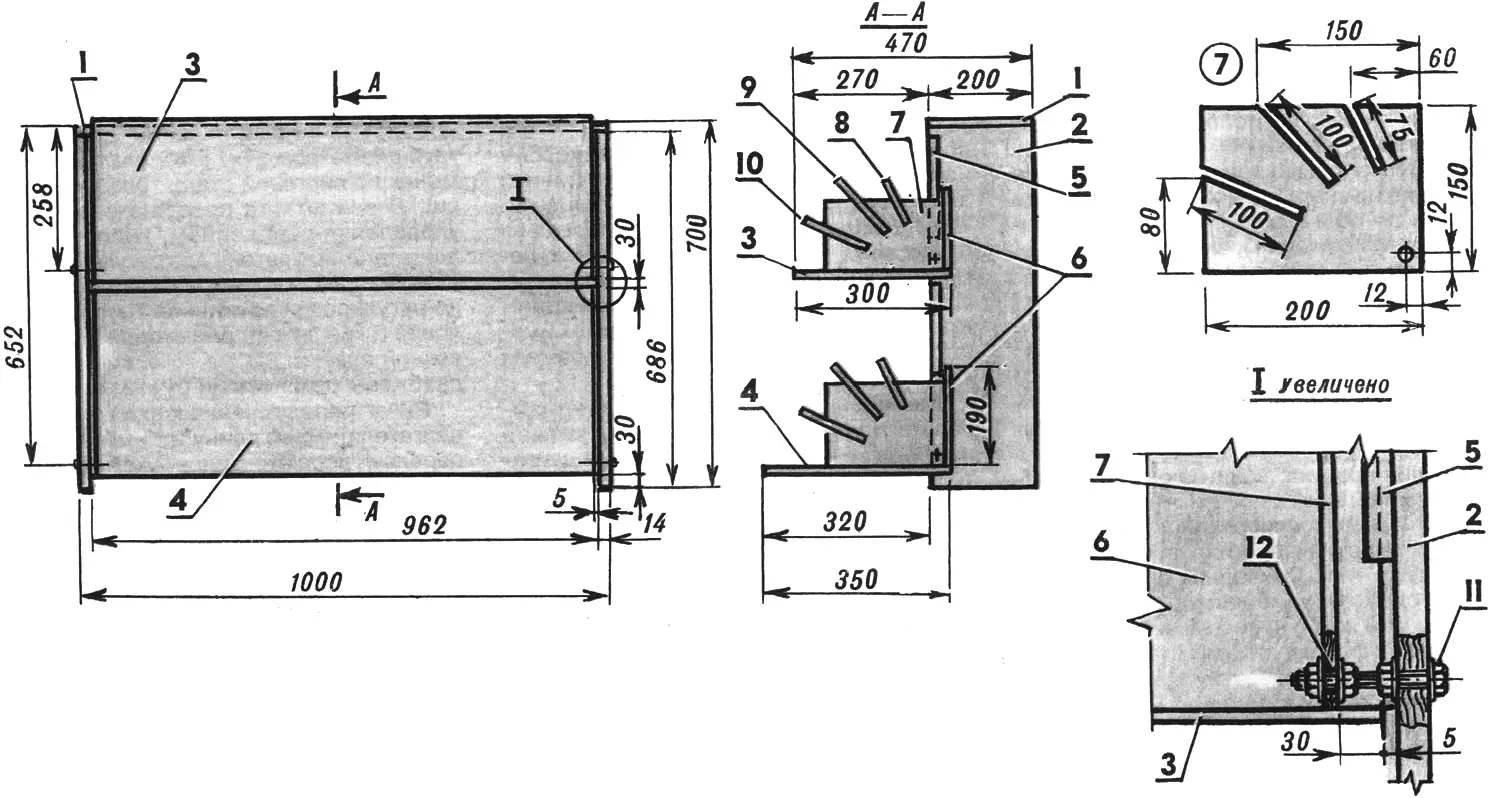
1 — top cover (chipboard s14); 2 — side panel (chipboard s14, 2 pcs.); 3,4 — compartment doors (plywood s6); 5 — stop (wood block 20×20, L200, 4 pcs.); 6 — compartment bottoms (plywood s6, 962×190); 7 — partition (plywood s6, 6 pcs.); 8 — rear shelf (plywood s6, 902×100, 2 pcs.); 9 — middle shelf (plywood s6, 902×150, 2 pcs.); 10 — front shelf (plywood s6, 902×170, 2 pcs.); 11 — hinge axle (M8 bolt, 4 pcs.); 12 — bushing (4 pcs.).
So what is a “multi-section shelf”? Let us consider one compartment as an example, since the second is identical. The door is connected to the bottom panel, so when the door is folded down, the bottom rises as well. Three partitions are built between them, into which three shelves are inserted at different angles: this creates a multi-section shelf with two compartments. Put shoes into them, lift the door, and everything ends up inside the compartment. Rotation is provided by hinges in the side panels.
To ensure the doors stop in a horizontal position when opened, limiting wooden blocks are attached to the side panels; the bottoms rising with the doors rest against these blocks.
The side panels and top cover are made of chipboard; the doors and other compartment parts are made of 6 mm plywood; and the back panel is hardboard. Decorative finishing can be any kind. Externally, for example, it can be painted with enamel paints, covered with “wood look” film, or stained and coated with several layers of furniture varnish.
“Modelist-Konstruktor” No. 10’99, O. PRILUTSKY
Recommend to read
 THE MANY FACES OF “WIESEL”
The command of the Bundeswehr started the revival of its airborne forces in the late 1950s, However, as in the days of the Wehrmacht, look at VDV was still as highly mobile light... DRILL-IMPROMPTU
If there is an urgent need to punch a hole in the tree, but you don't have suitable drill, you can make... of the nail. Asclepia it on the end as shown in the drawing, and sharpen edges...
