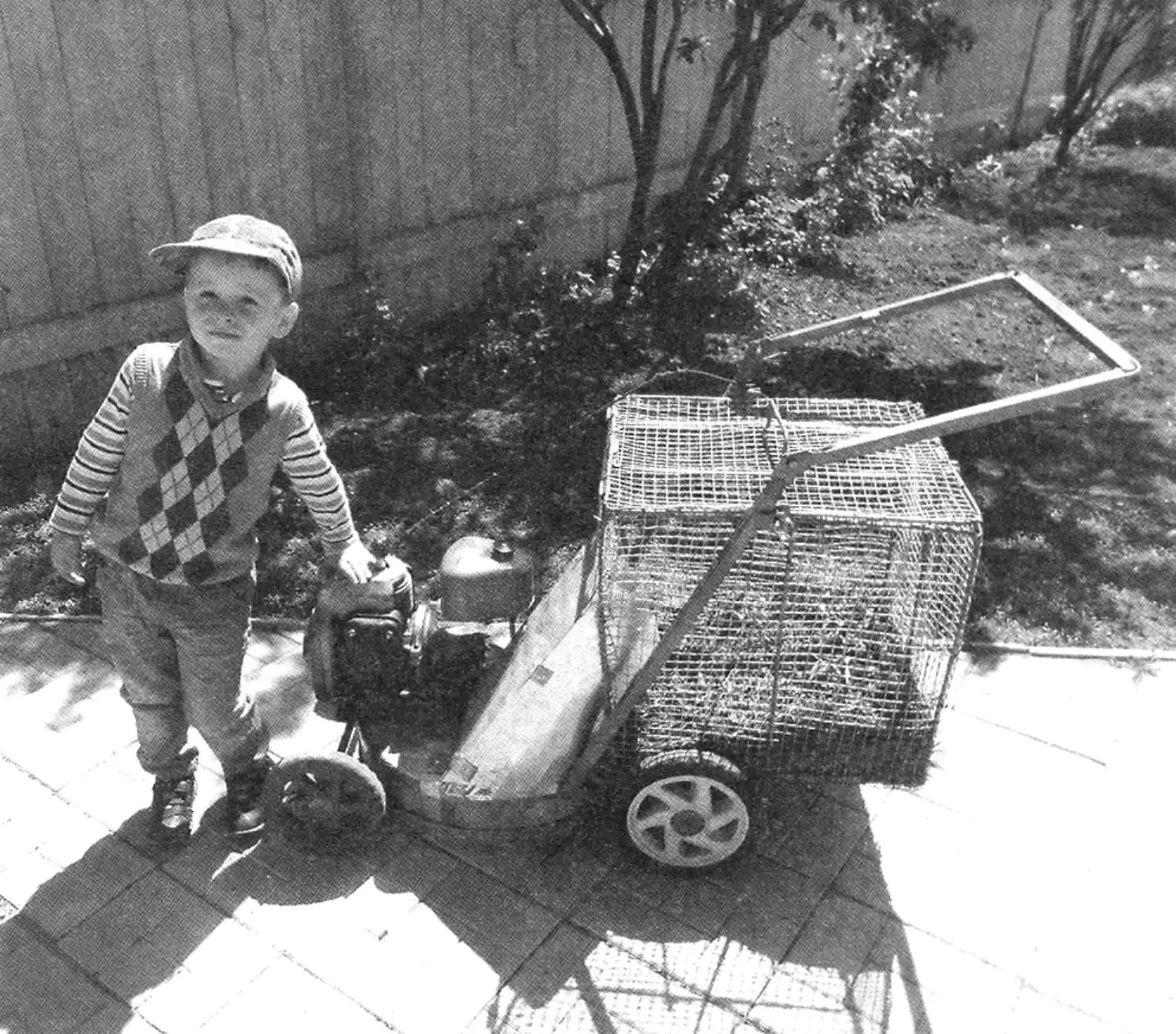
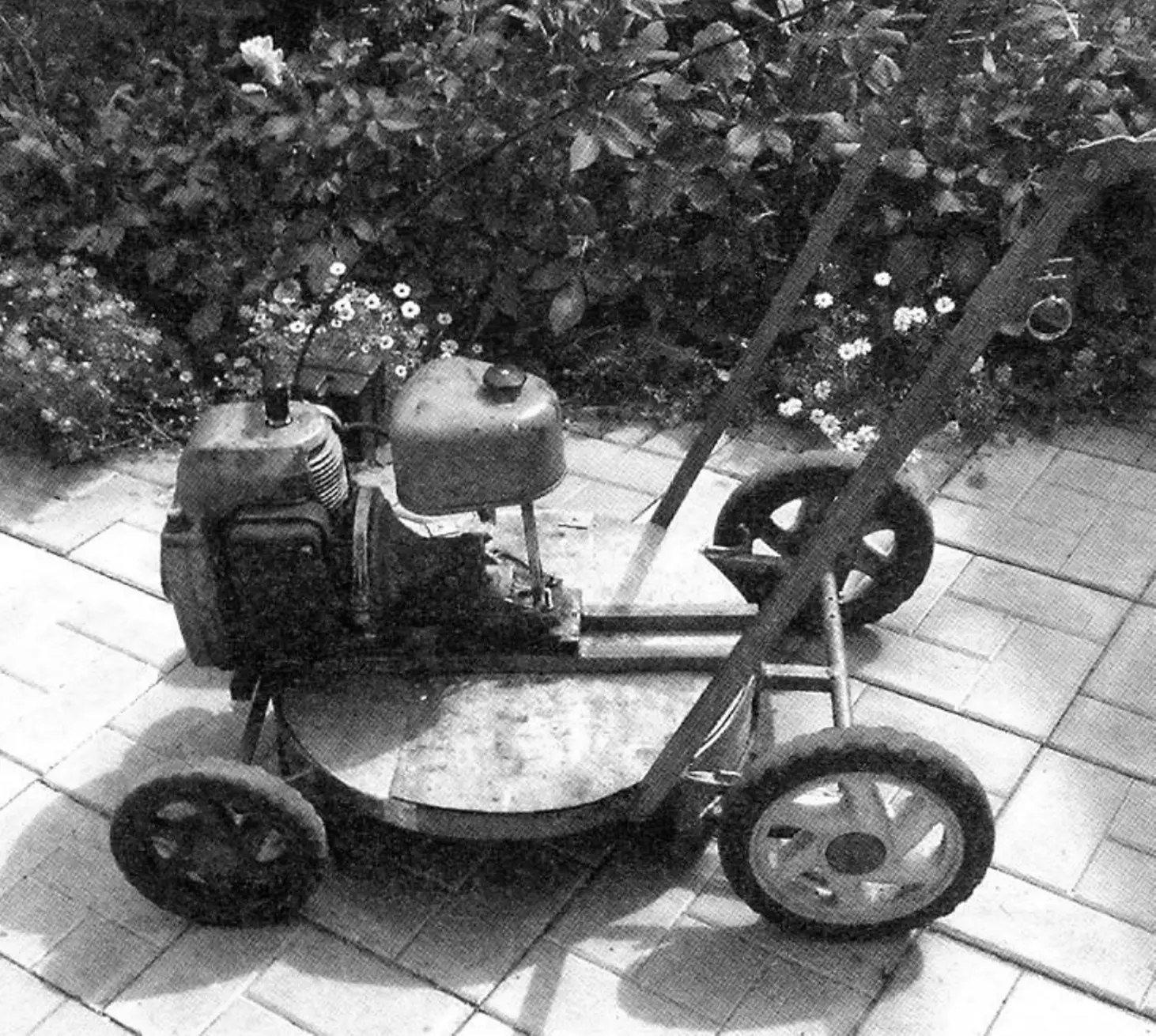
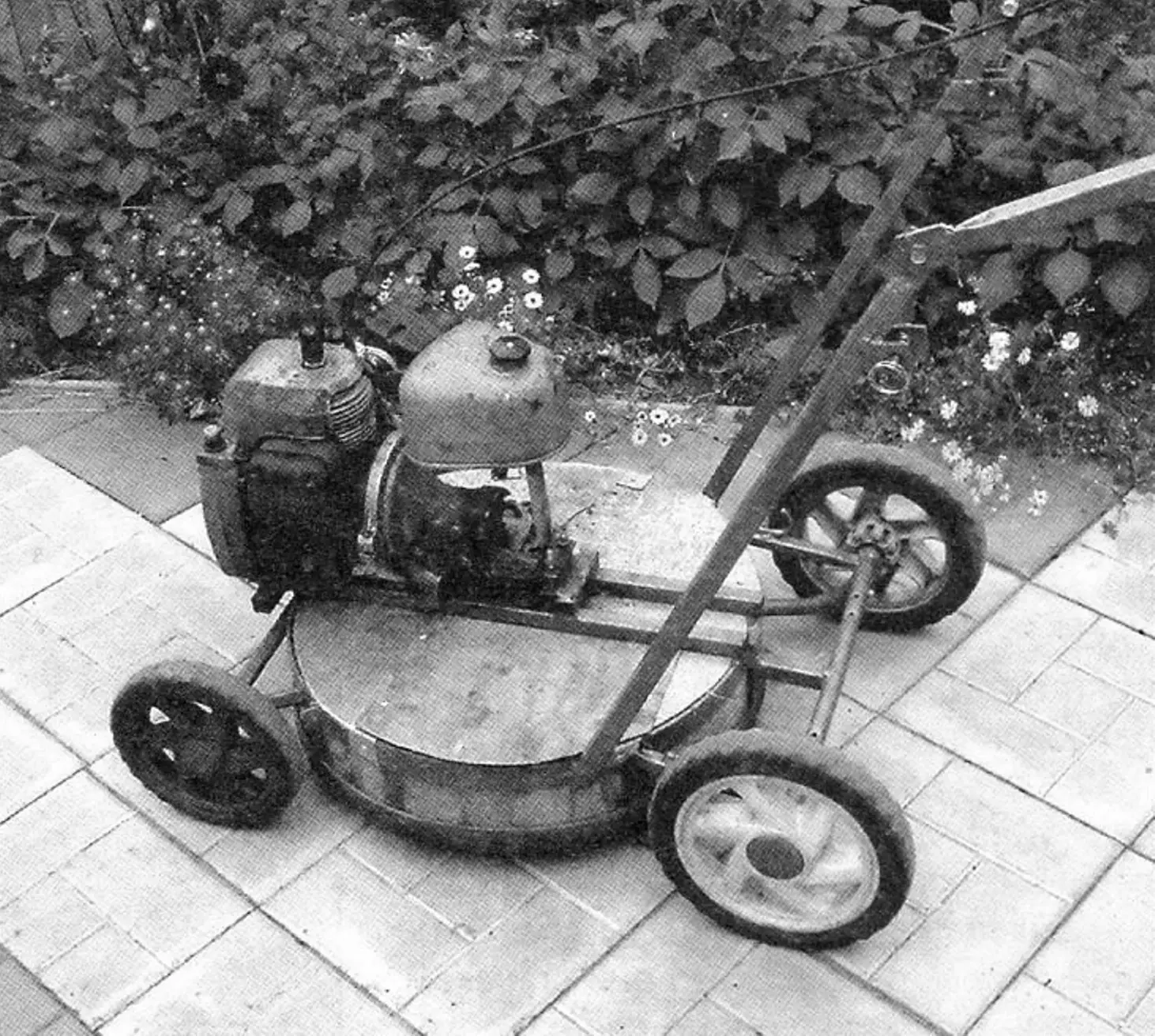
This spring this lawn mower was assembled quite quickly. Why quickly? Because there was no need to machine a single part. In addition, the design used inexpensive, readily available materials and spare parts.
The mower has a number of advantages even over commercial machines: a large swath width — 500 mm; it mulches green grass (with the catcher and the discharge chute removed and the top window closed); it cuts the shredded mass and throws it to the left; it has a large grass catcher. Most importantly, its cost is modest. We often use the lawn mower to obtain supplemental feed for farm animals, so it rarely sits idle.
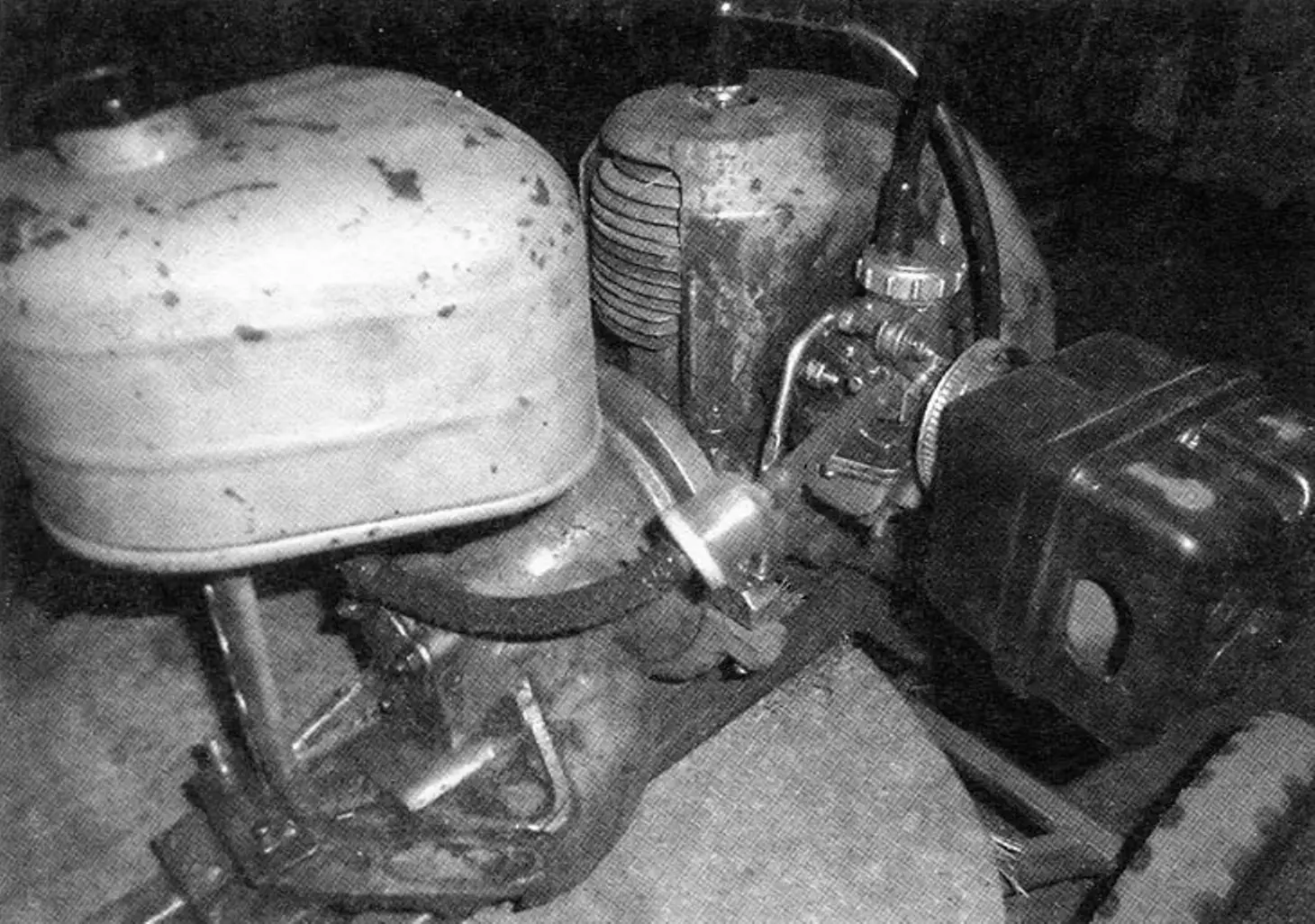
The lawn mower engine is taken from a Ural-2M chainsaw rated at 5 hp, with minor modifications: an imported scooter carburetor is installed through a phenolic adapter about 15 mm thick. With this carburetor the engine runs more evenly and steadily at all speeds, consumes less fuel, and is easier to start.
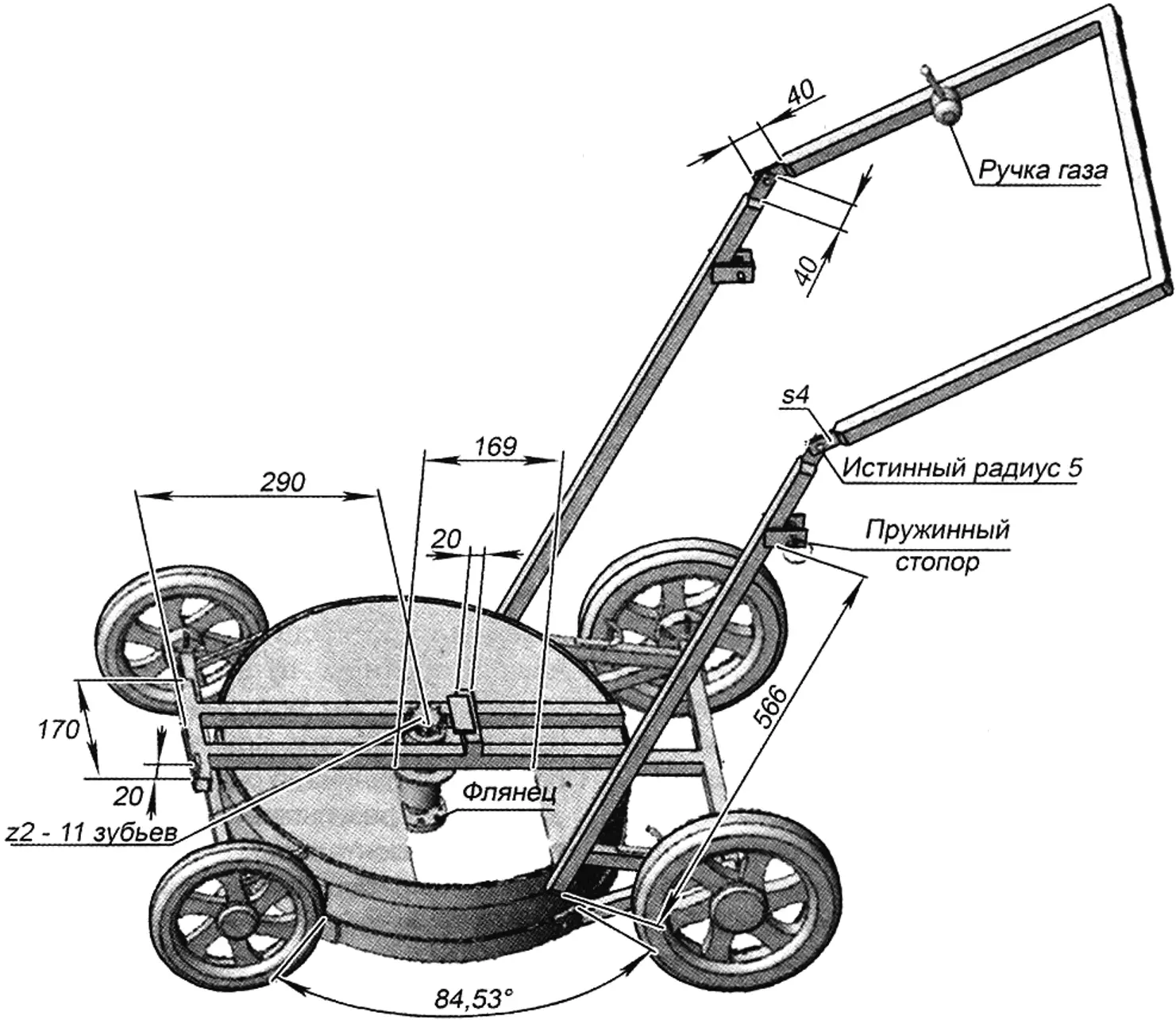
A fuel tank from the same Ural chainsaw, 1.6 liters (it matched the shape and look of the power unit better), is bolted to the engine gearbox base with a bracket. To avoid clogging the carburetor, a fuel filter from the same scooter is installed in the fuel line.
The mower transmission includes a centrifugal clutch, which helps prevent serious damage if a foreign object (for example, large branches) accidentally gets under the blade. The chainsaw gearbox (gear ratio 1:2) is unchanged (it is only rotated 90° with the sprocket facing down). The chain drive with 12.7 mm pitch uses a driving sprocket Z1 with 17 teeth and a driven sprocket Z2 with 11 teeth. The speed-increasing chain gearbox is the price paid for not modifying the transmission. Driving sprocket Z1 is welded to the original chainsaw chain sprocket after removing its guide plates.
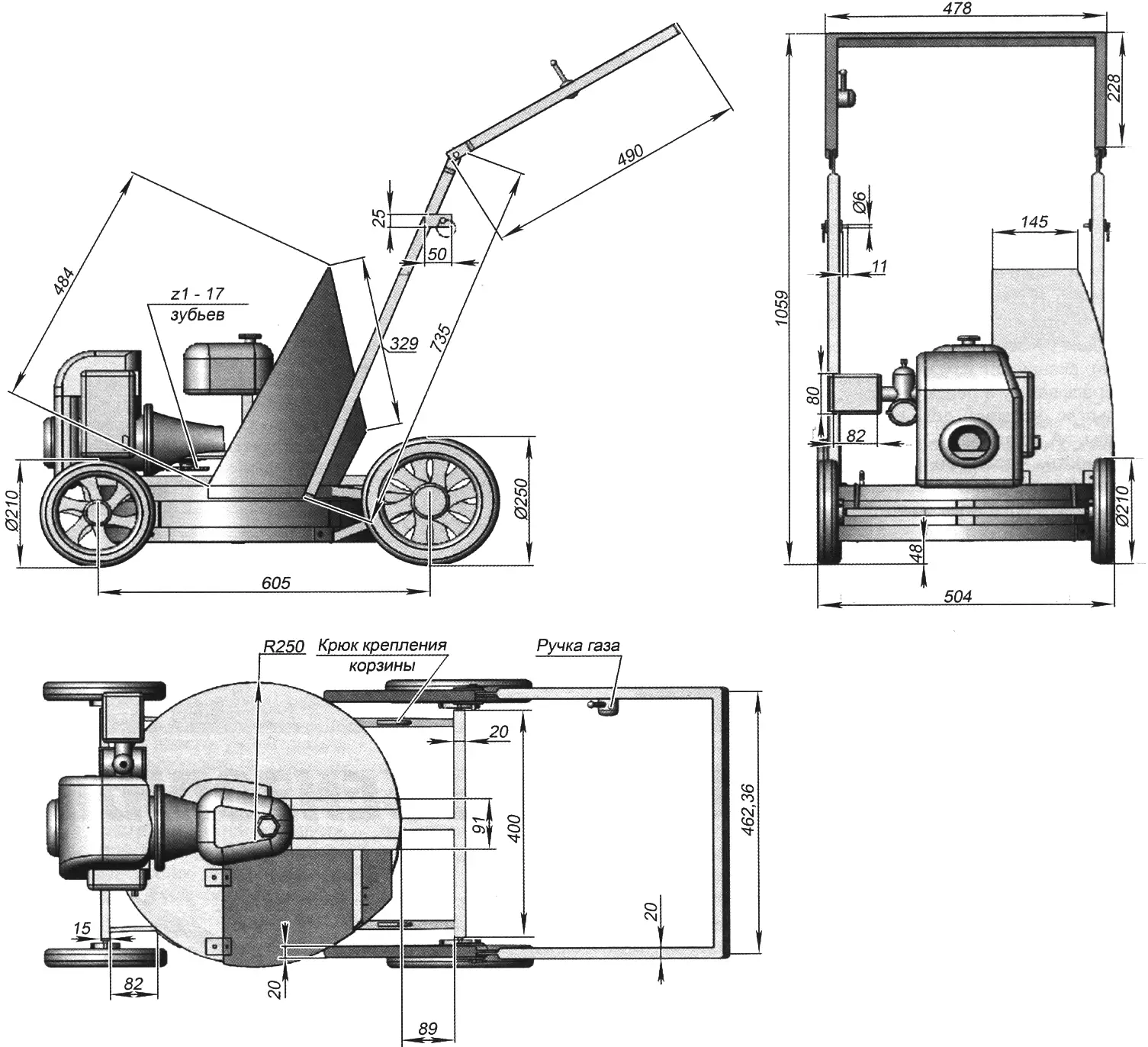
The mower frame consists of two hoops bent from 30×4 mm steel strip with an inner diameter of 500 mm. These hoops are welded together so that the width of the resulting rim is 110 mm. The remaining parts of the body, including the handles, are made from 20×20×1.5 mm square tube; only the front axle uses 15×15×1.5 mm square tube (leftover stock).
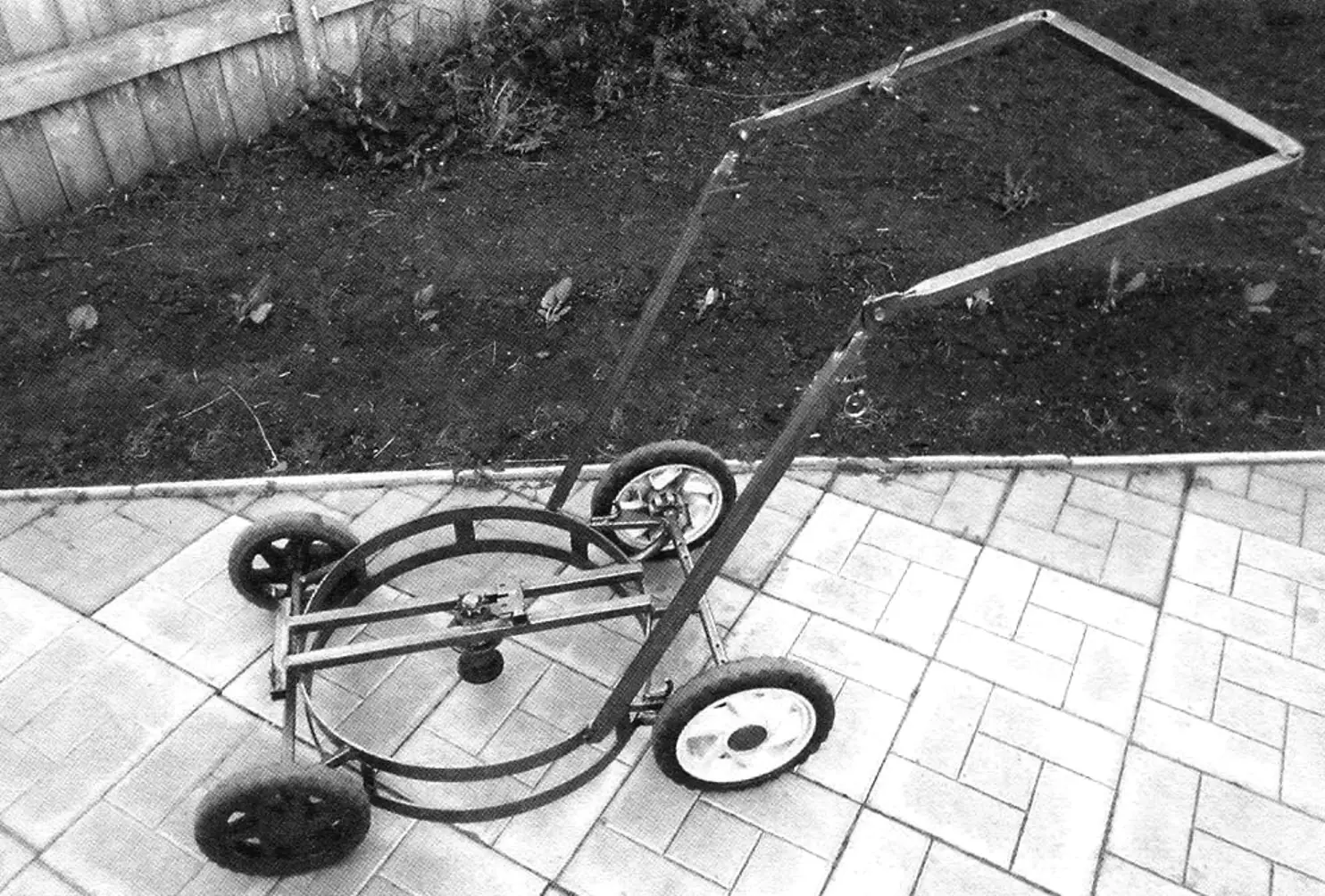
The handle has a joint that allows height adjustment; for winter storage it can be folded backward so it takes less space. The wheels are from baby strollers and have different diameters (finding two pairs is easier than four identical wheels). From experience: in an earlier mower version we used small wheels (side training wheels from a children’s bicycle), and they were inconvenient — they kept catching on obstacles. I did not add blade-height adjustment for cutting height because I settled that parameter long ago. It is about 50 mm from the ground plane to the blade plane. I found these 50 mm experimentally: cutting shorter looks poor (it exposes the stem bases near the crown — the sod layer, which is white or yellow), so the lawn looks untidy, and the grass catcher also pulls in soil (animals are not fond of that “seasoning”). With a high stubble the plot still looks uncut.
Total material used for the frame: 30×4 mm strip — 3.5 m; 20×20×1.5 mm square tube — 5.1 m; 15×15×1.5 mm square tube — 0.4 m.
For blade installation a steel hub half was welded to the frame; it was removed from the aluminum wheel half of an IZH motorcycle wheel. The axle was taken from the front wheel of the same motorcycle; only the bearings had to be replaced with sealed units because the originals were worn. As can be seen, driven sprocket Z2 with 11 teeth is welded to the upper part of the axle. An 8 mm thick washer, made from 15 mm ID water pipe, is placed between the sprocket and the hub bearing. On the lower side of the axle a flange from the water pump of a UAZ-31512 fits the hub axle ID. The axle only had to be turned with an angle grinder to machine metal for a wedge fit between the flange and the axle.
Later, after assembly, a side “window” was cut in the left side of the housing to discharge green mass to the left. This layout makes it easier to cut (mulch) grass with less load on the mower motor, even on heavily overgrown plots.
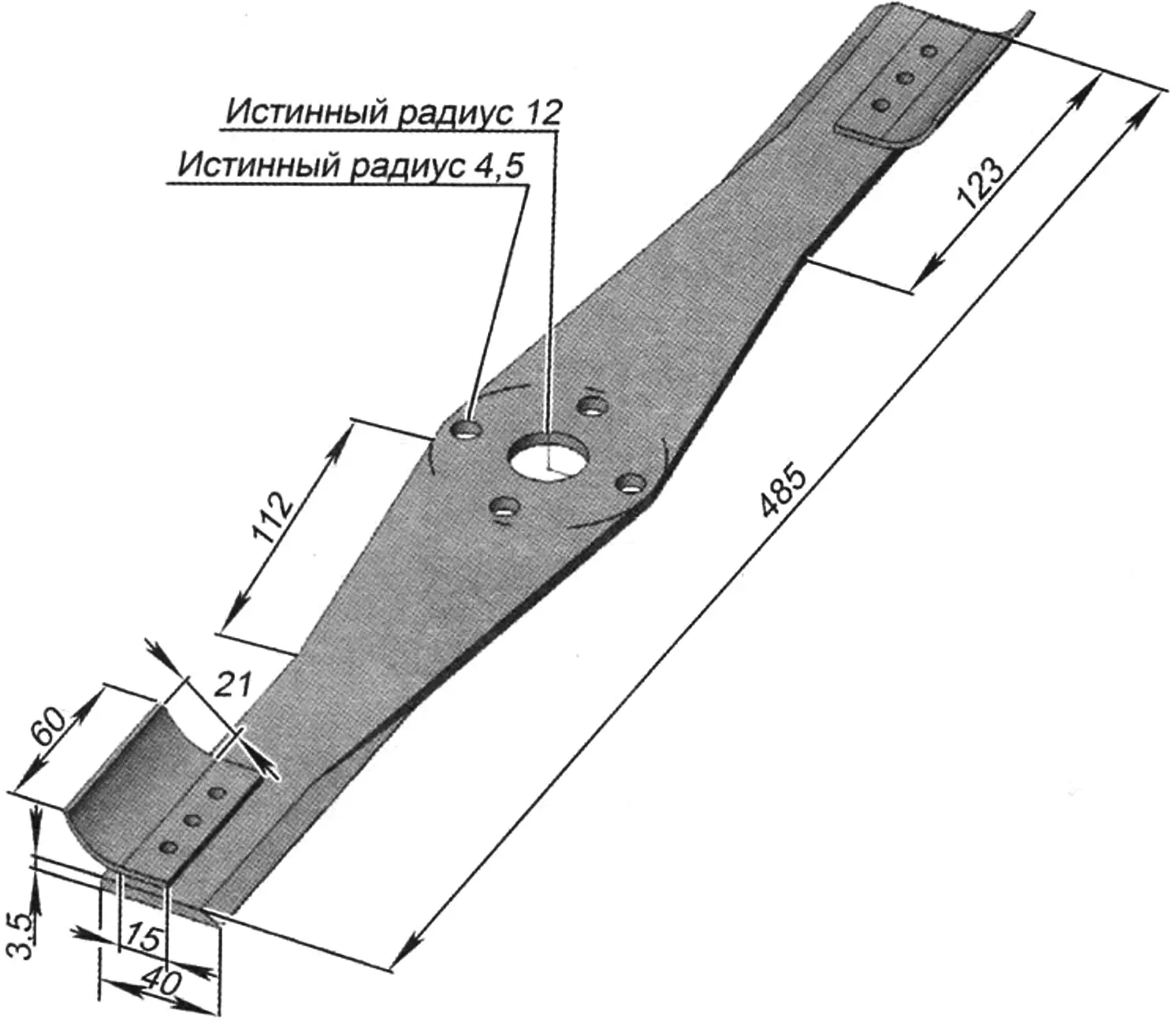
The mower blade is cut from ordinary non-hardened steel 3.5 mm thick. This way, if the blade hits a serious obstacle it will not break or throw off a piece — it will bend but stay in place. The blade has two bent “paddles” cut from 1.5 mm stainless steel. The paddles are joined with 5 mm steel rivets. The paddles feed green mass into the catcher. The blade was balanced right on the mower shaft (before the chain drive was connected): the shaft spun easily, and the installed blade was rotated and ground at “heavy spots” until balance was achieved.
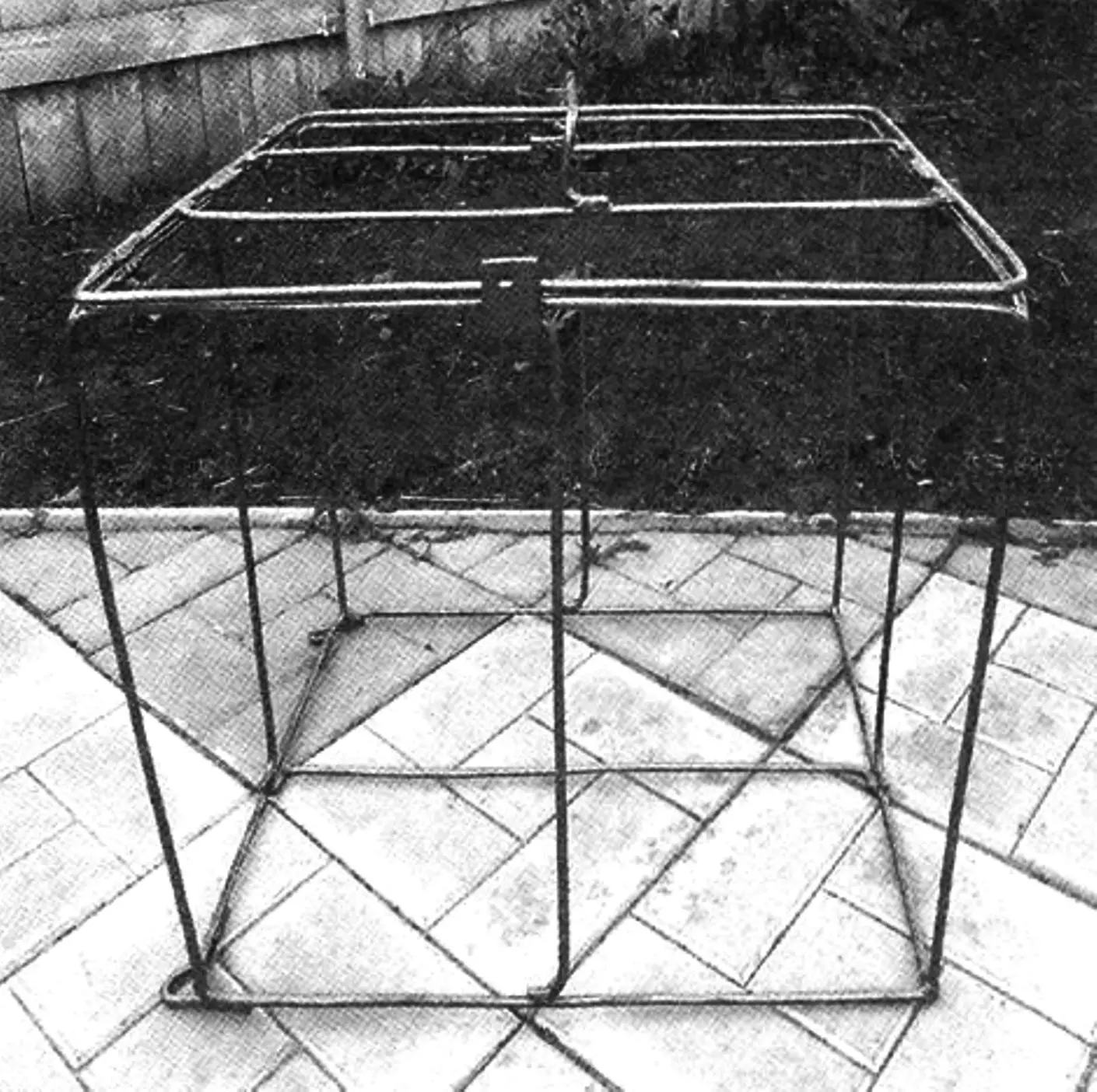
The grass catcher is welded from 7 mm steel rod. It is covered with green 2 mm polyethylene mesh with 10×10 mm cells. It turned out the mesh was too coarse, so mosquito netting was added on top. About 12 m of steel rod, two simple hinges, and two meters of polyethylene mesh were used.
The catcher has two welded hinge loops at the lower front for attachment to the mower body, and two lugs at the top for spring retainers.
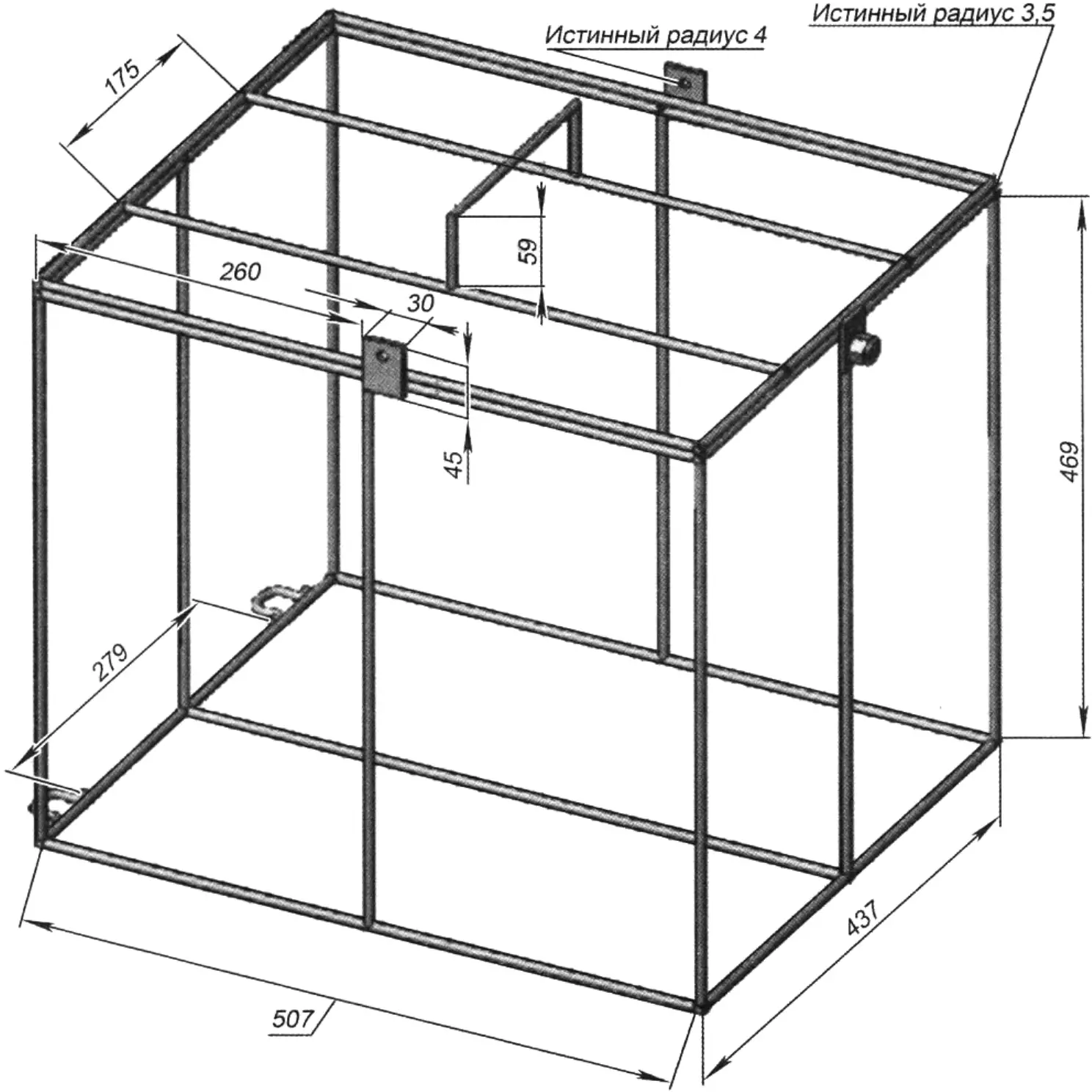
The catcher lid is attached to the catcher with two small window hinges. There is also a lid latch made like a clamp screw and lug. The catcher also has a handle for easier removal and carrying.
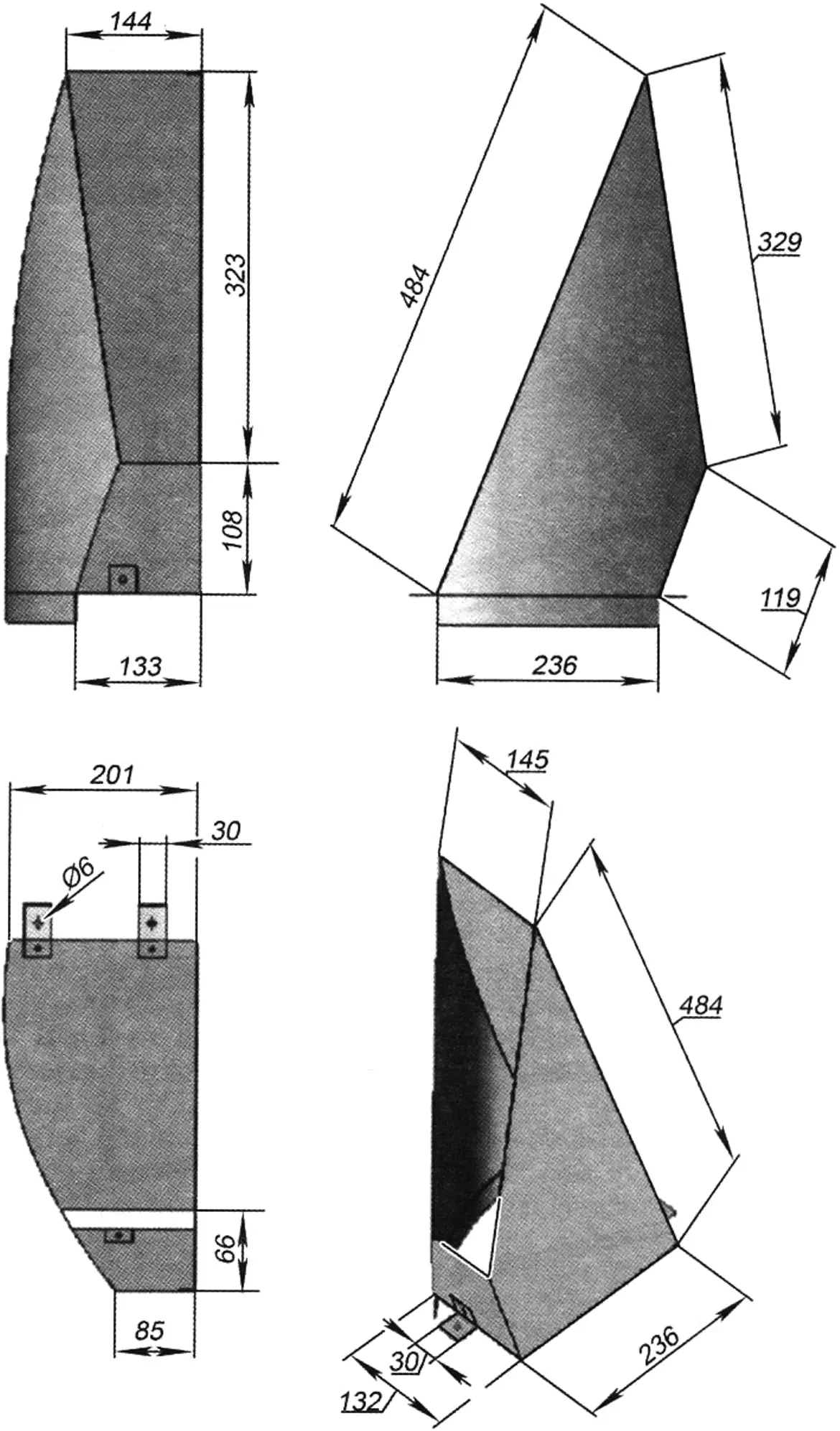
The discharge chute is made from 0.5 mm galvanized sheet steel; because its shape is somewhat difficult to bend, it was cut from separate pieces. These pieces are joined with a narrow angle piece and rivets cut from the same galvanized sheet. The chute is attached to the housing at three points with M6 bolts.
The mower design description lists the amounts of materials used; it remains to estimate their cost and obtain the result.
Modelist-Konstruktor No. 3’2016, D. SLONOV
Recommend to read
 A home for a four-legged friend
A roof over one’s head is needed by a four-legged friend who guards your home too. It doesn’t have to be a palace, but shelter from the weather is essential for a dog. Building a kennel is... REZINOMOTORNAYA FOAM
Not everyone can use the balsa when building models. Not everywhere is the enamel and long-fibre paper, stitched. That's why modelers are constantly looking for new more affordable...
