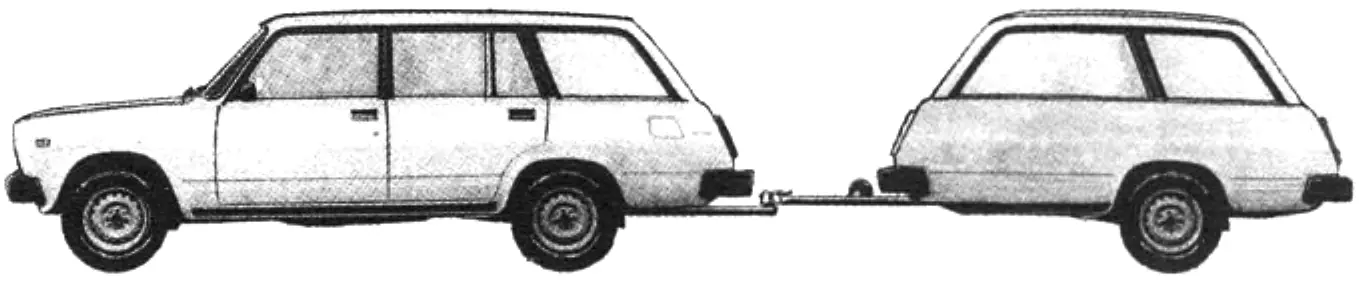
A universal trailer for a passenger car. My wife and I often go on short trips in our car — sometimes fishing at a lake, sometimes into the woods for mushrooms. And on these trips we always lacked a trailer, a kind of compact camper where we could sleep peacefully and have a snack regardless of the weather. Of course, we could have bought a tent, but we are not keen on resting under a fabric roof. At the same time, we had no desire to buy or build a bulky trailer cottage (camper) — a two-berth bedroom on wheels that could easily be transformed into a two-seat dining area would have been quite enough.
I borrowed the design idea for such a mini-camper from a description in the 1970s magazine “Modelist-Konstruktor” of a trailer by B. Vishnevsky, which he built for his Zhiguli from the rear part of a wrecked “kopeyka”.
I liked the idea, only as the basis for the future camper I used the bodies of two wrecked VAZ-2104 station wagons. A preliminary check showed that plenty of such wrecked cars are now lying around in scrapyards.
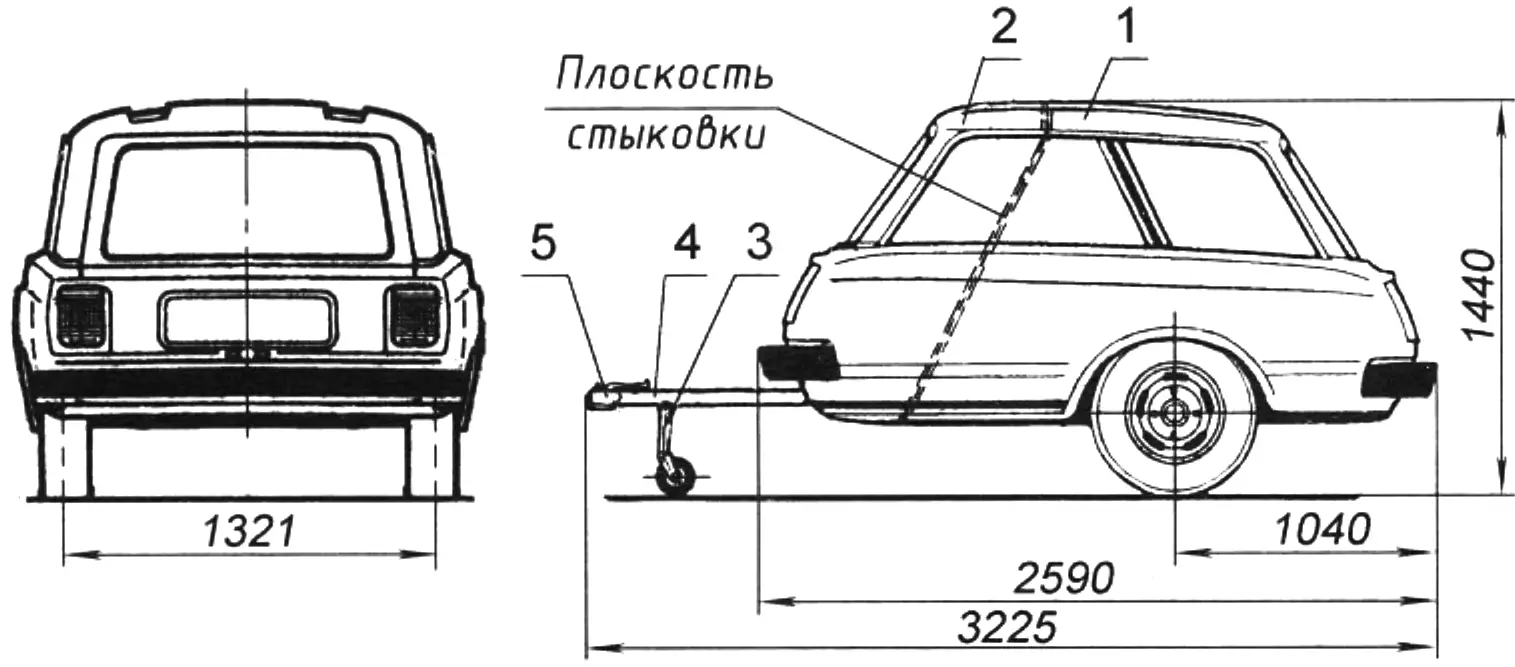
1 — rear body section of the trailer (from the rear body of a VAZ-2104); 2 — front body section of the trailer (from the rear body of a VAZ-2104); 3 — folding support with a self-orienting wheel; 4 — trailer frame; 5 — tow hitch
The basis of my camper was two fragments cut from the rear parts of two bodies — one of them the main one, about 2100 mm long, measured from the rear bumper of the body (it became the rear part of the trailer), and the second an additional one, about 1150 mm long (for the front part of the camper).
First I cut and chopped off all the excess metal from the body fragments, after which I joined them into a single unit so that the overall length of the camper body was 2590 mm (from bumper to bumper) — this produced an optimal match of the curved outlines of the front and rear parts of the future trailer. Joining was done in several stages by successive approximation; for temporary fastening of the shells, straps made from pieces of steel strip and M4 bolts with nuts were used. After selecting the optimal mutual position, the camper body parts were finally joined using a previously prepared strap of steel strip with a cross-section of 2.5×40 mm, installed from inside the body, and 4-mm bolts with nuts. The fasteners were installed at a pitch of about 50 mm. Finally, all joints were secured with an intermittent CO₂ arc weld.
The trailer frame, consisting of side members, a drawbar, and crossmembers, is welded from rectangular steel tubes 30×60 mm. The frame width is 670 mm, which matches the location of the stock Zhiguli side members on the body floor.
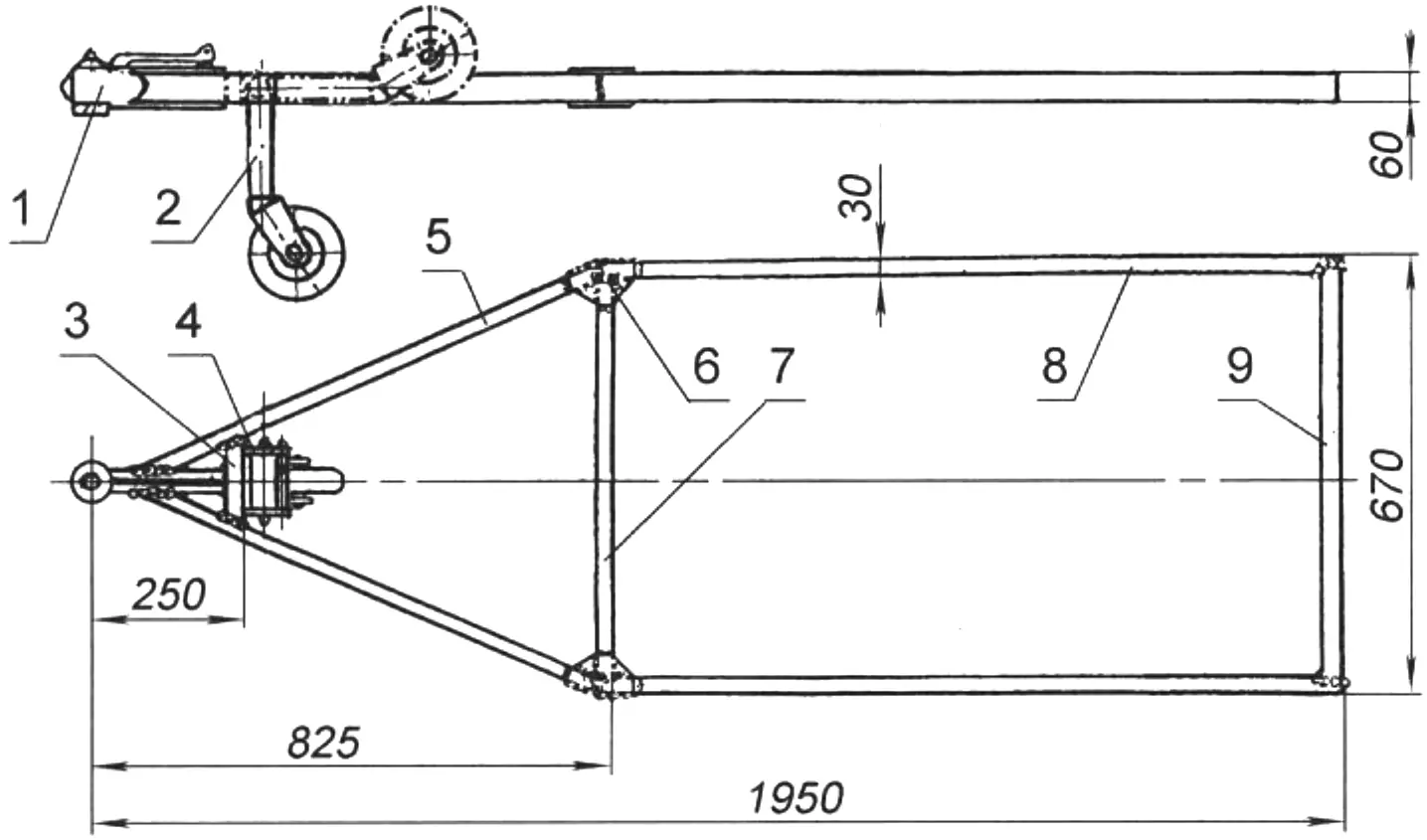
1 — standard tow hitch for a 50 mm ball; 2 — folding support with a self-orienting wheel 250 mm in diameter; 3,7,9 — crossmembers (steel, tube 30×60), 4 — hinge-lock assembly of the folding support; 5 — drawbar (steel, tube 30×60); 6 — gusset (steel, s3); 8 — side member (steel, tube 30×60)
At the front of the drawbar a standard tow hitch is installed, designed for a ball coupling element 50 mm in diameter.
In addition to the tow hitch, a retractable auxiliary support with a self-orienting wheel 250 mm in diameter is installed at the front of the drawbar — with it, moving the camper around parking areas is much easier.
The suspension of the trailer’s rear wheels is practically the same as the Zhiguli rear suspension. True, the massive rear axle with half-shafts and a differential had to be replaced with a steel tube 60 mm in diameter, with flanges for mounting two Zhiguli front-wheel hubs welded to it beforehand. Accordingly, I welded spring seats, brackets for the trailing arms, a bracket for the transverse rod, and shock-absorber brackets to the new rear axle. In short, all the mounting points of the stock Zhiguli axle were carefully transferred to the tube.
The camper has two doors (the rear doors of a VAZ-2104), but on trips we use only one — the rear one. However, I do not recommend welding up the front door: sometimes we have to carry long items in the trailer (pipes, boards, battens), and in those cases the front door makes loading and transporting such materials much easier.
The absence of a driveshaft and differential made it possible to cut away the tunnel shell in which they were located and lower the floor level considerably at that point. The openings that appeared in the floor pan were closed with patches of 1.5 mm sheet steel, secured with an intermittent CO₂ arc weld.
The flooring in the camper is made of 12 mm plywood resting on wooden crossmembers. To protect the wooden parts from damp, they are all coated with two layers of parquet varnish.
I will not describe the camper’s interior — I leave that entirely to your discretion. I can only suggest that in my trailer tourist sleeping mats are laid on top of the flooring, and furniture fabric on top of them.
“Modelist-Konstruktor” No. 12’2011, I. TEREKHOV
Recommend to read
 WALLPAPER — TIGHTLY!
At pasting of walls or ceiling paper panels often their edges at the joints tend to come off. To avoid this, these places need to pre-note and paste them on paper strips (for example,... PACKAGES DO
With this simple device you can make a plastic bag of any size. The technology is very simple: between two of the straps are clamped by the two segments of the film so that the region...
