
Having decided to build a sauna on my country plot, I read a fair amount of relevant literature. Not everything in the proposed stove designs appealed to me. I wanted to simplify the construction, make it more practical from a manufacturing standpoint, and at the same time improve its operational qualities.
As a result, I designed my own stove. I have been using it in the sauna for more than five years, and it is liked not only by me but also by my acquaintances.
I offer readers a description of my sauna stove heater. I hope it will serve lovers of the Russian sauna well. In winter, the stove heats a 9 m3 steam room to 80 degrees in an hour and a half, and also the washing room to 25 degrees. Thanks to water circulation through the serpentine grate, 240 liters of water are heated intensively to boiling.
The sauna stove heater is welded from 3 mm sheet steel. For ease of assembly and transport, it consists of three separate blocks: the firebox-ash pit; the stone heater; and the hot-water tank. Each block is 500 mm high, 700 mm wide, and 700 mm deep. The bottom of the tank and the stone heater are framed around the perimeter with a 50×50 mm steel angle welded by electric welding.
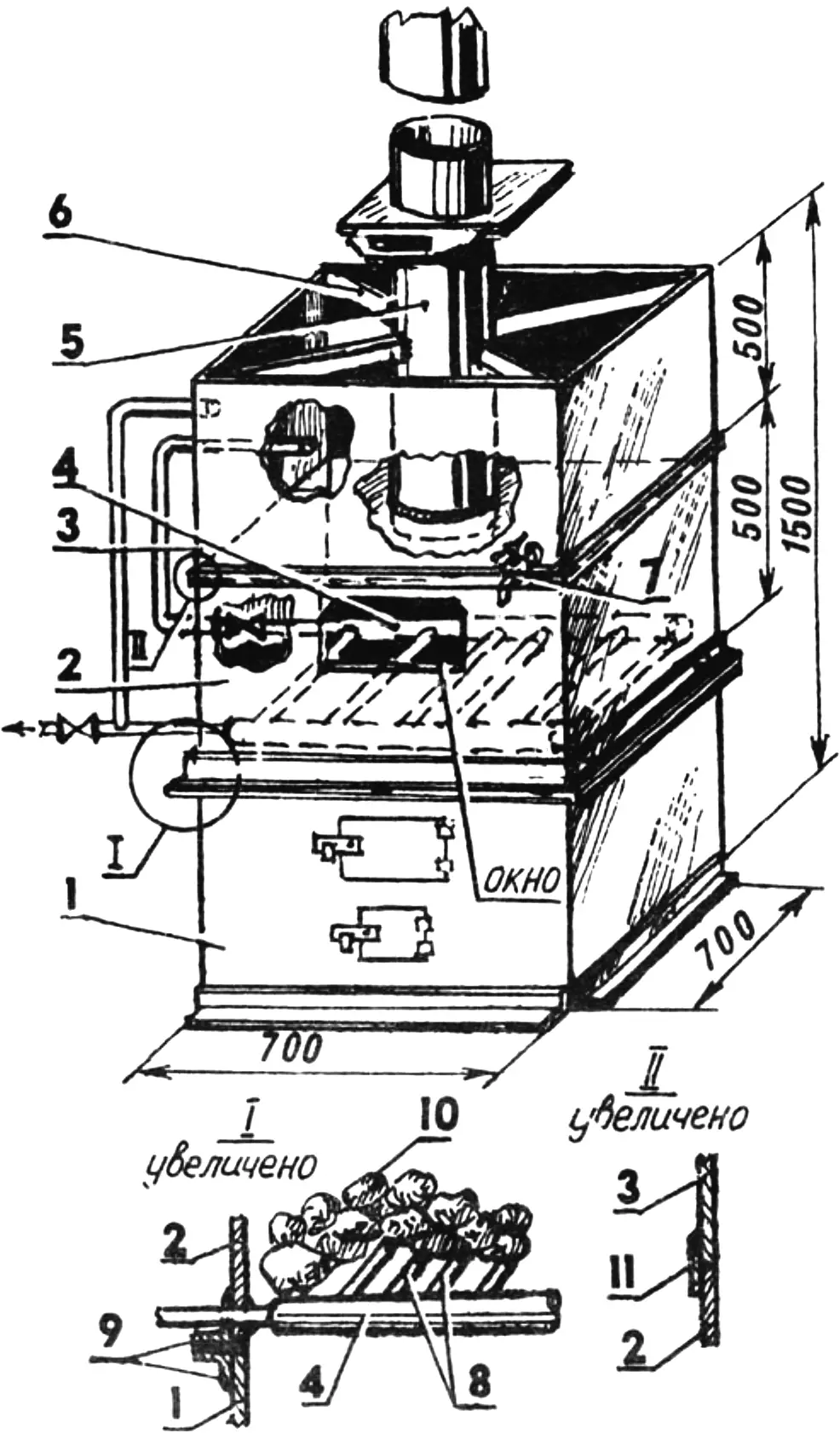
The firebox-ash pit (1) is installed on the foundation. The firebox and ash pit are lined inside with firebrick set in clay; between them is a grate. The front wall of the block has two doors: one for firewood and one for removing ash. They were taken from an ordinary village stove.
The stone heater (2) has a window in the front wall and a removable steel sheet damper door (not shown in the drawing), which is closed while the stove is being fired. The bottom of the block is a serpentine grate under the stones (10), welded from two longitudinal pipes (4) 40 mm in diameter and a set of transverse pipes (8) 20 mm in diameter. The longitudinal pipes have two 1/2″ connection fittings for connection to the water supply and the hot-water tank.
A chimney (5) — a 150 mm steel pipe — passes through the tank (3). It is welded to the steel spacer plates (6) of the tank and to the bottom, through which it protrudes downward by 50 mm. The protrusion is needed to retain heat longer in the stone heater. A damper is welded into the upper part of the chimney. For draining hot water, the tank has a tap (7) at the front.
In my version, the firebox-ash pit and the stone heater are joined together with eight M6 bolts through holes in the angles (9); and for airtightness, the joint is sealed with a gasket.
The hot-water tank, framed at the bottom with a metal strip (11), is simply placed on the stone heater and requires no additional fastening. Because the tank and the serpentine grate are connected by two pipes, a circulation loop is formed that speeds up and maintains water heating. The tank is closed at the top with a steel sheet lid.
“Modelist-Constructor” No. 10’2002, V. AVTUKH, Ozery village, Grodno region, Belarus
Recommend to read
 GENTLE CLAMP
Despite the fact that the clamps clamping the Cup is loosely fitted on the axis and not rotate as you tighten, it can be rotated together with the screw, damaging the surface of the... GENUINE RUSSIAN NAVY
The victory over France in the war of 1870 opened to the Federation of German States, formed under the auspices of Prussia, a completely new Outlook In Central Europe is variegated...
