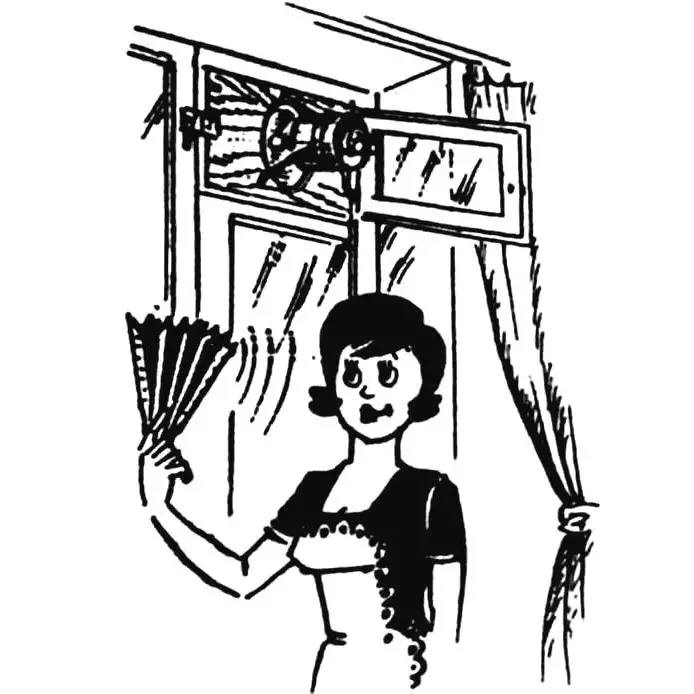
On a hot summer day, when the scorching air stands still in the absence of a breeze, neither an open transom nor even a wide-open window brings the desired coolness.
It’s good when there’s a built-in window fan. Well, for those who don’t have one, I offer a way to quickly install a removable fan on a regular window without modifying it.
Existing options for household window fans involve mounting them directly in the glass (which is difficult to do yourself, as it requires cutting the glass in a specific shape) or instead of a transom (which is also not very convenient, since the transom is needed more often than the fan, and you have to come up with some kind of combined design).
The proposed solution eliminates all the mentioned inconveniences, as it allows achieving the desired result without any changes to the window, namely: having a fan in the transom at the moment and for the duration needed.
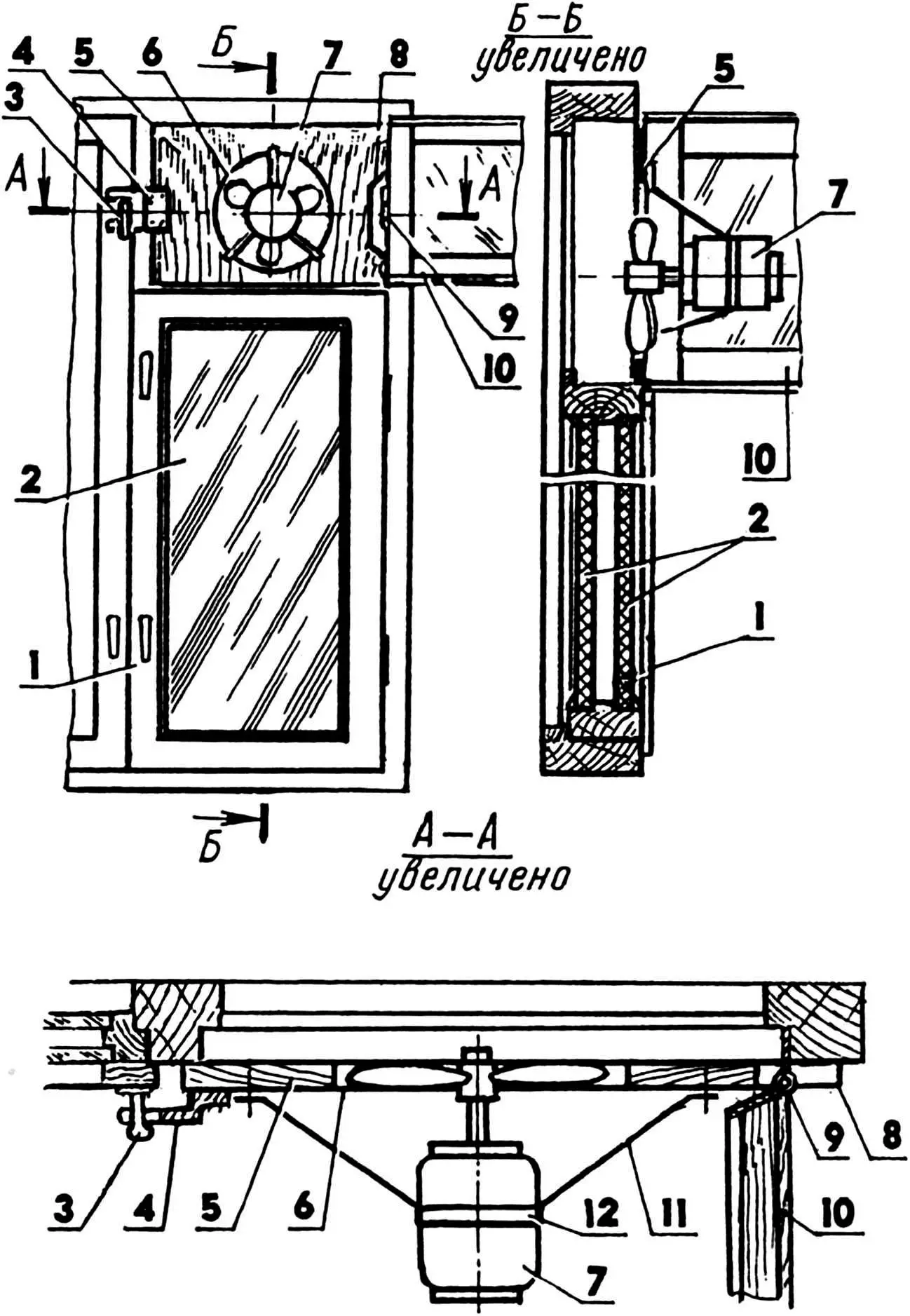
1 — window sash; 2 — glass; 3 — window handle, locking; 4 — fan shield hook plate; 5 — fan shield; 6 — opening for fan blades; 7 — fan; 8 — cutout in shield for transom hinge; 9 — transom hinge; 10 — transom (open); 11 — fan bracket leg; 12 — bracket mounting strap.
At the same time, everything is designed so simply that it’s accessible for anyone to replicate. Judge for yourself. You open the transom and insert into its opening a shield of the appropriate size with a cutout in the middle, against which the fan is mounted. When the need for ventilation is gone, the shield with the fan is just as easily removed and you can normally close the transom.
However, the shield needs to be somehow secured in the opening. For this, the window’s own capabilities are used. On one side of the shield, a cutout is made, with which it is “put on” the hinge in the gap of the open transom. And on the other side, a shaped hook plate is attached to the shield, which can hook onto the locking handle of the adjacent window half.
As a shield, you can use a blank cut to the size of the transom opening from 5–10 mm thick plywood. In its middle part, a round or square hole is cut, the size of which is dictated by the size of the blades of the available fan. The fan itself is mounted against this opening on three legs made of 2 mm thick and 20 mm wide metal strip. One end of each leg has a hole for a screw to attach to the shield, and the other is bent under a metal strap that is tightened around the fan housing.
Depending on which fan operating mode is preferable (supply—air is drawn from outside, or exhaust—air is expelled from the room), the fan housing is installed accordingly on the outer or inner side of the shield.
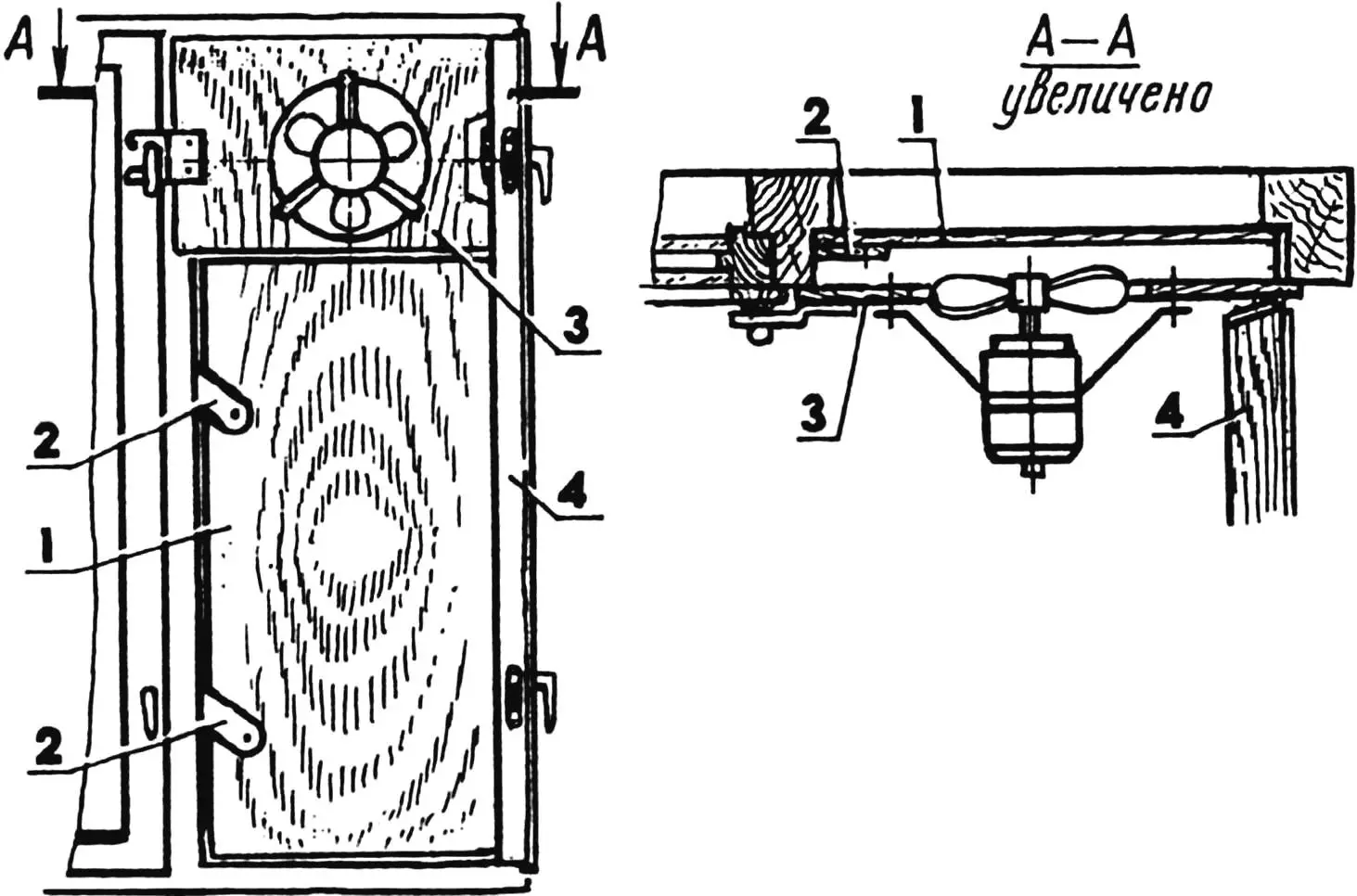
1 — barrier shield; 2 — barrier shield mounting turnbuckles; 3 — fan shield; 4 — window sash (open).
The location and size of the cutout on the shield for the transom hinge, as well as the configuration of the hook plate, are determined on site. Instead of a hook, a turnbuckle can be installed, the end of which will enter the transom locking socket on the window frame and securely hold the inserted shield with the fan.
The shield itself and the metal fan mounting elements should be painted with oil paint or enamel after assembly.
The design allows it to be used even in cases where the window does not have a transom. Then, in the opening of the open window sash, a barrier shield is first installed, leaving a small space at the top that imitates a transom, and then the fan shield is inserted into it.
The same materials are used for the barrier shield as for the fan shield, with the same protective paint coating of enamel or oil paint. The shield mounting in the opening repeats the principle of installing the fan shield—a cutout is made for the hinge and two turnbuckles, one of which is for the existing window locking socket.
V. Ilyin
Recommend to read
 HISTORY OF ONE DELUSION
When our boys faced the problem of choosing equipment for the new sports season were not differences. All who are engaged in class models AM 1 and AM 2, stopped, as agreed, the scheme... ADJUSTABLE PLIERS
the Owners of the most different techniques faced with a secret or castellated nuts. You can make a master key from an ordinary pair of pliers. For this purpose, the ends of the handles...
