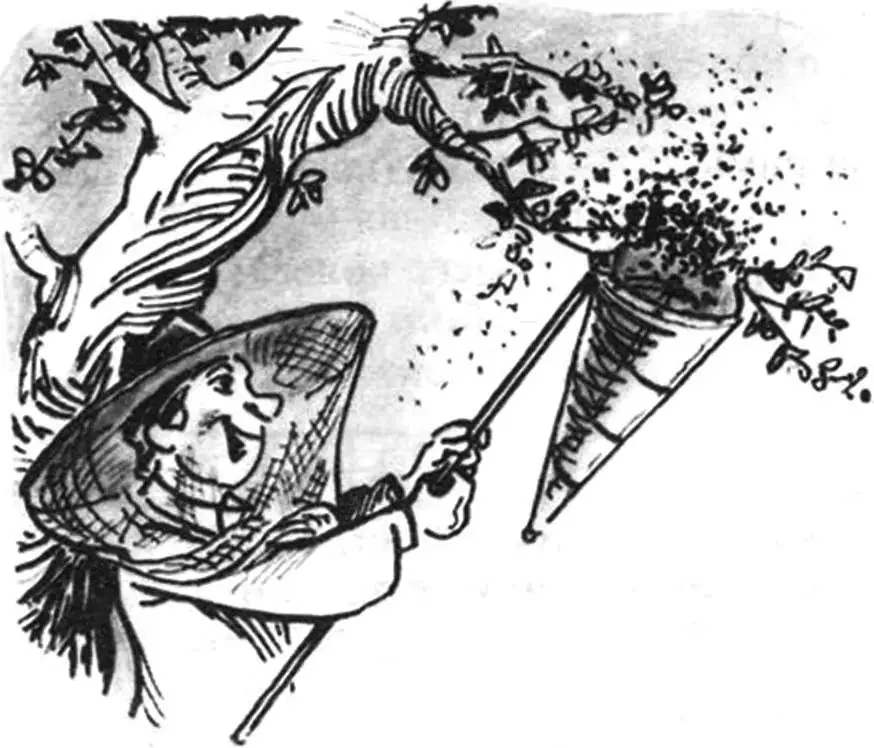
Everyone who decides to engage in beekeeping must prepare themselves for many things. Including the fact that they will have to “remove” swarms alone. This task, I know from experience, is far from simple. After all, bees “graft” (land during swarming) often in places where it is not easy for a person (without appropriate training, equipment) to even reach. The situation is aggravated by a strict time limit, due to the impatience of the swarm itself, ready to “depart in an unknown direction”…
The device I designed is intended to facilitate the work of a beekeeper (especially a beginner or, conversely, a professional of advanced years). Simple and accessible for self-manufacturing, it, as practice shows, surpasses expensive swarm catchers produced by industry in its effectiveness.
The basis of the proposed technical solution (see fig.) is a light but sufficiently strong, propolis-treated cone (“bag”, rolled from fiber from old, worn-out suitcases) with a volume of at least 15 liters. And all work with such a device comes down to only elementary actions in one of two characteristic typical situations.
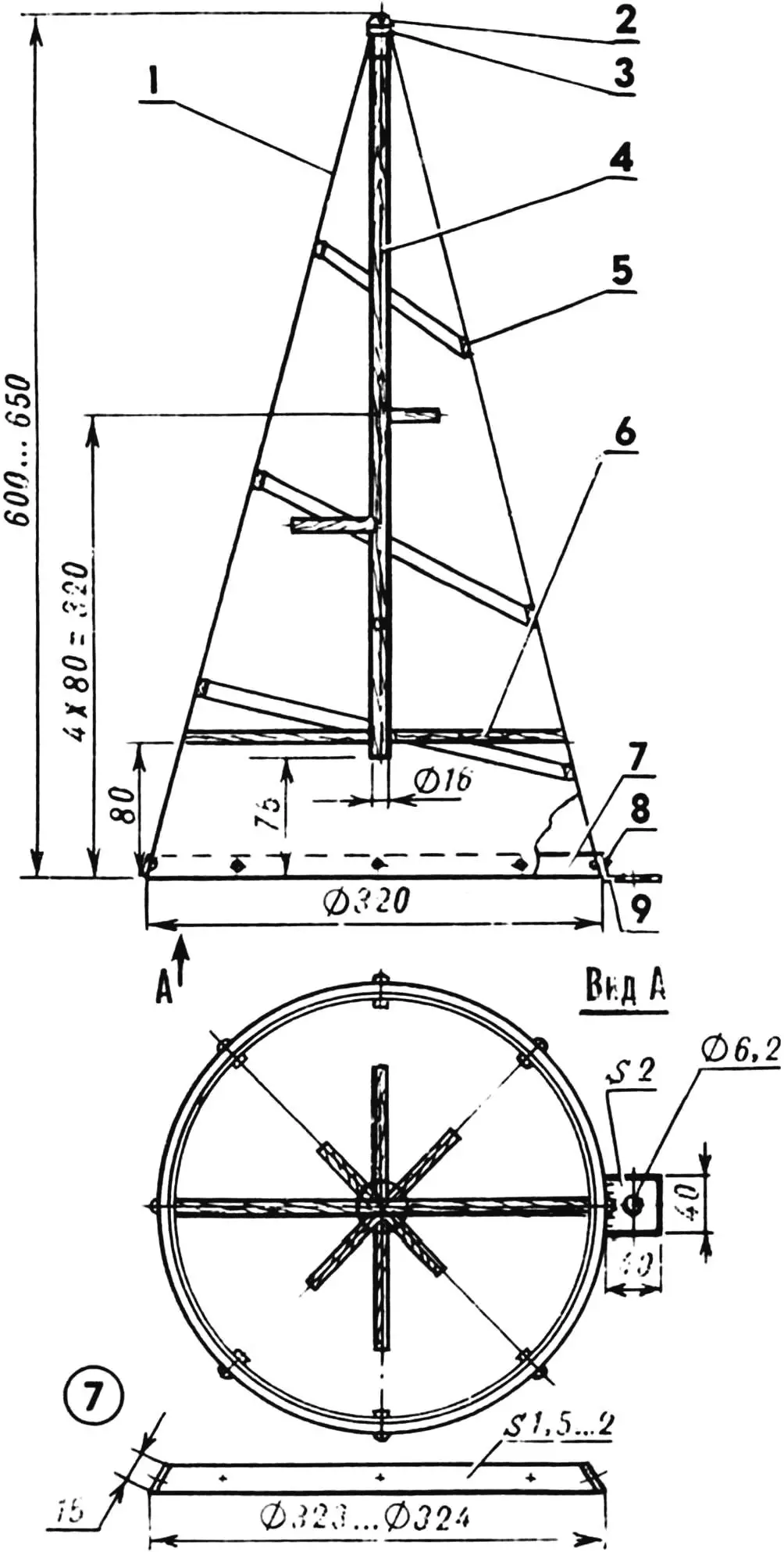
1 — cone-“bag”, 2 — screw 4×60, 3 — head, 4 — wooden frame rod, 5 — spiral insert, 6 — wooden cross brace (length — depending on the mounting tier on the crosspiece, 4 pcs.), 7 — ring, 8 — rivet or bolt M3 with nut (8 pcs.), 9 — pole bracket.
Suppose the swarm’s “grafting” site is a tree trunk or thick branch. A cone with the opening facing down is brought on a pole to the temporarily settled living cluster here (positioning as close as possible and slightly above it). And… wait. They know that bees, true to instinct, will certainly gather in the “bag” with their native scent within 20…30 minutes, and the fiber insert, bent in the form of a two-turn spiral and secured from inside, will prevent the swarm from spontaneously falling out of the cone. Then the device together with its contents is carefully removed from under the tree crown, the pole is disconnected, and, removing the “bag”, the bees are “poured” into the prepared container. This is the first option.
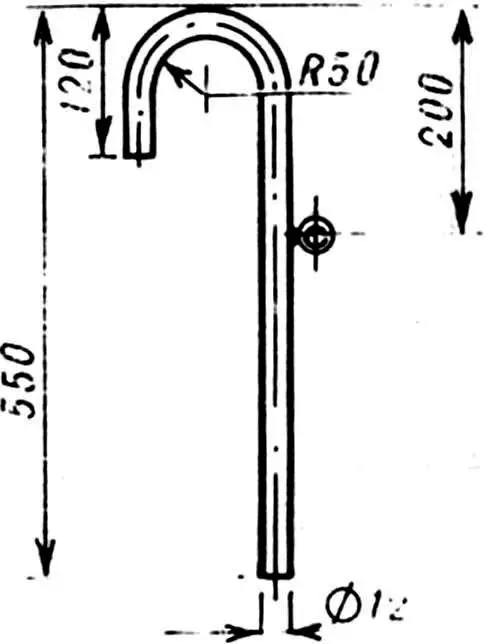
As for the second, it is resorted to in the case when the swarm, having chosen some long branch, “grafts” at its end. The device is then used by turning the cone base up. And with a special hook (hung on the branch next to the swarm using the same pole, but turned with the hollow end up) the swarm is shaken into the “bag” placed below.
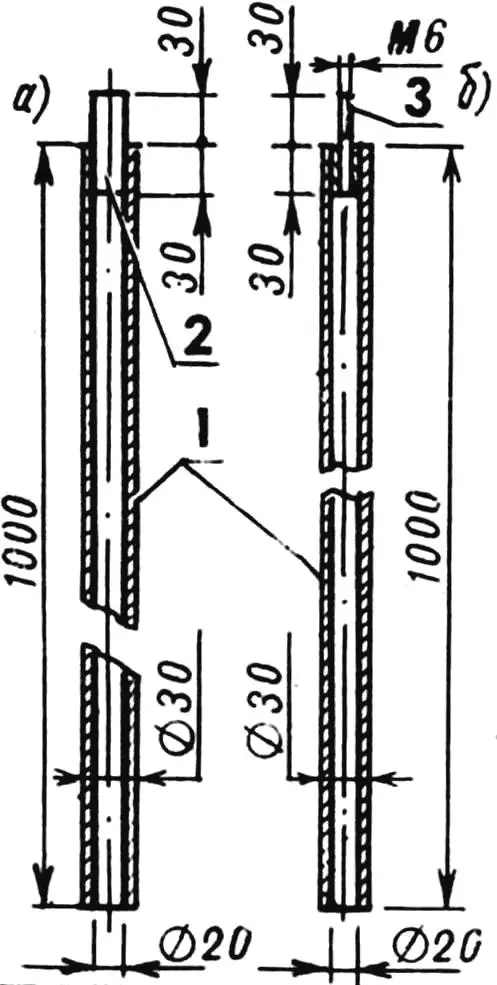
1 — tube, 2 — insert, 3 — pin.
And now a few technological tips for manufacturing the proposed device. The material for the “bag” is, as already noted, thin fiber. The blank is cut according to a typical cone development (not shown in the fig.). Optimal dimensions of the source sheet — 1100×650 mm. The resulting blank is soaked in water and rolled into a cone with further fixation of the required shape (for example, with twine) until completely dry, after which the joint is stitched or glued. The base is reinforced with a ring made of 1.5…2-mm steel strip 15 mm wide and 1005 mm long with a pre-soldered pole bracket 40x40x2 mm (St3), in which a hole is made for the M6 pin of the top pole link.
The inner surface of the cone-“bag” is coated 2 — 3 times with a 30-percent alcohol solution of propolis. Then the spiral fiber insert and wooden frame, treated with the same solution, are reinforced.
The latter consists of a vertical rod 16 mm in diameter with four 8-mm holes made at different heights at an angle of 45° to each other. Cross braces are tightly inserted into them, the length of which equals the diameter of the housing at their installation point. The upper end of the vertical rod enters the head (champagne cork) with subsequent tightening, carried out using a single screw. This, combined with the cross braces resting at the end, gives the necessary rigidity to the entire structure.
The pole is also assembled, from eight easily joined tubular links into a single whole: the upper ones are sequentially mounted on the lower ones. The exception is the top link — a tip with an M6 pin for attaching the cone-“bag”.
The hook for shaking the swarm is made from an aluminum rod (D16T) and has a welded ring for tying a nylon rope.
S. KALASHNIKOV, Chairman of the Beekeepers Society
Recommend to read
 FROM “PIONEER” TO “JUNIOR”
Throwing glider pioneer. Non-motorized model glider is very popular among modelers. Made in the form of models of monotypes, throwing gliders allow for fun competitions on the range,... ANTONOV AN-70
An-70 medium — range cargo (operational-tactical military transport) aircraft of the new generation of short take-off and landing. Antonov an-70 intended to replace the obsolete An-12....
